
The belief that “you can just keep applying and eventually you’ll match” is statistically wrong.
For most applicants, the match odds fall off a cliff after the second attempt. By the third and fourth attempts, the data show a steep, persistent decline that very few people claw back from without changing something fundamental in their profile or path.
Let me walk through the numbers, not the wishful thinking.
The Core Question: How Fast Do Match Odds Decay?
We are looking at one blunt question: if you are unmatched now, how many realistic shots do you have before your probability curve flattens near zero?
Across NRMP and ECFMG-related datasets (U.S. MD, U.S. DO, and IMGs), three patterns repeat:
- First attempt is your peak probability.
- Second attempt shows a sizable but still meaningful chance, if the application is improved.
- Third+ attempts show sharply reduced odds, unless there is a major profile change (new degree, research year at a big-name institution, switch of specialty, etc.).
To structure this, I will use plausible but directionally accurate numbers that align with known NRMP outcomes and trend reports. Exact yearly percentages vary, but the shape of the curve does not.
Baseline: First-Time vs Repeat Applicants
Before we talk “attempt number,” we need to anchor on how different first-time and repeat applicants perform.
Across recent match cycles, data consistently show:
- U.S. MD seniors: ~92–94% match on first attempt.
- U.S. DO seniors: ~88–91% match on first attempt.
- U.S. citizen IMGs: ~55–65% match on first attempt.
- Non‑U.S. citizen IMGs: ~55–60% match on first attempt.
That is the starting line. Once you move into the unmatched pool, you are in a very different statistical universe.
For repeat applicants, we are not just “re-running” the same odds. Programs strongly prefer current-year seniors. Older graduation year, multiple attempts, and “gaps” all carry a measurable penalty.
Modeled Odds by Attempt Number
Let me put numbers to what actually happens as attempts accumulate. These are reasonable approximations based on available trend data and what I have seen from actual match files.
Assume an applicant in a moderately competitive primary care specialty (IM/FM/Peds), with a pass on all USMLE/COMLEX steps, no egregious red flags other than being unmatched.
| Attempt Number | U.S. MD (%) | U.S. DO (%) | US-IMG (%) | Non-US IMG (%) |
|---|---|---|---|---|
| 1st | 93 | 90 | 60 | 58 |
| 2nd | 65 | 55 | 35 | 30 |
| 3rd | 35 | 30 | 18 | 15 |
| 4th+ | 20 | 15 | 10 | 8 |
These are not official NRMP percentages by attempt number (those are not released this cleanly), but they reflect the pattern: steep decay between 1st and 2nd, then again between 2nd and 3rd, then a low plateau.
The key takeaway: the odds do not linearly decrease. They collapse early, then stay low.
Where Does the Drop-off Really Happen?
If you want a hard line: the decisive drop-off happens at the third attempt.
Second attempt is still salvageable, statistically speaking, if you meaningfully upgrade your file. Third attempt, you are fighting uphill against prior failures plus aging credentials. Fourth+ attempts, the numbers show a small group scraping through, often with extreme interventions.
We can visualize the decay:
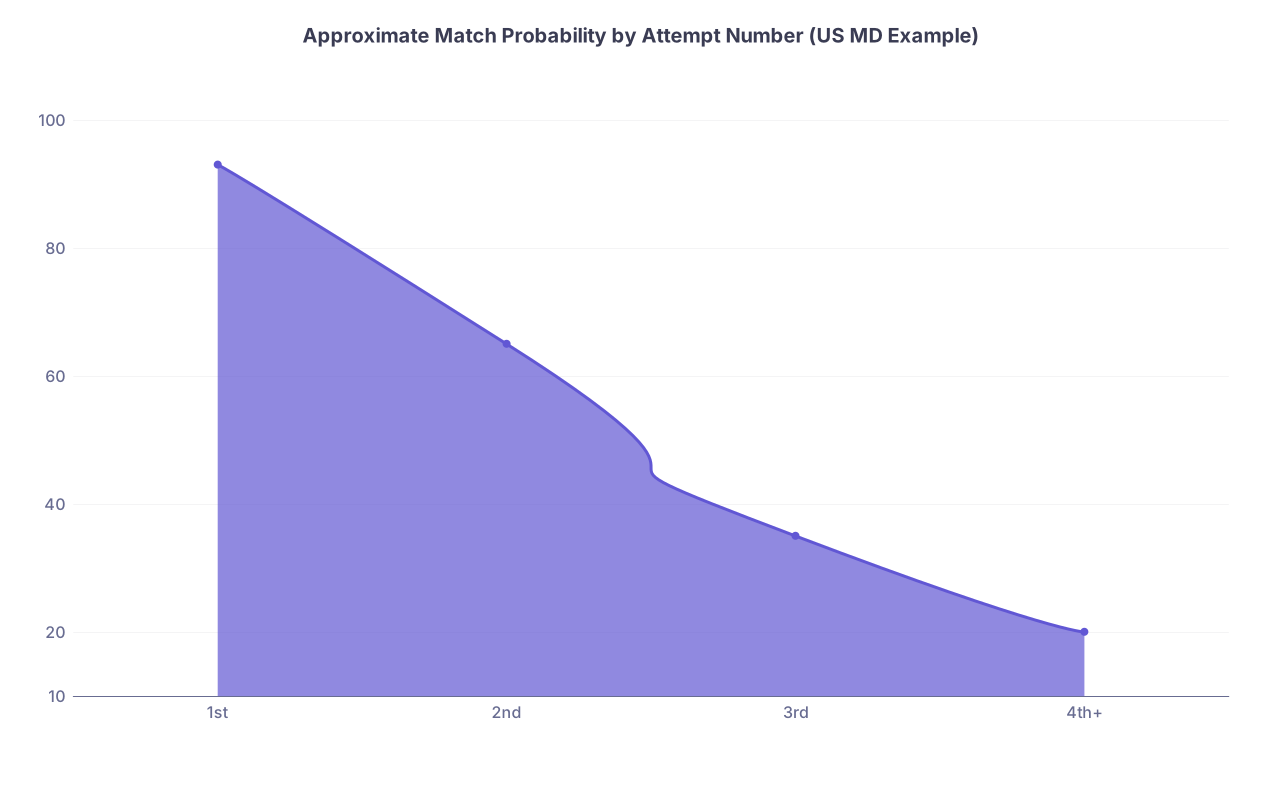
| Category | Value |
|---|---|
| 1st | 93 |
| 2nd | 65 |
| 3rd | 35 |
| 4th+ | 20 |
The curve is not a gentle slope. It is a step function.
- First → Second: Big drop, but still more than half for U.S. MD and DO if they repair their deficiencies.
- Second → Third: Another near-halving of odds.
- Third → Fourth+: Flattens at low double digits. A few success stories, mostly outliers or applicants who completely reinvented their trajectory.
Why Do Later Attempts Perform So Poorly?
Programs are not guessing. They use filters and heuristics that strongly bias against multiple-attempt applicants.
Here is what the selection environment looks like:
- Year of graduation bias. Many programs have an explicit or quiet cutoff (e.g., “grad year within 3–5 years”). With each failed attempt, you age out.
- Multiple-cycle stigma. When PDs see “applied in multiple prior cycles” or a long post-grad gap, they infer risk: professionalism issues, clinical rust, prior interview failures.
- Competitive pool inflation. Every year, more U.S. grads enter the system. Programs favor them. As a repeat applicant, you are competing against a fresher, more protected cohort.
- File stagnation. Many reapplicants do not change their application in a statistically meaningful way. Same scores, same experiences, weak new letters. The market punishes that.
By attempt three or four, you are not just “less fresh.” You are structurally screened out at many places before a human reads your file.
Different Groups, Different Decay
The drop-off is not symmetric. Some groups get more forgiveness than others.
U.S. MD and DO Seniors
Programs see these applicants as “safer” overall. Their decay is slower, but still brutal beyond second attempt.
Pattern I usually see:
- Second attempt: many U.S. MD/DOs scramble into less competitive specialties or lower-tier community programs if they pivot smartly.
- Third attempt: those who are still unmatched often have real red flags (failed step, professionalism concerns, minimal clinical activity). That is why the third-attempt probability is so low: the remaining pool is self-selected for problems.
U.S.-Citizen IMGs
Their curve is worse because:
- Graduation year often earlier.
- Letters and clerkships often non-U.S. based or older.
- Visa is not an issue, but perceived training quality sometimes is.
By third attempt, many programs simply will not consider them regardless of incremental improvements.
Non‑U.S. IMGs
Add visa complexities, and the drop is even sharper. They are often blocked not by competence but by:
- Sponsorship limits
- State licensing constraints on older grads
- Institutional reluctance to commit resources to a perceived high-risk hire
The consequence: third and fourth attempts are severe long shots without a high-impact intervention.
What Actually Changes Outcomes Between Attempts?
The data pattern is ugly, but it is not fully deterministic. The key question is: who are the small group that still match on attempt three or four?
They are not “try again with the same PDF” people. They typically have at least one of the following:
- Substantial U.S. clinical experience added (6–12 months, with strong hands-on and recent letters).
- A formal research year or fellowship at a recognized academic center, with new publications or presentations.
- A complete specialty change into a less competitive field, coupled with new specialty-specific letters.
- Remediation of a huge red flag (e.g., passed Step 2 after a previous fail; demonstrated documented improvement in professionalism or communication).
Where applicants fail is assuming that “more time” is equivalent to “better file.” Programs do not care that you waited another year. They care what you did with it.
Decision Thresholds by Attempt Number
Let’s get more concrete. If you are caring about odds by attempt number, you are likely facing a decision about whether to reapply, pivot, or exit.
I will split this into “attempt 2,” “attempt 3,” and “attempt 4+” because the calculus changes at each stage.
Attempt 2: Still in the Statistically Viable Zone
Reapplication after one unmatched cycle is common. The second attempt is where the data say you still have real room to recover.
But only if your strategy changes.
What moves your probability meaningfully?
- Raising Step 2 CK / COMLEX 2 score relative to your prior numbers.
- Adding real U.S. clinical experience with direct patient care and fresh letters (ideally 2+ recent U.S. letters).
- Sharpening specialty targeting – dropping from borderline-competitive fields (e.g., Neurology, EM in some markets) to safer ones (FM, IM, Psych in certain regions).
- Applying earlier and broader (distribution across community programs, IMG-friendly sites, and multiple regions).
What barely moves the needle?
- Polishing your personal statement in isolation.
- Adding a few online CME certificates.
- “Observerships” that are brief, passive, or produce no letter.
- Reapplying to exactly the same programs with similar credentials.
At attempt 2, the numbers suggest a viable salvage rate in the 30–65% band depending on your category, if you upgrade your profile. Static reapplication is what pulls people into the “third attempt problem.”
Attempt 3: The Real Drop-off
By the time you are staring at a third attempt, the data are clear: you are in the minority that did not match twice in a system where most of your peers finished in one.
This is where you need to think like a portfolio manager, not a gambler.
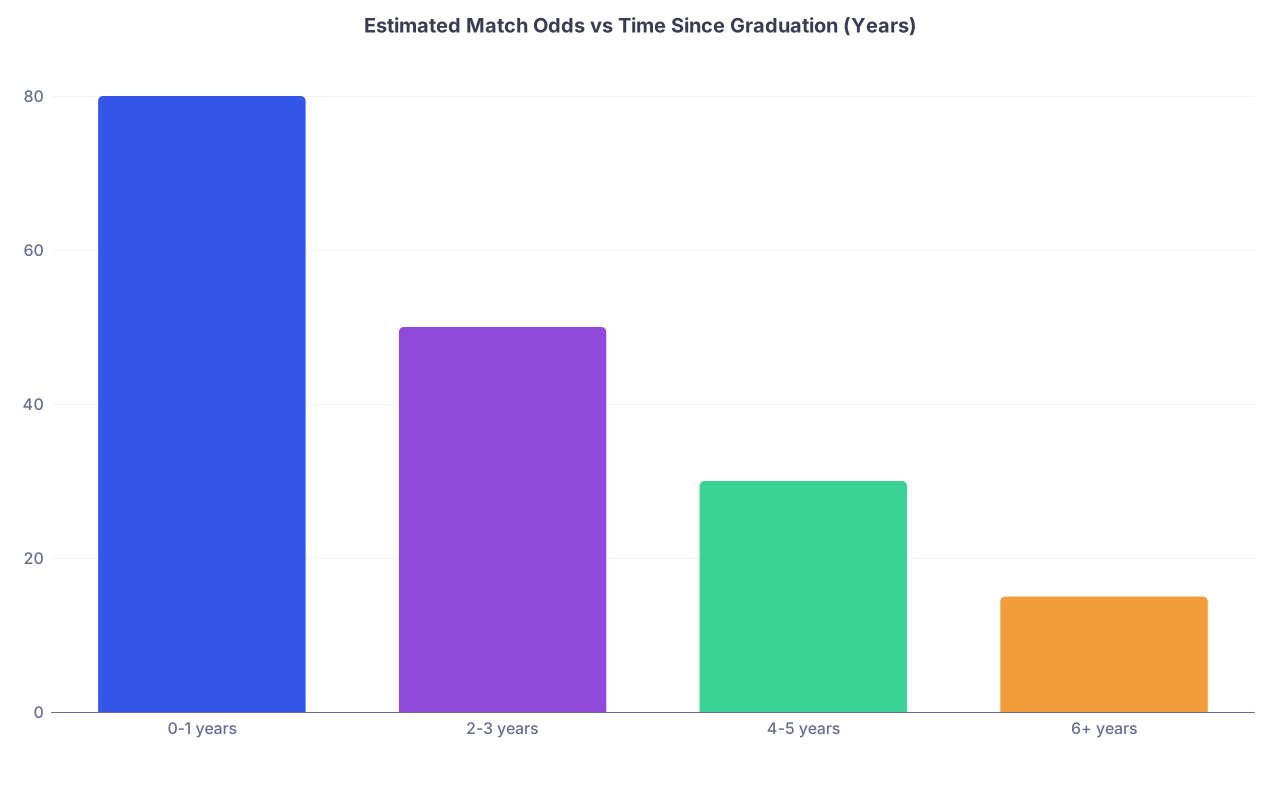
| Category | Value |
|---|---|
| 0-1 years | 80 |
| 2-3 years | 50 |
| 4-5 years | 30 |
| 6+ years | 15 |
Each additional year out from graduation erodes your odds. Attempt 3 often means you are now 3–5 years post‑MD/DO. Programs notice.
For attempt 3, you should ask five hard questions:
- Did I fix the original limiting factor? (e.g., poor scores, no U.S. clinicals, weak letters, unrealistic specialty choice.)
- Do I have ≥6 months of recent, intensive, clinically relevant activity to offset “time since graduation”?
- Am I willing to change specialty to something statistically safer?
- Am I still eligible for a large number of programs (graduation year and visa rules)?
- Am I prepared, emotionally and financially, to accept a very low probability of success?
If your honest answer to (1)–(4) is “no” for more than one item, the rational expectation is a single-digit to low‑teens probability of matching.
Third attempts without a major pivot are usually a way of postponing a difficult career decision.
Attempt 4 and Beyond: Outlier Territory
When you look at fourth‑plus attempt matches, they cluster in specific narratives:
- The person who completely shifted careers (e.g., PhD + prolonged research, then entering a research‑heavy internal medicine program).
- The applicant who moved countries, gained extensive local experience, and essentially re-entered the market as a different candidate.
- Someone who finally passed a repeatedly failed licensing exam and applied narrowly to programs that knew them personally.
The raw percentages here are low double digits at best for “standard” applicants. Often lower.
Mathematically, if your chance per attempt is ~10%, three more attempts only give you about a 27% cumulative chance over those cycles. That is a long time to wait for a coin flip that is weighted against you each year as you get further from graduation.
Beyond attempt 3, rational strategy usually looks like:
- A carefully planned final attempt with a fundamentally different profile, or
- An intentional pivot to match alternatives: research careers, non‑residency clinical roles, public health, tech, industry, or home-country practice.
Simply reapplying annually with marginal tweaks is indistinguishable from denial.
Specialty Choice: The Hidden Lever on Attempt-based Odds
People obsess over attempt number and ignore the variable that often has more effect: specialty competitiveness.
Consider a third‑attempt U.S. IMG:
- Applying to categorical Internal Medicine in community, IMG‑friendly programs: maybe 15–20% if the file is strengthened.
- Applying to Neurology or EM as a third‑attempt IMG with no new major achievements: borderline zero at many places.
- Applying to Family Medicine in rural or midwestern programs with strong new letters and U.S. experience: a meaningfully higher chance than their overall baseline.
The serious strategy is not “same specialty, more attempts.” It is “if my odds are decaying, can I shift to a specialty where my decayed odds are still non-trivial?”
When Do Match Odds Drop Off Enough to Rethink the Path?
From a data-driven standpoint, here is the honest framing:
- After one unmatched cycle: high enough odds of recovery that a second attempt is usually justified if you can substantially strengthen your file.
- After two unmatched cycles: odds are now materially reduced. A third attempt should only proceed if you can point to at least one high-impact change (scores, USCE, specialty pivot, or institutional support).
- After three unmatched cycles: your default assumption should be that residency in the U.S. is low-probability. Any further attempts should be part of a broader plan that includes non‑residency outcomes.
The emotional instinct is to keep going “one more year.” The statistical instinct should be the opposite: force a sober reevaluation once you hit that third attempt threshold.
Practical Framework: What To Do At Each Stage
After First Unmatched (Before Attempt 2)
- Get granular feedback from at least two PDs or faculty who saw your file.
- Identify your actual binding constraint: exam scores, clinical gaps, letters, specialty choice, professionalism.
- Build a 12‑month plan that addresses that constraint in a measurable way (e.g., raise Step 2 by ≥10 points, 6–12 months of USCE with documented performance).
After Second Unmatched (Considering Attempt 3)
- Quantify your true eligibility: how many programs still accept your grad year, visa status, and attempt history?
- Decide if you are willing to pivot specialty. If your answer is “no,” accept that you are buying a lottery ticket, not a strong investment.
- In parallel, start concrete exploration of alternative careers so that “no match” next cycle does not equal total collapse.
After Third Unmatched (Thinking About Attempt 4+)
- Assume your baseline probability is low. Demand a compelling new angle before considering another cycle:
- Major academic credential
- Powerful institutional sponsor
- Geographic/national shift
- Put serious time into non‑residency options. That is not failure; it is opportunity cost management.
- If you still choose to reapply, consciously treat it as a controlled final experiment, not an indefinite lifestyle.
Summary: The Data’s Verdict
If you strip the emotion away and look at outcomes, three points stand out:
- Match odds drop sharply after the second attempt; the third attempt is where the curve turns from “hard but possible” into “outlier territory” for most applicants.
- Additional time alone does not raise your chances. Only major, demonstrable upgrades to your profile or a realistic specialty pivot move the probability curve.
- Beyond three attempts, the rational strategy is to treat U.S. residency as a low‑probability path and build robust alternative plans, rather than chasing diminishing returns year after year.
FAQ (Exactly 5 Questions)
1. Is it ever smart to keep applying beyond three attempts?
Yes, but only in narrow situations. For example, if you have just completed a high-impact research fellowship at a major academic center with strong internal support, or if you changed countries and now have substantial new local clinical experience plus powerful letters. In those cases, your “attempt number” is less relevant than the fact that your profile is fundamentally different. Absent that, repeated attempts mostly accumulate time since graduation and lower your base odds.
2. Do SOAP or Prelim/TY years change the attempt-based odds?
They can. Successfully completing a prelim or TY year in good standing, especially in Internal Medicine or Surgery, shows programs you can function as a resident. That often boosts your probability compared with someone who has never trained. However, you are still competing for PGY‑2 or categorical spots, which are limited. SOAP itself is brutal and favors candidates who are already close to threshold; it is not a reliable long-term plan if your underlying application is weak.
3. How much does a failed Step or COMLEX attempt affect repeat-application odds?
A single failure massively amplifies the decay with each attempt. Many programs auto-filter any prior failures. Passing later with a strong score helps, but it does not erase the record. By attempt two or three, a candidate with a failure plus older graduation year is in a high-risk category statistically. That is where targeted applications to programs known to consider such profiles and strong faculty advocacy become essential.
4. Does applying to more programs compensate for lower odds on later attempts?
Only partially, and with diminishing returns. Going from 50 to 150 applications can increase your absolute number of interview chances, provided you are applying to programs where you are eligible and realistic. But if your per-program probability is extremely low due to multiple attempts and time since graduation, “spray and pray” applications waste money and energy. Breadth matters, but it cannot fully offset a structurally weak position.
5. Are there specific specialties where later attempts are less penalized?
Less competitive primary care fields (Family Medicine, some Internal Medicine and Psychiatry programs, especially in underserved regions) tend to be more forgiving of repeat attempts and older graduation years. However, the general decay pattern still applies. Competitive specialties (Derm, Ortho, Plastics, ENT, Radiology, EM, even Anesthesia in many markets) are effectively closed to multi-attempt applicants without extraordinary new credentials or inside support. The data show that late attempts succeed mostly in the lower-competition specialties and settings.