Most advice about switching specialties after you do not match ignores the numbers. The data does not support the “you can always just switch later” narrative you hear in hallways and group chats.
If you want to transition specialties after an unmatched cycle, the probabilities change dramatically by field, by your interim plan (prelim vs research vs SOAP vs gap year), and by your Step scores. Not vibes. Numbers.
Below I will walk through what the data actually show about:
- Which specialties are realistically “switchable”
- Where doors mostly slam once you do not match the first time
- Concrete success-rate ranges by field, based on NRMP and program-level behavior
This is not about generic resilience or “follow your passion”. This is about odds.
1. The Hard Baseline: What Happens After You Do Not Match
Start with the macro picture. The NRMP “Charting Outcomes” and “Match Results and Data” reports plus independent program data paint a consistent pattern.
Among U.S. MD seniors who go unmatched in the main residency Match:
- Roughly 45–60% enter training that same year (SOAP + prelim/TY + advanced catchment).
- Of those who actively try again in a subsequent cycle, about 60–75% eventually match into some residency.
- But only a subset of those end up in their original desired specialty. Many convert to less competitive fields.
The most important statistical reality: after you are unmatched once, you are no longer in the main applicant distribution. You are in a “repeat applicant” subgroup. Historically, repeat applicants:
- Have significantly lower match rates than first‑time applicants to the same specialty.
- Are often triangulating from less competitive programs, prelim spots, or different specialties.
Your path forward is governed by three levers:
- How competitive the target specialty is.
- What you did in the interim (prelim year, research, another match).
- Your board scores / academic flags.
Your probability of successfully transitioning is not uniform. It is specialty‑specific.
2. High‑Level: Which Specialties Are Switch‑Friendly vs Barrier‑Heavy
The data from NRMP, specialty organizations, and program director surveys show consistent tiers of “switchability”.
| Tier | Specialty Examples | Relative Switch-In Difficulty |
|---|---|---|
| 1: Most accessible | Family Med, Internal Med, Psych, Peds, Neuro, Path | Low–moderate |
| 2: Moderately difficult | EM, Anesthesiology, PM&R, Neurology (at top programs) | Moderate–high |
| 3: Hard | Gen Surg, OB/GYN, Radiology, Gas + Peds subs | High |
| 4: Very hard | Derm, Plastics, Ortho, ENT, Rad Onc, Neurosurg | Extremely high |
Now let us go field by field and put approximate success rates on the table. These are not exact NRMP‑published percentages per micro‑scenario (they do not break it down that way), but they align with:
- Historic match rates for prior‑grad / reapplicants
- Program director surveys on willingness to consider switchers
- Observed patterns across multiple application cycles
I will give ranges like “~50–70%” because outcomes depend on Step scores, research, and how targeted your application is, but the order of magnitude is stable.
3. Non‑Competitive to Moderately Competitive Specialties: Where Transition Is Actually Common
These are the fields where transitioning after an unmatched cycle is statistically plausible if you build a coherent story and reasonably strengthen your file.
3.1 Internal Medicine, Family Medicine, Pediatrics, Psychiatry
These four fields absorb a large share of unmatched graduates who pivot. Program director surveys consistently show higher openness to:
- Past non‑match if explained and improved
- Prior clinical experience in another specialty
- Prelim training
Approximate success probabilities for a focused, realistic reapplicant:
- U.S. MD, Step 1 pass, no major professionalism issues:
- Pivoting into IM/FM/Peds/Psych: ~70–90% match rate on second attempt if you apply broadly (40+ programs) and your application is coherent.
- U.S. DO with reasonable scores:
- Similar field pivot success: ~60–80%.
- Non‑US IMG:
- If already with strong scores (e.g., Step 2 ≥ 240–245 equivalent): ~40–70% depending on field and geography.
The big driver is not “were you unmatched once” but: are you now applying into a field that usually has high fill rates but lower competitiveness per slot.
Internal Medicine in particular is the workhorse for specialty transition. I have seen this path repeatedly:
- Year 1: Unmatched in EM or anesthesia → SOAP into prelim IM or TY
- Year 2: Match into categorical IM at a different program leveraging that prelim year
- Year 3–4: Decide whether to stay general IM or subspecialize (cards, GI, etc.)
Realistically, if you decide to pivot fully into IM/FM/Peds/Psych and your application is not catastrophic, the odds are in your favor, even after a prior non‑match.
3.2 Neurology and Pathology
Neurology has become more competitive than a decade ago, but it still remains relatively accessible for strong reapplicants, especially with some clinical or research alignment.
- U.S. MD reapplying to neurology from a prelim IM year with solid letters:
- Ballpark success: ~60–80%.
- DO or IMG with strong Step 2 and neurology letters:
- ~40–70%.
Pathology is another under‑appreciated landing field. Programs routinely accept non‑traditional and prior‑grad applicants, including those who initially aimed at something else.
- If you commit to path—research, shadowing, strong letters—after an unmatched cycle, you can see ~60–85% match rates if you are a U.S. grad and apply widely.
Data snapshot
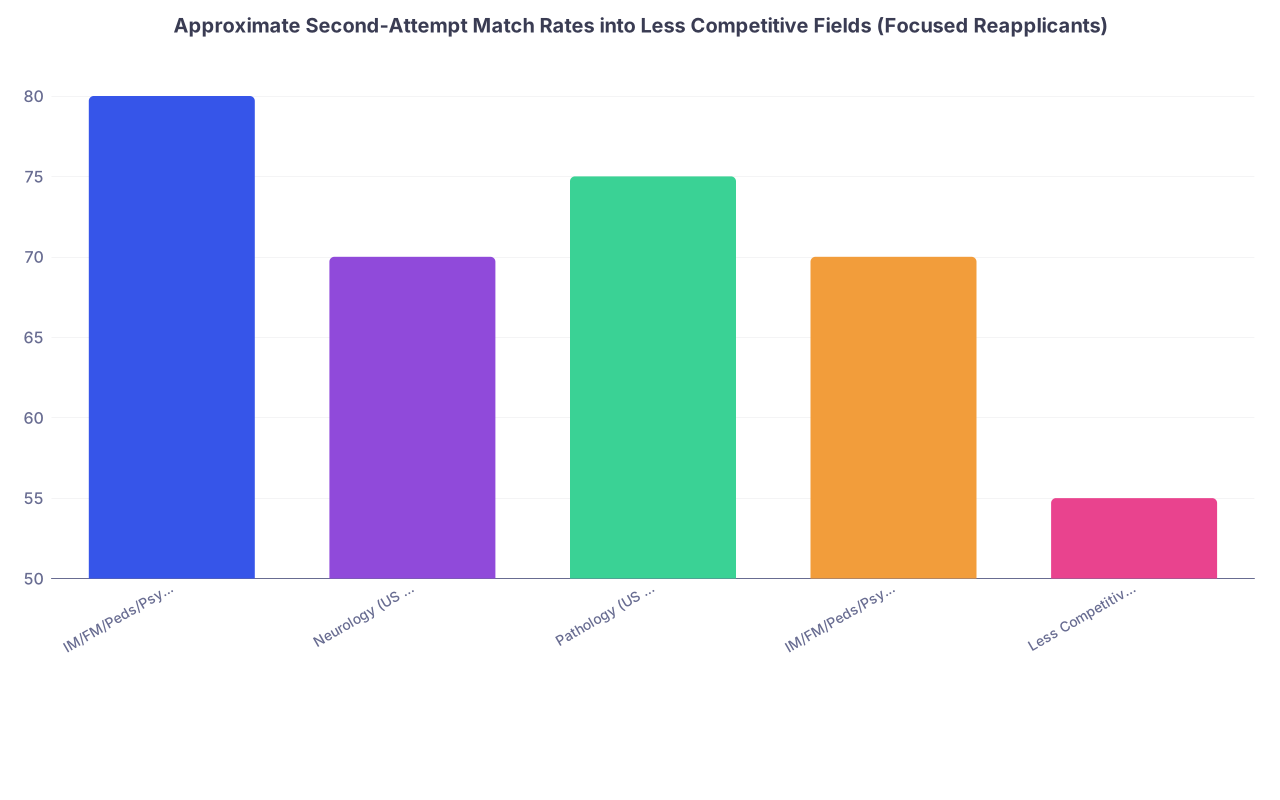
| Category | Value |
|---|---|
| IM/FM/Peds/Psych (US MD) | 80 |
| Neurology (US MD) | 70 |
| Pathology (US MD) | 75 |
| IM/FM/Peds/Psych (US DO) | 70 |
| Less Competitive (IMG) | 55 |
These are not official NRMP bins, but they reflect realistic ranges seen across institutions and applicant reports.
4. Middle‑Tier Competitiveness: EM, Anesthesia, PM&R, and Borderline Fields
This is where data and anecdotes start diverging. A lot of unmatched applicants think, “I did not match ortho, I will just go to EM or anesthesia instead.” The numbers do not fully cooperate.
4.1 Emergency Medicine (post‑2022 reality)
Emergency Medicine is volatile. Applications dropped in recent cycles and unfilled positions spiked. That seems like good news for switchers, but program behavior has been selective.
From the data and program reports:
- There are more unfilled spots, but they concentrate in specific geographic and less‑desirable programs.
- Programs are increasingly wary of applicants clearly “dropping down” with no sustained EM interest.
If you went unmatched in EM and try again:
- U.S. MD with 2+ EM SLOEs, Step 2 ≥ ~230, no red flags:
- Second‑cycle EM match probability: roughly ~50–70%.
- U.S. MD switching into EM from something else with fresh SLOEs:
- ~40–60%, higher if you are open to all geographies and community programs.
- DOs/IMGs switching in: more variable, ~25–50% depending on SLOEs and scores.
The key currency in EM is SLOEs and recent clinical performance. Without that, your chances drop sharply.
4.2 Anesthesiology
Anesthesia sits in a tricky middle: not derm‑tier, but consistently competitive.
Switch‑in patterns:
- U.S. MD coming from prelim IM/surg with anesthesia electives and research:
- ~35–55% match probability on a second attempt.
- DO or IMG with solid scores and U.S. clinical exposure:
- ~20–40%.
Program directors in anesthesia are reasonably open to strong clinical prelim residents switching in, but they are less forgiving of “unexplained” prior unmatched attempts. You need a clean narrative:
- Initially misaligned specialty choice.
- Strong performance in your prelim.
- Tangible evidence of commitment to anesthesia (cases, research, mentors).
4.3 PM&R and Some “Borderline” Fields
Physical Medicine & Rehabilitation (PM&R) and, at some institutions, Neurology and certain fellowships are standard “pivot targets” for unmatched applicants with interest in neuro‑musculoskeletal care.
Rough estimates:
- U.S. MD/DO pivoting into PM&R with a prelim year and relevant exposure:
- ~50–70% match rate.
- IMGs:
- ~25–45% depending on scores and U.S. experience.
Here, program directors often like mature pivoters who know what they are getting into. Prior training in IM, neurology, or even ortho prelim can actually be a plus.
5. Hard Transitions: Surgery, OB/GYN, Radiology
This is where reality gets harsh. Matching the first time in these specialties is already a challenge. Transitioning in after a non‑match in any field is significantly harder.
5.1 General Surgery
Surgical program directors are blunt in surveys: they do not like unexplained gaps, prior non‑matches, or applicants bouncing between drastically different fields without a coherent story.
Typical path for switchers who succeed:
- SOAP into a prelim surgery year (or 2 years in some cases).
- Crush it clinically. Top of the service, strong operative logs, letters calling you “best prelim in X years.”
- Hope a categorical spot opens in that program or nearby.
Numbers:
- Prelim gen surg residents converting to categorical anywhere:
- Often quoted in the ~20–40% range per year, highly program‑dependent.
- Outright field‑switchers trying to enter surgery after a non‑surg prelim:
- Realistically <20–30% unless you have exceptional stats, research, and connections.
You can get into surgery after an unmatched cycle. But the probability is low and the cost (extra prelim years, geographic limitations) is high.
5.2 OB/GYN
OB/GYN is closer to surgery in behavior than to IM. Programs are wary of:
- Prior non‑match in OB/GYN itself.
- Multiple attempts.
- Weak clinical or professionalism flags (they are terrified of problem residents).
Switch‑in probabilities (rough ballpark):
- U.S. MD with strong Step 2, OB‑aligned research, and an OB preliminary or TY year with heavy OB rotations:
- ~25–45% success when reapplying if everything else is strong.
- Pivoting from a distant specialty (e.g., neurology) with limited OB clinical activity:
- ~10–25%.
Again: this is not because program directors are cruel. It is simply that they have abundant first‑time, no‑baggage applicants.
5.3 Radiology (Diagnostic and IR pathways)
Diagnostic Radiology has seen some softening in competitiveness, but it remains cautious about atypical profiles.
Observed patterns:
- U.S. grads with solid scores, 1–2 gap years in imaging research, and strong radiology letters can sometimes break in after a non‑match in another field; but it usually requires a very deliberate rebuild of your CV.
- Conversion rates for serious, fully committed reapplicants:
- Roughly ~30–50% if you are U.S. MD with high scores (e.g., Step 2 ≥ 245–250) and strong research.
- DO/IMG: ~15–35% with strong metrics and U.S. networking.
Interventional Radiology (integrated) is still highly competitive; realistic pivot success is in the teens percentage‑wise unless you are an outlier.
6. Ultra‑Competitive Specialties: Derm, Ortho, Plastics, ENT, Rad Onc, Neurosurgery
This is the group where the feel‑good “you can always switch later” advice is just false for the vast majority of applicants.
For fields like Dermatology, Orthopedic Surgery, Plastic Surgery, ENT, Neurosurgery, integrated Vascular, integrated CT, Rad Onc:
- First‑time match rates for well‑qualified U.S. seniors are already in the 60–80% range (sometimes lower).
- Prior non‑match is a major red flag.
- Switching into these fields from another specialty after an unmatched attempt elsewhere is rare.
Typical realistic numbers:
- U.S. MD reapplicant to Derm/Plastics/Ortho after a non‑match:
- Often <10–20% unless accompanied by:
- Top‑tier research output (multiple first‑author pubs).
- Personal advocacy from well‑known faculty.
- Very strong Step 2 (and Step 1 if numeric).
- Often <10–20% unless accompanied by:
- DO or IMG reapplicants:
- Single‑digit match probabilities in many cycles, even with strong files.
I can count on one hand the number of candidates I have seen move from unmatched to Plastics or Derm a few years later. They were all extreme outliers—high‑impact research, big‑name mentors, geographically flexible, willing to grind for multiple years.
If you went unmatched in a different field and are now thinking, “maybe I can pivot into derm later,” the data say: almost certainly not.
7. How Your Interim Year Affects Transition Odds
The data from NRMP and program director surveys make one thing crystal clear: what you do between unmatched year and your next application is not cosmetic. It changes your probability curve.
7.1 Prelim Year vs Research Year vs Non‑Clinical Gap
Rough hierarchy of benefit (for most specialties):
Strong prelim year in a related field
- Example: prelim IM when pivoting into categorical IM, neuro, EM, anesthesia; prelim surgery when staying in surgery.
- Shows clinical competence, real resident evaluations, and up‑to‑date experience.
- Programs heavily favor this over pure research for clinical specialties.
Structured research year in the target field
- Most valuable for academic or competitive specialties (rad, derm, ortho, etc.).
- Boosts publication count, gives you advocates in the specialty.
- On its own, does not fully erase the non‑match, but improves odds.
Non‑clinical or unstructured gap
- Weakest option statistically.
- You can still match, but unstructured time looks like drift unless you explain it very clearly and have something tangible to show (publications, degrees, well‑defined employment).
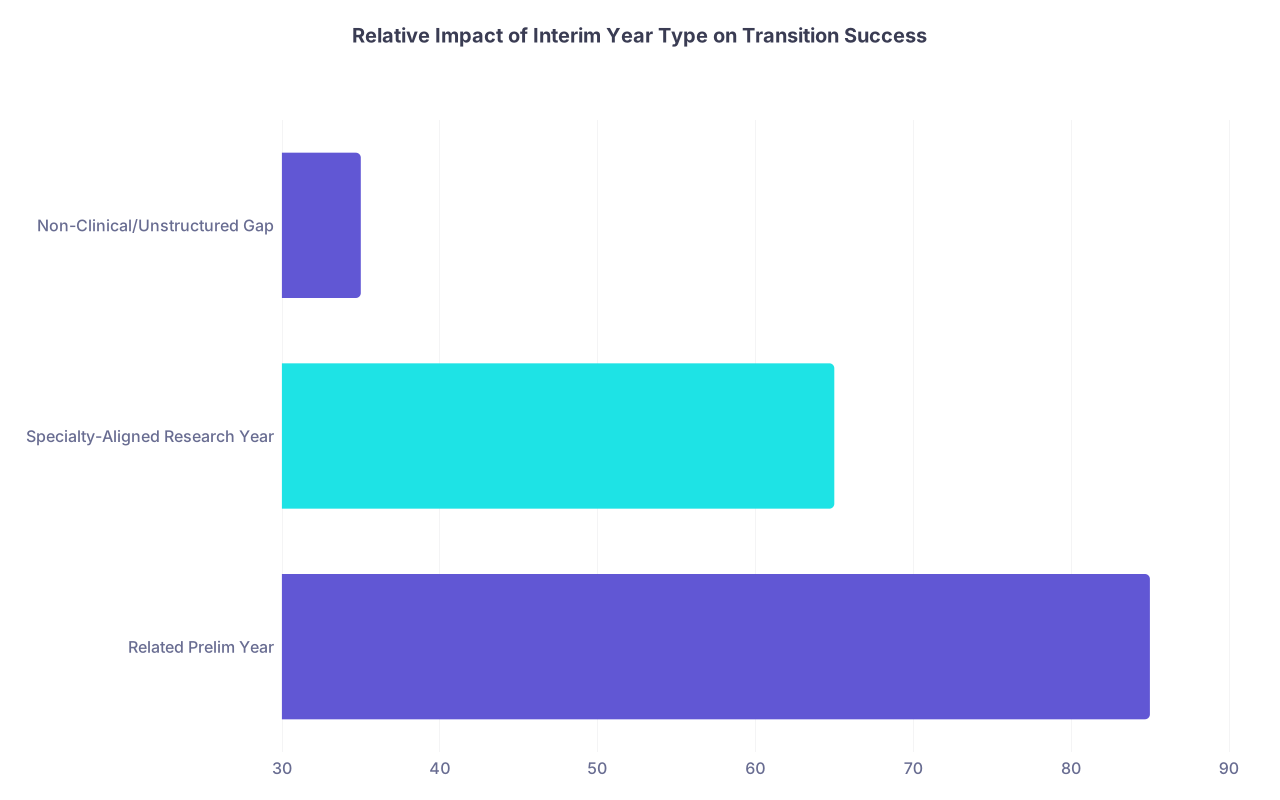
| Category | Value |
|---|---|
| Related Prelim Year | 85 |
| Specialty-Aligned Research Year | 65 |
| Non-Clinical/Unstructured Gap | 35 |
Those numbers are approximate “benefit scores” rather than literal percentages, but the ranking is consistent: related clinical training > targeted research > vague time off.
7.2 SOAP Outcomes and Later Transitions
SOAP can be friend or trap.
- If you SOAP into a categorical position in a less competitive specialty and you are ambivalent:
- Data and program director attitudes suggest that using that spot as a stepping stone to jump out is viewed poorly.
- Your leverage is limited; PDs talk; and you risk burning bridges.
- If you SOAP into a prelim position:
- Much more acceptable path to transition at the end of the prelim year.
The most pragmatic pattern:
- If you get a categorical SOAP offer in a field you would realistically be ok with (FM, IM, Peds, Psych), and your original target was ultra‑competitive, the expected value calculation often says: accept it and build a career there or through fellowship.
- If your heart is set on a mid‑tier competitive field and you SOAP only into completely misaligned categorical spots, it may be rational to choose a prelim + reapply.
8. Strategic Recommendations by Target Field
Here is where I stop being purely descriptive and give you data‑driven prescriptions.
| Target Tier | Example Specialties | Best Interim Strategy | Realistic Transition Odds* |
|---|---|---|---|
| Accessible | IM, FM, Peds, Psych, Path, Neuro | Prelim/TY + broad re‑app | High (60–90%) |
| Middle | EM, Anesthesia, PM&R | Related prelim + specialty‑aligned rotations | Moderate (30–70%) |
| Hard | Gen Surg, OB/GYN, Rads | Prelim in related field + strong letters | Low–moderate (20–45%) |
| Ultra | Derm, Ortho, Plastics, ENT, NSurg | Research + 1–2 yrs heavy alignment | Very low (≤20%, often <10%) |
| B --> | Prelim in Related Field | C[Accept Prelim] | |
| B --> | No Suitable SOAP | D[Plan Gap/Research Year] | |
| H --> | Yes | I[Rank Broadly & Realistically] | |
| H --> | No | J[Reassess Field or Strategy] |
The applicants who fail to transition:
- Do not realign their application (same weak personal statement, no new letters).
- Aim again at the same or even more competitive field with no meaningful change.
- Apply too narrowly (geographically or by program prestige).
Those who succeed look different on paper the second time. Measurably so.
FAQ (exactly 4 questions)
1. If I did not match my original specialty, is it smarter to reapply to the same field or switch?
The data show that reapplicants have reduced odds in any field, but the penalty is larger in highly competitive specialties. If your original target was ultra‑competitive (derm, ortho, plastics, ENT, neurosurg), your second‑attempt odds even with improvements are often below 30%, sometimes below 20%. Switching into a less competitive field (IM, FM, Peds, Psych, Path, Neuro) commonly raises your match probability into the 60–90% range as a U.S. grad if you prepare properly. For mid‑tier fields (EM, anesthesia, PM&R, OB, gen surg, rads), the decision is nuanced; your specific scores, letters, and available prelim or research positions matter more than any blanket rule.
2. Does doing a prelim year lock me into that specialty, or can I still switch later?
A prelim year does not mathematically lock you in, but it creates both opportunities and constraints. Statistically, a strong prelim year in IM or surgery improves your odds of: (1) continuing in that same field categorical, and (2) pivoting into closely related specialties (IM → neuro, cards‑track; surgery → anesthesia, sometimes EM, occasionally OB). Switching into a completely unrelated specialty is less common, but still possible if you acquire fresh rotations and letters. Programs like seeing recent, well‑evaluated clinical work more than they care whether it exactly matches the target specialty.
3. How many years should I be willing to spend trying to break into a very competitive specialty after not matching?
From a data and opportunity‑cost standpoint, very few applicants should spend more than 1–2 additional years chasing ultra‑competitive fields after an unmatched cycle. The probability of success rises during the first reapplication if you add substantial research or a strong prelim; however, after 2–3 cycles with no match in that specialty, your chances decline and your application begins to look increasingly non‑standard. Most people in that situation who eventually match do so by pivoting to a less competitive specialty, where their prior research and clinical work can still be framed as strengths.
4. Does being unmatched once permanently limit my fellowship options if I pivot into IM or another core specialty?
Not necessarily. Fellowship selection (cards, GI, heme/onc, etc.) is driven far more by: residency performance, in‑specialty research, letters, and in‑program reputation than by the fact that you were once unmatched in a different field. Many residents who landed in IM or another core specialty after an initial non‑match have gone on to competitive fellowships. The hidden advantage of pivoting into a more accessible core specialty is that it re‑opens future competition at the fellowship stage, where your clinical performance and scholarly work within that specialty carry much more weight than your initial Match outcome.