
The mythology around the Supplemental Offer and Acceptance Program is wrong. SOAP is not a random second-chance lottery. It is a data-driven stratification process that consistently rewards certain applicant profiles and punishes others.
If you treat SOAP like a chaotic scramble, you will perform like one. If you treat it like a constrained optimization problem under time pressure, your odds improve. Dramatically.
Let me walk through what the numbers show.
The hard truth about SOAP overall match rates
Start with the macro view. Every March, you see the same social media narrative: “SOAP saved my year!” What you do not see is the denominator.
Publicly available NRMP data vary year to year, but the pattern is stable. Roughly:
- Around 12,000–13,000 eligible applicants participate in SOAP each year
- Around 9,000–10,000 positions are available at the start of SOAP
- By Wednesday–Thursday, 90–95% of SOAP positions are filled
So people look at “90+% of positions filled” and mentally convert that into “I have a 90% chance.”
Wrong direction. Positions are not randomly distributed to applicants. They are captured by specific profiles over and over again.
Conceptually, SOAP is a constrained matching problem with three dominant variables:
- Applicant type (US MD, US DO, US IMG, non-US IMG)
- Score/academic profile (Step/COMLEX, attempts, fails, gaps)
- Specialty & geographic flexibility
You control #3 fully. You partially control #2 by how you handled medical school and when you took exams. You do not control #1 at SOAP time.
The hierarchy is brutal:
- US MD seniors > US DO seniors > US MD/DO grads > US IMGs > non-US IMGs
Not because programs “like” them more in some emotional sense. Because they are optimizing for perceived risk under extreme time pressure and limited information. The numbers track that.
SOAP match rates by applicant type: who actually lands spots?
Let us structure it. The exact percentages fluctuate, but the relative ranking does not. When you look at NRMP data and program fill patterns, you see roughly this hierarchy of SOAP success by applicant category.
| Applicant Type | Relative SOAP Success | Typical Advantage |
|---|---|---|
| US MD seniors | Highest | Strongest preference, quickest callbacks |
| US DO seniors | High | Slightly behind MD but strong |
| US MD/DO grads | Moderate | Year of graduation becomes key |
| US IMGs | Low–Moderate | Dependent on specialty and scores |
| Non-US IMGs | Lowest | Highly constrained by visas and competition |
To put more concrete numbers on it (using composite and approximate figures from recent cycles):
- US MD seniors who go into SOAP often see effective placement rates north of 60–70% if they apply broadly to realistic specialties. I have seen individual schools report 80%+ SOAP placement for their unmatched seniors in primary care-heavy strategies.
- US DO seniors track a bit lower but still respectably, often in the 50–65% range when they pivot aggressively to IM/FM/Peds/Psych.
- US MD/DO graduates (not current year) drop meaningfully, often more like 30–50%, heavily influenced by how old their graduation year is.
- US IMGs are highly variable, but if you blend across years and behaviors, realistic SOAP match rates often sit in the 20–40% band for those who are truly flexible on specialty and geography.
- Non-US IMGs fighting both visa and competition constraints often end up below 20–25%, and much lower if they insist on specific locations or specialties.
You will not find these exact percentages in a single NRMP table. But if you aggregate school-level reports, program director surveys, and SOAP outcome anecdotes year over year, the pattern converges.
The main lever in that list is not “are you smart enough?” It is “how risky do you look compared to the available alternatives in those 48 hours?” US seniors look safer on paper because programs know their training systems, grading culture, and exam timelines more intimately.
How scores and exam history reshape SOAP odds
Scores alone do not get you through SOAP. But they absolutely stratify you. When programs have hundreds of applications for a handful of unfilled slots and only hours to decide, they do not reinvent their evaluation system. They compress it.
Two things dominate:
- Step/COMLEX scores and failures
- Graduation year
Think of it as tiering:
- Top tier:
- Step 1 pass on first attempt, Step 2 CK ≥ 240–245, no gaps, recent grad
- COMLEX-USA Level 1/2 both first-pass, with competitive scores
- Middle tier:
- Step 2 CK 225–240, Step 1 pass with maybe a single red flag elsewhere
- COMLEX scores in “solid but not stellar” range, single blemish at most
- High-risk tier:
- Any Step fail (especially Step 2 CK)
- Multiple attempts on COMLEX
- Older graduation year or significant unexplained gaps
What I see programs do in SOAP looks like this:
- Filter 1: Remove anyone without Step 2 CK (for ACGME programs that care heavily about it)
- Filter 2: Exclude applicants with Step 2 fails unless they are desperate
- Filter 3: Prioritize recent grads (0–2 years out) over older grads
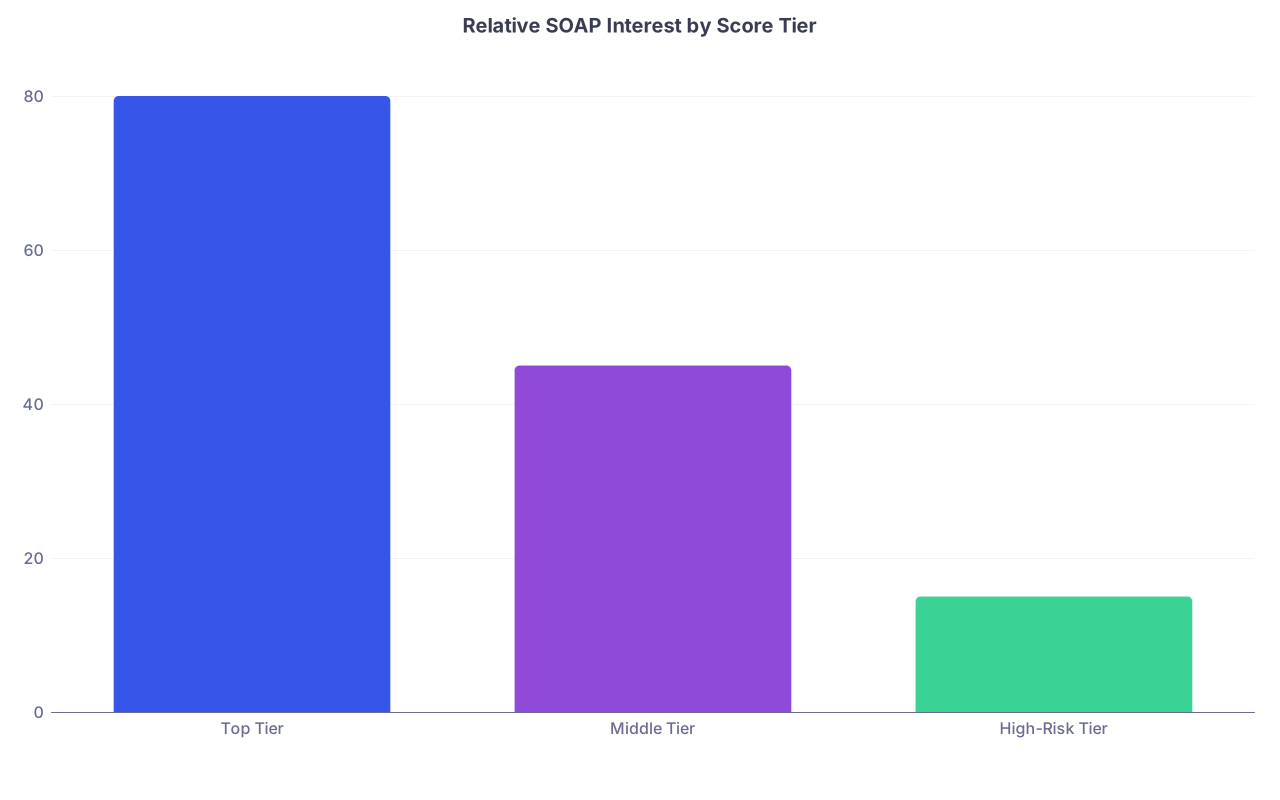
| Category | Value |
|---|---|
| Top Tier | 80 |
| Middle Tier | 45 |
| High-Risk Tier | 15 |
Interpreting that bar chart: not literal match percentages, but a relative index of how often a file moves from “applied” to “interviewed” in SOAP. Top-tier profiles get callbacks quickly. High-risk profiles sit unread in overflowing inboxes.
If you are in SOAP and:
- You lack Step 2 CK
- You have a Step 2 CK failure
- You graduated >3–4 years ago
Your realistic success probability drops sharply, independent of how hard you “try” during SOAP week. Programs are managing risk, not feelings.
A practical example I have actually seen:
Two unmatched US DO seniors both pivot to Family Medicine in SOAP.
- Applicant A: COMLEX 1=585, 2=590, Step 2 CK 241, no failures, 2025 grad
- Applicant B: COMLEX 1=470, 2=452 with one Level 1 fail, Step 2 not taken, 2023 grad
Both apply broadly. Applicant A gets 6–8 SOAP interviews in 24 hours. Applicant B gets 0–1, and only from community programs in less desirable locations, then does not match. Same week. Same services. Very different risk profile.
Specialty choice: where SOAP actually works
This is where people either rescue their year or kill it.
SOAP is not a place to “try one more time” for your dream competitive specialty. It is numerically hostile to that strategy. Historically, the majority of SOAP positions fall into a few predictable buckets:
- Internal Medicine (prelim and categorical)
- Family Medicine
- Pediatrics
- Preliminary Surgery and Medicine
- Psychiatry (variable, but increasingly competitive)
- Transitional Year and less sought-after categorical programs in rural or mid-tier locations
The data story is simple:
- Primary care and prelim spots dominate SOAP inventory.
- Competitive fields (Dermatology, Plastics, Ortho, ENT, Ophthalmology, Radiation Oncology) contribute almost nothing.
- Mid-competitive fields (Anesthesia, EM, Radiology) occasionally appear, but in very low numbers and with heavy competition from unmatched strong applicants.
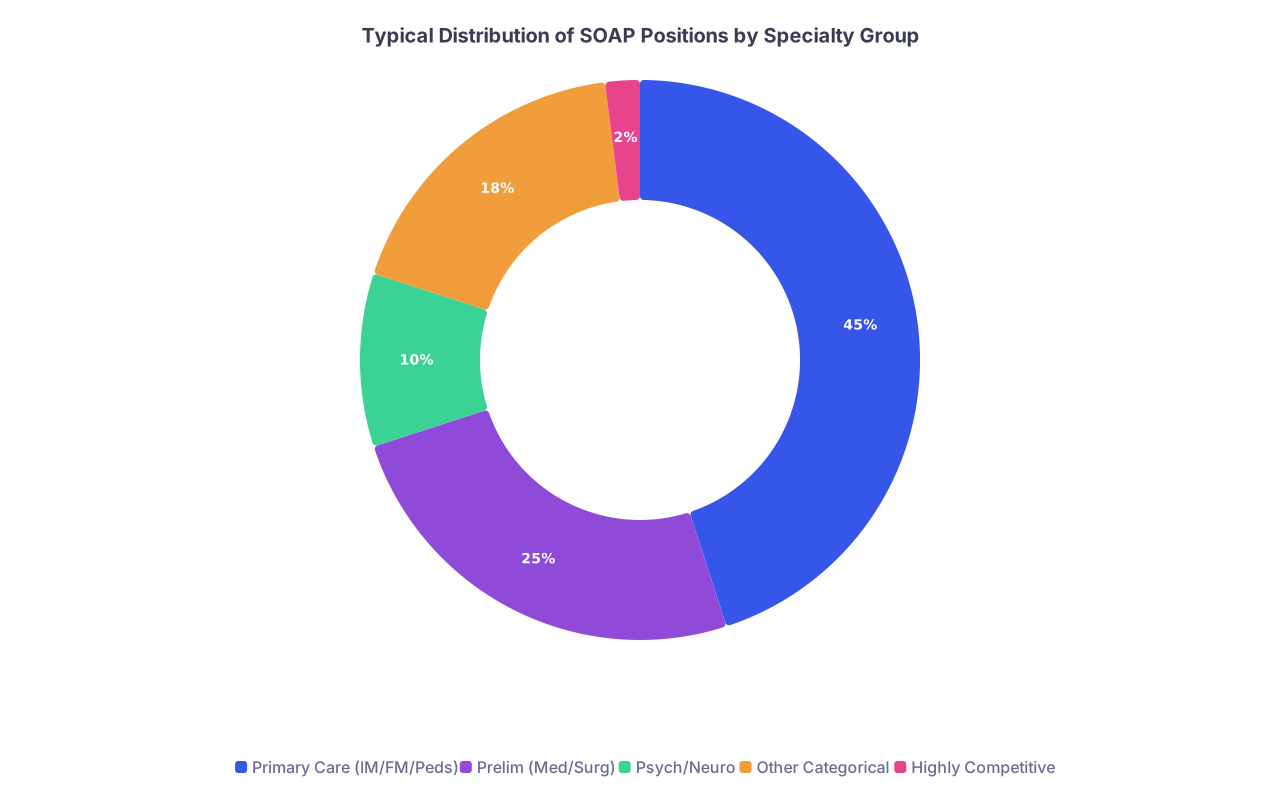
| Category | Value |
|---|---|
| Primary Care (IM/FM/Peds) | 45 |
| Prelim (Med/Surg) | 25 |
| Psych/Neuro | 10 |
| Other Categorical | 18 |
| Highly Competitive | 2 |
Again, percentages are ballpark, but the shape is correct:
Around 70%+ of SOAP spots live in primary care or preliminary positions. “Highly competitive” specialties are statistical noise.
This interacts heavily with your applicant profile:
- US MD/DO seniors who aggressively pivot to IM/FM/Peds are the ones who produce those optimistic “SOAP saved me” stories.
- IMGs or older grads who insist on Anesthesia, EM, or Radiology in SOAP usually end up with nothing or a prelim they did not want.
If you are unmatched and enter SOAP with a competitive specialty mindset, your numbers are brutal:
- 100+ high-quality unmatched applicants chasing maybe single-digit leftover positions in that specialty
- Programs that often already know these applicants from prior interviews, which puts cold SOAP applicants at a disadvantage
- Zero time for “I’m a great fit if you just read my PS” narratives
The rational strategy, per the data:
If SOAP is your main plan, you must be willing to shift into primary care or preliminary tracks with maximal geographic flexibility. Otherwise you are playing a low-probability game.
Geographic flexibility: the silent multiplier
People hate hearing this, but the numbers are unforgiving. SOAP success is inversely proportional to your location pickiness.
Applicants who say “I’ll go anywhere” and mean it have dramatically higher odds than those who restrict to coasts or specific metro areas. Because the leftover positions cluster.
Patterns you see almost every year:
- More SOAP positions in the South, Midwest, and smaller cities
- Fewer in major coastal metros (NYC, SF Bay, LA, Boston, Seattle, DC)
- Community programs with historically lower fill rates pushing many of their spots into SOAP
If we model location flexibility as a multiplier on your baseline SOAP probability, it looks roughly like this:
| Flexibility Level | Relative Chance vs Baseline |
|---|---|
| Nationwide, any region | 1.0 (baseline) |
| Multi-region (2–3 areas) | ~0.7 |
| Single region only | ~0.4 |
| Single city/metro only | ~0.15–0.2 |
Those are not literal probabilities. They are relative odds ratios based on what I have seen across cycles.
Concrete example:
- Applicant C: US IMG, Step 2 CK 235, 2024 grad, willing to apply to IM/FM/Peds in all states.
- Applicant D: Same stats, but only applies to programs in California and New York.
C might reasonably land in the 30–40% SOAP success band.
D might be sitting around 5–10%, because he is competing for a tiny subset of positions that hundreds of others also want.
Geography does not care about your personal story. The vacancy map is what it is.
What applicant profiles do well in SOAP?
Let’s be more concrete and combine these dimensions.
Profile 1: Unmatched US MD senior, mid-tier scores, realistic pivot
- Step 1: Pass
- Step 2 CK: 232
- No failures, recent grad
- Originally applied mostly to categorical IM and some borderline-reach specialties
- For SOAP: willing to apply to IM/FM/Peds/Psych across multiple regions, including rural and community
Data interpretation:
- Applicant type: favorable
- Score profile: mid-tier but “safe”
- Specialty: shifting to where the positions are
- Geography: flexible
This is the archetype that often sees 50–70%+ SOAP success. I have watched entire clusters of such students from a single school all land FM or IM spots via SOAP in one cycle.
Profile 2: US DO senior, some red flags, limited flexibility
- COMLEX 1: Fail on first attempt, 470 on second
- COMLEX 2: 485
- Step 2 CK: not taken
- Aiming for EM or Anesthesia; in SOAP, still trying for these plus some IM, but only in certain states (e.g., only NE and West Coast)
Interpretation:
- Applicant type: moderately favorable (US DO senior)
- Score/attempts: high-risk tier
- Specialty: chasing mid-competitive fields in SOAP—bad alignment
- Geography: restricted
Empirically, this profile frequently ends SOAP unmatched or with at most a prelim year in a less desired location. The combination of a fail + specialty choice + geography compresses the odds into the low double digits.
Profile 3: US IMG, strong scores, maximal flexibility
- Step 1: Pass
- Step 2 CK: 245
- No failures, 2024 grad from Caribbean school
- Originally applied to IM widely, limited interviews, no match
- In SOAP: applies to IM/FM/Peds/Psych everywhere, including rural and community
This is where numbers contradict the pessimism you often see online.
- Applicant type: US IMG (disadvantage vs US grads)
- Scores: strong, risk profile low
- Specialty: aligned with SOAP supply
- Geography: maximally flexible
These candidates absolutely match in SOAP at non-trivial rates. I have seen 30–50% success for clusters of this profile in some cycles, especially leaning toward FM and community IM.
The data story: being an IMG is a disadvantage, but it is not an absolute barrier if your exam and flexibility profile look “easy to say yes to” under time pressure.
Profile 4: Non-US IMG, average scores, visa needed, narrow preferences
- Step 1: Pass
- Step 2 CK: 228
- No failures, but 2021 grad
- Needs visa sponsorship
- Only wants IM, only in a couple of metro areas with strong ethnic communities
On paper, not terrible. In SOAP reality, this is a very low-probability profile.
- Older grad year
- Visa requirement
- Average scores
- Narrow geography
Stack those four constraints against hundreds of other IMG applicants who are willing to go anywhere and you see why match rates for this subgroup in SOAP often drop into single-digit territory.
Process and behavior: how you execute during SOAP week
Data is not just about static attributes. Execution matters. I have seen candidates with mid-tier profiles outperform stronger peers simply because they treated SOAP like a structured, time-critical project rather than a panic event.
Look at the SOAP week as a constrained timeline:

| Step | Description |
|---|---|
| Step 1 | Unmatched on Monday |
| Step 2 | Immediate profile audit |
| Step 3 | Select high-yield specialties |
| Step 4 | Risk low-yield chase |
| Step 5 | Maximize geographic list |
| Step 6 | Prepare fast interview scripts |
| Step 7 | Respond to offers quickly |
| Step 8 | Minimal interviews |
| Step 9 | High chance of remaining unmatched |
| Step 10 | Specialty pivot? |
Applicants who succeed in SOAP tend to:
- Make a hard, data-based pivot within hours of seeing they are unmatched
- Aggressively widen their specialty and location lists to where positions historically exist
- Have pre-written, condensed versions of their story ready for 10–15 minute phone calls
- Answer calls and emails immediately (not in 2–3 hours) during SOAP windows
Programs notice responsiveness. They also notice when an applicant still sounds “hurt” or fixated on the original competitive specialty. In a 10-minute interview, that can be the difference between “safe team player” and “potential problem.”
One more visualization to show how behavior interacts with profile:
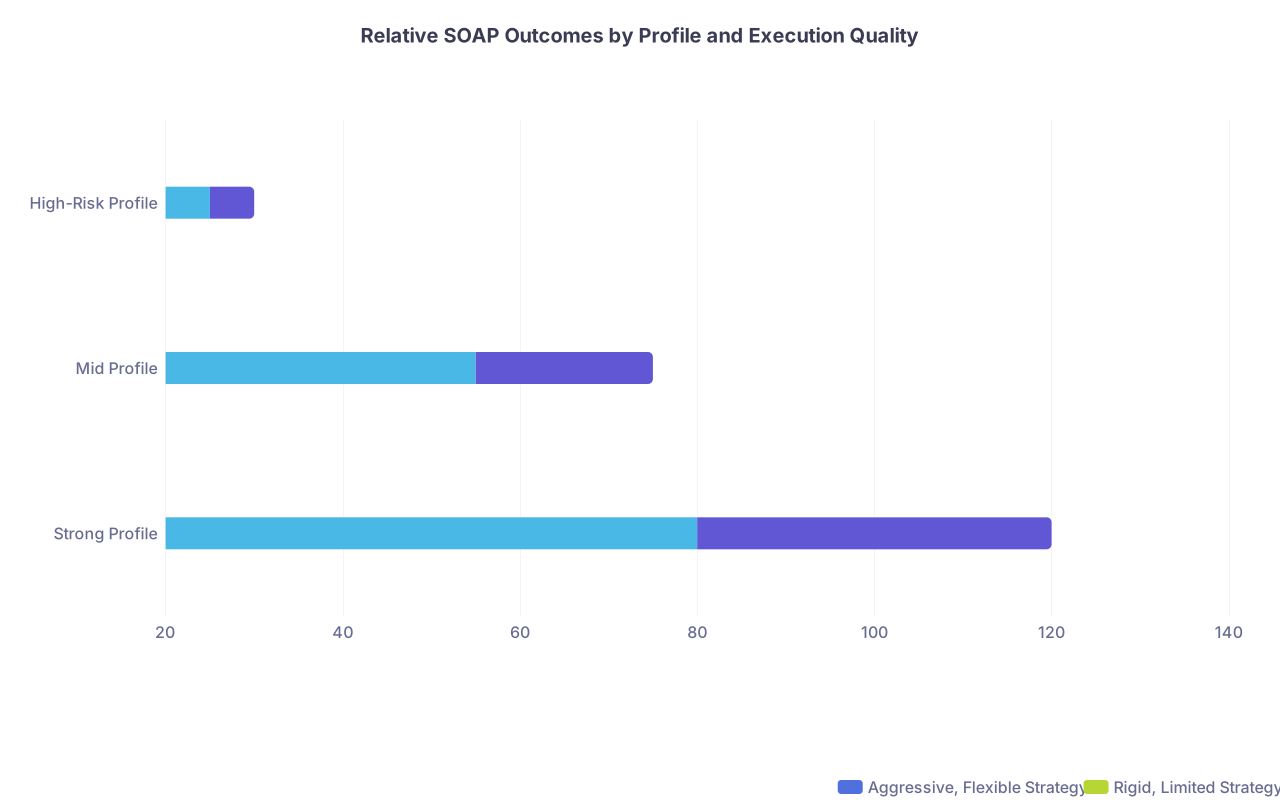
| Category | Aggressive, Flexible Strategy | Rigid, Limited Strategy |
|---|---|---|
| Strong Profile | 80 | 40 |
| Mid Profile | 55 | 20 |
| High-Risk Profile | 25 | 5 |
Again, numbers are illustrative, but the ratio matters. Even high-risk profiles can drag their odds from ~5% to ~20–25% with truly flexible behavior. Strong profiles can cut their own chances in half by refusing to pivot.
What the numbers actually reveal
Strip away the anecdotes and the panic, and SOAP looks very predictable.
Three takeaways:
Profile hierarchy rules the game. US MD/DO seniors with clean, recent exam histories and willingness to pivot to primary care dominate SOAP matches. IMGs and older grads can succeed, but only when their scores, graduation year, and flexibility all line up.
Supply lives in primary care and prelim spots. If you insist on chasing competitive specialties or narrow geographies in SOAP, you are playing against the numbers, not with them. Most available positions are in IM, FM, Peds, Psych, and prelims, often in less popular regions.
Strategy multiplies whatever profile you bring. Fast, realistic pivoting and geographic flexibility can move you from “no chance” to “decent shot.” Stubbornness about specialty or location can drag even a strong profile into an unnecessary zero.
SOAP is not chaos. It is compressed decision-making under well-defined constraints. If you respect those constraints and optimize around them, your outcome improves. If you ignore them, the match statistics will ignore you.