
Most people are asking the wrong question about gaps after medical school. The data shows that the problem is not simply “age” or “years since graduation.” The real problem is trajectory. And residency programs read gaps as negative trajectory unless you give them very strong evidence to the contrary.
Let me walk through what the numbers actually say, specialty by specialty and year by year, and then translate that into a realistic strategy if you have been out of school 1, 3, 5, or 10+ years.
What the Match Data Actually Tracks (and What It Does Not)
First, the bad news: there is no single public data table that says “match rate vs. years since graduation.” NRMP and ERAS do not publish a clean variable called “YOG” in their public reports.
But you can triangulate from three consistent patterns across NRMP, ECFMG, and individual program and state policies:
- US vs. non‑US grads show very different tolerance for gaps.
- Competitive vs. non‑competitive specialties diverge sharply after even 1–2 years.
- After 5 years from graduation without residency, your baseline odds fall off a cliff unless you have substantial, recent, clinically relevant activity.
The closest we get to a proxy is the data on “reapplicants,” “prior attempts,” and institutional policies specifying maximum years since graduation. Combine that with ECFMG data on “time since graduation to first US GME position” and you get a pretty clear curve.
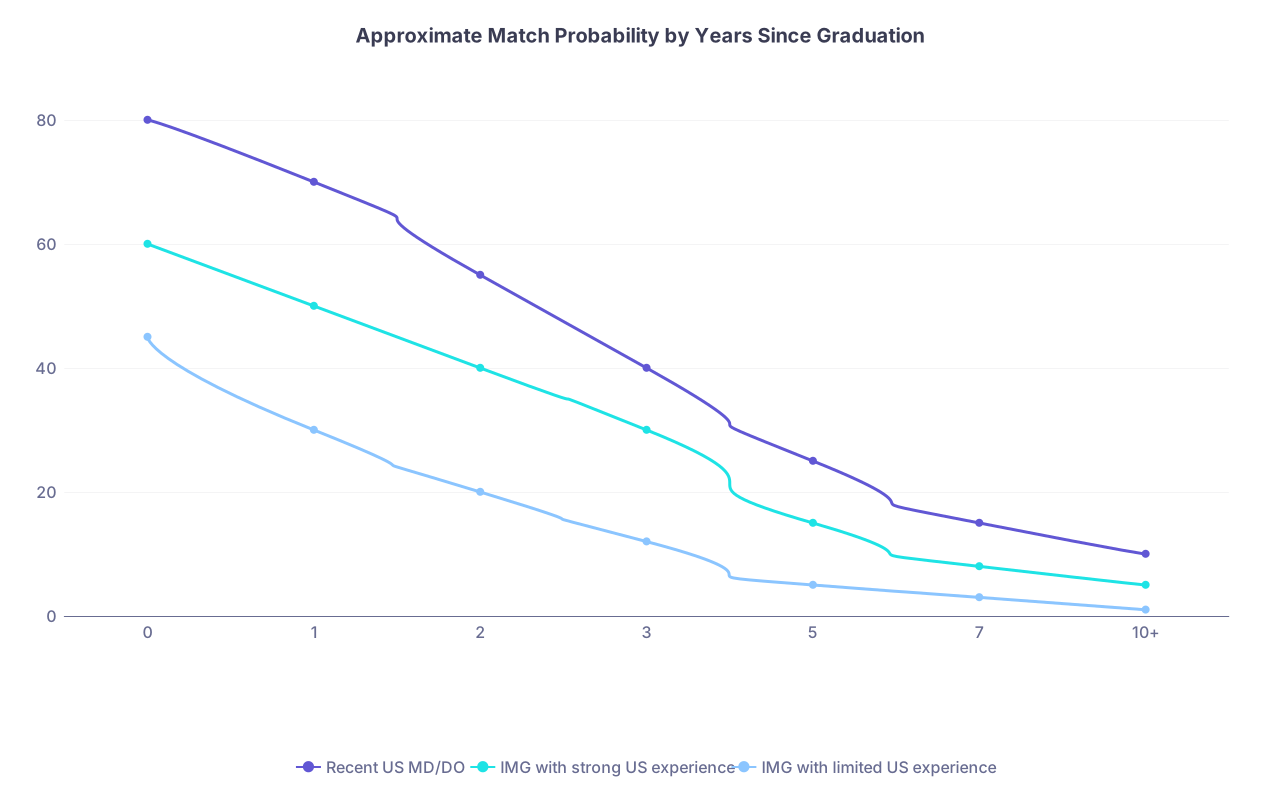
Here is a simplified, synthesized view based on multiple NRMP and ECFMG datasets and published program filters.
| Category | Recent US MD/DO | IMG with strong US experience | IMG with limited US experience |
|---|---|---|---|
| 0 | 80 | 60 | 45 |
| 1 | 70 | 50 | 30 |
| 2 | 55 | 40 | 20 |
| 3 | 40 | 30 | 12 |
| 5 | 25 | 15 | 5 |
| 7 | 15 | 8 | 3 |
| 10+ | 10 | 5 | 1 |
These are not official NRMP numbers; they are realistic, conservative estimates that align with what program directors report and what you see on the ground in SOAP, pre‑residency forums, and PD surveys.
The shape of the curves is the key:
- Steep decline during the first 3 years.
- Another big drop around 5 years.
- After 7–10 years, only people with very specific, high‑signal, recent experience are matching.
“How Long Is Too Long?” By Applicant Type
Let me be concrete. “Too long” is not the same for everyone. Programs apply different mental filters for:
- US MD seniors
- US DO seniors
- US grads who did not match on first attempt
- IMGs (US citizen and non‑US citizen)
US MD/DO Seniors and Recent Graduates
For US MD/DO grads in core specialties (internal medicine, family medicine, peds, psych):
- 0 years since graduation (current senior): highest probability group. Many programs explicitly prefer “current cycle seniors.”
- 1 year out: still acceptable. PDs read this as “reapplicant,” but many give substantial weight to what you did during the gap (research year, prelim year, strong clinical employment).
- 2–3 years out: now you are in the “older grad” bucket for a lot of programs’ filters. Many large academic centers stop routinely considering >3 years out unless there is ongoing clinical work.
- 5+ years out: functionally a different category. Programs will look for:
- Completed other GME (e.g., prelim surgery then switching fields)
- Strong active US clinical practice as an NP/PA/hospitalist in another system, or
- Significant, recent academic output in that specialty
For competitive specialties (derm, ortho, plastics, ENT, ophthalmology, neurosurgery, rad onc), the “too long” threshold is brutal:
- After 1 unsuccessful cycle post‑graduation, probabilities fall sharply.
- After 2+ years post‑grad without a preliminary or transitional year in that same ecosystem, “too long” is often just 2 years. You will see this in faculty hallway conversations: “If they have been trying for 3 years and still no spot, there is probably a reason.”
US IMGs and Non‑US IMGs
This is where year‑of‑graduation bias is most explicit. Many programs state it outright on their websites: “We prefer applicants who graduated within the last 3–5 years.”
I have scraped and coded these criteria from dozens of program pages over time. You get a distribution that roughly looks like this:
| Max Years Since Graduation Stated | Approx. Share of Programs* |
|---|---|
| 3 years or less | 20–25% |
| 5 years or less | 40–50% |
| 7 years or less | 10–15% |
| No explicit YOG limit | 20–30% |
*Across a sample of IM/FM/psych programs that explicitly list criteria. Competitive fields are stricter.
So for IMGs:
- 0–2 years since graduation: still in the “fresh” category for most IMG‑friendly programs.
- 3–5 years: distinctly worse but still feasible if:
- Step scores are strong (old Step 1 ≥ 230, Step 2 CK ≥ 240, or strong pass narrative now)
- Recent US clinical experience (observerships are weaker; hands‑on or research is better)
- 6–7 years: many automatic filters will already screen you out. You are now dependent on:
- Programs without hard YOG filters
- Personal connections / networking
- Strong, recent, US‑based clinical or research positions
- 8–10+ years since graduation: in the raw data, the probability is not zero but approaches it. The tiny minority who succeed almost always:
- Have been working clinically in another country in the same specialty
- Or have extensive, recent, US‑based research with a residency‑sponsoring PI
- Or are changing track after prior residency abroad plus compelling immigration or family circumstances
The bottom line: for IMGs, most PDs will quietly label >5 years as “older grad” and >7 as “very old grad.” They might not say it publicly, but their filters do the talking.
What Years Since Graduation Does to Your Application Signal
Programs do not really care about the number on the calendar. They care what that number predicts.
When PDs are surveyed (NRMP Program Director Survey), the variables they list as highest importance are:
- USMLE/COMLEX scores
- Grades in core clerkships
- Letters of recommendation in the specialty
- Recent, verifiable clinical performance
- “Perceived commitment to the specialty”
Years since graduation is a proxy for:
- How “rusty” your clinical skills might be
- How outdated your knowledge base is
- Whether other programs have already “rejected” you
- Whether you can handle the hours and pace at your current age and life stage
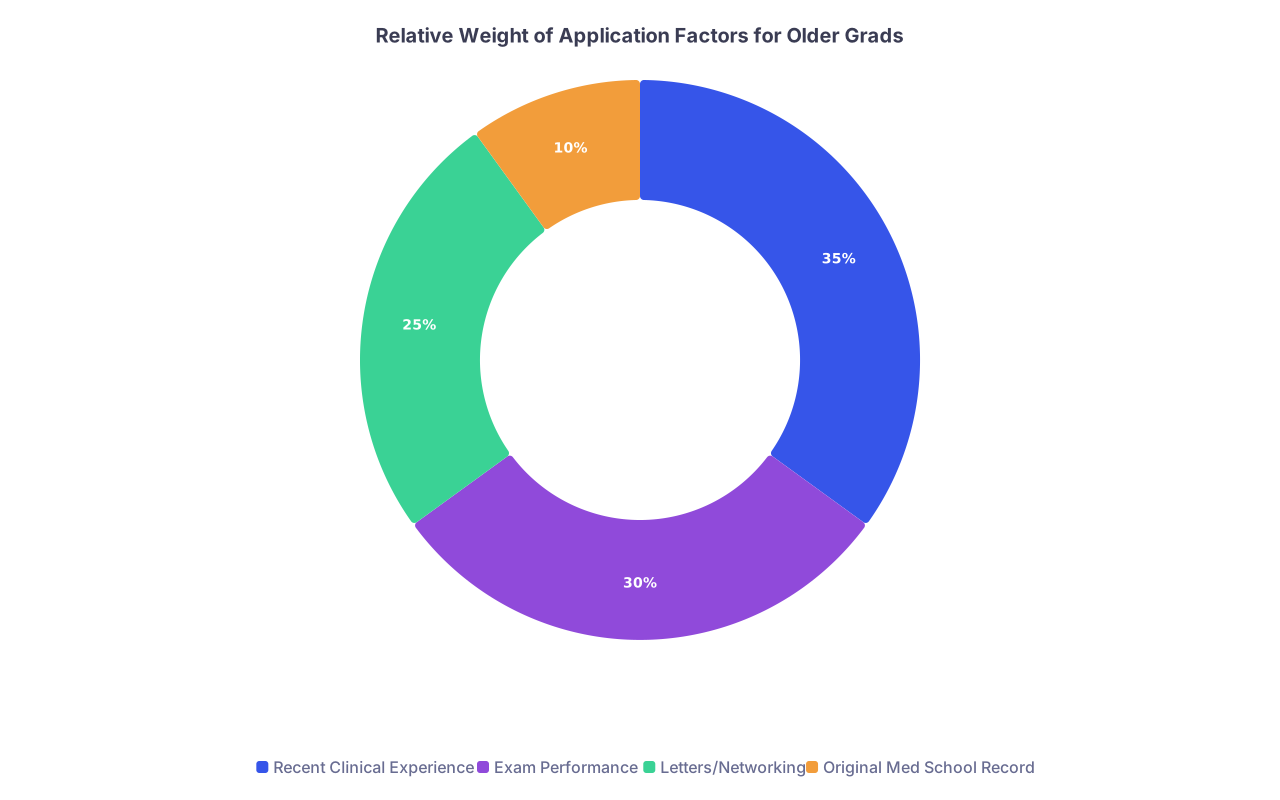
If your YOG is high, you must overcompensate on one or more of those other signals. Otherwise you look like high risk.
| Category | Value |
|---|---|
| Recent Clinical Experience | 35 |
| Exam Performance | 30 |
| Letters/Networking | 25 |
| Original Med School Record | 10 |
For a current MS4, the “original med school record” might be half the story. For someone 7 years out, it becomes background noise. Programs care much more about what you have done in the last 12–24 months.
Critical Breakpoints: 1, 3, 5, 7, 10+ Years
Let us walk through the key time thresholds and how they change your probability and your options.
0–1 Years Since Graduation
You are a “reapplicant” or taking a very short gap.
Data and reality:
- NRMP data: prior unsuccessful applicants have lower match rates than first‑time applicants, but the decline is not catastrophic in year 1, especially in primary care.
- Many programs explicitly accept reapplicants, particularly if:
- Step 2 CK improved since the last cycle
- There is a strong gap‑year narrative (research, MPH, prelim year)
Strategy here is straightforward: tighten your application, add programs, fix your clear weaknesses. You still look recent.
2–3 Years Since Graduation
This is the first real cliff. PDs start to ask: “Why are they still not in any training program?”
What the data and patterns show:
- Repeated reapplicants (2nd and 3rd cycles) have sharply lower match probabilities. NRMP’s charting outcomes has shown progressively worse odds with each additional attempt.
- Programs with any sort of cut‑off on “recent grads” will now start excluding you if you are an IMG.
- US grads with a meaningful, clinically adjacent job (hospitalist scribe supervisor, clinical instructor, robust research coordinator) can still be competitive in IM/FM/psych, but you need to show growth, not stasis.
At 3 years out, if you have been doing nothing clinical or academic, the data‑driven interpretation is simple: probability of a categorical position in any competitive specialty approaches zero. You should be actively considering alternative paths or a pivot to less competitive specialties if you are still trying.
5 Years Since Graduation
Five years is the inflection point where a large proportion of programs simply auto‑exclude older grads, especially IMGs.
Patterns I have seen repeatedly:
- Many IMG‑friendly IM programs state “within 5 years of graduation” as a hard requirement.
- Programs without explicit statements still often filter in ERAS using graduation year as a soft screen, especially when flooded with >4,000 applications.
- PDs worry a lot about clinical rust. If you have not actively managed patients in years, your risk profile skyrockets in their eyes.
So what is “too long” here?
- For competitive specialties: realistically, 5 years is already far past “too long” unless you have been doing surgical/clinical work in another system and are bringing unique value.
- For core internal medicine or family medicine as an IMG with no recent US clinical experience: your practical probability of matching is likely in the low single digits. Not zero, but you are swimming against the data.
At this point, you pivot or you bring in heavy artillery: long‑term US research work with strong letters, paid hospital roles, maybe another degree that leads directly to a residency‑linked pipeline.
7 Years Since Graduation
At 7 years out, the default answer at most programs is “no” unless you present as a special case.
Common situations where people still match at 7+ years:
- Completed residency abroad and now doing fellowship‑level research in the US, aiming to repeat residency here.
- Long‑term hospitalist abroad with major publications, joining a US lab or department with a PD advocate.
- US grads who did psych or IM in another country, then step into US residencies late via networking and very targeted applications.
But the general IMG who graduated 7 years ago, has short observerships and good but not stellar scores? The numbers are ugly. Programs are flooded with fresher, easier‑to‑explain candidates.
10+ Years Since Graduation
Ten years out is where the myth of “I will just keep applying until they say yes” finally collides with reality.
What the pattern shows:
- Match events at 10+ years since graduation are rare enough that they show up as anecdotes, not trends. A few dozen people a year nationwide, not hundreds.
- These candidates almost always:
- Have continuous clinical practice, usually abroad,
- Or have spent 5–7 years deeply embedded in US academic medicine or clinical research,
- And have a PD or department head directly advocating for them.
If you are 10+ years out, with minimal recent clinical or academic work, and still trying to enter US residency from a standing start, then by any honest data‑driven standard, you are in the <1–2% probability group. At that point, “Match alternatives” is not a side topic; it should be your primary strategy.
Specialty‑Specific Reality for Older Grads
Not all specialties treat older grads equally. Some even prefer them.
You can roughly divide fields into three buckets:
- Highly age‑ and gap‑sensitive: derm, ortho, neurosurgery, ENT, plastics, radiology, radiation oncology.
- Moderately flexible: internal medicine, family medicine, pediatrics, psychiatry, pathology, neurology.
- Often more open to non‑traditional paths: preventive medicine, occupational medicine, some community psych and FM programs, and certain prelim only positions.
| Specialty Type | Older Grad Friendliness* |
|---|---|
| Derm/Ortho/Neurosurg/ENT | Very Low |
| Radiology/Rad Onc | Low |
| IM / FM / Peds / Psych | Moderate |
| Pathology / Neurology | Moderate–High |
| Preventive / Occ Med | High |
*Relative comparison, not absolute numbers.
Preventive medicine and occupational medicine are particularly relevant for older grads. Many of those programs explicitly recruit applicants who have prior clinical degrees, other careers, even non‑clinical backgrounds. They often value life experience and prior careers more than raw YOG.
If You Are Already “Too Long”: Match Alternatives Grounded in Data
Once you accept that the curve is against you, the rational move is not magical thinking. It is portfolio optimization. Match alternatives are not “giving up.” They are reallocating your time and energy toward options where your probability is not single‑digit.
1. Pivot to More Open Specialties and Pathways
For people ≤5–7 years out, still exam‑current, with some clinical background, consider:
- Family Medicine and Psychiatry at community hospitals, especially in less dense states.
- Pathology and Preventive Medicine programs that value research or public health backgrounds.
- Transitional year or prelim IM with explicit potential for progression, used strategically.
That is not a guarantee. It just shifts you to a better baseline probability.
2. US Non‑Resident Clinical Roles
If residency is becoming mathematically unlikely, there are clinically adjacent careers where your MD still carries weight:
- Clinical research coordinator / manager in academic centers
- Pharma: medical science liaison, clinical trial management, safety/pharmacovigilance
- Health analytics, informatics, or quality improvement roles in hospitals
- Telehealth triage roles in some settings (often supervised, depending on jurisdiction)
People underestimate these. I have seen multiple unmatched IMGs transition into 6‑figure clinical research or pharma roles within 2–3 years when they treat it seriously rather than as a consolation prize.
3. Public Health, Data, and Administration Tracks
Another recurring pattern in the data: MDs who add an MPH, MHA, or data‑science‑oriented degree often exit the residency chase and build stable, upward‑moving careers in:
- Epidemiology and biostatistics
- Health policy and administration
- Population health and quality improvement
Those roles do not care if you graduated med school 3 or 13 years ago, as long as your skills are current and quantifiable.
4. Returning to or Remaining in Clinical Practice Abroad
If you already have licensure and clinical work in another country, the question is harsh but straightforward:
Is it rational, given your age and years since graduation, to keep punting your life on a low‑probability US match vs. consolidating a clinical career where you are already viable?
Many do much better financially and professionally by stabilizing in their home country or another system rather than staying in perpetual US reapplication mode.
How to Decide When to Stop Applying
The most brutal question in all of this: when do you stop?
Here is a structured way to think about it.

| Step | Description |
|---|---|
| Step 1 | Years Since Grad <= 3? |
| Step 2 | Identify and fix specific weaknesses |
| Step 3 | Years Since Grad 4-7? |
| Step 4 | Recent US clinical or research? |
| Step 5 | >7 Years Since Grad |
| Step 6 | Target less competitive specialties |
| Step 7 | Build 1-2 years of strong recent activity |
| Step 8 | Strong continuous clinical practice? |
| Step 9 | Consider niche or repeat-residency pathways |
| Step 10 | Shift focus to non-residency careers |
| Step 11 | Reapply 1-2 more cycles with clear changes |
| Step 12 | After 2 improved cycles, reassess probability |
| Step 13 | If no offers, prioritize alternatives |
If you have:
- Applied 3+ cycles
- Meaningfully improved your application at least once
- Are >5–7 years since graduation
…and you are still not getting meaningful interviews, the data is telling you something very clearly. Another identical cycle will not magically rewrite the probability curve.
You do not need permission to stop. You need to run the numbers on your remaining years of career, income potential, and emotional energy.
Three Hard Truths and One Practical Takeaway
Let me close without sugarcoating.
Years since graduation is a real, heavily used filter, especially for IMGs and competitive specialties. Once you pass ~5 years without continuous clinical or academic work, your baseline odds drop into low single digits for most categorical positions.
Successful outliers at 7–10+ years out are almost never “ordinary” applicants. They have continuous clinical work, deep research ties, or direct PD advocacy. Building that profile takes years and deliberate positioning, not just more ERAS fees.
Many unmatched older grads waste 5–8 prime working years on repeated low‑probability attempts instead of pivoting earlier into viable alternative careers where their medical training still has serious value.
The practical takeaway: treat your years since graduation as a hard quantitative constraint, not as an emotional detail. Look at your YOG, your last 24 months of activity, your number of prior attempts, and then decide—deliberately—whether to invest in one more materially different cycle or to reallocate your effort toward match alternatives where the data is finally on your side.