
The brutal truth is this: most reapplicants do not fail to match because they are cursed. They fail because their second application looks uncannily similar to their first.
The data show that marginal tweaks rarely move the needle. But you also do not need a miracle. You need targeted, quantifiable improvement in the right places.
Let me walk through what the numbers actually suggest about “how much is enough” for a reapplicant.
1. What the data say about reapplicants and the Match
We do not have a neat, public “reapplicant match rate” line item from NRMP, but there are enough signals to build a realistic picture.
Start with the big buckets:
- US MD seniors: match rate ~93–94 %
- US DO seniors: ~89–91 %
- Independent applicants (previous grads / IMGs / reapplicants lumped): ~58–62 %
Reapplicants are buried in that independent category. Within it, performance diverges sharply. A US MD graduate reapplying to internal medicine looks nothing like a non‑US IMG reapplying to dermatology. You already know that intuitively.
The more useful lens is not “reapplicant vs first‑time” but “how did your profile compare to successfully matched applicants last cycle, and how far from those benchmarks were you?”
That is where the “how much improvement” question lives.
2. Benchmarks that actually matter for reapplicants
There are five levers that reliably change outcomes for reapplicants:
- Step/COMLEX scores (or lack thereof, in the Step 1 era)
- Clinical performance and recency (YOG, U.S. experience)
- Specialty choice and application strategy
- Program count and distribution
- Application quality (LORs, PS, red‑flag narrative)
You do not need to max all five. But you cannot ignore more than one or two and expect a different result.
Let us quantify each.
3. Scores: how much gain moves you out of the rejection bin?
Step 1 is now pass/fail, but Step 2 CK and COMLEX‑Level 2 are still heavily filtered. Programs do not read 1,500 apps per cycle by hand; they screen.
For reapplicants with a numeric score:
- A gain of +2–3 points is statistically noise.
- A gain of +5–7 points starts to change your percentile band.
- A gain of +10–15 points can move you across an actual cut‑off line.
The question is not “How big a jump can I get?” but “Where am I relative to the typical matched applicant in my target specialty?”
| Specialty Group | Typical Matched Step 2 CK | “Concern” Zone for Reapplicants |
|---|---|---|
| Ultra-competitive (DERM, ENT, Ortho, Plastics) | 250+ | < 240 |
| Competitive (EM, Anes, Rads, Gas) | 245–250 | < 235 |
| Core (IM, Peds, Psych, FM) | 235–245 | < 225 |
| Primary care safety net / prelim-only | 230–235 | < 220 |
If you are sitting at 218 Step 2 applying to categorical internal medicine at big university programs, the data are not subtle. You are below typical matched numbers.
What does improvement that actually moves the distribution look like?
- 218 → 225: You are still in the “concern” zone. A bit less bad, but not transformed.
- 218 → 232: You move from “likely auto‑screened at many places” to “borderline but reviewable” for community / mid‑tier programs.
- 218 → 238: Now you are near the bottom of matched IM ranges. Much more viable if paired with other improvements.
In other words: for people starting in the low 220s, a +10–15 point gain on a new exam (e.g., Step 2, Level 2, or a retake where allowed) often marks the difference between “systematically filtered” and “actually seen.”
For DO/COMLEX candidates, the principle is identical: you want to move one bracket up relative to your peers in your specialty, not snag a cosmetic +3.
4. Specialty choice: the single biggest “improvement” lever
Most unmatched reapplicants underestimate how much of their outcome was baked in by specialty selection and program list, not by their personal qualities.
If you applied to:
- 40 dermatology programs with a 238 Step 2 and zero home derm department
- 35 emergency medicine programs with 215–220 Step 2 and no SLOEs
- 25 categorical surgery programs with lower‑third MSPE and no meaningful research
You did not “almost match.” Statistically, you were nowhere near the center of the matched distribution.
The data are stark when you compare fill and match rates by specialty. For recent cycles:
- Dermatology / plastics / ENT / ortho / neurosurgery: sub‑95 % applicant match rates, often < 70 % of US MD seniors matching when self‑selecting too aggressively.
- Internal medicine / family medicine / pediatrics / psych: 98–99 % US MD senior match rates, ~90 %+ US DO senior.
For a reapplicant, the question becomes: do you want a guaranteed uphill battle, or do you want to change the denominator?
A realistic “improvement” pattern I have seen work:
- EM → IM or FM
- Surgery → IM, anesthesia, or prelim + a long‑term plan
- Derm / Rad Onc / Urology → IM or Path with actual research alignment
Statistically, changing to a less competitive specialty is often worth far more than squeezing out another 4 Step 2 points. A switch from EM to IM with an unchanged 225 Step 2 can shift you from “below average for matched” to “squarely in range for many community IM programs.”
You may not like that, but the numbers do not care.
5. Program count and targeting: how much more is enough?
Almost every unmatched reapplicant I talk to did one of three things:
- Applied to too few programs for their risk profile
- Applied to the wrong strata (top heavy, coastal, academic only)
- Ignored community and newly accredited programs entirely
The NRMP and ERAS data are clear: for weaker applicants in core specialties, volume and distribution matter.
You can think in ranges:
- Low‑risk US MD, solid scores, no red flags: 25–40 programs in core specialties can be enough.
- Moderate‑risk (US DO, mid‑220s Step 2, mediocre MSPE, small red flags): 60–80 programs.
- High‑risk (reapplicant, IMG, YOG > 3 years, low Step 2): 80–120+ programs in core fields is normal, sometimes necessary.
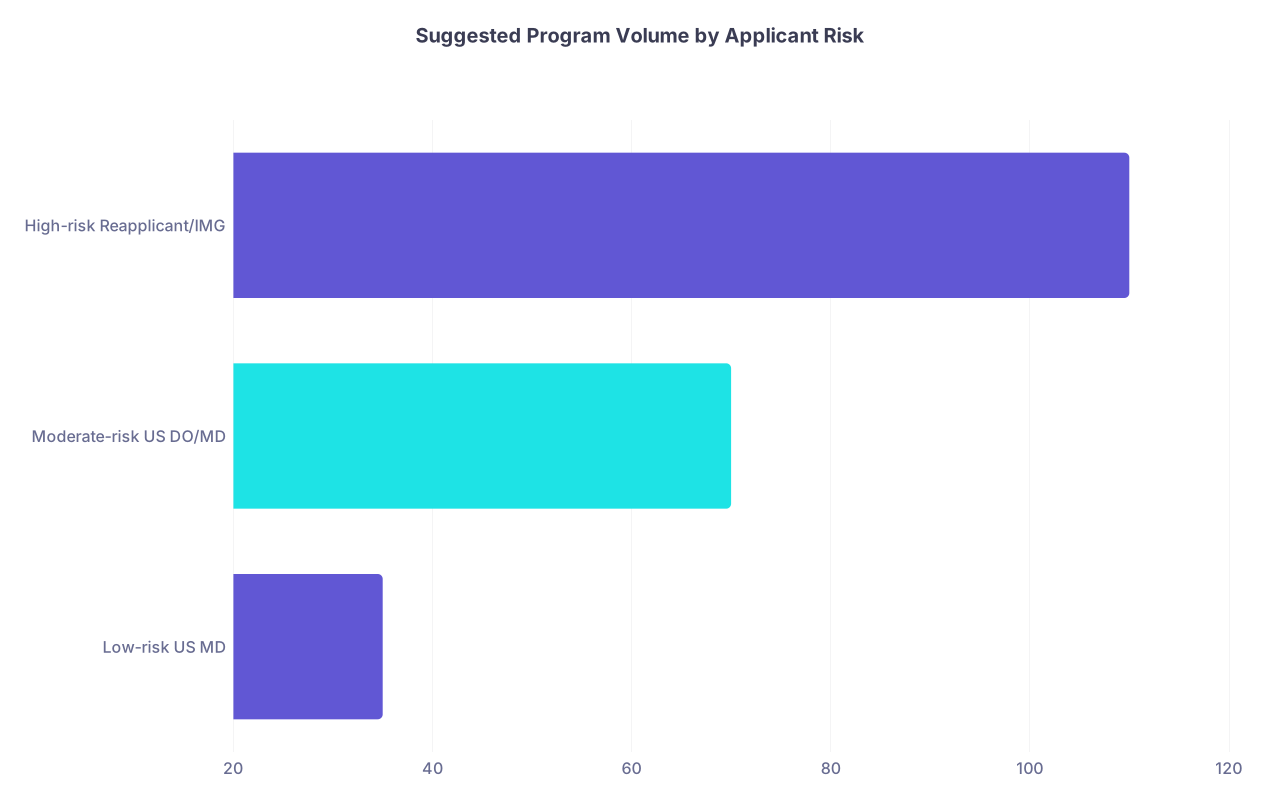
| Category | Value |
|---|---|
| Low-risk US MD | 35 |
| Moderate-risk US DO/MD | 70 |
| High-risk Reapplicant/IMG | 110 |
How much improvement do you need on program count as a reapplicant?
- If you applied to 30 IM programs last time with a 225 Step 2 as a DO and got 0 interview invites, doubling to 60 selective but realistic programs is a bare minimum.
- If you were an IMG who applied to 80 programs but 70 were big‑name university programs, the issue is not the raw number; it is your distribution. You may need to keep 80–100 but shift 40–50 toward true community programs in IMG‑friendly regions.
The correct question for a reapplicant is: “How does my new program list compare to what applicants like me who matched actually did?” Not “Do I feel like I applied broadly?”
6. Clinical recency, YOG, and U.S. experience
There is a quiet filter a lot of reapplicants miss: time since graduation (YOG) and recency of clinical work.
Programs look at:
- YOG > 3–5 years (varies by specialty and program)
- Last US clinical experience > 2 years ago
- Large blank periods with no work, research, or training
For IMGs in particular, adding fresh, documented U.S. clinical experience (USCE) is often more impactful than a small score gain.
How much improvement here actually matters?
- Adding 2–3 months of hands‑on USCE (sub‑internships, externships, hospital‑based observerships where you are evaluated) with strong letters commonly shifts you from “no US experience” to “minimum threshold met” for many community IM/FM programs.
- Updating your YOG impact is trickier: you cannot change your graduation year. But working in a clinical role (hospitalist scribe, research coordinator in a clinical department, junior faculty at home institution) shortens the perceived functional gap.
I have seen reapplicants move from 0 interviews to 5–10 interviews in IM simply by:
- Keeping the same Step 2 score
- Changing specialty from EM to IM
- Adding 3 months of IM USCE with new, specific LORs
- Expanding from 40 to ~90 well‑chosen programs
Score stayed flat. Outcome did not.
7. Red flags and narrative: fixing what sank you the first time
Not every unmatched case is due to numbers. Program directors are explicit about what they hate to see:
- Unexplained leaves, failures, or gaps
- Vague or lukewarm letters
- Generic, copy‑paste personal statements
- Evidence of poor professionalism
Reapplicants often repeat the same narrative errors. That is a problem. Programs remember patterns; some literally tag applications as “reapply – no change.”
So what does substantive narrative improvement look like?
You directly address major red flags with data.
- “Failed Step 1 due to family crisis” with no evidence you have stabilized is weak.
- “Failed Step 1, then passed Step 2 with 242, remediated two clerkships to honors, completed a year as chief scribe with excellent reviews” is an actual arc.
Your LORs change in both authorship and content.
- Not the same letter dated a new year.
- New letters that reference specific rotations, concrete patient stories, and mention your growth since previous attempts.
Your personal statement focuses less on trauma, more on competence.
- Programs are not your therapists.
- They want to see what you concretely did between cycles to be a safer bet.
You do not need poetic brilliance. You need evidence of trajectory.
8. So how much improvement is “enough” in different scenarios?
Let’s go case by case with realistic numbers.
Scenario A: US MD, unmatched EM, reapplying to IM
Last cycle:
- Step 2: 223
- Applied EM only, 45 programs, 2 interviews, no match
Target improvement:
- Scores: You would like +5–10, but not essential if you pivot.
- Specialty: Switch to internal medicine.
- Programs: Apply to ~70–90 IM programs, skewing toward community, Midwest/South, IMG‑friendly, smaller academic centers.
- Clinical: Add 1–2 IM electives or a sub‑I with strong LORs.
Quantitatively, your “profile index” changes from:
- EM: 223 Step 2 (below typical matched EM), 45 programs → high risk of unmatched
- IM: 223 Step 2 (low‑normal for IM), 80 programs, new IM letters → moderate risk but very matchable
You did not need a 240. You needed a specialty shift and 30–40 more programs in the right tier.
Scenario B: DO, unmatched IM, reapplying IM
Last cycle:
- COMLEX 2: 495, no USMLE
- Applied to 40 IM programs (mostly university‑affiliated, coastal), 1 interview, no rank
Target improvement:
- Scores: Take USMLE Step 2, aim for 230–238. That is a real shift in the perceived distribution.
- Programs: Increase to 80–100 IM programs, with at least half being truly community or IMG‑/DO‑friendly regions.
- Clinical: If possible, add 1 month IM audition at a community program with known DO support.
In number terms:
- Before: effectively 220–225 equivalent, 40 programs → screening risk + volume risk.
- After: 230–235 Step 2, 90 programs → you move into the primary distribution for many community IM spots.
Here, a +10–15 point Step 2 and a 2x–2.5x increase in well‑targeted programs is often the difference between 1 interview and 8–12.
Scenario C: Non‑US IMG, unmatched IM, older YOG
Last cycle:
- YOG: 6 years out
- Step 2: 234
- No USCE, only home country internships
- Applied to 120 programs, 0 interviews
This is where people throw their hands up. But the failure is obvious: zero U.S. clinical experience with an older YOG.
Target improvement:
- USCE: Add 3–6 months of hands‑on IM/FM observerships or externships with ECFMG‑savvy sites; secure 2–3 detailed US letters.
- Narrative: Make your PS and MSPE addenda explicitly show what you have done clinically for the last 2–3 years.
- Programs: Keep 100–120, but refocus toward IMG‑heavy regions (NY/NJ, Midwest, certain Southern states) and true community programs.
Score can remain 234. That is fine for many IM programs if the other filters are met.
The “improvement” metric is not numeric but categorical: going from 0 to “yes” on the USCE checkbox. That alone can easily move your interview count from 0 to 4–6 if the program list is realistic.
9. How to decide if your planned improvements are actually meaningful
You need a sanity check before you spend another year and thousands of dollars.
A blunt checklist:
Scores
- Did I move at least one meaningful bracket?
Example: from <225 to 230–238 in a core field; from <240 to 250+ in a competitive one.
If not, am I changing specialty or substantially upgrading other areas?
- Did I move at least one meaningful bracket?
Specialty alignment
- Am I applying to a specialty where my numbers and profile are within the 25th–75th percentile of matched applicants, not just applicants?
Program volume and targeting
- Am I at 70–100+ programs for core fields if I am a reapplicant / IMG / DO with any weakness?
- Is at least half my list realistically reachable (community, DO‑friendly, IMG‑friendly, non‑coastal)?
Clinical recency
- Do I have U.S. or equivalent clinical experience in the last 1–2 years with strong letters?
- If not, is there a plan to get 2–3 months before applications are reviewed?
Red flag remediation
- Have I converted unexplained failures/gaps into a documented story of recovery and subsequent success?
If you can only truthfully say “yes” to 1 of these 5, your odds as a reapplicant remain poor. Two is better. Three or more, and the numbers start to tilt in your favor.
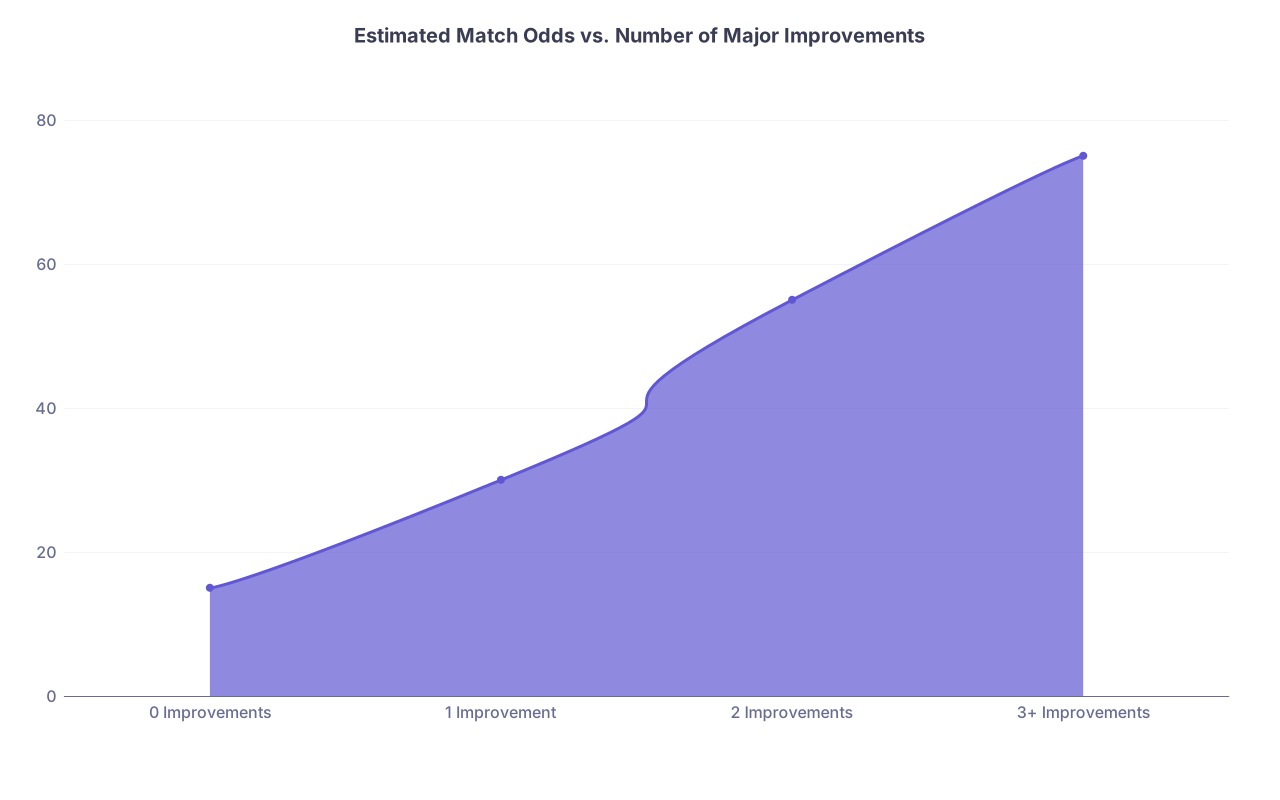
| Category | Value |
|---|---|
| 0 Improvements | 15 |
| 1 Improvement | 30 |
| 2 Improvements | 55 |
| 3+ Improvements | 75 |
Those percentages are illustrative, not literal. But they reflect what I have seen in actual cycles: one minor change rarely saves a reapplication; multiple substantive upgrades often do.
10. Where “try again” becomes “stop”
There is a point where the data turn against you, and it is dishonest to pretend otherwise.
Red flags that become increasingly hard to overcome:
- Multiple exam failures without a clear subsequent strong pass
- YOG > 7–8 years with no continuous clinical work
- Two or more failed Match cycles with minimal profile change
If you have:
- Reapplied twice with essentially the same scores and no new USCE
- Still received 0–1 interviews each time
Then the probability that “one more try” without a entirely different plan will magically work is low.
At that point, “match alternatives” should be literal: non‑GME clinical roles, research careers, public health, informatics, other degrees, international training. There is nothing noble about sinking another year into an unchanged pattern.
Key takeaways
The data show that reapplicants do not need perfection, but they do need real change: new bracket scores, different specialties, more and better‑targeted programs, and fresher clinical experience.
A small score bump or a tweaked personal statement alone is not enough; meaningful improvement usually means upgrading at least 2–3 of: scores, specialty choice, program list, USCE, and narrative.
If you cannot point to clear, quantifiable upgrades in your profile compared with last cycle, the Match probably will not treat you differently this time.