

You are here
It is mid-March. Match Week. Your phone has already shown you the NRMP email: “We are sorry to inform you…”
Your group chat is full of screenshots of “Congratulations, you have matched!” posts and cheesy celebration photos. Your inbox? A couple of generic SOAP emails and silence. You have looked at your ERAS CV three times tonight, and the same thought keeps looping:
“I am now officially a red flag.”
You start replaying every potential problem in your head:
That failed Step attempt. The leave of absence. The dismissal and readmission. The low quartile clerkship evals. The PD letter that never materialized. The whole unmatched status itself.
Let me be blunt: on paper, programs will see those as liabilities. Some of them will not read far enough to find the nuance. But the programs you actually have a shot at? The ones that routinely take “non-traditional,” “red flag,” or SOAPed applicants? For them, how you tell the story around your red flags is the difference between “screened out” and “call this person for an interview.”
This is not about spin. It is about reframing. That means: controlling the narrative, choosing the frame, and demonstrating that the risk you pose is understood, contained, and compensated for by specific strengths.
Let me break this down specifically.
Step 1: Understand how programs actually see red flags
If you cannot see it from their side, you cannot reframe it.
Most residency selection committees think in three buckets when they encounter a red flag:
- Risk of future failure
- Risk of professionalism or behavioral problems
- Risk of admin burden and drama
That’s it. Everything else is variations.
| Red Flag Type | What They Worry About |
|---|---|
| Failed Step/COMLEX | Future exam failure, board ineligibility |
| LOA / Extended training | Reliability, health, burnout, discipline |
| Course/rotation failure | Clinical performance, knowledge gaps |
| Dismissal / probation | Professionalism, policy violations |
| Unmatched / SOAP | Competitiveness, hidden issues |
They are not reading your file with your internal narrative. They are thinking:
- “Will this person pass boards on first try?”
- “Will this person show up, take feedback, and not create chaos?”
- “Will this person finish our program and make us look okay to the ACGME and our board?”
Your job is not to “explain what happened” in some abstract therapeutic way. Your job is to show:
- I understand exactly what risk category you are worried about.
- I can show concrete, recent evidence that mitigates that risk.
- I can prove that the problem is past, bounded, and under control.
If your “red flag essay” does not hit those three, it fails.
Step 2: Choose the right storytelling frame
Most unmatched applicants talk about red flags in one of three ways:
- The confessional – long emotional backstory, lots of detail, minimal data.
- The legal defense – technical explanations, blame on circumstances, adversarial tone.
- The shrug – two vague sentences: “There were personal circumstances, now resolved.”
All three are bad.
You need something else: a clinical case presentation frame applied to your own history.
Think like this:
- Chief complaint → the red flag (failed Step, LOA, dismissal, etc.)
- HPI → concise, relevant context, not a memoir.
- Pertinent positives → what actually went wrong, owned clearly.
- Pertinent negatives → what did not happen (no integrity issue, no patient harm).
- Assessment → what you learned, what pattern you recognized in yourself.
- Plan → the durable system you put in place and the outcomes since.
That structure keeps you honest, efficient, and focused on risk-mitigation.
Here is how that converts into narrative components.
The 4-beat “reframe” structure
Use this backbone for almost any red flag paragraph:
Direct naming
One clear sentence that names the red flag without euphemism.Tight context
2–4 sentences that describe what contributed, focusing on behavior and systems, not victimization.Intervention and change
3–6 sentences laying out exactly what you did differently, who helped you, and how your process changed.Objective outcomes
Concrete evidence that the risk is now lower: scores, evals, leadership roles, continuity.
If any of those beats is missing, your story feels either evasive, melodramatic, or hollow.
Step 3: Map your specific red flag to the right strategy
Let us get specific. I am going to go through the main red flag categories and the advanced storytelling approach for each.
1. Failed Step/COMLEX or low score + Unmatched
Programs worry: “Will this person fail boards as a resident and hurt our board pass rates?”
Your story must do three things:
- Show that the cause of poor performance is fully understood and controllable.
- Show changed process, not just “I worked harder.”
- Show a sustained run of success afterwards (not just one lucky test).
Bad version:
I failed Step 1 because I was dealing with family stress and did not study effectively. After that, I worked harder and passed on my second attempt.
Good, advanced version (notice the specificity and outcomes):
I failed Step 1 on my first attempt. I approached it with a poor strategy: I relied heavily on passive resources, tracked hours instead of mastery, and tried to manage a part‑time job that limited my ability to do question-based learning.
After failing, I met with the learning specialist at my school, my advisor, and a psychiatrist. We identified two issues: untreated ADHD impacting my executive function, and a disorganized study approach. I started stimulant medication with close follow‑up, shifted to a daily board‑style question schedule with explicit performance targets, and used weekly check‑ins to adjust my plan.
Over the next 6 months I completed over 4,000 board-style questions with progressive improvement, moved from 40–50% to consistent 70–80% correct, and passed Step 1 on my second attempt. Using the same structure for Step 2, I scored a 243, and my last three core clerkships all included comments on clinical reasoning and preparation.
This does not pretend the failure is “nothing.” It frames it as a now-managed condition with data.
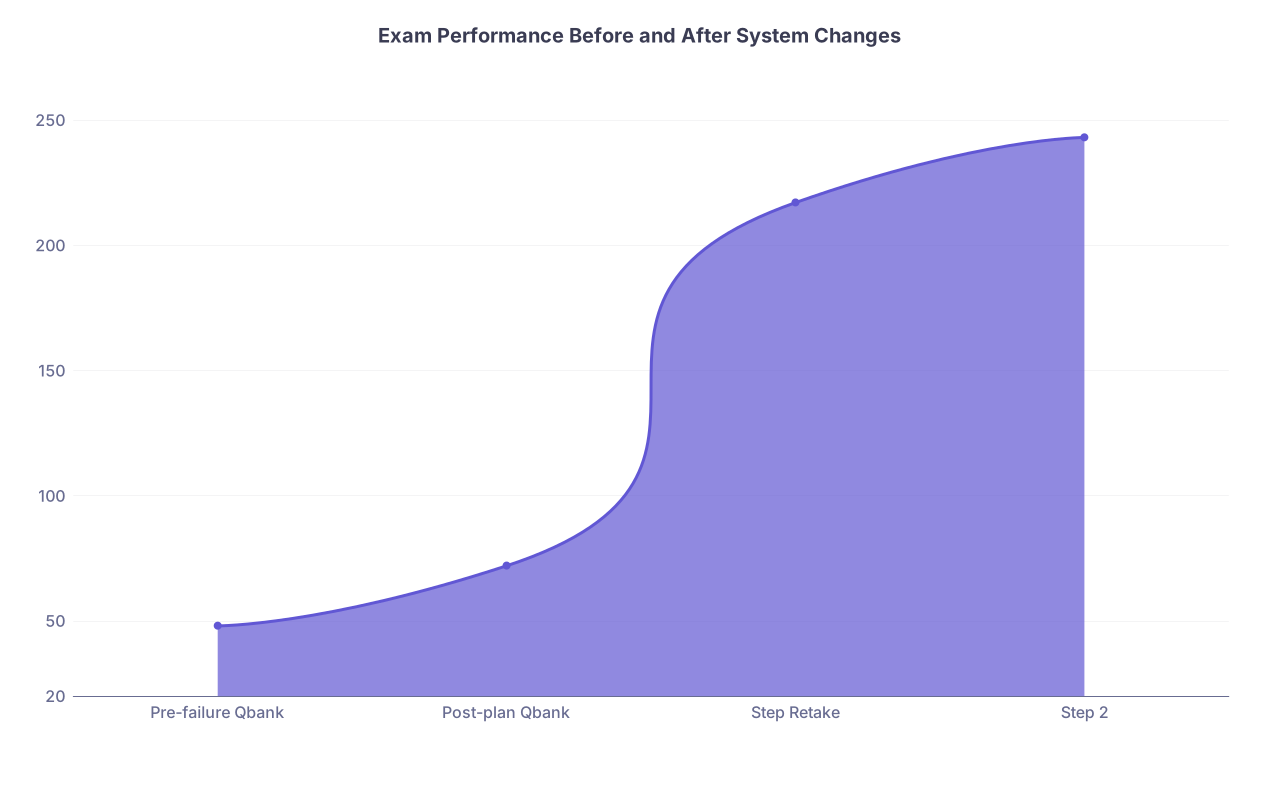
| Category | Value |
|---|---|
| Pre-failure Qbank | 48 |
| Post-plan Qbank | 72 |
| Step Retake | 217 |
| Step 2 | 243 |
Key storytelling levers you should notice:
- You convert a character flaw (“I am dumb / lazy”) into a process flaw that has been fixed.
- You demonstrate insight: you understand exactly why the first attempt failed.
- You match the fear (future exam risk) with exactly the counter-evidence (Step 2, NBME, shelf exams, etc.).
If you are unmatched with a test red flag, your personal statement and any “Additional Comments” section should lean hard on recent objective wins: shelf percentiles, strong exam comments, Step 2, remediation successes.
2. LOA or extended time – academic or personal
Programs worry: “Will this person disappear again? Are they fragile? Was there professionalism trouble?”
Your task: draw a boundary around the LOA, label what kind it was, and show that:
- The underlying driver has either resolved or is stably managed.
- You have a demonstrated track record after the LOA that looks boringly reliable.
You need to also disarm the hidden suspicion of professionalism issues. If your LOA had nothing to do with professionalism, you say that explicitly once.
Example, academic LOA with personal health:
I took a leave of absence from medical school between my second and third years due to a major depressive episode that required intensive treatment. There were no professionalism or disciplinary concerns related to this leave.
During that year I worked closely with a psychiatrist and therapist, stabilized on a consistent medication regimen, and completed a structured cognitive-behavioral program. With my dean’s support I returned to rotations on a half‑time schedule initially, then progressed to full‑time.
Since returning, I have completed all remaining clerkships on schedule, passed Step 2 on my first attempt with a 238, and have not required any additional leave. My current treatment is stable, I see my psychiatrist quarterly, and I use a very predictable weekly routine to guard my sleep and schedule. Multiple attendings have commented on my consistency and follow‑through, which reflects the work I have done to build a sustainable way of practicing medicine.
That is how you talk about mental health without sabotaging yourself: specific, bounded, and focused on the functioning after the event.
If the LOA was academic for struggling with pre-clinical coursework, the same structure holds. You emphasize the change in learning systems and the success in clinical environments after.
3. Course or rotation failure, remediation, or professionalism note
Programs worry: “Was this a one-off bad fit, or is this someone who cannot take feedback and improve?”
You must zoom out and show a learning curve. One failure plus later excellence is a story. Repeating the same problem is a pattern. You want story, not pattern.
Bad:
I failed my internal medicine clerkship because I was not prepared and had difficulty adjusting to clinical responsibilities. After remediation I passed.
Better:
I failed my internal medicine clerkship in my third year. My mid‑rotation feedback identified disorganized patient presentations, incomplete pre‑rounding, and slow note-writing. I underestimated the transition from pre‑clinical to clinical work and did not seek help early.
In remediation, I worked one‑on‑one with a faculty mentor who observed my presentations, had me script pre‑rounding checklists, and required daily plans for each patient. I also shadowed a senior resident known for efficiency and adopted their note templates and task prioritization system.
I repeated the rotation and passed with a “High Satisfactory,” receiving specific comments on improved organization and communication. Since then, I have completed surgery and family medicine with “Honors,” and multiple attendings have highlighted my reliable pre‑round preparation and succinct presentations. That early failure has made me extremely proactive about asking for mid‑rotation feedback and adjusting quickly, which I plan to carry into residency.
You are not just saying, “It got better.” You are dissecting the process of improvement.
4. Dismissal, probation, or serious professionalism event
This is the hardest category. Some programs will not touch this, full stop. You are writing for the ones that might.
Their fear: “Will this person undermine our culture, create legal risk, or damage our reputation?”
You cannot vague this away. You also do not need to relitigate every detail. You need a surgical level of honesty, some humility, and proof of growth.
Core rules here:
- Name the sanction: “placed on academic probation,” “dismissed and later reinstated,” etc.
- Name the domain (professionalism, academic dishonesty, chronic absenteeism, etc.).
- Admit fault using clear language. No passive voice nonsense.
- Show the corrective process: professionalism committee work, reflective pieces, coaching.
- Show long-term, boringly clean performance since.
Example, professionalism probation for chronic lateness / documentation issues:
During my third year, I was placed on professionalism probation for repeated episodes of tardiness to clinic and late completion of notes. I had underestimated the importance of punctuality and documentation timeliness and treated them as secondary to reading and studying, which was unacceptable.
As part of the probation process, I met with the professionalism committee, created a written remediation plan, and worked with a faculty coach. We broke down my schedule, identified the unrealistic time assumptions I was making, and implemented alarms, a fixed pre‑clinic arrival buffer, and a daily documentation cutoff. I submitted weekly logs and had my attendings verify arrival times and note completion.
I completed the probationary period without any further incidents, and the status was removed after six months. Since then, all of my clerkships and sub‑internships have commented positively on my punctuality and responsiveness. As a sub‑intern on the inpatient medicine service, I was trusted with early sign‑out and independently managing discharge paperwork because my attending knew my documentation would be complete.
This reads like someone you can trust, not someone who is still fighting the system.
If your issue was more serious (e.g., academic dishonesty), you must acknowledge the moral dimension and then show how you rebuilt trust in smaller contexts. You are asking them to take a risk; you owe them clarity.
5. Being unmatched itself as a “red flag”
Here is the uncomfortable truth: many PDs see “previously unmatched” and immediately wonder: “What did everyone else see that I am missing?”
You cannot just pretend the previous application cycle did not exist. You also cannot just say “the Match is random” and hope they nod along.
Your story has to show:
- You did a rigorous post-mortem on the previous cycle.
- You changed your application strategy and your substance.
- You did something meaningful with your in-between time.
| Profile | PD's First Question |
|---|---|
| High scores, no match | Letters? Fit? Interpersonal? |
| Borderline scores, no match | Too competitive list? Red flag? |
| IMG, multiple attempts | Any realistic capacity? |
| Career changer, older grad | Commitment? Stamina? |
A decent unmatched reframe paragraph might look like this:
I applied to internal medicine last cycle and did not match. In reviewing my application with my advisor and a former program director, three issues emerged: my initial specialty list was weighted heavily toward highly competitive academic programs, my personal statement was generic and did not explain my failed Step 1 attempt, and I had no recent U.S. clinical experience.
Over the past year I have addressed those gaps. I completed two additional hospitalist‑led sub‑internships at community IM programs, earning strong letters that specifically comment on my reliability and exam performance. I rewrote my personal statement to directly address my Step 1 failure and highlight the sustained progress since. I also expanded my application strategy to include a broader mix of academic and community programs that train residents with similar profiles.
This period has been humbling, but it has made me more intentional about where I can contribute and what environments are the best fit for my learning style and clinical strengths.
Notice: no whining about the Match. You own the strategy errors and you show correction.
Step 4: Integrate your red flag story across the whole application
Most applicants treat the “red flag paragraph” as quarantine. One box. One explanation. Done.
That is a mistake.
Programs read your file as a coherent narrative. If your personal statement, experiences, letters, and interview story do not match, they will feel the inconsistency even if they cannot articulate it.
Here is how you integrate:
Personal statement: anchor, do not center, the red flag
Your whole statement is not about your failure. But you cannot pretend the big thing didn’t happen if it clearly did.
General pattern:
- Opening: patient story / why this specialty, something clean that shows who you are.
- Middle: one concise paragraph that uses the 4-beat structure for your main red flag.
- Remainder: your current clinical identity, strengths, and what you offer to a program.
What you avoid:
- Opening with your worst moment.
- Ending on your worst moment.
- Spending more than ~20–25% of the statement on the red flag.
Experiences section: embed growth and continuity
When you describe roles—tutor, scribe, research assistant—subtly show that the areas that used to be weak are now part of your identity.
If you had:
- Poor time management → talk about roles where you coordinated schedules, managed teams, closed notes on time.
- Communication issues → show roles where you taught, led conferences, or handled family updates.
Example bullet transformation:
Bad: “Worked as a research assistant in cardiology lab.”
Better: “Coordinated a 6‑person cardiology research team, created shared task lists and deadlines, and ensured all IRB documents and data logs were submitted on schedule, resulting in abstract acceptance at [meeting].”
That is not fluff. It is building evidence that those “risk categories” are now part of your skill set.
Letters of recommendation: targeted asks
If you know your main red flag is, say, previous professionalism probation for tardiness, your ideal letter writer says something like:
“On our inpatient team, [Name] was consistently early, took responsibility for pre-rounding, and volunteers for weekend work when needed. She responded quickly to feedback and never required reminders for tasks or documentation.”
You do not write this for them, obviously. But you can tell them:
- “I am happy to share some context about my previous professionalism issue and how I have been working on reliability. If you have observed improvements there, it would be helpful to programs to hear your perspective.”
You are not asking them to “fix” your file. You are calibrating what they choose to emphasize.
Interviews: rehearse the story until it is boring to you
Every red-flag applicant gets the same question in some form:
- “Can you tell me about your Step 1 attempt?”
- “I see you took a leave of absence—what happened there?”
- “Looks like you applied previously. Tell me about that experience.”
The key: you must sound like you have done the work already. Not like you are still raw and surprised.
Structure your out-loud answer with:
- 1–2 sentences naming the event.
- 2–3 sentences outlining what specifically went wrong.
- 3–4 sentences on what you changed and how it shows up now.
- 1 sentence linking it to how you will function as a resident on their team.
If your answer takes more than 2 minutes, it is probably too long. If it is under 30 seconds, it is probably too thin.
Step 5: Connect your red flag to your unique value, not your shame
Advanced storytelling is not just defense. It is offense. The best unmatched applicants I have seen eventually do something subtle and powerful: they convert the red flag into a credible source of strength for a specific type of program.
Not “I failed so now I am more empathetic” in some vague feel-good way. I mean:
- “Because I failed Step 1 and rebuilt my study system, I now have a replicable way to help juniors prepare for in-training exams. My co-students already come to me to build their exam plans.”
- “My LOA for depression forced me to build sustainable work-hygiene routines; as a result, I am often the one on the team who notices when people are quietly burning out and can open conversations early.”
- “Remediating my IM clerkship made me obsessive about feedback; I bring that same structure when I work with interns, asking them for goals daily and giving them specific, actionable comments.”
Programs do not take risks out of charity. They take calculated risks if they believe the upside is concrete and aligned with what their residents need.
So ask yourself:
- What did going unmatched force me to learn about humility, preparation, and persistence?
- What did failing an exam force me to systematize?
- What did that professionalism scare teach me about communication, follow-through, or boundaries?
And then thread one of those through your narrative as a selling point.
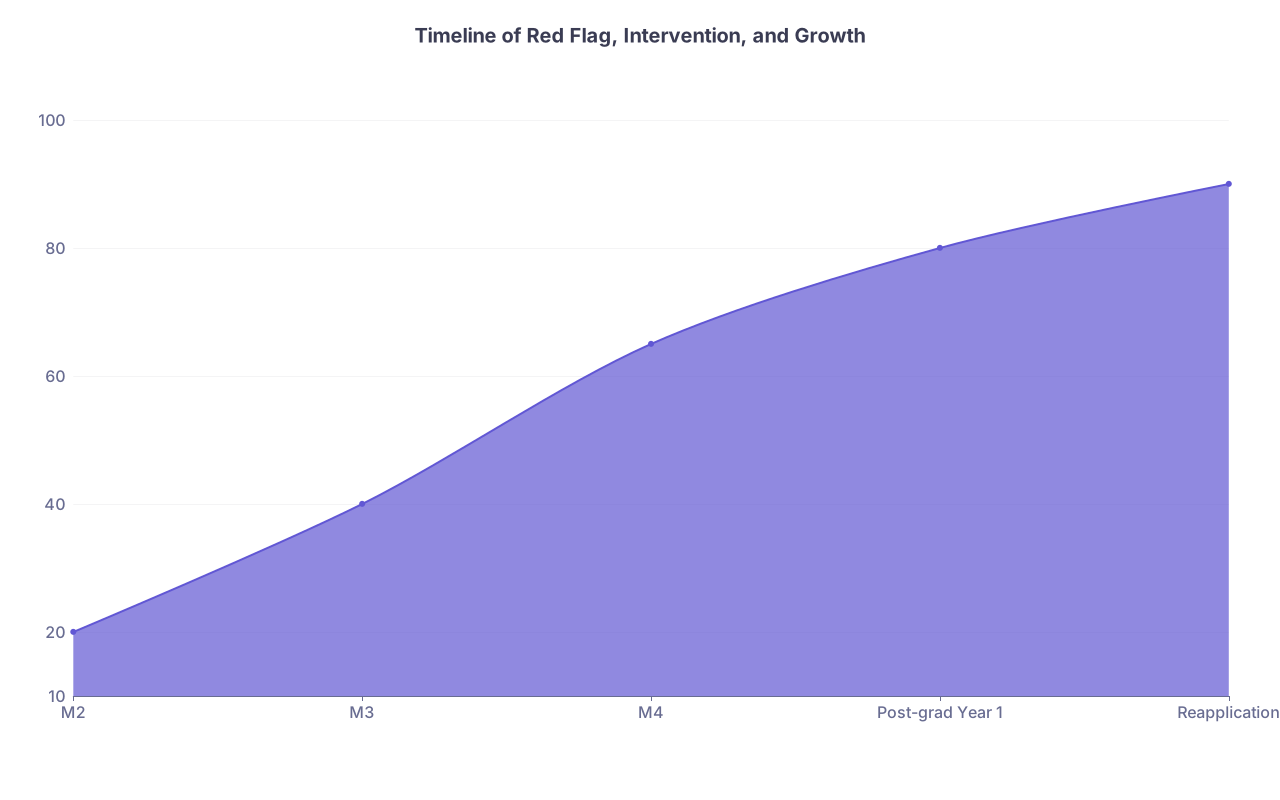
| Category | Value |
|---|---|
| M2 | 20 |
| M3 | 40 |
| M4 | 65 |
| Post-grad Year 1 | 80 |
| Reapplication | 90 |
Step 6: Align story with realistic match alternatives
You are in the MATCH ALTERNATIVES territory now. That means your storytelling is not operating in a vacuum. It intersects with strategic decisions:
- Do you reapply to the same specialty or pivot?
- Do you do a prelim year, a research year, an MPH, or non-resident clinical job?
- Do you expand regionally or shift to programs that have historically taken applicants like you?
Here is where most unmatched applicants go wrong: they tell a beautiful redemption story and then apply to the exact same hyper-competitive, research-heavy, Step-obsessed programs that just passed on them.
You need the story and the strategy aligned.
For example:
- If your red flag is an exam failure but your later clinical performance is strong, you will be more compelling at community-heavy programs that care more about service and less about perfect scores.
- If your red flag is professionalism, you might be better off at smaller programs where you can build direct longitudinal trust, not anonymous mega-programs.
- If you are an IMG with multiple attempts, you must target programs with a track record of training IMGs with similar profiles and emphasize your resilience, visa status clarity, and readiness to hit the ground running.
| Red Flag Profile | Best-Fit Program Types |
|---|---|
| Exam failures, strong clinical | Community IM/FM, prelim years |
| LOA for health, good evals | Supportive mid-size programs |
| Older grad, career change | Programs with non-traditional residents |
| Prior unmatched, improved app | Programs open to SOAP/second-chance |
Your narrative evolves from “please forgive my past” to “here is the version of me that fits you now, and here is the track record that backs that up.”
Step 7: Build a short, written “red flag brief” and test it
I recommend you literally write a 1-page document just for yourself:
- Top: list your red flags the way a skeptical PD would.
- Middle: 2–3 sentence “case presentation” for each.
- Bottom: bullet list of evidence you have that each risk is mitigated.
Then show it to:
- A brutally honest attending or advisor.
- If you can, someone who has sat on a residency selection committee.
Ask a very specific question: “If you read this and then my file, would you feel that the risk is understood and adequately controlled, or would you still hesitate?”
Their discomfort is your gold. You fix the gaps before ERAS opens, not after your second unmatched email.
You are aiming for reactions like:
- “I still do not see enough recent exam performance.”
- “You sound a little defensive in this paragraph about the professionalism issue.”
- “You are underselling how much growth you had here; be more explicit.”
You tune. You refine. You practice saying it out loud until your heart rate does not spike when you get the question.

| Step | Description |
|---|---|
| Step 1 | Identify Red Flags |
| Step 2 | Translate to PD Risk Categories |
| Step 3 | Draft 4-Beat Narratives |
| Step 4 | Integrate into PS & Experiences |
| Step 5 | Align with Program Strategy |
| Step 6 | Test with Advisors |
| Step 7 | Refine & Rehearse for Interviews |
Where you go from here
Right now, you are sitting with the sting of the word “unmatched” attached to your name. That label feels permanent because it is fresh. It is not.
Over the next few months, your job is not just to “do something productive” and “reapply stronger.” Your real job is to:
- See your file the way a skeptical program director does.
- Translate every red flag into a tight, honest, clinically-structured story.
- Stack real, objective evidence on top of that story.
- Aim that combination at programs and paths that actually make sense for who you are now.
You do that well, and “unmatched” becomes a chapter, not your title.
You are moving into the phase of rebuilding, repositioning, and, yes, selling a more seasoned version of yourself. Once you have that reframed narrative and some new experiences under your belt, the next problem is choosing between the different match alternatives—prelim years, research tracks, backup specialties, even leaving the match completely for a while.
That is the next fork in the road. And that choice, with all its tradeoffs, deserves its own careful breakdown.


