

Structuring Clinical Observerships and Hands-On Roles Post-Unmatched
Most unmatched applicants waste their “recovery year” drifting through random observerships. Then they act surprised when the next Match looks exactly like the last one.
You cannot afford that.
If you went unmatched, every single clinical experience you do from this point forward has to be engineered. Not just “done.” Designed. Timelined. Aligned with how program directors actually think: “Will this person function on my team on July 1 without scaring patients or pissing off my seniors?”
Let me break this down specifically.
1. Get Your Reality Straight Before You Chase Any Observership
Before you start emailing every Gmail address on the hospital website, you need a brutally honest damage assessment. Otherwise you will build the wrong year.
1.1. Identify what actually sank your Match
You structure observerships differently based on the reason you went unmatched. Very different plans for:
- Solid scores but weak US clinical experience (USCE)
- Outdated graduation year
- Red flags (failures, professionalism issues, unexplained gaps)
- Poor strategy (too few programs, wrong specialty, no backup)
- Weak letters, generic personal statement, or lack of continuity
Here is the filter I use when I work with unmatched applicants:
| Primary Weakness | Priority for Observerships / Hands-On Work |
|---|---|
| Minimal / no USCE | High – need sustained, structured USCE in target field |
| Old grad (>5–7 years) | High – need recent, continuous US experience |
| Step failures / low scores | Medium – strengthen narrative + show reliability |
| Poor letters / no advocates | High – choose roles with real faculty interaction |
| Under-applied / wrong list | Medium – some USCE, but more about strategy correction |
If your main problem was strategy (e.g., you applied to 40 categorical surgery programs with a 220 Step 2 and no research), you still need clinical work, but the structure is more forgiving. If you have no USCE or are a 10-year grad, clinical roles are not optional. They are oxygen.
1.2. Decide your real target specialty now
This is where many people sabotage themselves. They spend a year doing observerships in internal medicine, then reapply to neurology and family medicine “just in case,” then wonder why their application looks confused.
Pick a primary specialty and a realistic backup early. Then design all clinical roles to support that story.
If you are switching specialties post-unmatched (surgery → IM, psych → FM, etc.), that switch has to show up in your clinical calendar immediately. One token month in the new field is not convincing. You want 6–9 months that clearly say: “I live here now.”
2. Observership vs Hands-On Roles: What Actually Matters to Programs
There is a lot of mythology around “hands-on” vs “observership.” Most of it comes from people who repeat what they heard, not what they have seen program directors actually say in ranking meetings.
Here is the blunt hierarchy.
| Type of Experience | Relative Value for PDs |
|---|---|
| ACGME-accredited extern / sub-I (true hands-on with notes, orders, call) | Highest |
| Paid clinical assistant / research+clinical hybrid with real responsibility | High |
| Structured in-hospital observership with daily rounds, presentations, and faculty evals | Moderate–High |
| Loose shadowing, outpatient-only, no documentation or presentations | Low |
| Remote “tele-observerships” / Zoom clinics | Very Low (almost symbolic) |
Programs care less about what you call it and more about:
- Who supervised you (and will they write a specific, strong letter?)
- Did you function as part of a team in a realistic way?
- Was it in the US (or Canada) and in the same specialty you are applying to?
- Is it recent (within 1–2 application cycles)?
“Hands-on” is attractive, but a chaotic, unstructured pseudo-externship at a no-name clinic can be less helpful than a properly structured observership with a respected academic faculty who can pick up the phone for you.
So the question is not “observership vs hands-on.” It is: “Does this role get me (1) credible performance, (2) real mentorship, (3) a usable letter, and (4) a coherent story?”
3. Build a 12-Month Clinical Plan Like a Project, Not a Vacation
If you are aiming for the next Match cycle, your timeline is not theoretical. You have roughly:
- March: SOAP / unmatched result
- April–August: High-yield clinical + letters + exams
- September: ERAS submission
- October–January: Interviews while continuing clinical/research
- Next March: Second Match Day
You need a calendar that is realistic and protects two things: continuity and recency.
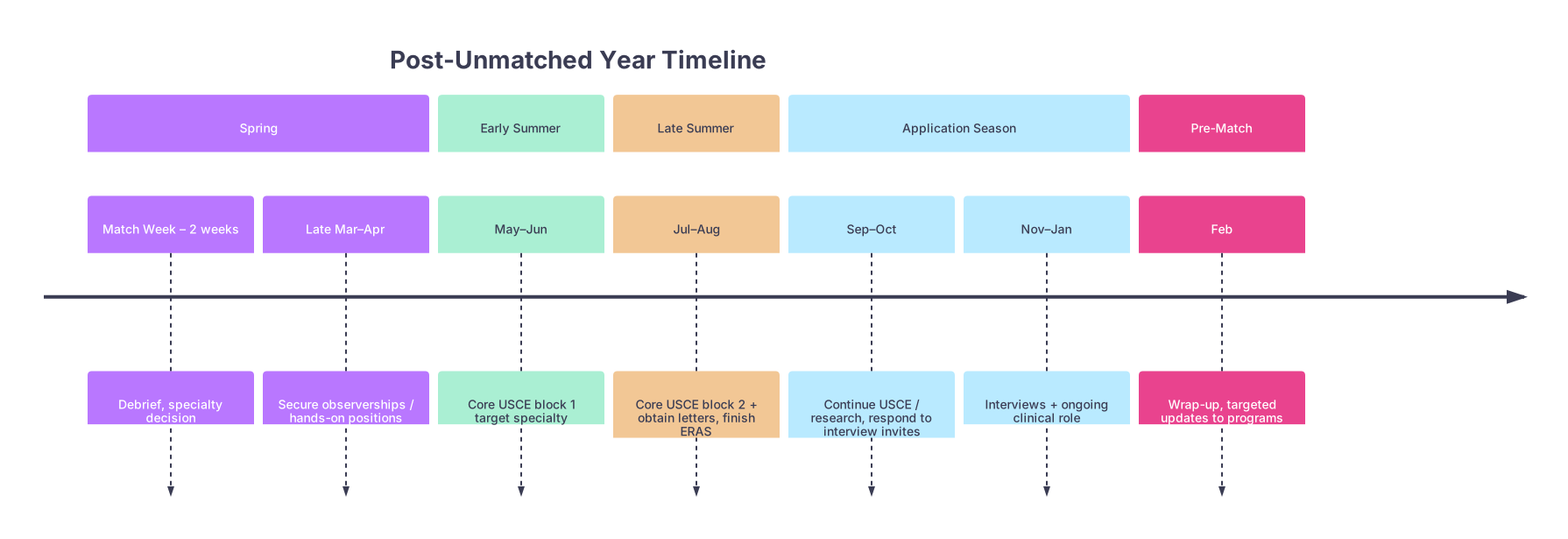
| Period | Event |
|---|---|
| Spring - Match Week – 2 weeks | Debrief, specialty decision |
| Spring - Late Mar–Apr | Secure observerships / hands-on positions |
| Early Summer - May–Jun | Core USCE block 1 target specialty |
| Late Summer - Jul–Aug | Core USCE block 2 + obtain letters, finish ERAS |
| Application Season - Sep–Oct | Continue USCE / research, respond to interview invites |
| Application Season - Nov–Jan | Interviews + ongoing clinical role |
| Pre-Match - Feb | Wrap-up, targeted updates to programs |
Basic rule: do not leave big empty spaces. Program directors hate unaccounted gaps, especially after an unmatched year. If you are not in clinic, you should be in research or a clear academic role, and it needs to be documented in your CV.
4. How to Structure a High-Yield Observership (If That Is What You Can Get)
A “high-yield observership” is not a website marketing term. It has specific anatomy. If you are stuck with observer-only status (cannot write notes, no order entry), you can still squeeze real value from it—if you structure it correctly.
4.1. Minimum structural elements you should insist on
When negotiating or selecting an observership, ask about these specifics:
Daily schedule
You want predictable, full clinical days. Typical structure:- Pre-rounds or team huddle
- Attending rounds / clinic sessions
- Noon conference / teaching conferences
- Afternoon follow-ups, family meetings, consults
Direct involvement with evaluation
Observers do not get official “evaluations,” but you want:- Weekly feedback from the attending (even informal)
- Agreement that the attending will consider writing a letter
- Ideally, involvement in at least one case presentation or short talk
Documentation adjacent work
Even if you cannot write in the chart:- Draft notes on your laptop to present orally
- Help organize data, create med lists, or discharge summaries unofficially
This positions you as someone who thinks like a resident.
Contact density
One month with an attending who sees you daily is better than three scattered months where nobody remembers your name. Continuity with a single team matters.
Without these, you are just another shadow in the hallway.
4.2. Weekly structure that signals “residency readiness”
You cannot control hospital policy, but you can control how you show up. A good self-imposed weekly structure for an observership in internal medicine, for example:
Monday–Friday, 7:00–5:00 or 8:00–5:00:
- Pre-read on admitted patients the night before or early morning
- Join team handoff if allowed; if not, get a quick update from a resident
- On rounds:
- Take structured notes on HPI, exam, labs, assessment, and plan
- Volunteer to present the story back (even briefly) to the resident or attending
- Noon conference:
- Sit with residents, not other observers
- Take notes, ask one concise, relevant question once or twice a week
- Afternoon:
- Follow up your “assigned” patients: imaging results, labs, consult notes
- Prepare a mini 5–7 minute talk per week (e.g., “Approach to hyponatremia in cirrhosis”)
Weekly:
- Ask your attending for 10–15 minutes: “What can I do better? Where am I falling short?”
- Keep a log of cases with brief learning points for your CV and future personal statement
You are not there to rack up “hours.” You are there to give one or two faculty members enough real material to say, “This person thinks like a PGY-1.”
5. Structuring True Hands-On Roles (Externships, Clinical Assistant, Scribe-Plus)
If you can legally and institutionally get hands-on work, you can accelerate trust-building. But it has to be structured; otherwise you become a glorified clerical worker with no educational narrative.
5.1. What “hands-on” should actually look like
I have seen “hands-on” misused for everything from taking blood pressures in a hallway to genuine sub-internship level responsibility. You should aim for:
- Direct patient contact:
- Focused histories, basic physical exams
- Patient education, discharge instructions
- Chart work under supervision:
- Drafting notes that the attending co-signs (or at least reads)
- Entering vitals, updating med lists, reconciling meds
- Operational tasks that mimic resident life:
- Calling consults under supervision
- Following up labs and imaging
- Participating in sign-out discussions
If your “hands-on” job is 90% scanning documents and answering phones, it might keep you in the building, but it will not by itself convince anyone you are residency-ready unless you tightly couple it with a supervising physician who understands what you are trying to achieve.
5.2. The clinical assistant / hybrid role done correctly
Some of the strongest unmatched-to-matched transitions I have seen involved hybrid roles:
Example: “Clinical research fellow + clinical assistant in Cardiology at [Mid-tier Academic Center].”
Structure:
- 40–60% research (data collection, writing, abstracts, maybe one publication)
- 40–60% outpatient and inpatient clinic support:
- Rooming patients, doing vitals and brief HPI
- Sitting in on consultations and drafting notes
- Helping with follow-up calls or med reconciliation
- Regular, scheduled teaching:
- Weekly case conference with supervising cardiologist
- Journal club or small teaching assignments
Programs love this combination. It says: “I show up every day in a US environment, I do work that the team relies on, and I produce academic output.”
6. How Many Months, In What Order, and Where?
Stop thinking in terms of random “rotations.” Think of your year as a portfolio.
6.1. The 6–9 month rule for the seriously unmatched
If you had no USCE, old graduation, or multiple failed cycles, you should aim for:
- 6–9 months of continuous, specialty-aligned US clinical work
- In no more than 2–3 institutions (too many looks scattered and desperate)
- With at least 2, ideally 3, strong faculty advocates
A typical structure for an unmatched international graduate targeting internal medicine might look like this:
- May–June: Inpatient IM observership at Community Hospital A
- July–September: Hands-on clinical assistant / research hybrid role at Academic Center B (cardiology or hospital medicine focus)
- October–December: Continuation at Center B with increasing responsibility; maybe a 1-month elective in ICU or subspecialty
- January–February: If interviews are light, add a focused observership at Hospital C (ideally where there is a residency program you will reapply to)
You want to be able to list on ERAS:
- “Clinical observer, Department of Internal Medicine, Hospital A, 2 months”
- “Clinical research fellow & clinical assistant, Department of Medicine, Academic Center B, 6 months (ongoing)”
- “Clinical observer, Pulmonary and Critical Care, Hospital C, 1 month”
This looks like a coherent year, not panic.
6.2. Academic vs community sites
Everyone chases the big names. That is sometimes a mistake.
Academic centers:
- Strengths: Name recognition, research possibilities, structured letters, exposure to residents and PDs
- Weaknesses: Harder to get meaningful roles as a non-trainee, more observers, less autonomy
Community hospitals:
- Strengths: More real clinical responsibility, closer relationships with attendings, less competitive to access
- Weaknesses: Fewer residency programs on-site, letters may carry slightly less brand weight unless the attending is well-known
Ideal approach: Mix both. For example, 2–3 months at an academic center to get a branded letter, and 3–6 months at a strong community affiliate where you can function more like a sub-intern.
7. Extracting Letters of Recommendation: The Main Output of All This
Do not fool yourself: the primary product of your observerships and hands-on roles is Letters of Recommendation (LORs), along with a believable story of growth. Everything else is supporting detail.
7.1. How to signal from day 1 that you are LOR material
You should be transparent with your supervising faculty without sounding transactional. Something like:
“Dr. X, I want to be upfront about my situation. I went unmatched this year in internal medicine, and I am determined to correct that. My goal during this month is to demonstrate that I can function at the level of a PGY-1. If at the end of this rotation you feel I meet that standard, I would be honored if you would consider supporting my application.”
This does three things:
- Sets the bar: PGY-1 level behavior
- Signals seriousness
- Gives them permission to say no if you underperform (which is fine; you should not want a lukewarm letter)
7.2. Behaviors that make attendings actually want to write for you
I have heard attendings say some version of: “If every observer behaved like X, I would write letters all day.” The pattern:
- Show up early and prepared
Know yesterday’s patients better than the interns by week 2. - Ask for work:
- “Can I follow these two patients and present them tomorrow?”
- “Would it help if I prepared a quick summary of this condition for the team?”
- Protect the team’s time:
- Ask targeted questions at the right time, not in the middle of a code or discharge rush.
- Take feedback without defensiveness:
- If they say your presentations are unfocused, you come back 48 hours later drastically better.
You are auditioning. Not just attending.
7.3. Timing and content of the letter request
Do not wait until the last day at 4:55 pm. Around the midpoint of a 4-week rotation, if your performance is solid:
“Dr. X, I value your feedback. Based on what you have seen so far, do you feel you would be comfortable supporting my residency application with a strong letter if I continue to improve at this pace?”
If they say “yes, as long as you keep this up,” ramp up even more for the last 2 weeks and then:
- Provide:
- Your updated CV
- A brief 1-page summary of your unmatched story and your specific career goals
- A bullet list of specific cases or contributions you made with them (you are refreshing their memory, not writing your own letter)
Letters should be uploaded to ERAS ideally by late August. If your role continues beyond that, you can have them update the letter later with a short addendum.
8. Integrating Your Clinical Roles With the Rest of the Application Repair
Your observerships and hands-on work sit in the middle of a bigger rebuild. If you treat them as an isolated activity, you will undercut their value.
8.1. Align everything with one narrative
Your personal statement, interview answers, and activities section must echo the same arc that your clinical year demonstrates.
For example, your story might be:
- “I went unmatched in 2024 after targeting internal medicine with limited US exposure.”
- “I realized my application did not convincingly show my ability to function in a US healthcare team.”
- “Over the subsequent year, I undertook 8 months of structured US clinical work across inpatient wards and subspecialty clinics, assumed increasing responsibility for patient care tasks, and worked closely with three attendings whose feedback reshaped how I present, prioritize, and follow through on clinical decisions.”
Then your ERAS activity descriptions must match that. Not:
- “Observer, Internal Medicine, watched rounds and attended conferences.”
But something more concrete, like:
- “Participated in daily inpatient rounds on a 18–24 bed teaching service; followed 3–4 patients daily under direct supervision; prepared oral case presentations and daily problem lists; assisted with reviewing labs and imaging, and coordinated with nursing staff for non-procedural care tasks; attended and summarized weekly noon conferences.”
Now your observership actually reads like a proto-residency.
8.2. Use clinical roles to offset specific red flags
Example: you failed Step 1 once, then passed. Your clinical year can do the following:
- Function flawlessly across 6–9 months, with no professionalism issues
- Take Step 3 during or right after your USCE, and pass comfortably
- Have letters explicitly mention your reliability and consistency
Then your personal statement can say, briefly and directly:
“I initially struggled with Step 1, failed on my first attempt, and corrected that with a pass on the second. Over the last year, working full-time in a US hospital environment while preparing for and passing Step 3, I have proven to myself and to my supervisors that I can manage a sustained workload and clinical complexity.”
Now the red flag is contextualized, not haunting you.
9. What Badly Structured Observerships Look Like (And How to Avoid That Trap)
I have to spell this out because I see it every year.
A low-yield, badly structured post-unmatched year usually looks like:
- Three separate 1-month observerships in different states, different specialties, none of them with residency programs you are targeting
- No continuity with any one attending long enough to justify a strong letter
- Months “off” to travel, study for exams, or “prepare applications,” often with nothing to show for it
- One or two lukewarm letters from private practice physicians who barely remember your name
And then in March: unmatched again, same cycle of panic.
You avoid this by:
- Limiting site hopping
- Securing at least one long block (3–6 months) in a single institution or department
- Choosing supervisors who understand US residency and are willing to advocate
- Keeping a written log of activities and accomplishments so you can communicate them clearly
10. Concrete Example Scenarios
Let me make this even more explicit with two composite scenarios.
10.1. IMG, no USCE, unmatched in internal medicine
Profile:
- Grad year: 2020
- Step 2: 238
- No US clinical experience
- Applied to 50 IM programs, 1 interview, no Match
Structured plan:
April:
- Debrief. Decide to stay with IM.
- Reach out to IM departments at community hospitals and academic affiliates; secure:
- May–June: IM inpatient observership at Community Hospital
- July–December: Clinical research fellow + clinical assistant at University-affiliated IM department
May–June (Observership):
- Daily ward rounds, 6 days/week
- Follow 2–3 patients/day, present on rounds
- Give two 10-minute talks (DKA management, acute GI bleed)
- Request LOR at end of month
July–December (Hybrid role):
- Two days/week: data collection for a heart failure outcomes study
- Three days/week: clinical assistant in hospital medicine service:
- Rooming, vitals, brief HPI
- Drafting progress notes for attending review
- Following up labs and imaging
- Supervisor agrees upfront to consider LOR if performance is strong
- Submit ERAS in September, with this role described as ongoing
End result by application:
- 1 LOR from Community Hospital IM attending
- 1–2 LORs from Academic IM attendings
- 8 months of recent, continuous, specialty-aligned USCE
- Potential abstract submitted to a national IM meeting
This is a dramatically different application than the first one.
10.2. US-IMG switching from surgery to family medicine after unmatched
Profile:
- Step 2: 229
- 3 months of US surgery electives in med school
- No primary care exposure
- Applied categorical surgery only, 30+ programs, no interviews
Structured plan:
March–April:
- Decide to switch to family medicine and commit fully.
- Contact FM programs, FQHCs, and community clinics; secure:
- May–July: FM outpatient hands-on role (clinical assistant / scribe+) at FQHC
- August–September: 2-month FM observership at a community hospital with FM residency
May–July (FQHC role):
- 5 days/week, continuity clinic
- Rooming patients, vitals, HPI, presenting to preceptor
- Assist with chronic disease management calls
- Join weekly team huddles and QI meetings
- Obtain strong letter from medical director
August–September (FM observership):
- Inpatient FM service + OB exposure if possible
- Present on rounds, one teaching session on perioperative care (bridging from prior surgery interest)
- Obtain second letter
Now when they reapply, the “surgery to FM” story is backed by 6+ months of primary care experience and letters from actual FM attendings.
11. Final Checks: If Your Observership/Hospital Job Is Worth Keeping
Ask yourself three questions every 2–3 months:
- Is someone here willing and able to write me a strong LOR for my target specialty?
- Am I clearly more integrated and more functional on the team now than I was 4–6 weeks ago?
- Does this experience line up cleanly with the narrative I want to present in my personal statement and interviews?
If the answer to any of these is “no” and you cannot change it, it might be time to move—deliberately, not impulsively—to a better-structured role.
12. Two Visual Benchmarks: Time and Value
To sanity-check the structure of your year, you can think about time allocation and experience value.
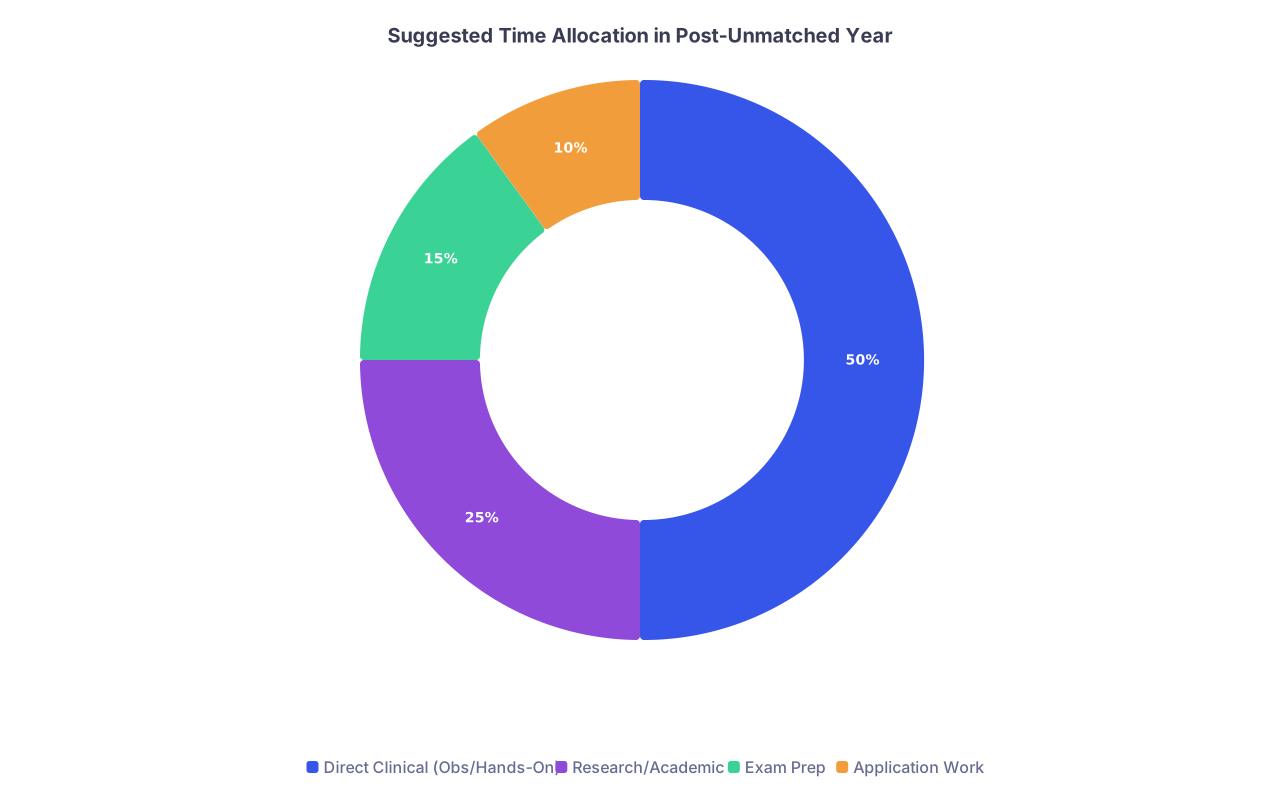
| Category | Value |
|---|---|
| Direct Clinical (Obs/Hands-On) | 50 |
| Research/Academic | 25 |
| Exam Prep | 15 |
| Application Work | 10 |
And in terms of what program directors quietly rank highest when they skim your CV:
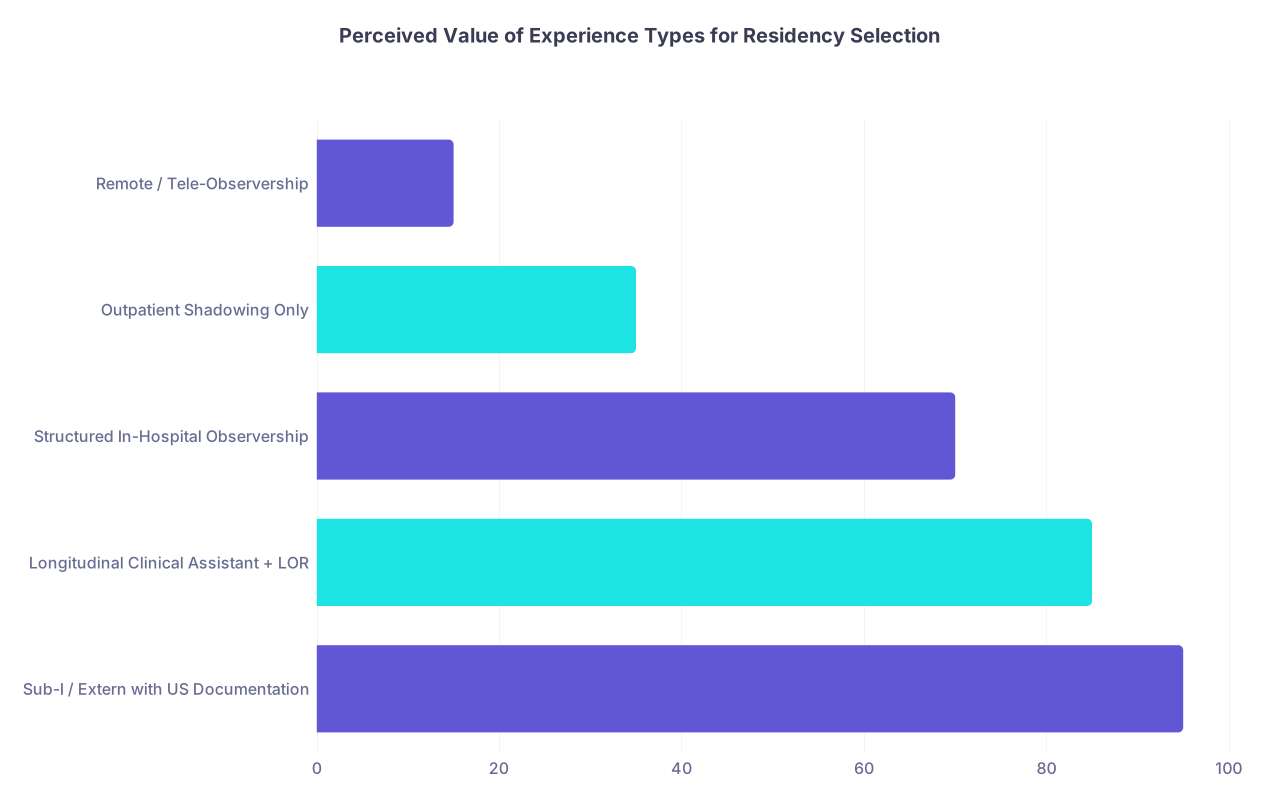
| Category | Value |
|---|---|
| Sub-I / Extern with US Documentation | 95 |
| Longitudinal Clinical Assistant + LOR | 85 |
| Structured In-Hospital Observership | 70 |
| Outpatient Shadowing Only | 35 |
| Remote / Tele-Observership | 15 |
Those numbers are not official; they match what you will hear behind closed doors.
Key Takeaways
- Post-unmatched clinical work must be engineered, not improvised: pick a specialty, map 6–9 months of continuous, aligned US experience, and avoid scattered, low-contact rotations.
- The true output of observerships and hands-on roles is strong, specific advocacy from faculty—so structure your daily and weekly work to earn letters that say you already behave like a PGY‑1.
- Tie every clinical role explicitly into your repair narrative: recent US experience, proven reliability, and a coherent specialty story that looks very different from the application that went unmatched.


