

The worst personal statements I read are from reapplicants who pretend last year never happened.
You do not get to do that. And if you try, programs will notice.
You are in a different category now—whether you like it or not. A reapplicant is judged on a harsher, more specific set of questions:
- Why did you not match the first time?
- What exactly did you do about it?
- Why should we believe this outcome will be different?
If your personal statement does not answer those three questions clearly, you are wasting your second shot.
Let me break this down specifically.
1. The Core Problem: Reapplicants Who Write Like First‑Timers
Most reapplicants reuse 60–80% of their prior personal statement. They tweak a few lines, update a date or two, maybe add “after my preliminary year…” and call it a day.
Programs see hundreds of these every season. They are not impressed.
The mindset has to change. As a reapplicant, your personal statement is no longer just:
- “Why this specialty”
- “Who I am”
- “What I have done”
It becomes:
- “What went wrong”
- “How I responded”
- “Why I am now lower‑risk and higher‑value”
If you are applying through match alternatives (SOAP, off‑cycle, prelim to categorical transition, reapplying after a gap year, switching specialties), the scrutiny is even tighter. A bland, generic essay is death.
Your personal statement must do four specific jobs:
- Own the reapplication status without sounding defensive or self‑pitying.
- Frame the prior outcome (no match / SOAP only / wrong fit / scramble, etc.) intelligently.
- Demonstrate concrete growth with receipts—scores, letters, research, clinical evaluations, new roles.
- Convince a PD: “If I invest one of my limited spots in this person, I will not regret it.”
If any of those pieces are missing, your essay stays in the “maybe” pile and usually dies there.
2. What Programs Actually Worry About With Reapplicants
Stop guessing what PDs think. Their concerns are boringly predictable.
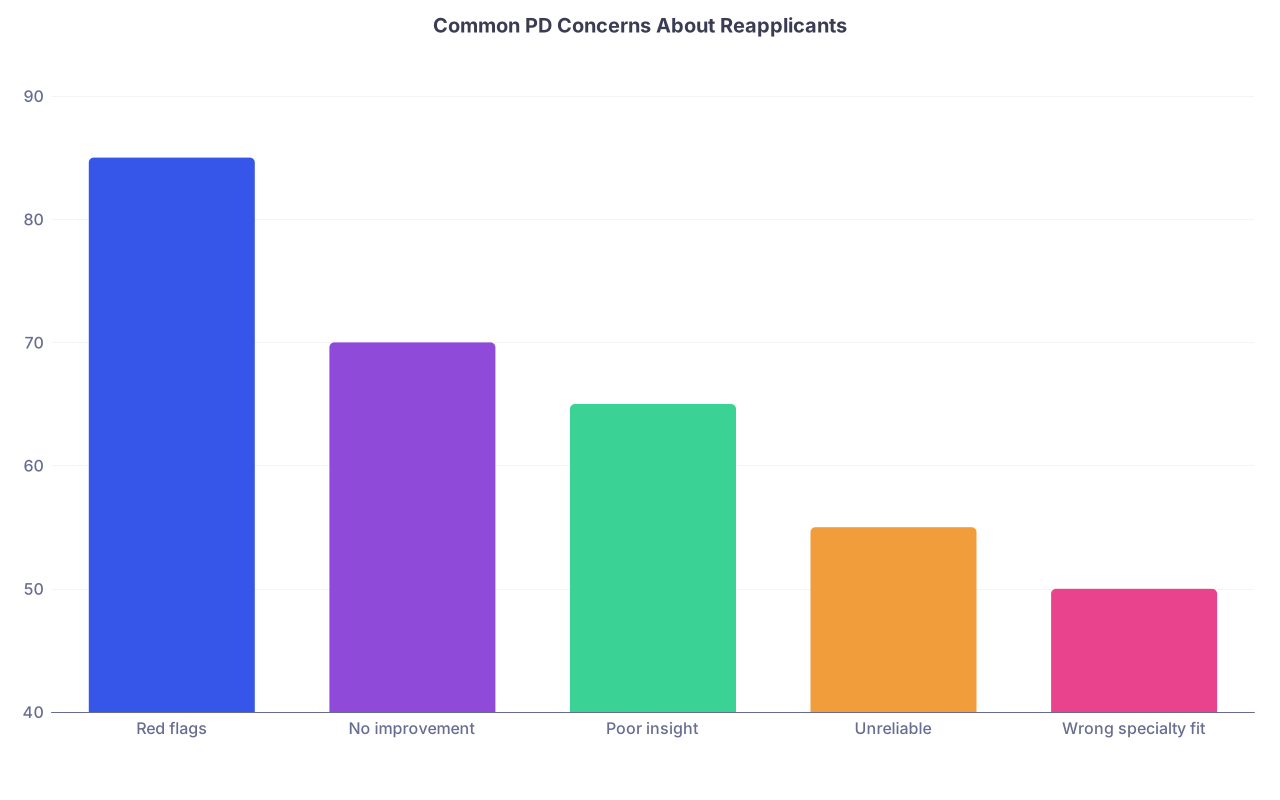
| Category | Value |
|---|---|
| Red flags | 85 |
| No improvement | 70 |
| Poor insight | 65 |
| Unreliable | 55 |
| Wrong specialty fit | 50 |
The reapplicant label triggers five specific questions in most program directors’ heads:
Does this person understand why they did not match?
If you cannot articulate the reasons, they assume you lack insight or maturity. Or worse—you are blaming everyone else.Have they actually improved their application?
Not “I tried harder.” Concrete improvement. Higher Step 2, new letters, stronger clinical performance, more targeted applications, better specialty alignment.Are there professionalism or behavior concerns?
Gaps, withdrawals, probation, failed rotations, “personality issues.” If your record suggests trouble, your statement has to directly and calmly neutralize this.Is this still the right specialty?
For example, someone applying IM → Rad Onc → back to IM with vague explanations. That reads unstable. You must tie your path into a coherent narrative.Will this person be coachable and low‑drama?
They read between the lines. Tone matters. If you sound bitter, entitled, or vague—they move on.
Your personal statement is where you attack those concerns head‑on. If you just recycle your “Why I love internal medicine” essay from two years ago, none of those questions are answered.
3. Anatomy of a Strong Reapplicant Personal Statement
Let me give you a structure that actually works. Not theoretical. This is the pattern I have seen move reapplicants from “no interviews last year” to “solid rank list this year.”
Core Structure
- Hook + present identity
- Clear specialty motivation (tight, not flowery)
- Brief, explicit acknowledgment of reapplication status
- Concrete description of what changed since last cycle
- Focused clinical narrative(s) that show current readiness
- Specific fit with the specialty (and sometimes with type of program)
- Forward‑looking close that sounds grounded, not desperate
Here is the key: Sections 3 and 4 are what distinguish you from a first‑time applicant. Get those wrong and the whole thing collapses.
4. How To Acknowledge You Are a Reapplicant (Without Sounding Weak)
This is where most people either over‑explain or hide.
Bad version:
“I was devastated when I did not match. I felt lost and questioned my worth as a physician…”
Programs read that and think: emotional liability, poor coping, maybe still unstable.
Also bad:
“I am reapplying this year.” And then nothing. That reads evasive.
You want factual, concise, and framed for growth.
Examples by scenario:
Scenario A: Unmatched the first time, then did a research year
“After my initial application in 2023, I did not match into categorical internal medicine. I took that outcome seriously. I reviewed my application with mentors, identified my limited clinical exposure and lack of scholarly work, and committed to strengthening both. Over the past year as a research fellow in cardiology at [Institution], I have…”
Short, direct, no drama. The focus immediately moves from failure → action.
Scenario B: Completed a prelim year, reapplying same specialty
“Last year I matched into a preliminary internal medicine position, with the goal of transitioning into a categorical spot. My intern year at [Hospital] confirmed that internal medicine is the right field for me. I built stronger clinical skills, received consistent positive feedback on my evaluations, and worked with mentors who supported my decision to reapply for a categorical position this cycle.”
Again: calm, confident, signals growth, not damage control.
Scenario C: Switching specialties after a prior match attempt
“I initially applied to diagnostic radiology in 2023, drawn by the analytic aspects of the field. During my preliminary internal medicine year, I recognized that what I found most meaningful was direct, longitudinal patient care—discussing goals, navigating complex decisions, and building trust with families. After careful reflection and discussion with my mentors and program leadership, I am reapplying this cycle to categorical internal medicine.”
Own the pivot. Then prove it.
5. The “Improvement Section”: Your Most Important Paragraph
This is where weak reapplicants implode. They say things like:
- “I have grown tremendously this year.” (Meaningless.)
- “I have worked harder than ever.” (Everyone says that.)
- “I learned resilience.” (Show me, do not tell me.)
You need receipts. Quantifiable, specific, verifiable improvements.
Think in four buckets:
- Exam performance (Step 2 / CK, OET, language exams, etc.)
- Clinical performance (rotations, prelim year, sub‑I, letters)
- Professionalism / reliability (leadership, teaching, systems roles)
- Specialty alignment (research, QI, specialty‑specific experiences)
| Area | Weak Statement | Strong Reapplicant Statement |
|---|---|---|
| Exams | I improved my test-taking skills. | I increased my Step 2 CK score from 214 to 238 on retake. |
| Clinical | I became a better clinician. | I received “Exceeds Expectations” on 8 of 10 IM rotations. |
| Professionalism | I learned to be more responsible. | I served as night float team lead, coordinating cross-cover for 40+ patients nightly. |
| Specialty Fit | I explored my interest in IM. | I completed 2 additional IM sub-I rotations and co-authored an abstract in hospital medicine. |
Now, convert that into a tight, focused paragraph:
“Since my previous application, I have made concrete improvements. I retook Step 2 CK and increased my score from 214 to 238, reflecting more disciplined preparation. During my preliminary year at [Hospital], I consistently received ‘Exceeds Expectations’ in clinical judgment and teamwork on my evaluations. I completed two additional internal medicine sub-internships, where I functioned at the level of a junior resident, managing cross-cover for up to 40 patients overnight. I also co-authored a quality improvement abstract on reducing 30-day readmissions in heart failure patients, which was accepted for presentation at [Conference].”
That is what programs are looking for: evidence that this cycle is materially different from the last.
6. Handling Red Flags and Sensitive Issues Directly
If you are a reapplicant, red flags are often part of the story. Course failure. Step failure. Leave of absence. Disciplinary issue. Poor prior LOR. They are not necessarily fatal, but hiding them in your statement is the worst strategy.
You only address red flags in the personal statement if:
- They are not already fully explained elsewhere
- Or you need to reframe them away from gossip and assumptions
You do not write a confession letter. You write a clinical, factual summary with emphasis on what changed.
Examples:
Example: Step 1 / Step 2 failure
“During my second year, I failed Step 1 on my first attempt. I underestimated the exam and allowed other responsibilities to dilute my preparation. After that experience, I met with our learning specialist, created a structured study schedule, and passed on my second attempt. I applied those same strategies to Step 2 CK and scored 239. The process forced me to confront and correct poor habits in time management and self‑assessment, which has since benefited my clinical performance.”
You admit the problem, show insight, and connect it to present reliability.
Example: Leave of absence / personal crisis
“I took a six‑month leave of absence in my third year related to a family crisis. During that period I focused on stabilizing the situation and securing long-term supports so that it would not affect my future training. When I returned, I completed all core clerkships on schedule and received honors in internal medicine and pediatrics. My program director is aware of this history and has seen no recurrence of related issues.”
You show that the problem is resolved and non‑recurring.
7. Rewriting Content from a Prior Cycle: What To Keep, What To Kill
You should not reinvent your entire voice just because you are a reapplicant. But you cannot just recycle.
Here is a practical rule set:
Keep:
- Any strong, specific clinical story that still reflects who you are now
- Core motivations for the specialty (assuming they are still true)
- A compelling, well‑crafted opening hook, if it does not ignore the reapplicant context
Modify:
- Reflection sections: these must include growth since last cycle
- “Why this specialty” language: sharpen to focus on skills you have now, not just feelings you had in MS3
- Tone: move from “aspiring” to “functioning at an early resident level” (if you have a prelim or PGY1 year)
Delete entirely:
- Anything that sounds naive (“I want to help people” as the primary reason)
- Overly dramatic childhood origin stories that do not connect to current practice
- Long, generic shadowing tales from preclinical years if you now have real clinical experience
- References to programs, locations, or mentors that are now irrelevant or risky
I have literally seen personal statements where the applicant forgot to remove a line about “looking forward to taking Step 2.” As a PGY1. PDs notice.
If you still have last year’s document, open it and mark it up brutally. At least 40–50% should change, even if the overall theme stays aligned.
8. Specialty‑Specific Tuning for Reapplicants
Different specialties read reapplicant statements through different lenses. You have to match the subculture.
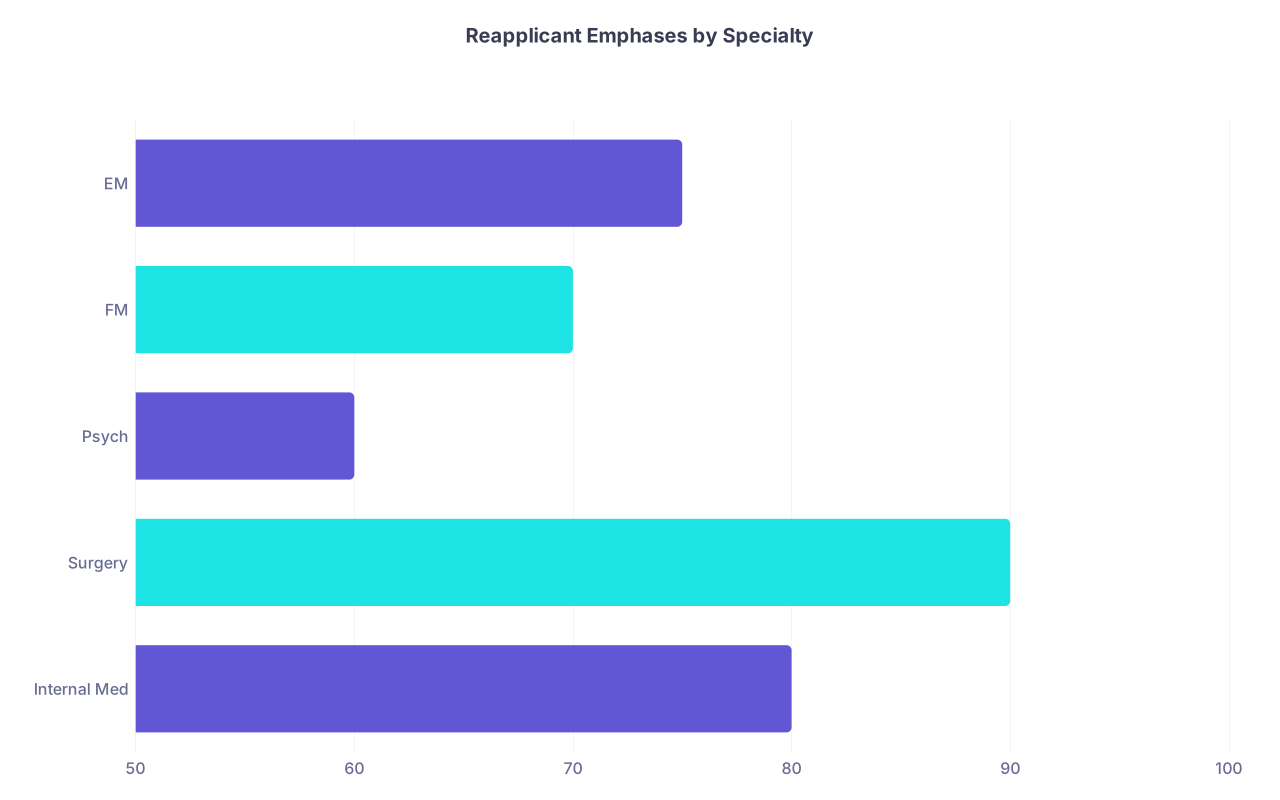
| Category | Value |
|---|---|
| Internal Med | 80 |
| Surgery | 90 |
| Psych | 60 |
| FM | 70 |
| EM | 75 |
(Scale here: relative importance of showing “grit and readiness” for reapplicants as perceived by PDs, anecdotally.)
Internal Medicine / Family Medicine
They want:
- Steady clinical performance
- Teamwork, accountability
- Commitment to continuity, complex decision‑making
For reapplicants, highlight:
- Night float, cross‑cover responsibility
- Complex patient management stories (DKA, sepsis, multi‑morbid elders)
- Examples of following through: calling families back, arranging follow‑up, closing loops
Surgery (General and Subspecialties)
They want:
- Work ethic, resilience, humility
- Technical interest and improving skill
- Strong upper‑level and attending support
For reapplicants, you had better show:
- That you showed up early, stayed late, owned your patients during your prelim year
- Honest acknowledgement if you were not ready before, and how you toughened up without whining
- At least one concrete example of surgical initiative (drains, wound care, OR performance, QI in peri‑op workflow)
A surgery reapplicant whose essay is 80% about “loving anatomy in first year” is finished.
Psychiatry
They want:
- Stability (ironically yes)
- Reflective capacity without oversharing
- Strong interpersonal skills and collegiality
As a reapplicant, do not write an emotional diary about not matching. Instead:
- Show how you process setbacks thoughtfully
- Highlight communication with difficult patients, team mediation, consistent follow‑through
- If switching into psych, clearly explain what you saw in clinical work that shifted your path
9. Tone Problems That Kill Reapplicant Statements
You can have strong content and still ruin your chances with the wrong tone. I have seen this happen more than I like.
The top offenders:
Bitterness or blame
Lines like “Despite my strong qualifications, I was disappointed not to match” or “I felt overlooked” are landmines. PDs read: “This person will blame us if things go wrong.”Over‑selling hardship
Everyone has had a hard year. Do not turn your personal statement into a trauma narrative unless it is directly relevant and handled with precision. You are applying to be a colleague, not a memoirist.Self‑pity disguised as reflection
“Although this was the most painful experience of my life, I have grown.” They can smell the subtext: I still hurt, I am still preoccupied.Desperation
“I am willing to train anywhere” sounds like you have no standards. Better: “I value programs that…” then specify realistic features (diverse pathology, strong teaching, etc.) without sounding like you are begging.Over‑polished, generic language
Reapplicants often overcompensate by stuffing in clichés. “I am committed to lifelong learning,” “I will be a strong asset to your program” without evidence. The more generic the line, the less they trust you.
Read your draft out loud. If you sound like you are pleading for rescue, start over.
10. One Concrete Revision Workflow That Actually Works
You are probably busy (prelim year, research fellow, post‑SOAP rotation grind). You still need a deliberate process.
Use a compressed, 4‑step workflow:

| Step | Description |
|---|---|
| Step 1 | Print Last Years Statement |
| Step 2 | Mark What Still Represents You |
| Step 3 | Identify Reapplicant Questions to Answer |
| Step 4 | Draft New Growth & Reapplication Sections |
| Step 5 | Integrate, Cut, and Tone-Check with Mentor |
Step 1: Print last year’s statement. Physically mark:
- Green: still true, still strong
- Yellow: maybe, needs adjustment
- Red: delete
Step 2: For this cycle, list the exact concerns programs have about you. For example:
- “Failed Step 1 then passed Step 2”
- “No categorical spot last year”
- “Switching from anesthesia to IM”
Step 3: Write 2–3 paragraphs responding only to those concerns: explanation + growth. Forget prose quality at first. Just facts.
Step 4: Merge the best of the old content (green) with the new paragraphs. Aim for ~650–800 words, depending on specialty norms. Then give it to one person who knows you and one person who reads applications (PD, APD, faculty, at least a senior resident). Ask them specifically:
- What worries do you still have about me after reading this?
- Where do I sound defensive or vague?
- What do you not believe?
Then revise only around those answers.
11. Match Alternatives Context: When Your Audience Is Different
You flagged this under “MATCH ALTERNATIVES” for a reason. If you are aiming at:
- SOAP
- Off‑cycle PGY1/PGY2 positions
- Non‑traditional pathways (e.g., preliminary → switch specialty, physician re‑entry, international graduates after gaps)
The personal statement has a slightly different job: reassure on stability and immediate usability.
SOAP programs in particular are not reading essays like novel chapters. They skim. They are asking:
- Can this person safely and reliably show up on July 1?
- Are there glaring attitude or professionalism issues?
- Does this person understand they are joining under pressure and will not implode?
So your reapplicant SOAP‑oriented statement should be:
- Slightly shorter
- Even more concrete about current role and responsibilities
- Very clear about being ready to contribute immediately
For example:
“As a preliminary medicine intern at [Hospital], I currently manage 8–12 patients per day on our general medicine service, independently presenting on rounds, writing notes, and coordinating care with consultants. I take overnight calls every fourth night, cross-covering approximately 40–50 patients with attending backup. This experience has prepared me to step into a categorical internal medicine role with minimal transition time.”
That language makes a PD feel safer taking a SOAP risk on you.
12. Quick Self‑Audit Checklist Before You Submit
Run your final draft through this short, ruthless checklist:
- In the first 1–2 paragraphs, is it clear I am a reapplicant / prelim / switcher without melodrama?
- Do I explicitly state at least 3–4 concrete improvements since my last application cycle?
- Have I provided at least one clinical example from the most recent year, not just medical school?
- Is every sentence something a PD could realistically believe and verify?
- Does the tone read as calm, professional, and forward‑looking—rather than wounded or resentful?
- Could someone who has never met me read this and understand why this year is different?
If you cannot answer “yes” to those, you are not done.
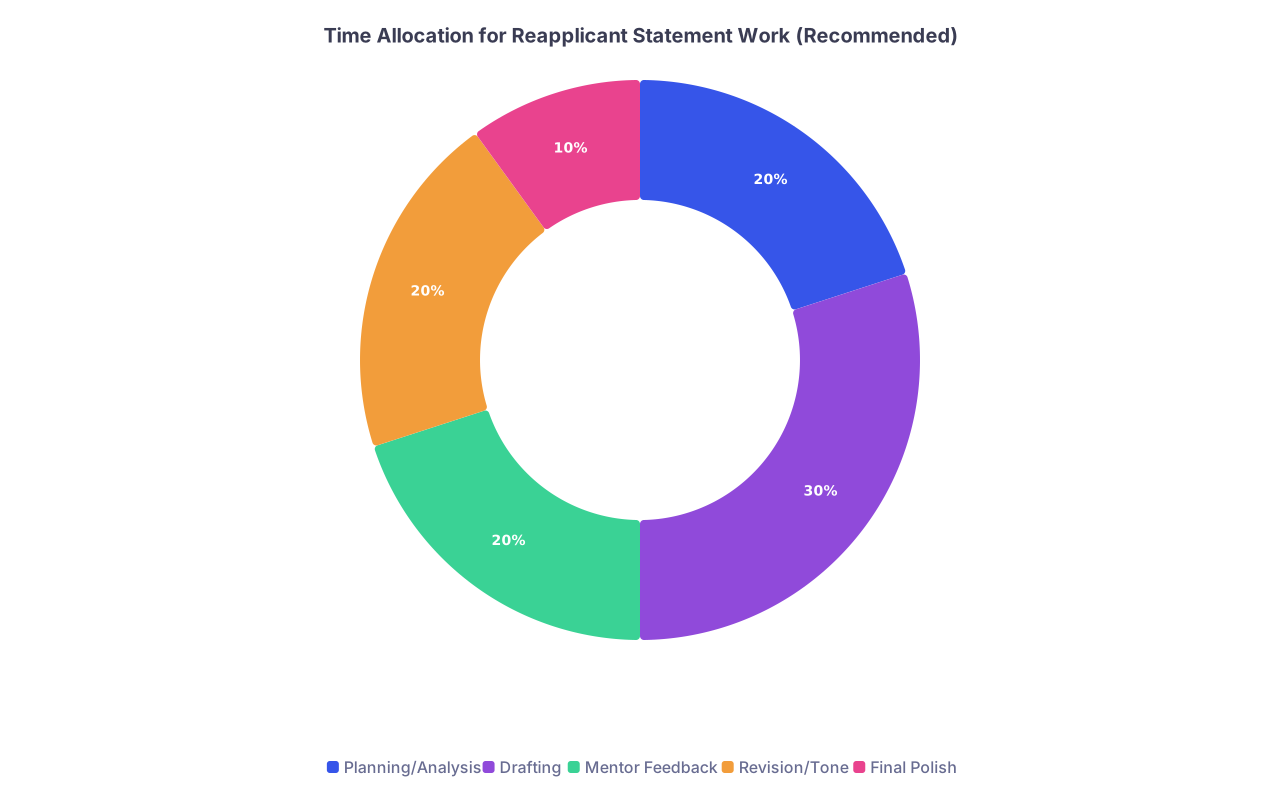
| Category | Value |
|---|---|
| Planning/Analysis | 20 |
| Drafting | 30 |
| Mentor Feedback | 20 |
| Revision/Tone | 20 |
| Final Polish | 10 |
FAQ: Reapplicant Personal Statement
Should I explicitly say “I did not match last year” in my statement?
If you were fully unmatched, yes, but keep it concise and immediately framed around what you did afterwards. A single line such as, “After not matching into categorical internal medicine in 2023, I…” is enough. Do not write three paragraphs about the emotional impact. Then shift quickly to specific steps you took to strengthen your application.Can I reuse parts of my old personal statement?
You can reuse specific, high‑quality elements—particularly strong clinical stories and accurate descriptions of why you chose the specialty. But at least 40–50% of the content should be new or substantially revised. Anything that ignores your reapplicant status or sounds like a preclinical student should be rewritten or deleted.How honest should I be about why I did not match?
Honest, but curated. If the main reasons were obvious (low scores, late application, poor specialty alignment), you can briefly acknowledge them in neutral language and focus on how you addressed those problems. Do not speculate about PD politics or perceived unfairness. Stick to what you controlled and changed.Do programs expect a different tone from reapplicants than from first‑time applicants?
Yes. Less aspirational, more grounded. Programs expect you to sound like someone who has been in the system, understands its demands, and is ready to function like an early resident. Overly sentimental or naive language (“ever since I was a child…”) feels especially out of place in a reapplicant’s essay.If I am switching specialties, how much of my statement should explain the change?
Enough to make your path coherent, not so much that it becomes a justification essay. Usually 1–2 well‑crafted paragraphs. Clarify what you learned in the prior specialty, what specifically drew you toward the new one, and why the change is stable—not impulsive. Then spend the rest of the statement acting like a focused applicant to the new specialty, not a refugee from the old one.Is it ever better not to mention I am a reapplicant in the personal statement?
Almost never. Programs can see your prior ERAS submissions, prior NRMP attempts, or prelim year on your CV. If you ignore it, they assume avoidance or lack of insight. A controlled, matter‑of‑fact acknowledgment, followed by concrete growth, is far safer than silence.
Three things to remember.
First, as a reapplicant you are being judged more on trajectory than on raw numbers. Your statement must highlight the slope, not just the snapshot.
Second, do not write like a victim of the Match. Write like a colleague who had a setback, dissected it, and came back stronger.
Third, the only personal statement that works for a reapplicant is one that answers the quiet question every PD is asking: “Why should I believe this time will be different?” If your essay nails that, you are finally in the game.


