

Designing a High-Yield Research Portfolio in a Gap Year Post-Unmatched
It is mid-March. Your email still says “We are sorry, you did not match.” The scramble is over, SOAP is done, and there is no PGY‑1 starting in July with your name on it.
After the shock fades, you start hearing the same line from everyone: “Just do research for a year.”
That advice is lazy. “Do research” is not a plan. It is not specific, and it absolutely does not guarantee you will be a stronger applicant next cycle. I have watched people waste an entire gap year running spreadsheets for a weak project and come back with a single middle-authorship poster that no program director cares about. I have also seen others use 9–12 months to build a surgical-level research portfolio that completely rewrote their application story.
You are not trying to “stay productive.” You are trying to design a high-yield research portfolio that moves the needle for the next Match.
Let me break down how to do that, specifically.
Step 1: Get Ruthlessly Clear on Your Target Specialty and Story
Before you send a single email for a research position, you need clarity on two things:
- What specialty are you targeting next cycle?
- What exact weaknesses made you vulnerable this cycle?
If you are vague here, you will design the wrong year.
A. Decide: Same specialty or pivot?
You have three basic paths:
- Reapply to the same specialty
- Reapply to the same specialty but with a parallel (e.g., reapply EM + apply IM)
- Pivot entirely to a new specialty
Your research strategy depends heavily on which one you choose.
| Strategy | Primary Research Focus | Secondary Focus |
|---|---|---|
| Same specialty (no pivot) | Specialty-specific | General methodology/statistics |
| Same + parallel specialty | Primary + parallel mix | Anything publishable quickly |
| Full pivot | New specialty-focused | General scholarly output |
If you are reapplying to something competitive (derm, ortho, ENT, plastics, rad onc, urology, integrated IR, neurosurg), the bar is much higher. A generic bench job in some unrelated field will not impress anyone.
If you are pivoting from, say, ortho to IM or from EM to FM, the threshold is different. Programs want to see:
- Commitment to the new specialty
- Evidence you can produce meaningful work
- That you did not drift aimlessly in your gap year
B. Diagnose why you did not match
Be brutally honest. Ask yourself and at least two trusted faculty:
- Were your board scores weak for that specialty?
- Was your application too late (late Step 2, late ERAS, late LORs)?
- Did you have minimal research for a research-heavy specialty?
- Were there professionalism or communication concerns from interviews?
- Were your geographic preferences too narrow?
Then map that to what research can fix and what it cannot.
Research can help with:
- Demonstrating academic productivity and work ethic
- Strengthening your narrative (e.g., “I am serious about neurology; here is a year of neuro research”)
- Building relationships for stronger LORs
- Filling a “quiet” section in ERAS (research, posters, publications)
Research cannot:
- Fix severe professionalism flags
- Turn a catastrophic board profile into derm-ready material
- Replace strong clinical performance and letters entirely
Your research portfolio needs to directly respond to your weaknesses. This is not cosmetic. It is strategic repair.
Step 2: Choose Research Settings That Actually Help You Match
“Any research is good” is a lie. Some environments produce five posters and three papers per year. Others produce busywork, broken promises, and “we will submit it eventually” emails.
You are designing for output and letters, not just an interesting experience.
A. Types of research roles in a gap year
You will generally see four main models:
- Full-time paid research fellow (often in high-demand specialties)
- Unpaid full-time research assistant / “fellow”
- Part-time research plus clinical job (scribe, prelim, MPH, etc.)
- Remote / multi-institution project patchwork
In a post-unmatched gap year, my bias is clear: If you truly want to maximize match chances, aim for a structured full-time research role embedded in your target specialty.

High-yield environments:
- Departments with established “research fellow” positions (e.g., many ortho, neurosurg, IR, EM, and cardiology departments at large academic centers)
- Labs or clinical research groups with a proven track record of student authorship and regular publications
- PIs who have previously mentored unmatched or reapplicant students successfully into residency
Low-yield environments:
- A “maybe we can come up with a project” PI without established infrastructure
- Basic science labs with 3–5 year timelines for meaningful output (unless the lab is already mid-project and you are plugging in at the final manuscript stage)
- Volunteer gigs that use you as data-entry with no ownership, no authorship, no clear timeline
B. How to quickly judge a research position
You do not have time for vague promises.
You should be asking, out loud, in an early conversation:
- “How many medical students or research fellows have you mentored in the last 5 years?”
- “How many of them got at least one first- or second-author paper with you?”
- “What is realistic for me to complete in 9–12 months?”
- “Can I see recent abstracts / publications with trainee authors?”
If the answer is hand-wavy and they cannot show you concrete outputs, walk away. You are in a one-year salvage mission, not a multi-year PhD.
Step 3: Design the Portfolio — Types of Projects That Yield Fast and Matter
Now we get into the actual portfolio design. Think like an investor. You are not putting all your “research capital” into a single long-shot RCT that might publish in 2028.
You want a portfolio of project types with different time horizons and payoff structures.
A. Fastest wins: Reviews, retrospective studies, and case reports
You need some early wins. Things you can list in ERAS as “submitted” or even “accepted” within 6–9 months.
High-yield categories:
Systematic reviews / meta-analyses
- If the PI or team knows what they are doing, these can move from inception to submission within 4–6 months.
- Good for first-authorship.
- Builds your methods skills.
Narrative / scoping reviews in underdeveloped topics
- Especially in niche subfields of your specialty.
- Faster than full systematic reviews if scoped properly.
Retrospective chart reviews (single-center)
- Ideal if your department has existing IRB-approved data sets you can tap into.
- First- or second-author is realistic if you do the bulk of the work.
- Goldmine for posters and quick publications.
Case reports and small case series
- Alone, they are not impressive. But 2–4 of them, especially in rare disease or key procedures, help fill the publication section.
- Pair them with conferences for easy abstracts/posters.
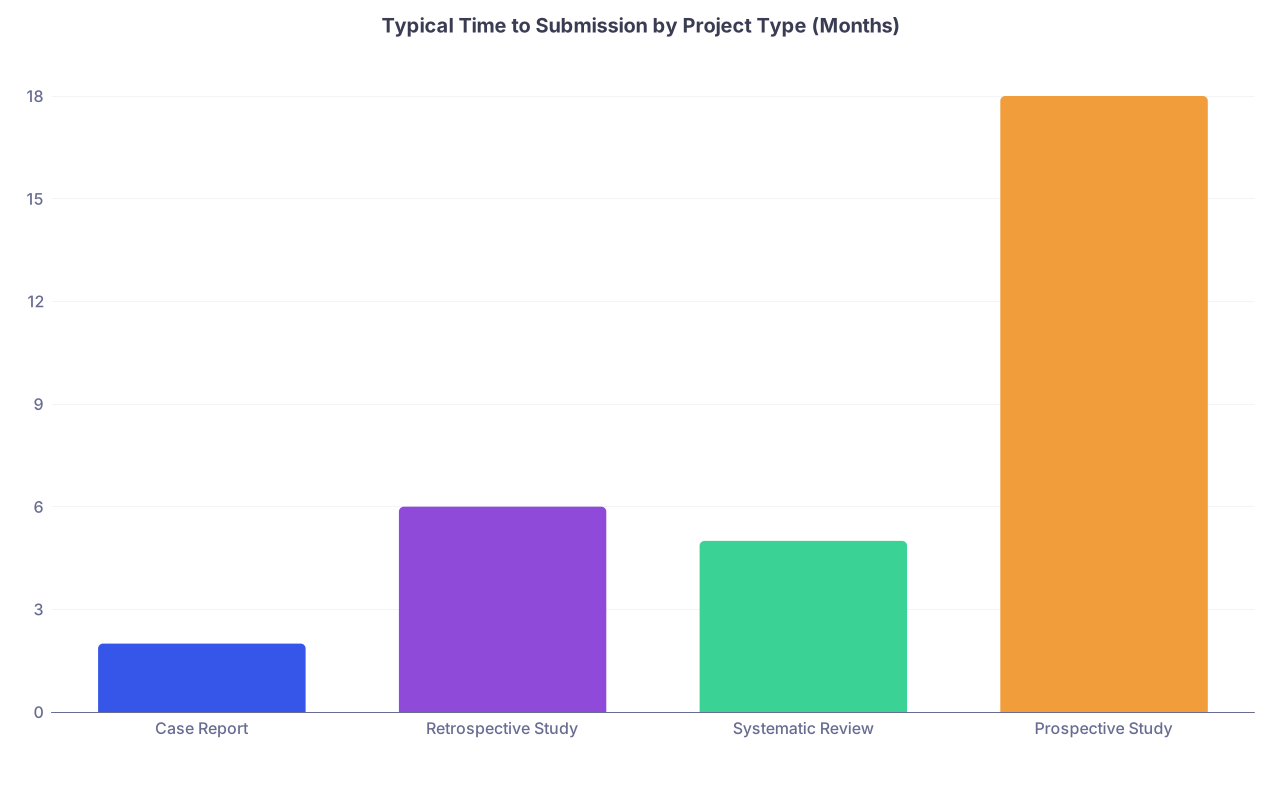
| Category | Value |
|---|---|
| Case Report | 2 |
| Retrospective Study | 6 |
| Systematic Review | 5 |
| Prospective Study | 18 |
You want at least 2–3 projects in the “fast win” category that you can realistically take from idea to submission within the year.
B. Medium-horizon work: Prospective observational, QoL, education projects
You may not get these fully published before ERAS, but you can get:
- Abstracts submitted
- Preliminary data
- “Manuscript in preparation” with clear roles
Examples:
- Prospective observational cohorts (e.g., post-op pain scores after different regimens)
- Quality improvement studies (e.g., implementing a new order set or protocol)
- Education research (simulation curriculum, OSCE changes, flipped classroom in clerkships)
These projects are great for talking points in interviews. They show you understand study design and implementation, not just data mining.
C. Long-horizon “anchor” project (optional but powerful)
If you land with a serious PI, they may plug you into a large existing trial or big registry project. You might only end up as 3rd–5th author on a high-impact paper that publishes later, but that still helps.
This is your “anchor” project. Do not let it swallow your year. It should not be your only significant work.
Target mix across 9–12 months:
- 2–3 fast-win projects (reviews, chart reviews, case series)
- 2–3 medium-horizon projects (QI, education, prospective observational)
- 1 anchor project with a strong team / major PI
That kind of distribution gives you multiple shots on goal.
Step 4: Build for Authorship, Not Just Participation
I have seen too many unmatched grads do a year of “data work” and leave with acknowledgments instead of authorships.
You do not need dozens of first-author papers. But you do need meaningful positions in the byline.
A. Have an authorship conversation early
You are not being greedy by asking. You are being smart.
Phrase it plainly:
- “For the projects I lead from start to finish, is first authorship realistic if I do the bulk of the work?”
- “For team projects, how is authorship usually decided in your group?”
If the answer is evasive or clearly exploitative, that is a massive red flag.
B. Take ownership of complete arcs
If you want first- or second-author positions, you need to own an entire arc of the project:
- Background and question refinement
- Data collection or literature search
- Data cleaning and analysis (with statisticians as needed)
- Drafting the manuscript, tables, figures
- Responding to reviewer comments
Do not accept only the “grunt work” pieces (copying data from EMR into REDCap) on all projects. That is how you end with middle authorship on a single paper after 12 months.
Step 5: Align Your Research with Your Future Specialty Narrative
Your portfolio is not just a pile of PubMed IDs. It is part of your application story.
A. Specialty-specific vs. general research
Here is the reality: Program directors care much more about specialty-aligned research when the specialty is competitive or academic-leaning.
If you are reapplying to:
- Dermatology, ortho, ENT, neurosurg, plastics, IR, rad onc, urology, ophtho, academic IM/ cards/ GI/ heme-onc
You should aim for the majority of your work to be within that domain or very closely adjacent.
If you are pivoting to:
- FM, psych, pediatrics, path, neurology, anesthesia, community IM
Then strong, methodologically sound research in any clinically relevant area still helps, though you should still ideally have some projects in the new specialty to show commitment.
| Specialty Tier | Specialty-Focused Research Needed? | Generic Clinical Research Value |
|---|---|---|
| Ultra-competitive | Essential | Supplementary |
| Moderately competitive | Strongly preferred | Helpful |
| Less competitive | Helpful but not mandatory | Often sufficient |
B. Use your projects to fix narrative gaps
Example scenarios:
You applied to ortho with no ortho research and generic internal medicine letters.
Gap year: Ortho trauma outcomes, sports med registry, ortho education projects. Letters from ortho attendings who watched you work.You applied to IM but had no scholarly work and an average Step 2.
Gap year: Strong IM or subspecialty research (cards, pulm, ID). Multiple posters, one or two first-authored manuscripts submitted.You are pivoting from EM to psych after not matching EM.
Gap year: Psych or ED-psych interface research (suicidality, substance use, agitation management). Shows logical pivot with bridge between your background and your new target.
Your future PD needs to see: “This person used a tough year to double down on my field, not drift through generic productivity.”
Step 6: Daily and Weekly Structure: How to Actually Produce
A lot of unmatched grads get a research position and then float. They answer emails, attend lab meetings, and somehow have nothing concrete 6 months in.
You need structure. And you need to treat this like a job with deliverables, not an optional year off.
A. Time allocation
You want a balance between:
- Deep work: writing, data analysis, literature synthesis
- Administrative / collection work: chart review, data entry, IRB work
- Meetings: PI updates, stats consults, team discussions
A functional weekly breakdown in a full-time role might look like:
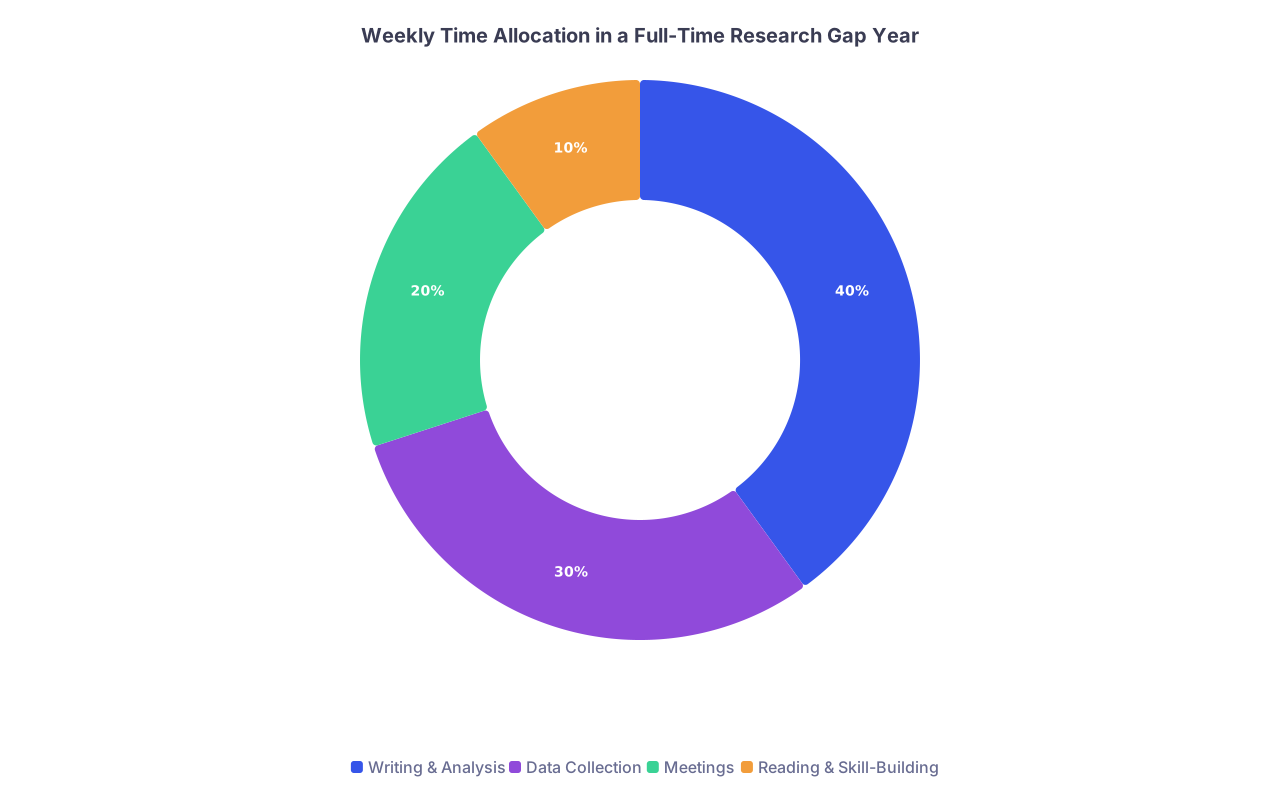
| Category | Value |
|---|---|
| Writing & Analysis | 40 |
| Data Collection | 30 |
| Meetings | 20 |
| Reading & Skill-Building | 10 |
It will shift depending on project stage, but the key is this: if weeks go by and you are not writing or analyzing, you are not moving toward publishable output.
B. Set explicit, written milestones
Do not rely on vibes. Create a calendar with:
- Project A: draft introduction by X date, data collection complete by Y, submission by Z
- Project B: systematic review search done by X, screening complete by Y, results synthesis by Z
- Abstract deadlines for relevant conferences (e.g., RSNA, AAOS, ACG, ATS, AHA, etc.)
Use these deadlines in meetings with your PI. Say: “I am aiming to have a complete first draft by [date]; can we plan a review then?” That keeps pressure on both sides.
Step 7: Use the Gap Year to Upgrade Your Research Skill Set
Programs are not only evaluating what you produced. They are inferring what you can continue to produce as a resident.
You want to leave the year with:
- Comfort reading and critiquing papers in your field
- Basic but competent stats literacy
- Experience with at least one major data tool (REDCap, R, SPSS, Stata, or Python)
- Practical understanding of IRB, consent, data security

A. Minimum research literacy you should aim for
By the end of the year, you should be able to:
- Explain the difference between cohort, case-control, cross-sectional, RCT, and systematic review designs
- Interpret basic regression outputs (odds ratios, confidence intervals, p-values)
- Understand when to use t-tests, chi-square, logistic regression, survival analysis at a conceptual level
- Identify major bias threats in observational research
If you cannot do this yet, fix it. Take a free online course in biostats. Work closely with your group’s statistician instead of just emailing them raw data.
Step 8: Conferences, Networking, and Letters — The Non-PubMed Benefits
A high-yield research year does more than give you papers. It embeds you in a department.
A. Turn abstracts into conference presence
Aim to submit multiple abstracts to:
- Specialty national meetings
- Regional conferences
- Institutional research days
Even a poster at a mid-tier meeting beats staying completely invisible.
Conferences give you:
- A line item on the CV
- Content for interview conversations (“At [conference], we presented data on…”)
- Face time with faculty who might remember you when reviewing ERAS
B. Engineer strong letters of recommendation
Your research mentors are ideally also your letter writers. To earn a strong letter:
- Show up consistently
- Hit deadlines
- Take initiative (“I drafted the methods; could you review?” instead of “What should I do next?” every week)
- Be professional and collegial with everyone, including coordinators and data managers
Remind them as ERAS approaches:
- Provide a summary of your contributions
- Include a draft bullet list of specific things you hope they mention (projects you led, presentations, your work ethic)
You want letters that say:
- “This applicant functioned at the level of a PGY‑1 in terms of reliability.”
- “They led X, Y, and Z projects from inception to manuscript draft.”
- “We will happily take them in our program if they match here.”
Those letters carry more weight than a generic “they helped me with some research.”
Step 9: Risk Management — Common Ways People Waste a Gap Year
Let me be blunt. Here are the big mistakes I see:
Starting too late.
You finish Match week, do nothing until June, then start a research gig in July. By the time you have orientation, IRB, ramp-up, it is September. ERAS is already in. Your gap year has almost no representation in your application.Overcommitting to a single giant project.
One massive trial that will not publish for 3 years is not a gap-year strategy. You need shorter-cycle work.Being passive with mentors.
Waiting for your PI to tell you every next step. They are busy. If you want output, you drive the projects.Ignoring specialty alignment in ultra-competitive fields.
Doing a year of generic population health research when you want ortho. That mismatch is obvious to programs.Not updating ERAS strategically.
Failing to list “submitted” or “in preparation” projects with clear descriptions. Underrepresenting your actual progress.
Step 10: How This All Shows Up in Your Next Application
You are not just doing the work; you are also packaging it.
A. ERAS entries: be specific and honest
For each project, clearly indicate:
- Your role (designed study, collected data, did analysis, drafted manuscript)
- Status (submitted, in revision, accepted, in preparation)
- Presentation details (poster vs oral, which conference, year)
Do not inflate. But do not undersell either.
B. Personal statement and interviews
Your gap year story should sound like this:
- “I was disappointed not to match, but I used the year to deepen my engagement with [specialty]. I joined [lab/PI], led [X] projects on [topics], and presented at [meetings]. That year confirmed that [specialty] is the right fit for me and gave me the tools to contribute academically as a resident.”
Not:
- “I did some research because I had time.”

| Step | Description |
|---|---|
| Step 1 | Unmatched in March |
| Step 2 | Decide Specialty Strategy |
| Step 3 | Secure High-Yield Research Role |
| Step 4 | Design Project Portfolio |
| Step 5 | Produce Papers & Abstracts |
| Step 6 | Present & Network |
| Step 7 | Strong Letters & Updated ERAS |
| Step 8 | Reapply Next Cycle |
You want interviewers to see your year not as a dead space, but as one of the most productive, clarifying intervals of your career.
Final Check: What a High-Yield Gap-Year Portfolio Looks Like
If you do this right, by the time ERAS opens you should realistically have something like:
- 1–2 first-author manuscripts submitted (maybe one accepted)
- 2–4 co-authored manuscripts (submitted or in late-stage drafting)
- 2–6 abstracts accepted or submitted to relevant conferences
- At least one or two strong, research-based LORs from your target specialty
- A coherent narrative tying this work to your career goals
Not all of that will happen for everyone. But that is the direction you should be pushing.
Three Things I Want You to Remember
- “Do research” is not a plan. Choose a setting and portfolio that are designed for speed to output, specialty alignment, and authorship.
- Treat the year like a job with deliverables. Multiple fast-win projects, one or two medium-horizon ones, and maybe one anchor — not a single giant, slow study.
- Your gap year must rewrite your story. When a PD looks at your new application, they should see someone who took a setback, executed a focused, productive year in their field, and is now a stronger, more credible future resident.


