

Most unmatched applicants waste their “gap year” by chasing more applications instead of smarter mentorship. That is the critical mistake.
You do not need more generic advice. You need targeted faculty allies who will attach their name to your next cycle. That is a very different game than “finding a mentor.”
Let me break this down specifically.
1. Reset Your Strategy: Mentorship as a Deliberate Tool, Not Emotional Support
A failed Match cycle feels like a character judgment. It is not. It is a data point about market dynamics and your current signal strength.
You are now in a different phase:
- Before: selling your potential to residency programs
- Now: selling your trajectory to faculty gatekeepers
Faculty mentorship after an unmatched cycle has three explicit purposes:
- Generate credible advocates who can email program directors and call colleagues with confidence.
- Shape a coherent narrative: what went wrong, what changed, why you are now a safer bet.
- Produce objective upgrades: publications, structured clinical work, stronger specialty-aligned letters.
Anything that does not push one of those three levers is a luxury, not a priority.
So you are not “looking for anyone who is nice.” You are building a small, purposeful team:
- 1–2 core mentors in your target specialty (or a thoughtfully chosen backup specialty)
- 1 process mentor who understands the match and can talk through strategy (often a PD or APD)
- Optional: 1 skills mentor around research, QI, or clinical competence
This is more like building a mini-mentoring committee than hoping one savior appears.
2. Do a Ruthless, Honest Post‑Match Autopsy
Before you approach faculty, you need a precise diagnosis. “I guess I was unlucky” will not cut it.
You need to answer, on paper, three questions:
- Was I under‑qualified for the specialty or tier I targeted?
- Was my application incoherent (mixed signals, poor narrative, weak letters)?
- Did my performance in interviews or professionalism raise red flags?
Here is a simple structure. Write this out. Seriously.
| Domain | Your Data / Notes |
|---|---|
| Specialty | Primary + any backups |
| Step/COMLEX | Scores, pass/fail history |
| Class Rank/GPA | Quartile, honors |
| Research | # of pubs, abstracts, role |
| Clinical Evaluations | Any concerns, patterns |
| Geographic Limits | Regions you restricted to |
| Applications | # programs applied, # interviews |
| Red Flags | LOA, failures, professionalism issues |
Now rate, very bluntly:
- Competitiveness mismatch
- Geographical rigidity
- Application quality (personal statement, letters, CV formatting)
- Interview skill
You do not need this to be perfect. You need it to be thoughtful enough that when a faculty member asks, “Why do you think you did not match?” you do not freeze or spin.
That level of self-awareness is exactly what differentiates “salvageable” from “repeat liability” in the eyes of faculty.
3. Decide Your Primary Target: Same Specialty vs Pivot
Before you build mentorship, you need to answer: am I re‑loading in the same specialty or pivoting?
Because the mentors you need differ.
Staying in the same specialty (e.g., unmatched in IM, re‑applying IM):
- You need specialty‑specific mentors with program-director‑adjacent influence.
- You must show clear change: more specialty experience, better letters, tangible products (case reports, QI).
Pivoting (e.g., unmatched in Ortho, now applying FM or IM):
- You need honest specialty gatekeepers who will tell you if your pivot is realistic.
- You must craft a genuine narrative, not “generic backup.” Faculty can smell that.
If you are genuinely torn between two directions, you can have one exploratory meeting in each specialty. But do not try to build mentorship in two conflicting lanes long term. It looks unfocused and weakens advocacy.
4. Identify the Right Faculty Targets (Not Just the Nicest Humans)
Random “mentors” will burn your time. You want people with specific leverage.
For post‑match mentorship, your ideal targets are:
Program Directors / Associate PDs
- They understand the match data and what different programs value.
- They write letters that carry real weight because PDs read PD letters differently.
Clerkship / Sub‑I Directors in your specialty
- They have seen you clinically (or can).
- They often sit on residency selection committees.
Research‑active specialty faculty with regional influence
- They present at conferences, know PDs, and can email colleagues.
- They can plug you into ongoing projects quickly.
Institutional “fixers”
- Example: your school’s Director of Student Affairs, GME Dean, or someone who “handles” unmatched students every year.
- They know which departments are open to “gap-year” roles, visiting research positions, prelim spots, etc.
You are not trying to meet 20 people. You are trying to land 3–5 high-yield connections, of which 1–2 will become true mentors.
How do you actually find them?
- Check your school’s or hospital’s website: filter by specialty, leadership roles.
- Look at recent publications from your department: who is first or senior author repeatedly?
- Ask your student affairs dean directly: “Who in [specialty] has been particularly helpful with unmatched or nontraditional applicants?”
5. Your First-Contact Strategy: Stop Sending Vague “Can I Have Mentorship?” Emails
Faculty are flooded with meaningless “Can we chat about my career?” messages. Most are ignored, because they require too much work from the recipient.
Your outreach needs to do three things:
- Show that you know who they are and why you picked them.
- Demonstrate you already did your self-assessment and are coachable.
- Make a small, concrete ask as the first step.
Example email structure (tighten this to your voice):
Subject: Unmatched in [Specialty] – seeking targeted feedback and plan
Dr. [Name],
I am a [MS4 / recent graduate / prelim resident] from [School/Hospital]. I applied in [specialty] this year and went unmatched.
I am reaching out to you specifically because of your role in [PD/APD/Clerkship Director/Research in X], and because I am committed to re‑applying in [specialty] with a substantially stronger application.
Briefly:
- Applied: [# programs], Interviews: [# received, # attended]
- Strengths: [e.g., strong clinical evaluations, Step 2 250, one specialty rotation with honors]
- Gaps I have identified: [e.g., limited home‑institution mentorship, no specialty publications, geographically narrow list]
Would you be willing to meet for 20–30 minutes to:
- Give your honest assessment of whether a re‑application in [specialty] is realistic for me, and
- Help me identify 2–3 concrete priorities for this year (e.g., research, targeted rotations, specific types of letters)?
I have attached my CV and ERAS application PDF for context, and I would be grateful for any level of guidance you are able to offer.
Thank you for considering this,
[Name]
[Cell]
[AAMC ID if relevant]
That email:
- Signals insight and humility.
- Offers data without oversharing your life story.
- Does not ask them to “be your mentor” upfront. Just to have one focused meeting.
That is how you get actual responses.
6. Running the First Meeting Like Someone Faculty Want to Invest In
When you do get a meeting, do not show up empty-handed and emotional.
You bring three things:
- A 1‑page Match Autopsy Summary (bulleted, not a manifesto).
- A rough Priorities Draft for the coming year.
- A short list of specific questions, written down.
Concrete questions I have seen work well:
- “Given my scores and experiences, do you see a realistic path to [specialty] if I spend a year doing X, Y, Z?”
- “If I re‑apply, which program tiers or geographic regions make the most sense for me?”
- “Between these options—research year, non‑categorical prelim, or home‑institution research + outpatient clinic—what would you prioritize in my situation?”
- “What would make you comfortable putting your name on a strong, specific letter for me in 9–12 months? What would I need to demonstrate?”
And then you do something most applicants skip: you take notes. Not in your head. On paper.
Faculty remember the person who treated advice like a plan to execute, not a therapy session.
You close the meeting with:
- A 1–2 sentence summary: “So I am hearing that my main priorities should be [X, Y, Z], and I should avoid [A, B]. Is that accurate?”
- A narrow ask: “Would it be all right if I emailed you in a month or two with an update and a concrete plan based on this?”
Now you look like someone who can be mentored. Consistently.
7. Converting Helpful Faculty into True Mentors
Not every helpful faculty member will become a mentor. That is fine. You are aiming for depth with a few, not shallow contact with many.
Here is the progression:
Phase 1 – Advisor: One or two meetings, feedback on feasibility and priorities.
Phase 2 – Sponsor-in-training: They suggest concrete opportunities (research, clinic, QI). You start doing work for them or their group.
Phase 3 – True Mentor/Sponsor: They know your work ethic firsthand and are willing to attach their name to you in advocacy emails and letters.
Your job is to accelerate that progression by:
- Volunteering for defined work that solves their problems: “If you have any QI or chart-review projects that need a motivated person, I can take that on.”
- Showing up consistently: hit deadlines, over‑communicate, send clean drafts.
- Making reflection easy: send periodic brief updates that show growth, not drama.
A simple update email every 6–8 weeks works:
Subject: Brief update and next steps
Dr. [Name],
I wanted to briefly update you since we spoke on [date].
Since then:
- I have started working with [Dr. X] on a [QI / case series] project and completed [data collection / initial draft].
- I arranged a [sub‑I / observership / clinic block] in [month] to strengthen my clinical experience in [specialty].
- I have met with [Student Affairs / GME office] and confirmed [gap-year employment / research position].
Over the next 2–3 months, my priorities are:
- [Finish manuscript draft],
- [Secure additional LOR from ___],
- [Improve interview skills via ___].
Thank you again for your guidance. If you have any suggestions on additional clinical or scholarly activities that would be particularly valuable from a PD’s perspective, I would appreciate them.
Best,
[Name]
No needy tone. Just progress, focus, and respect for their time. That is how mentors decide, “This one is worth going to bat for.”
8. Plugging Yourself Into High-Yield Roles (Not Just Any Research Year)
Many unmatched applicants sign up for vague “research years” that produce one abstract and no advocacy. That is borderline useless.
You want roles that check at least two of these boxes:
- Proximity to program leadership (PD/APD, or tightly connected faculty).
- Clear deliverables with deadlines (manuscripts, posters, QI outcomes).
- Clinical visibility in the target specialty or a reasonable backup.
- A formal title that looks legitimate on ERAS (Research Fellow, Clinical Research Coordinator, Visiting Scholar, etc).
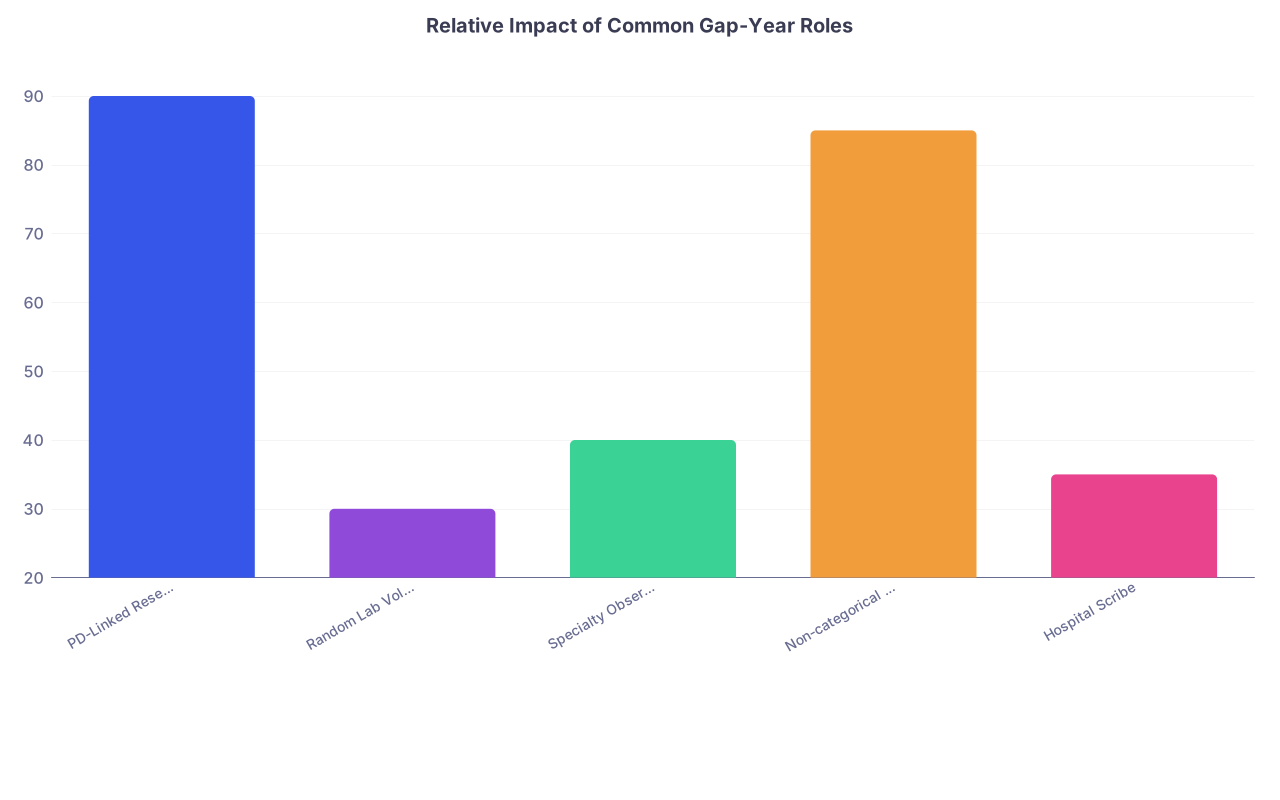
| Category | Value |
|---|---|
| PD-Linked Research Fellow | 90 |
| Random Lab Volunteer | 30 |
| Specialty Observership Only | 40 |
| Non-categorical Prelim Year | 85 |
| Hospital Scribe | 35 |
Interpret this the way faculty actually do:
- A PD-linked research fellow role with 1–3 solid outputs and close contact = high impact.
- A non‑categorical prelim year where you impress PDs daily = high impact, especially if they will advocate for you.
- A random lab volunteer where nobody knows you by name = low impact on residency selection.
- Pure observership without tangible products or letters = modest impact at best.
When discussing potential roles with faculty, ask directly:
- “If I take this position, how often will I interact with faculty who write strong residency letters?”
- “Are previous people in this role now in residency, and did you help place them?”
If they cannot answer that cleanly, be cautious.
9. Using Mentors to Repair Specific Weaknesses
Let us get concrete. Different weaknesses require different mentorship strategies.
Weak Letters / No Strong Specialty Advocates
You need:
- A faculty mentor who will supervise you closely clinically or academically for 3–6+ months.
- A clear plan: “I would like to work with you closely enough that you can eventually write a detailed letter commenting on my clinical skills / reliability / growth. What would that need to look like?”
Then you engineer repeated contact:
- Clinic once a week
- Research meetings
- QI project work
Mentors cannot write strong letters about people they saw twice.
Score Concerns / Moderate Academic Record
You cannot “mentor” your way out of a failing Step score, but you can create a story of resilience and competence:
- PD‑type mentor helps you:
- Decide if your target specialty is still realistic.
- Choose programs that historically take people with your profile.
- Emphasize performance and reliability in any gap-year or prelim role.
A letter that explicitly says, “Despite an early exam stumble, this resident/fellow has performed at or above the level of our incoming interns” has real weight.
Perceived Unprofessionalism / Red Flags
If you had a documented professionalism concern, you must address this head‑on with a mentor in leadership:
- Ask: “Given my history of [brief description], what would you need to see from me over the next year to be comfortable telling another PD that I am safe to train?”
- You may need structured remediation: coaching, formal professionalism course, or a role with tight supervision and feedback.
Mentor’s eventual letter should explicitly say:
- What the concern was (in appropriately general terms).
- What you did to address it.
- Why they now trust you with patients and teams.
Without that, most PDs will not touch you.
10. How and When to Ask for Strong Advocacy
Near the next application cycle, you need your mentors to do more than just upload a generic letter.
You are asking for three specific things:
- A strong, specific letter of recommendation uploaded early.
- Permission to list them as a reference for PDs or faculty who want to call.
- For your top 10–15 realistic programs, a direct email or phone call from your mentor to those PDs (where appropriate).
You do not open with the hardest ask. You build toward it.
Timeline (for a September ERAS submission):
- March–April: Confirm they feel comfortable writing a “strong letter” and ask what information they want (CV, statement draft, bullet list of things you hope they will highlight).
- May–June: Give them that material plus a 1‑page “application plan” with a realistic program list. Ask if any programs stand out as good fits.
- August: Politely mention, “For a small number of programs that you know personally and think might be a fit, would you be comfortable reaching out after my application is submitted?”
Never assume they will email anyone. Say it out loud. Many will say yes if you have proven yourself.
11. Protect Yourself From Bad or Useless Mentorship
Not all mentorship is good. Some faculty:
- Are chronically non‑responsive.
- Give vague reassurance and no concrete help.
- Push you into fantasy plans that ignore your actual competitiveness.
Red flags:
- “You will be fine, just reapply and cast a wider net” with no data.
- No willingness to look at your full ERAS or discuss actual numbers.
- They repeatedly cancel or delay meetings, or never follow up on promised connections.
You handle this by:
- Getting at least two independent senior opinions (PD/APD level if possible).
- Comparing advice. If one person is an outlier and cannot justify their optimism, do not anchor on them.
- Pivoting your energy to mentors who show up, give specific guidance, and open doors.
You are allowed to “downshift” a mentor to a more peripheral role if they are not helpful. You do not need to formally break up. Just re‑allocate your effort.
12. Work the Calendar: A Simple Year‑Long Mentorship Timeline
Assume you went unmatched in March.
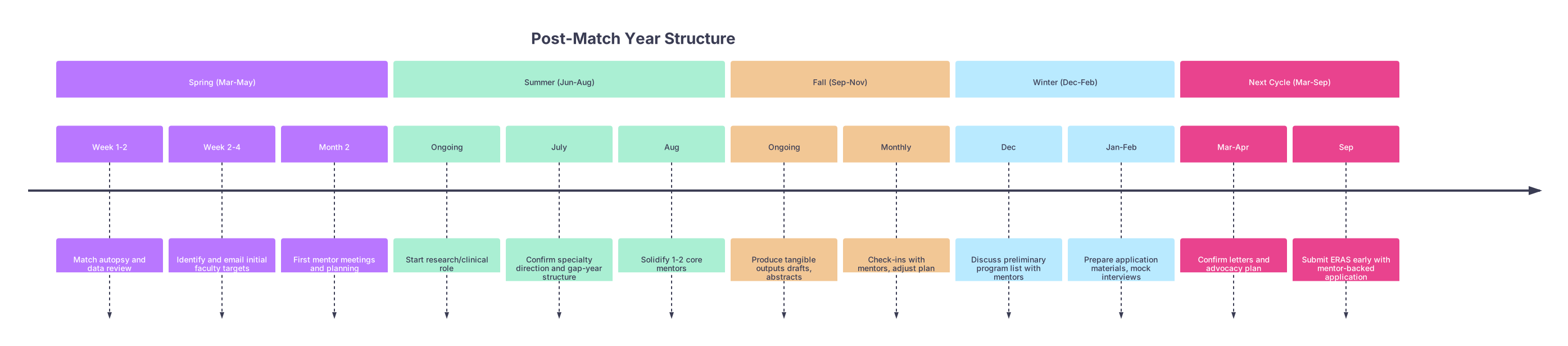
| Period | Event |
|---|---|
| Spring (Mar-May) - Week 1-2 | Match autopsy and data review |
| Spring (Mar-May) - Week 2-4 | Identify and email initial faculty targets |
| Spring (Mar-May) - Month 2 | First mentor meetings and planning |
| Summer (Jun-Aug) - Ongoing | Start research/clinical role |
| Summer (Jun-Aug) - July | Confirm specialty direction and gap-year structure |
| Summer (Jun-Aug) - Aug | Solidify 1-2 core mentors |
| Fall (Sep-Nov) - Ongoing | Produce tangible outputs drafts, abstracts |
| Fall (Sep-Nov) - Monthly | Check-ins with mentors, adjust plan |
| Winter (Dec-Feb) - Dec | Discuss preliminary program list with mentors |
| Winter (Dec-Feb) - Jan-Feb | Prepare application materials, mock interviews |
| Next Cycle (Mar-Sep) - Mar-Apr | Confirm letters and advocacy plan |
| Next Cycle (Mar-Sep) - Sep | Submit ERAS early with mentor-backed application |
Your mentorship plan is not “vibes.” It is structured around deliverables and decision points.
FAQ (Exactly 5 Questions)
1. Should I stay with the same mentor who advised me before I went unmatched?
Maybe, but not automatically. If that mentor missed obvious problems (e.g., wildly unrealistic specialty choice, geographic tunnel vision) and never challenged you, you probably need additional voices. You can keep them as a supportive figure, but bring in at least one PD- or APD-level mentor who will give you blunt guidance based on your full application.
2. How many mentors is “too many” after an unmatched cycle?
Once you go beyond 3–4 active mentors, you dilute the relationship. You want 1–2 core mentors in your primary specialty, possibly one in a backup specialty, and one institutional “process” mentor (student affairs or GME). More than that and you spend your time updating people instead of doing the work that makes you more matchable.
3. What if my school has no willing faculty in the specialty I want?
Then you widen the net. Look to affiliated hospitals, community programs where you rotated, or regional academic centers. Cold-email faculty with clear subject lines and a tight ask for a 20–30 minute Zoom meeting. In parallel, you may need to accept a research or clinical associate role at another institution specifically to embed yourself in that specialty’s ecosystem.
4. Is it better to take a non-categorical prelim year or a pure research year?
It depends on your profile and specialty. If your biggest gap is clinical performance, letters, or demonstrating that you can function at an intern level, a prelim year—especially in the same or adjacent specialty—often carries more weight. If your gap is scholarly output and lack of specialty alignment, a PD-linked research year with clear deliverables and visibility can be more strategic. This is exactly the kind of decision to tackle with a PD-level mentor who has seen both pathways succeed and fail.
5. How do I know if a mentor’s letter is actually strong or just polite?
You will not see the letter, but you can infer from how they talk. If they say, “I can write you a letter,” that is neutral. If they say, “I can write you a strong letter,” and they volunteer specific things they will highlight (e.g., your performance on X service, your ownership of Y project), that is a good sign. If they hesitate, deflect, or suggest someone else instead, believe them and secure additional letter writers who are genuinely enthusiastic.
Two core points to leave you with:
- After a failed Match, your main job is not to “do more stuff.” It is to build targeted, invested faculty mentorship that converts your gap year into measurable change and credible advocacy.
- Strong mentors do not appear magically. You identify the right people, approach them with clarity and humility, execute on the work, and then ask—directly and professionally—for the advocacy that moves residency program directors off the fence.


