
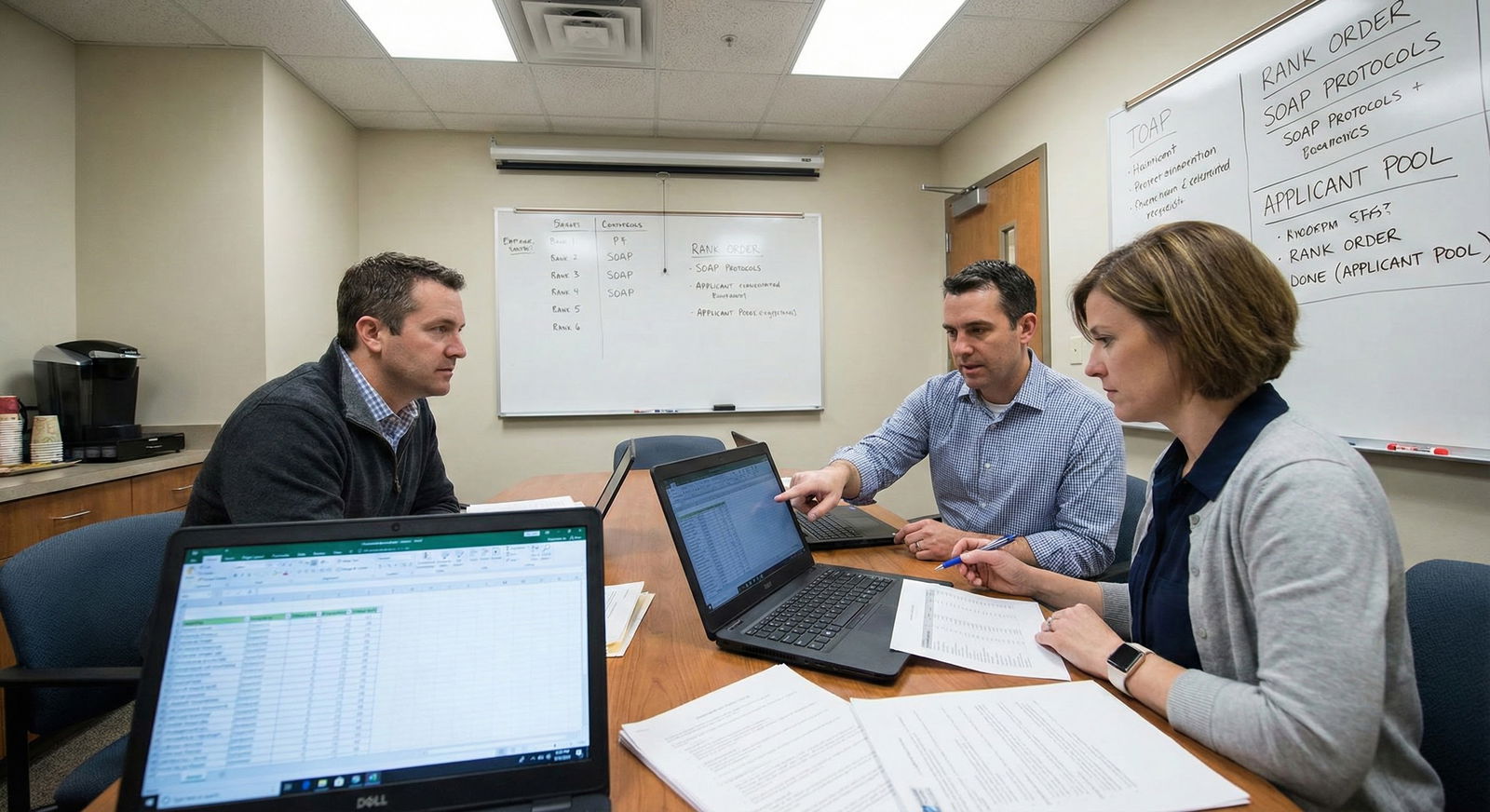
Only 27% of residency applicants with “research experience” actually have a single first-author PubMed paper by the time ERAS is submitted.
Yet almost everyone clicks “yes” on the research section and lists a dozen half-finished projects, posters from obscure local meetings, and “manuscript in preparation” that has been “in preparation” since M2.
Program directors are not stupid. They can smell fluff. And they are absolutely judging how you built your research portfolio—especially if you are using research to compensate for a weaker metric (Step, GPA, non-traditional path, or SOAP history).
Let me break down how to build a publication strategy that actually impresses PDs next cycle, not three years from now, not in some fantasy plan where six RCTs magically finish before September.
You have one application cycle. You need a 12-month publication strategy, not a vague “I like research” identity.
What PDs Actually Care About (Not What You Think)
Most applicants badly misjudge what “looks good” to PDs. They chase prestige and volume, and ignore timing and role.
Here is the PD reality, distilled:
- They prefer completed, PubMed-indexed work over massive “in progress” projects.
- They care a lot about your role (first / second author vs “Author #7 of 14”).
- They read where and when you published.
- They look for coherence – does your research fit a story that matches your specialty?
- They absolutely notice red flags: inflated CVs, fake “submitted” papers, and vague “ongoing” projects that never end.
Let’s put a structure to this.
| Applicant Thinks | PD Actually Likes |
|---|---|
| One big RCT in NEJM | Several small but completed, PubMed papers |
| Being 8th author on huge multi-center trial | First/second author on smaller, niche papers |
| Giant “Research Year” label | Clear timeline of output before apps open |
| 10 projects “in progress” | 2–4 projects finished, visible on PubMed |
| Name-drop famous PI | Evidence you can carry a project to publication |
How PDs scan your research section in 20–30 seconds
I have watched PDs and selection committee members review ERAS in real time. The pattern is depressingly consistent.
The quick scan goes like this:
- Open “Scholarly Activities” / “Publications.”
- First: Look for PubMed-indexed publications.
- Second: Scan your author position and year for each.
- Third: Check if the topic matches the specialty or at least medicine-adjacent.
- Fourth: See if it is part of a coherent body of work or just random noise.
- Finally: Compare your stated “research heavy” narrative to your actual output.
If they see:
- “Research year” + no actual publications → red flag.
- 15 entries all “submitted / in preparation” → skeptical eye-roll.
- 2–3 first-author papers in last 12–18 months, even in modest journals → quiet nod, “okay, this person executes.”
That nod is what you are aiming for.
Step 1: Decide Your Actual Goal For Research This Cycle
Your publication strategy depends heavily on your situation. You are not all playing the same game.
Let’s split you into realistic buckets. Be honest which one you are in.
Bucket A: Competitive specialty, solid metrics, using research as a differentiator
(Example: Applying Derm, Ortho, ENT, Rad Onc with Step 2 > 245)
Your goal: Show specialty-focused, visible productivity with clear author roles.
You need:
- 2–3 specialty-related PubMed papers (case reports, reviews, retrospective series are fine).
- 1–2 posters or oral presentations at relevant regional / national meetings.
- A consistent story: “I am actually interested in this field and have done real work in it.”
Bucket B: Using research to offset weaker metrics or prior SOAP / unmatched
(Example: IM / Neuro / Anesthesia applicant with Step 2 = 220–230, previous SOAP year)
Your goal: Demonstrate reliability, follow-through, and academic growth.
You need:
- Several completed projects, preferably with you as first / second author.
- At least 1–2 already on PubMed by ERAS submission.
- Time-stamped improvement: more output this past year than earlier in med school.
- No fake padding. PDs are looking for honesty and a trajectory.
Bucket C: Late start, minimal prior research, 6–12 months to go
(Example: M4 IMG, or US MD who woke up to research in the spring before applications)
Your goal: Maximize guaranteed output in minimum time.
You need:
- Fast-cycle projects: case reports, case series, narrative or systematic reviews, QI projects with rapid write-up.
- Avoid massive prospective studies that will not finish before September.
- Opportunistic authorship – join ongoing projects where the analysis is done and writing is left.
Your timeline defines your menu. Be ruthless about discarding anything that cannot realistically produce a visible product before ERAS locks.
Step 2: Understand Publication Types By Time-To-Impact
Different publication types pay off on different time scales. Stop treating them as equal.
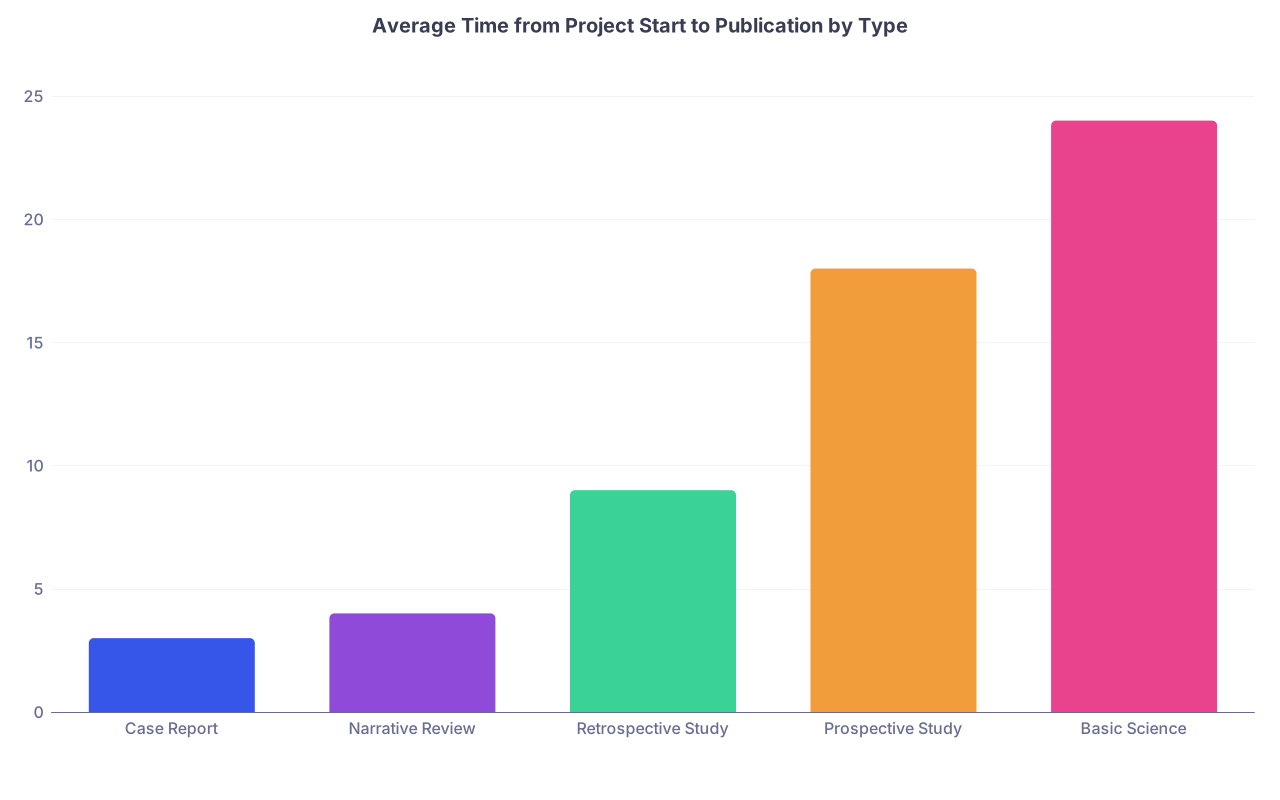
| Category | Value |
|---|---|
| Case Report | 3 |
| Narrative Review | 4 |
| Retrospective Study | 9 |
| Prospective Study | 18 |
| Basic Science | 24 |
Those numbers are approximate but accurate enough for planning.
Fast-cycle (2–6 months from start to “submitted” if you are aggressive)
- Case reports and case series
- Narrative reviews / mini-reviews
- Short communications, letters to the editor
- QI projects with existing data and strong institutional templates
These are your workhorses for “next cycle.” Not glamorous, but PDs do not sneer at a solid PubMed case report in their own specialty journal.
Medium-cycle (6–12+ months)
- Retrospective chart reviews
- Cross-sectional surveys
- Simple database analyses (e.g., NSQIP, NIS) if stats help is available
Worth doing if:
- You already have data access.
- You have a mentor actually committed to publishing within the year.
- You are explicitly promised an early author position and realistic timeline.
Long-cycle (12–36 months+)
- Prospective clinical trials
- Longitudinal cohorts
- Bench/basic science requiring multiple experiments
- Multi-center trials where you are one of 20 data collectors
These are career-builders. They are not cycle-savers.
If an attending now offers you: “We are starting a 2-year prospective cohort” and you are applying in 8–10 months, that is nice. But for this upcoming application cycle, it is almost worthless as a primary strategy.
You can still join. Just do not pretend this is your anchor for “research productivity next cycle.”
Step 3: Build a 12-Month Publication Map (Not a Wish List)
You need an actual plan with dates and deliverables, not “do more research.”
Think in quarters, not in vague “sometime this year.”
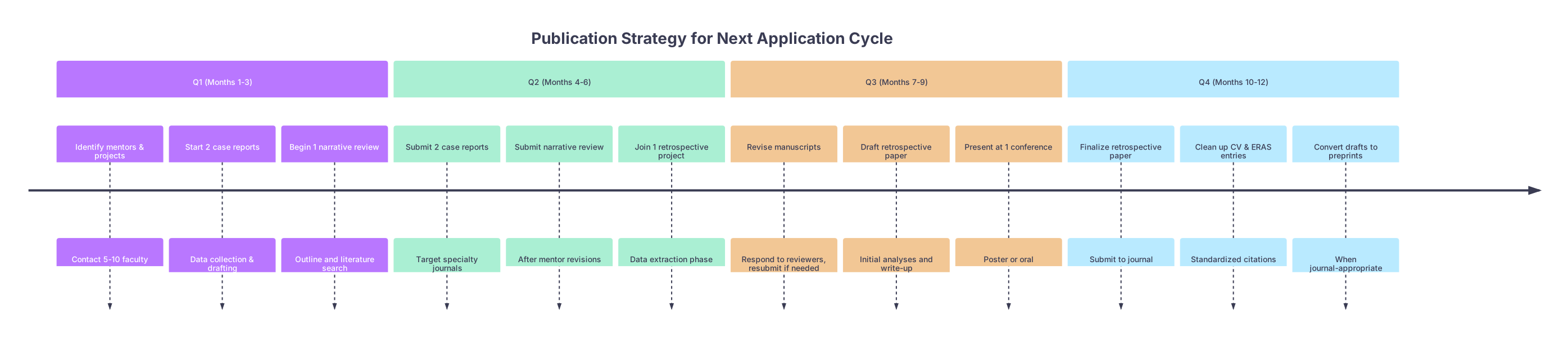
| Period | Event |
|---|---|
| Q1 (Months 1-3) - Identify mentors & projects | Contact 5-10 faculty |
| Q1 (Months 1-3) - Start 2 case reports | Data collection & drafting |
| Q1 (Months 1-3) - Begin 1 narrative review | Outline and literature search |
| Q2 (Months 4-6) - Submit 2 case reports | Target specialty journals |
| Q2 (Months 4-6) - Submit narrative review | After mentor revisions |
| Q2 (Months 4-6) - Join 1 retrospective project | Data extraction phase |
| Q3 (Months 7-9) - Revise manuscripts | Respond to reviewers, resubmit if needed |
| Q3 (Months 7-9) - Draft retrospective paper | Initial analyses and write-up |
| Q3 (Months 7-9) - Present at 1 conference | Poster or oral |
| Q4 (Months 10-12) - Finalize retrospective paper | Submit to journal |
| Q4 (Months 10-12) - Clean up CV & ERAS entries | Standardized citations |
| Q4 (Months 10-12) - Convert drafts to preprints | When journal-appropriate |
That is a realistic outline if you start with almost nothing and are urgent.
You should be aiming for something like this by ERAS opening:
- 1–3 submitted / accepted / published case-based or review papers.
- 0–2 submitted original studies that may not yet be fully published.
- 1–2 posters or oral presentations.
Does every single thing need to be “published” before ERAS submission? No. But submissions should be real, not fiction.
Step 4: Choosing Projects That Will Actually Finish
This is where most students fail: they say “yes” to projects that are structurally incapable of finishing in time.
When you are offered a project, you should immediately interrogate it on four axes:
- Scope – How many moving parts? Multi-site? Heavy IRB? Prospective follow-up?
- Data status – Is data already collected? Partially? Not at all?
- Mentor track record – Does this person actually publish? How fast? Check PubMed.
- Your role – Are you first/second author, or a glorified RA buried at author #12?
Here is a simple quick-screen table. If a project fails 2+ of these, walk away if you care about this upcoming cycle.
| Criterion | Green Light (Good) | Red Flag (Bad) |
|---|---|---|
| Data status | Already collected / near-complete | Not started, complex prospective |
| Mentor history | 3+ papers in last 2 years | 0–1 paper, constant “working on it” |
| Your authorship | 1st or 2nd author guaranteed | “We will see authorship later” |
| IRB / logistics | IRB in place or exempt | Multi-center, no IRB yet |
| Timeline to draft | Draft in 4–8 weeks feasible | “Maybe in a year we will start writing” |
If you are short on time (≤ 9 months to ERAS), you should aggressively prioritize:
- Case reports where the patient is already admitted / seen.
- Reviews where the attending says “I have an outline; I just need someone to run with it.”
- Retrospective projects where “data is already pulled, we just need to write.”
If the PI starts with “We need to design the REDCap database and then train the other sites,” that is a multi-cycle project, not this-cycle material.
Step 5: Making Your Role Unambiguously Strong
PDs are not only asking “Do you publish?” They are asking “Do you know how to actually drive a project to publication?”
You show that by:
- First- or second-author positions on multiple papers.
- Being able to talk, in detail, about the design, limitations, and future directions during interviews.
- Letters of recommendation that explicitly mention your role in getting work across the finish line.
You want at least:
- 1–2 first-author publications (case report, review, or original study).
- A second-author role on something a bit heavier (retrospective / database / etc).
If you are currently 5th–12th author on a big project and that is your only “major” thing, it will not carry your application alone. It counts. But it does not scream “this person can independently produce meaningful work.”
So ask directly:
“If I take responsibility for drafting and coordinating this, can I be first or second author?”
If a mentor refuses to define authorship, fine, you do not need to be rude. You just do not hang your cycle on that project. Take what you can get, but pursue other projects where your role is clearer.
Step 6: Specialty-Specific Strategy (Because It Is Not One-Size-Fits-All)
Let’s talk about a few high-yield specialty patterns.
Competitive specialties (Derm, Ortho, ENT, Plastics, Rad Onc, Urology)
These PDs expect:
- Specialty-related research. Random heme-onc bench work for a derm applicant does not help as much as a single derm case report plus a derm chart review.
- Evidence you know the culture of the field. Presenting at AAD, AAOS, AAO-HNS, ASTRO, etc, matters.
- Often larger average total publication counts for matched applicants.
Your move:
- Prioritize projects that are visibly within the specialty (topic and journal).
- Aim for at least 2–3 specialty publications or abstracts.
- Use any general medicine work as “bonus,” not your main sales pitch.
Academic-leaning IM / Neuro / Peds / Psych
Here, PDs want to see:
- That you can think in a structured, hypothesis-driven way.
- Some alignment between your subspecialty interest and your projects (e.g., stroke work for a future neuro applicant).
- A rising trajectory rather than raw numbers.
Your move:
- Have at least one “serious” project (retrospective or above).
- Use reviews and case reports to flesh out your portfolio.
- If you had weak preclinical performance or a prior fail, show that your academic output has been stronger recently.
Community-heavy or less research-intensive specialties (FM, EM in some regions, anesthesia at certain programs)
These PDs still appreciate publications but are not counting them like derm does.
They care more about:
- Legitimacy: no fake entries, no inflated “submitted” CVs.
- Evidence of curiosity and follow-through.
- Sometimes QI / systems-based work more than classic bench science.
Your move:
- 1–2 well-executed projects (QI, EM case report, anesthesia retrospective) can be enough to flag you as “academic-leaning and reliable.”
- Do not oversell research if your clinical performance is your true strength. Let the publications support your story, not be the entire story.
Step 7: Making Your Work Visible Before It Is Fully Published
PDs care most about PubMed, but they also notice intermediate outputs:
- Abstracts at national conferences
- Posters and oral presentations
- Preprints (depending on field and journal norms)
You should be pursuing multiple simultaneous visibility channels.
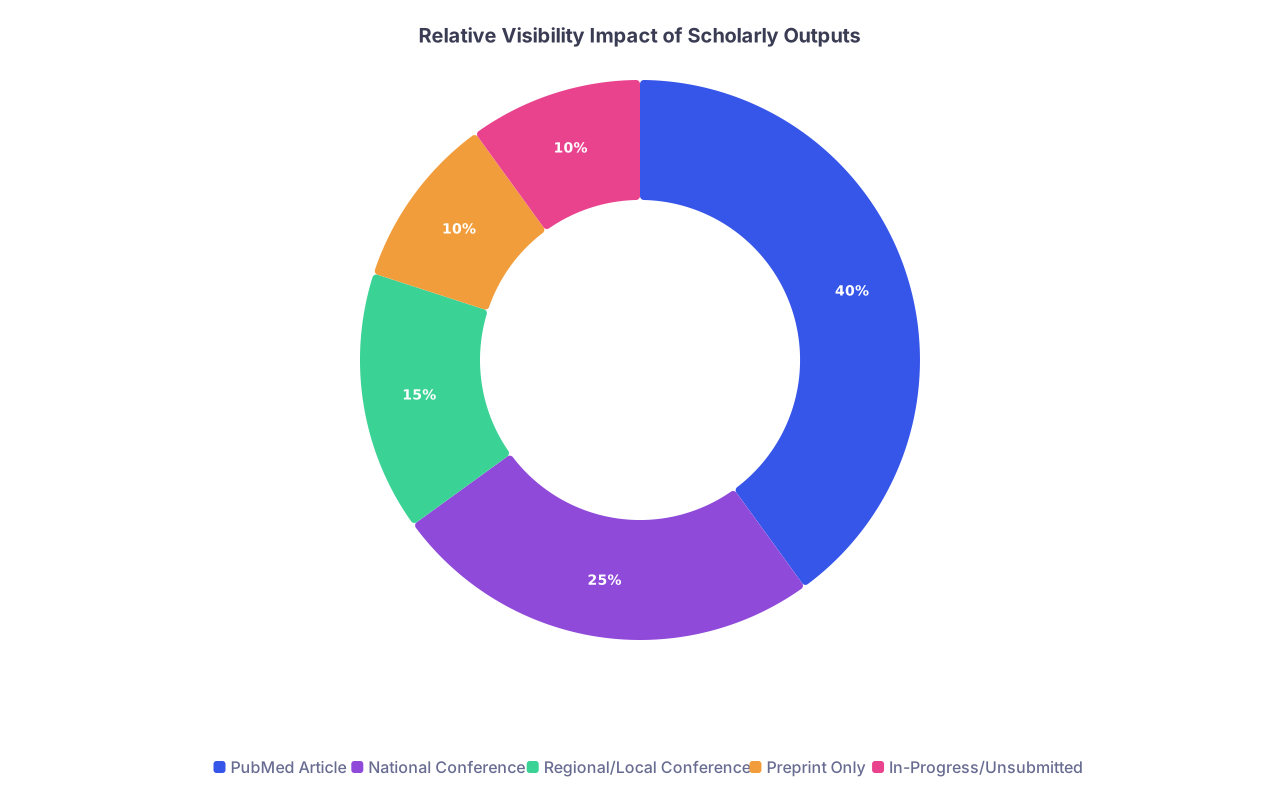
| Category | Value |
|---|---|
| PubMed Article | 40 |
| National Conference | 25 |
| Regional/Local Conference | 15 |
| Preprint Only | 10 |
| In-Progress/Unsubmitted | 10 |
If your paper is not going to be fully published in time, you want at least:
- Abstract accepted to a reputable specialty conference.
- Poster or oral presentation you can list and discuss.
- Preprint on a recognized server (medRxiv, etc.) if your mentor is on board.
Then, in ERAS, you can honestly label it:
- “Submitted,” with conference presentation already done or scheduled.
- “Accepted,” if you have confirmation, even if not yet in print.
Do not invent acceptance. It is career-suicide if caught.
Step 8: How To Present Your Publications So They Look Like What They Are
I have seen many applications where the applicant actually had solid work, but it was buried in a chaotic, inflated, or dishonest-looking research section.
Some rules:
Use consistent, real citation formats.
Journal. Year. Volume. Pages. PMID if available.Separate categories:
- Peer-reviewed journal articles
- Conference abstracts / posters / presentations
- Non-peer-reviewed or “Other scholarly” items (blog posts, book chapters, etc)
Do not mix submitted and published work in one unlabelled list.
For anything not yet published, clearly tag status:
- Submitted
- Under review
- Provisionally accepted
- In revision
Never list something as “In preparation” on ERAS. That belongs in conversations, not as a formal entry. PDs treat “in preparation” as vapor.
Step 9: Using Research In Your Personal Statement And Interviews (Without Sounding Like a Robot)
Research is not just a line item. It is a tool to reinforce your narrative.
In your personal statement, you do not need a detailed methods section. You need:
- 1–2 sentences connecting your research interest to your specialty choice.
- 1–2 concrete examples of what you learned (e.g., working through IRB, data cleaning, or discovering a knowledge gap that shaped your clinical interest).
In interviews, be ready for:
- “Tell me about your most important research project.”
- “What was your role specifically?”
- “What did you find and why does it matter?”
- “What was the biggest challenge and how did you handle it?”
- “If you had more time, what would be the next study?”
If you listed 8–10 projects and cannot speak in depth about any of them, you look like a passenger. PDs remember that.
I have seen candidates win over skeptical committees simply by describing a small, technically simple study with sharp insight and clear understanding of its limitations. That is far more persuasive than hand-waving about “large multi-center experiences” where you “helped collect data.”
Step 10: Common Mistakes That Quietly Kill Your Research Credibility
Let me be blunt. These things look bad, regardless of your scores.
- Listing projects as “Submitted to NEJM” when they have no chance.
- Multiple manuscripts “in preparation” with no drafts or conference submissions.
- Obvious CV padding: counting the same project 3 times in different categories.
- Claimed authorships that do not match what shows up on PubMed later.
- No understanding of basic methods on a paper where you are allegedly first/second author.
Also, do not underestimate the damage of overpromising to mentors. Word circulates. If you repeatedly vanish on projects, miss deadlines, and then try to get letters from those same faculty, you are finished locally. And PDs talk to each other informally.
Step 11: If You Are Already at the Edge of This Cycle
Some of you reading this are 3–4 months from ERAS and just now thinking clearly about research. Your options are limited, but not zero.
Focus on:
- Very fast case reports: find interesting cases from your recent rotations, talk to attendings who publish.
- Rapid reviews: if a faculty member has a half-finished review or an idea that can be executed quickly, volunteer to grind it out.
- Getting already finished work out the door: old QI you never wrote up, a student project that stalled at poster stage, etc.
And just as important:
Do not lie. Do not “upgrade” in-progress projects. Do not backdate fake submissions.
If your portfolio is light, own it and emphasize your clinical strengths, your growth trajectory, and your commitment to doing more in residency. Some PDs will appreciate the honesty more than a bloated, suspicious research section.
A Brief, Realistic Example: 9-Month Turnaround Plan
Say you are an M4 IMG applying to Internal Medicine, with minimal research and 9 months to ERAS.
A realistic, non-fantasy plan:
Month 1–2:
- Email 15–20 IM subspecialty faculty with a very specific, concise message offering help with case reports, reviews, and retrospective projects.
- Aim to lock in:
- 2 case reports where data is already present.
- 1 narrative review with a clear topic and mentor.
- Start writing immediately. Set internal deadlines: first full draft in 3–4 weeks.
Month 3–4:
- Submit the 2 case reports to mid-tier, specialty-aligned journals.
- Submit the narrative review to a journal that commonly publishes trainee work.
- Join 1 retrospective project where data is done or nearly done. Clarify authorship.
Month 5–6:
- Revise the case reports if rejected; resubmit quickly to another journal.
- Abstract submissions:
- If there are upcoming regional/national IM or subspecialty meetings, submit your case reports and retrospective project as abstracts.
- Draft 50–70% of the retrospective manuscript, or at least key sections (Intro, Methods, partial Results).
Month 7–9 (ERAS season):
- By now, you should have:
- 0–2 accepted or e-pub case reports.
- 1–2 “submitted” or “under review” manuscripts.
- 1–2 accepted abstracts for poster/oral.
- Enter them accurately into ERAS with real dates and journals.
Is that going to convert you into a perfect applicant for a top 5 IM program? No. But it will move you from “no research” to “respectable, believable scholarly output with evidence of follow-through.” That is a meaningful upgrade.
The Point Of A Publication Strategy
You are not trying to impress PDs with the illusion that you are an R01-funded PI trapped in a student body. They know you are a trainee. They know you are limited by time, access, and institutional politics.
They are looking for three things:
- Can you carry a project from idea to finished product?
- Does your research portfolio make sense for the specialty you claim to love?
- Does your output show growth, honesty, and reliability?
If your strategy for the next cycle is built around those questions—not prestige fantasies, not vague “I love research” statements—you will make much better decisions about which projects to accept, how to allocate your time, and how to present your work.
With that foundation, your next application cycle will not just list “research.” It will show what you can actually do. And once Match is behind you, the same skills and habits will make your residency research and early faculty career much easier.
With these pieces in place, you are ready to turn the next 6–12 months into real, visible work instead of wishful thinking. How you leverage that into specific program choices and targeted outreach to PDs—that is the next step in your playbook.


