

It is March. Your phone has stopped buzzing. NRMP email is sitting there in your inbox, opened ten times already: “We are sorry to inform you…”
You are in that limbo: not a student, not a resident, staring at a year you did not plan for. Recruiters and advisors are throwing generic advice at you—research, prelim, SOAP, reapply—but no one is giving you a concrete, structured path.
You have 10–12 months. You need something that:
- Fills the CV gap
- Signals maturity and systems-level thinking
- Generates real, discussable content for interviews
- Can be started without a lab, grant, or PhD mentor
That thing, for a lot of unmatched applicants, is quality improvement (QI). Let me show you how to use QI in a gap year like a scalpel, not a band-aid.
1. Why QI Is One of the Smartest Plays in a Gap Year
Let’s be blunt. Not all “gap year activities” are created equal.
Shadowing all year? Looks passive.
Random online courses? Mildly interesting at best.
Unfocused research that never leads to output? Common, unimpressive.
Well-designed QI work, though, hits multiple signals programs care about:
- You understand health systems, not just pathophys.
- You can move a project from idea to implementation to measurable outcome.
- You know how to work with nurses, pharmacists, admin, IT—people you will actually depend on in residency.
Most program directors do not expect unmatched applicants to come back with R01-level research. They do expect you to have done something structured, sustained, and outcome-oriented.
QI is perfect for that.
Why PDs care about QI more than you think
Residency programs are under constant pressure from:
- CLER visits and ACGME requirements
- Hospital quality dashboards (readmission, CLABSI, CAUTI, sepsis bundles, door-to-needle times)
- Patient safety metrics and root-cause analyses
- Value-based purchasing and public reporting
Residents are embedded in this. If you walk into an interview able to discuss a real QI project using concrete language—PDSA cycles, run charts, process mapping, failure modes—you immediately sound closer to “junior colleague” than “fourth-year student.”
Does QI fix a 210 Step 1 by itself? No. But I have seen applicants with mid-range scores and strong, well-executed QI projects get ranked above higher scorers who just looked “average” on paper.
So the question is not, “Should I do QI?”
The question is, “How do I structure a QI year so it actually moves the needle?”
2. Where QI Fits Compared to Your Other Options
You have a finite year. You cannot do everything. Think in trade-offs.
| Option | Time Intensity | Output Potential | Networking | Direct Clinical Tie |
|---|---|---|---|---|
| Bench/Lab Research | High | High (slow) | Moderate | Low–Moderate |
| Clinical Outcomes/Trials | High | High | High | High |
| Full-Time Scribe | High | Low | Moderate | High |
| QI Fellowship/Role | Moderate–High | High | High | High |
| Random Volunteering | Low–Moderate | Low | Low | Variable |
For many reapplicants, the sweet spot is:
- 1–2 substantial QI projects (ideally in your target specialty)
- Some clinical or paid role (scribe, clinical assistant, care coordinator)
- A small amount of exam remediation or extra Step 2 CK prep if needed
QI should not be the only thing you are doing. But it should be the backbone that gives your year structure and a narrative.
3. Finding Access: How to Actually Get Into QI Work
You cannot do real QI sitting at home with PubMed. You need a site—hospital, clinic, FQHC, VA, large private practice—and someone on the inside.
Here is the specific playbook I have seen work repeatedly.
Step 1: Clarify your target and your pitch
Pick 1–2 specialties you are genuinely interested in (and plan to reapply to). Your QI should ideally align.
Examples:
- Internal medicine or family: diabetes, hypertension, readmissions, sepsis bundles
- EM: throughput, door-to-doc time, left-without-being-seen
- Surgery: SSI rates, ERAS protocols, postoperative pain management
- Pediatrics: vaccination rates, asthma action plans, NICU line infections
Your cold email or outreach should be concise and specific. Something like:
“I am an unmatched applicant planning to reapply to internal medicine. I am looking for a 6–12 month opportunity to work on quality improvement projects, ideally focused on chronic disease management, readmissions, or resident education. I am willing to commit X days per week, can help with data collection, analysis, and literature review, and would like to work toward at least one poster/abstract.”
Send this to:
- Program directors and associate PDs
- Hospital quality or patient safety officers
- Department vice chairs for quality
- Clinic medical directors (especially academic or large system clinics)
Do not send a generic “I’ll do anything” email. People in QI are drowning in work; they will respond to concrete, plugged-in offers of help.
Step 2: Leverage your existing school or hospital
Even if you graduated and technically lost your student badge, you have connections:
- Former clerkship directors
- Chiefs you impressed
- Faculty who wrote strong letters previously
Ask them explicitly: “Who in your department is doing active QI work that involves residents? I would like an introduction.”
Hospital quality offices are almost always overextended. If they can get a motivated MD to join projects, they will consider it—especially if a known faculty member vouches for you.
Step 3: Know the typical structures that exist
Many systems already have formal or semi-formal options:
- QI fellow (non-ACGME, sometimes unpaid, sometimes stipend)
- “Clinical quality assistant” or “project associate” roles
- Research assistant positions grafted onto QI
- Volunteer QI roles via GME or quality office
You do not need an official title, but if you can get one, it cleans up the CV.
4. Designing a QI Project That Actually Impresses
Here is where unmatched applicants go wrong: they join something messy, unfocused, or trivial, and end up with a bullet point like:
“Participated in QI project to improve discharge documentation.”
Which means nothing.
You want something that you can talk about with specifics and data. Let me break down what that looks like.
Choose a high-yield topic
High-yield QI topics share three traits:
- Clinically meaningful (real outcomes, not cosmetic changes)
- Measurable with readily available data
- Aligned with institutional or specialty priorities
Examples that play well in interviews:
- Increasing completion of sepsis bundles in the ED from 60% to 85%
- Reducing 30-day readmissions for heart failure by improving post-discharge follow-up
- Improving vaccination rates in a continuity clinic from 72% to 90%
- Reducing unnecessary daily labs on a teaching service to cut costs and iatrogenic anemia
- Improving documentation of discharge medication reconciliation from 55% to 95%
Avoid fluffy projects that sound like:
- “Improve staff satisfaction” with no clear metric
- “Enhance communication” with no defined outcome
- “Redesign handoff templates” without measuring handoff quality or adverse events
Use a real QI framework (and be able to say it)
Most applicants cannot explain the difference between research and QI. That is low-hanging fruit for you.
You want to be able to say in an interview:
“We used a Model for Improvement framework with sequential PDSA cycles, starting with process mapping and baseline data collection.”
The classic structure:
Aim statement: Specific, measurable, time-bound.
“Increase X from A% to B% in Y months on Z unit.”Measures:
- Outcome measure (what you really care about)
- Process measures (what drives the outcome)
- Balancing measures (what might get worse)
Change ideas: Based on evidence, local expertise, and process analysis.
PDSA cycles: Small tests of change, repeated and refined.
Data visualization: Run charts, control charts, before/after comparisons.
If you can describe your project in that language, you sound like someone who has actually done QI, not just touched it once.
5. Month-by-Month Structure: Turning a Year into Output
You have roughly 10–12 months before ERAS goes live again. Let me give you a reasonable cadence.
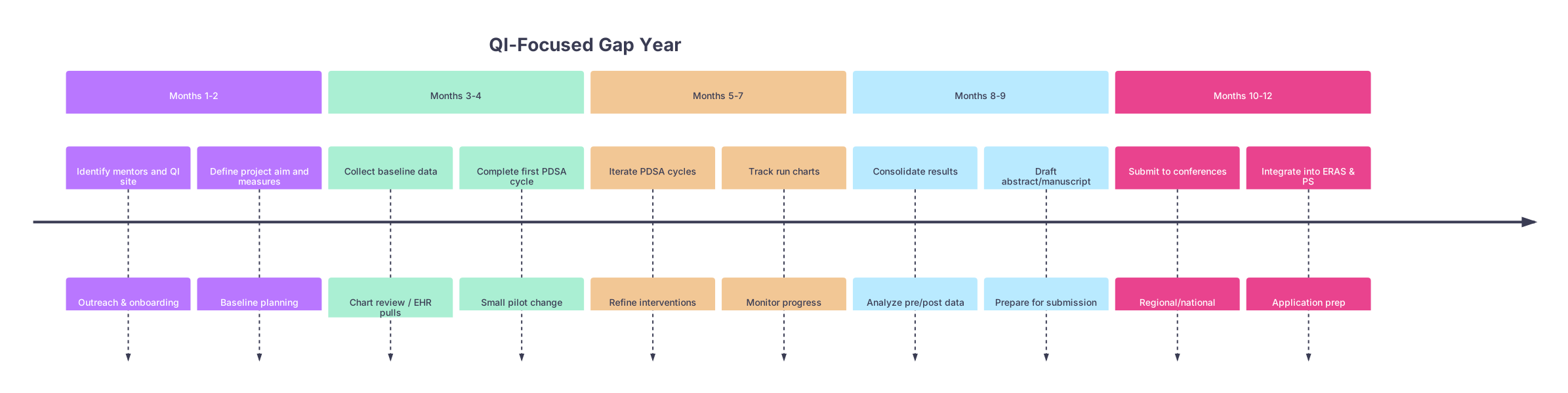
| Period | Event |
|---|---|
| Months 1-2 - Identify mentors and QI site | Outreach & onboarding |
| Months 1-2 - Define project aim and measures | Baseline planning |
| Months 3-4 - Collect baseline data | Chart review / EHR pulls |
| Months 3-4 - Complete first PDSA cycle | Small pilot change |
| Months 5-7 - Iterate PDSA cycles | Refine interventions |
| Months 5-7 - Track run charts | Monitor progress |
| Months 8-9 - Consolidate results | Analyze pre/post data |
| Months 8-9 - Draft abstract/manuscript | Prepare for submission |
| Months 10-12 - Submit to conferences | Regional/national |
| Months 10-12 - Integrate into ERAS & PS | Application prep |
If you are more ambitious, you can run two parallel smaller projects instead of one big one. But do not scatter yourself across five half-baked efforts.
6. Making the Project Measurable (and Publishable)
You are not doing QI just to file things in a hospital’s shared drive. You want:
- Hard numbers
- Graphs you can talk about
- At least one abstract / poster / presentation
You do not need a randomized trial. You do need basic statistical and methodological clarity.
Step 1: Baseline data that makes sense
Decide exactly:
- Who is your population? (e.g., “all adult patients admitted to the teaching service with HF between Jan–Mar 2025”)
- Which time window you are using for baseline vs intervention
- How you will identify them (ICD codes, service lists, clinic schedules)
Common mistakes I see:
- Changing definitions halfway through
- Mixing apples and oranges (e.g., including non-teaching and teaching services together when only one gets the intervention)
- Too few cases to say anything meaningful
Aim for at least a few dozen patients per period if possible. More is better for stability.
Step 2: Run charts and simple statistics
Do not overcomplicate. Residency PDs are not expecting you to run mixed-effects models. They are expecting:
- Run charts over time
- Simple percentage changes
- Maybe a chi-square test or t-test pre vs post if truly appropriate
A typical example:
- Baseline: 60% sepsis bundle completion (n = 80)
- Post-intervention: 82% completion (n = 95), p < 0.01
You can put that in an abstract and a slide without embarrassment.
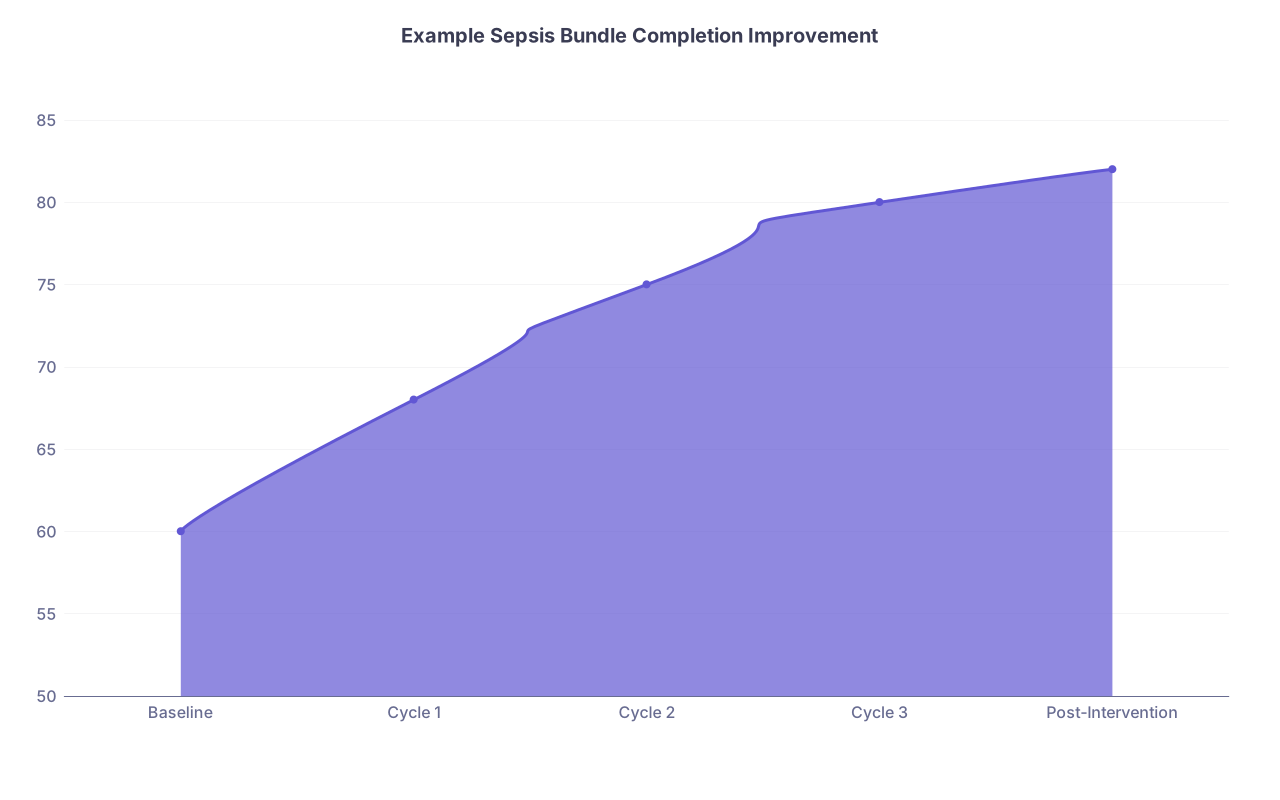
| Category | Value |
|---|---|
| Baseline | 60 |
| Cycle 1 | 68 |
| Cycle 2 | 75 |
| Cycle 3 | 80 |
| Post-Intervention | 82 |
Know how to explain your graph in a sentence or two—do not drown in jargon.
Step 3: Abstracts and conferences
Target conferences that actually accept QI:
- Specialty conferences with QI tracks (SGIM, SHM, ACEP, APSA, CHEST, AAP, etc.)
- Institutional resident/fellow research days (they often accept external MDs if sponsored)
- Local or regional QI symposia run by your health system
Typical abstract structure:
- Background / problem
- Aim statement
- Methods (setting, population, measures, QI framework)
- Interventions
- Results (numbers, graphs)
- Conclusions and sustainability
If you manage one poster at a national or strong regional meeting and one at a local level, that is already solid for a single gap year.
7. Day-to-Day: What Your Actual Work Might Look Like
Let me demystify how this plays out week by week. Because “QI project” sounds vague until you live it.
Typical weekly tasks:
- Pulling data from the EHR or working with an analyst
- Cleaning data in Excel or basic stats software
- Attending a weekly or biweekly QI team meeting
- Presenting updated run charts to the group
- Talking with nurses to understand practical barriers
- Doing short huddles or informal education with residents or interns
- Drafting checklists, order-set changes, or note templates
- Writing up IRB/QI exemption (if your site requires one)
- Gradually building the abstract/poster
If you do this well, you become “that QI person” on the floor. The one residents ask: “Can you help us measure X?” That is exactly where you want to be.
8. Framing QI in Your ERAS Application
You can do brilliant work and still undersell it with bad wording. Let me be specific.
ERAS experiences section
You should treat your main QI project like a prime work experience, not a throwaway bullet.
Bad entry:
“Participated in QI project to improve discharge summaries; attended meetings and reviewed charts.”
Good entry:
“Led multidisciplinary QI initiative on the internal medicine teaching service to increase documented discharge medication reconciliation from 58% to 91% over 8 months using Model for Improvement framework and three PDSA cycles. Developed and piloted a standardized discharge checklist and brief EMR template modifications. Collected, analyzed, and presented run-chart data at monthly departmental quality rounds. Submitted abstract to SGIM 2026 annual meeting (under review).”
That tells a PD: you led, you used a formal framework, you achieved a measurable change, you worked in a team, and you generated scholarship.
Personal statement integration
You do not write a whole personal statement about “QI is my passion” unless you are going into something like hospital medicine or administration. But you absolutely weave it in.
For example:
“During an unexpected gap year after not matching into internal medicine, I joined the quality improvement office at [Hospital]. Working alongside residents and nurses on a project to reduce unnecessary daily labs forced me to think beyond the individual patient and confront the impact of small habits on cost and patient comfort. It was the first time I mapped a process end-to-end, from the night float note that triggered automatic orders to the phlebotomist waking a patient at 4 AM. That experience reframed residency for me: not just as training in clinical decision making, but as full participation in how a system functions and improves.”
Do not hide the no-match. Use QI as evidence of how you responded.
9. How to Talk About QI in Interviews (Without Sounding Scripted)
You will get some version of: “What did you do during your gap year?” or “Tell me about a project you worked on.”
Most applicants ramble. You should be crisp.
I like a STAR-ish structure for your main QI story:
- Situation: “I did not match in 2025 and joined the quality office at X Hospital.”
- Task: “We were asked to address Y problem on Z service.”
- Action: “We defined an aim to increase A to B in C months and used PDSA cycles…”
- Result: “We moved from X% to Y%, presented the results, and the intervention is now standard.”
Have a 90-second version and a 3–4 minute deeper version. Be ready for follow-up questions like:
- “What was the biggest barrier?”
- “What would you do differently?”
- “How did residents react?”
- “How will you bring that mindset to our program?”
Here is what you want to convey, explicitly or implicitly:
- You took ownership instead of sulking through your gap year.
- You understand how messy QI is—people, culture, not just data.
- You learned skills that will help the program’s own QI metrics.
10. Common Pitfalls That Make QI Almost Useless
Let me be direct about where people screw this up:
- Being passive – Just “attending meetings” and waiting for someone to assign tasks. You need to ask for pieces of project ownership from day one.
- Joining a dying project – If a project has been “in progress” for three years with 12 owners already, run. You want something with a clear, time-bounded aim and leadership that actually meets.
- No data – If you end the year with no baseline vs post-intervention data, you essentially have nothing to show.
- No mentor – A QI project with no identifiable champion in the department will not get abstracts accepted or letters written.
- Scope too big – “Fix resident handoffs across the hospital” is not a one-year project for a single person. Narrow the target.
If you detect one of these forming around you, address it early with your mentor, or pivot to a healthier project before you sink months.
11. Getting a Strong Letter Out of QI Work
You want at least one letter from someone who supervised your QI work. But not just any letter. A specific one.
To set this up:
- Meet with your QI mentor around months 2–3 and state explicitly: “If this goes well, I hope you might be willing to write a letter for my reapplication.”
- Give them something to observe: presentations, interactions with staff, your reliability on data deliverables.
- Toward the end, send a packet: your CV, personal statement draft, bullet list of your concrete QI contributions and outcomes.
Good QI letters often include language like:
- “He independently led data analysis for…”
- “She became a point person for residents on the service for this initiative…”
- “He presented our results at the department’s QI forum to a group of faculty and residents…”
- “I would be eager to have her as a resident in our program.”
That is high-yield.
12. Parallel Tracks: Combining QI with Clinical and Exam Work
QI alone will not fix everything. You still need to demonstrate you are clinically engaged and, if your scores or failures were part of why you did not match, you must address that.
Typical effective combination in a 40–50 hour week:
- 20–25 hours: QI work (data, meetings, interventions, writing)
- 15–20 hours: Clinical work (scribing, MA, telehealth coordinator, etc.)
- 5–10 hours: Board prep, question banks, remediation of weak areas
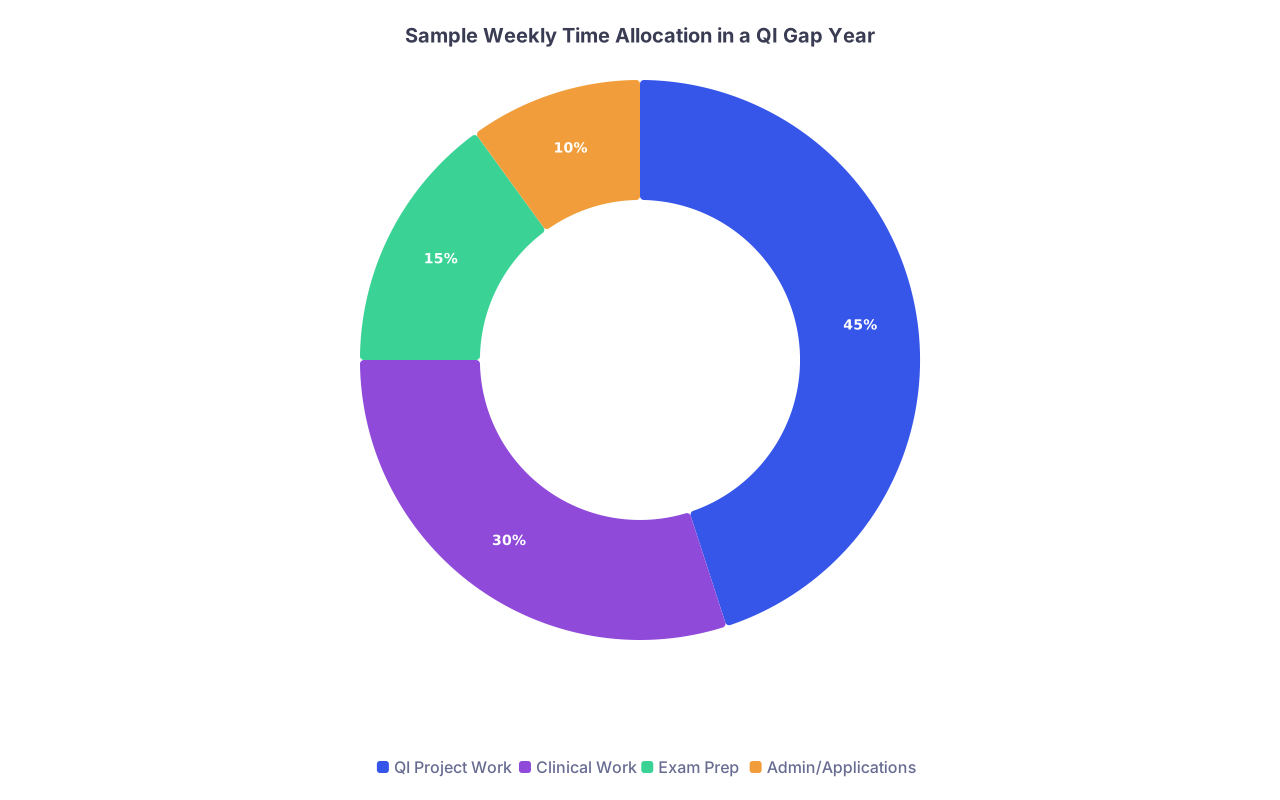
| Category | Value |
|---|---|
| QI Project Work | 45 |
| Clinical Work | 30 |
| Exam Prep | 15 |
| Admin/Applications | 10 |
This blend tells a PD:
- You stayed near patients
- You strengthened your weaknesses
- You contributed to system-level improvement
Much more compelling than “I tutored and did some online modules.”
13. Specialty-Specific Angles You Can Lean Into
If you already know your target specialty, align your QI accordingly.
Internal Medicine / Hospital Medicine
- Readmissions (HF, COPD, pneumonia)
- Sepsis bundle compliance
- Daily lab reduction
- Discharge documentation and follow-up
- Diabetes or hypertension control in continuity clinics
Emergency Medicine
- Door-to-doc time
- Left without being seen (LWBS)
- Pain control metrics
- Sepsis or stroke protocols
- ED boarding and throughput
Surgery / Anesthesia
- Surgical site infection reduction
- ERAS pathways (mobilization, opioids, nausea)
- Pre-op antibiotic timing
- PACU length of stay or pain control
Pediatrics / Family Medicine
- Vaccination rates
- Well-child visit completion
- Asthma action plan documentation
- Developmental screening
The closer your project sits to “things residents see in that specialty daily,” the more naturally it feeds interview conversation.
14. When QI Is Not the Right Centerpiece
I am not going to pretend QI is the magic answer for everyone.
If your main problem is:
- Multiple exam failures
- Serious professionalism issues
- Severe mismatch between your application and your chosen specialty
Then QI should be an accessory, not the core. Your main work then is remediation, new specialty exploration, or addressing the professionalism gaps.
QI is best leveraged when:
- You were close to matching or did match in SOAP but in the wrong fit and are reapplying
- Your scores are okay-to-mid but you lacked differentiation
- You are targeting fields that value systems thinking (IM, EM, peds, FM, psych, surgery to some extent)
If you are aiming at ultra-competitive fields (derm, plastics, ortho) and missed badly, your gap year may need to skew more heavily toward high-level research with known names. QI can still help, but it will not replace the need for big-name letters and publications.
With a year in front of you, the temptation is to scramble and do a little bit of everything, hoping something sticks. That is how people end up with twelve shallow bullet points and no real story.
A focused, well-executed QI project flips that. It gives you:
- A coherent professional narrative: “I learned how systems improve.”
- Concrete results: numbers, graphs, posters.
- A mentor who has seen you show up consistently for months.
- Multiple interview stories that do not sound like everyone else’s.
You went into this year because the match did not go your way. You come out of it either as “the applicant who took a hit and drifted for a year” or “the applicant who turned a setback into a systems-level apprenticeship.”
If you build and own a serious QI project, you are putting yourself firmly in the second category.
With that foundation, the next phase is straightforward: aligning your programs list, tightening your application narrative, and preparing to talk about this work like the near-resident you intend to be. That step—how to rebuild your overall reapplication strategy around what you have done this year—is the next conversation.


