

You just opened your email. “We regret to inform you…” again. Your friends are posting match photos in new cities. You are opening your old ERAS PDF and wondering where it went wrong, and more importantly, what to do differently this time that is not just “apply to more programs and hope.”
This is where most reapplicants make their fatal mistake: vague reflection, generic “I’ll work harder,” no clear priorities, no timeline. Then they recycle 80% of their old application, throw in a couple of new LORs, and are shocked when the result looks the same.
Let me be direct: reapplication is winnable, but only if you treat it like a quality improvement project on yourself. With data. With a problem list. With specific interventions. Not vibes.
This article is a detailed template for a laser‑focused improvement plan for residency reapplicants, especially those considering match alternatives or a non-traditional path back into the Match.
1. Step Zero: Define Your Exact Situation (No Hand‑Waving)
Before you “improve” anything, you need to know what game you are actually playing.
You need hard classification in four domains:
- Specialty competitiveness level
- Applicant type and graduation year
- Objective metrics (scores, attempts, gaps)
- Previous cycle performance
A. Specialty & Competitiveness
Stop pretending all specialties are equal. They are not.
| Category | Less Competitive | Mid-Competitive | Highly Competitive |
|---|---|---|---|
| Examples | FM, Psych, Peds | IM, OB/GYN, EM, Anesthesia | Derm, Ortho, Plastics, ENT |
| Typical IMG Path | Very feasible | Feasible with strength | Rare, requires standout app |
| Score Cushion | Lower | Moderate | Much higher |
If you are reapplying to a highly competitive specialty with multiple red flags and no significant changes, you are not “persevering.” You are burning time. We will talk specialty strategy later.
B. Applicant Profile Snapshot
Write this out. Literally. One page, no excuses:
- MD/DO or IMG (US-IMG vs non-US-IMG)
- Year of graduation
- Step 1: pass/fail or score; any failures; attempts
- Step 2 CK score and attempts
- Any gap years and what you did
- Visa status (if IMG)
- Number of programs applied to, by specialty (last cycle)
- Interview count and where (community vs university; geographic pattern)
If you cannot summarize your profile in a structured way, you cannot improve it.
2. Forensic Autopsy of the Last Application Cycle
You cannot fix what you have not dissected.
A. Quantitative Autopsy: Your “Application Metrics”
Build a simple table with the last cycle:
| Metric | Value Last Cycle |
|---|---|
| Total programs applied | |
| Programs by specialty (e.g., IM 120 / FM 40) | |
| Geographic spread (regions) | |
| Interview offers received | |
| Interviews attended | |
| Pre-interview rejections | |
| Post-interview rejections |
Patterns matter:
- 0–2 interviews after 150+ applications → global competitiveness problem
- 8+ interviews and no match → ranking strategy / interview performance problem
- Strong interview rate but all in one region → geographic / networking dependent
B. Qualitative Autopsy: Honest Feedback
You need outside eyes. At least:
- One program director, APD, or core faculty who reviews your full ERAS (even anonymized)
- One advisor who knows your school and match patterns
- If you had interviews: one faculty interviewer willing to give you post-hoc feedback
Ask them direct questions:
- “Would you interview this application again?” Why or why not?
- “Top three weaknesses that would make a PD pause.”
- “If I were your family member, would you advise reapplying in this specialty?”
Write down everything. Do not argue. Do not justify. You are collecting data.
3. Build a Clinical-Style Problem List for Your Application
Now we create a problem list like you would for a complex patient. No euphemisms.
Categories to consider:
- Exam performance issues
- Academic trajectory problems
- Clinical exposure / recency deficits
- Research / scholarly activity gaps
- LOR quality / quantity problems
- Personal statement and narrative issues
- Interview skills and professionalism concerns
- Specialty choice misalignment
- Geographic / visa / timing constraints
You should end with something like:
- Step 2 CK 214, 2 attempts; no retake possible
- 3-year gap since graduation; last US clinical experience 2.5 years ago
- No US letters from core faculty in target specialty
- 0 research or QI involvement in the last 2 years
- Personal statement generic and non-specific to specialty
- Applied to 70 programs in highly competitive specialty with multiple red flags
That list, ugly as it is, is your starting point. Your improvement plan answers: what will be different and meaningfully better by next ERAS submission?
4. Prioritizing What Actually Moves the Needle
You do not have infinite time. Nor infinite energy. Nor infinite money.
Use this triage:
- High-impact, feasible before next cycle
- High-impact, not feasible before next cycle
- Low-impact / cosmetic
Focus your energy on category 1. Be brutally realistic about timing.
Examples of high‑impact, feasible:
- New high-quality US clinical experience in target specialty with strong LORs
- Concrete, recent, specialty-aligned work (TPN clinic for IM, psych ward, etc.)
- Structured improvement in interview performance
- A step-up in research output if completed with clear role and aligned with specialty
- Tightening and reframing your narrative and specialty choice
Examples of high‑impact, not feasible quickly:
- Improving Step 2 CK score if you have already passed and cannot retake
- Erasing multiple failures or academic dismissals
- Changing year of graduation, major gaps, or visa category
Examples of low‑impact:
- Another generic online “observership” letter with two sentences and no specific praise
- One poster at a minor conference with you as author #12, unrelated to your specialty
- Rewording your personal statement without changing the underlying story
- Random non-clinical volunteer work that is obviously checkbox-filling
You should end with a 1-page “Prioritized Targets” document, listing 3–6 concrete priorities max.
5. Specialty and Strategy: Stay, Pivot, or Two-Tier Plan
Now the uncomfortable part. Specialty choices.
A. Who Should Strongly Consider a Specialty Pivot?
I will be blunt. You should seriously consider switching to a less competitive specialty if:
- You are >5 years since graduation with no strong US-based mentor or sponsor, and
- You have Step failures or marginal scores, and
- You are aiming for a highly competitive or even mid-competitive specialty without a clear differentiator
A typical example I have seen too many times:
- Non-US IMG
- Grad year 2017
- Step 1 pass on second attempt, Step 2 CK 222
- 0 US clinical experiences in last 3 years
- Applying to EM or anesthesia as a reapplicant
This profile marching into EM/anesthesia again is not persistence. It is denial.
B. The Two-Tier Strategy
You can craft a two-tier plan:
- Tier 1: Target specialty (e.g., IM categorical)
- Tier 2: More accessible alternative (e.g., prelim IM, transitional year, FM, psych)
You have to be strategic, not random. For some, a solid prelim IM year with strong evaluations and new letters can turn around an application. For others, that just delays the inevitable.
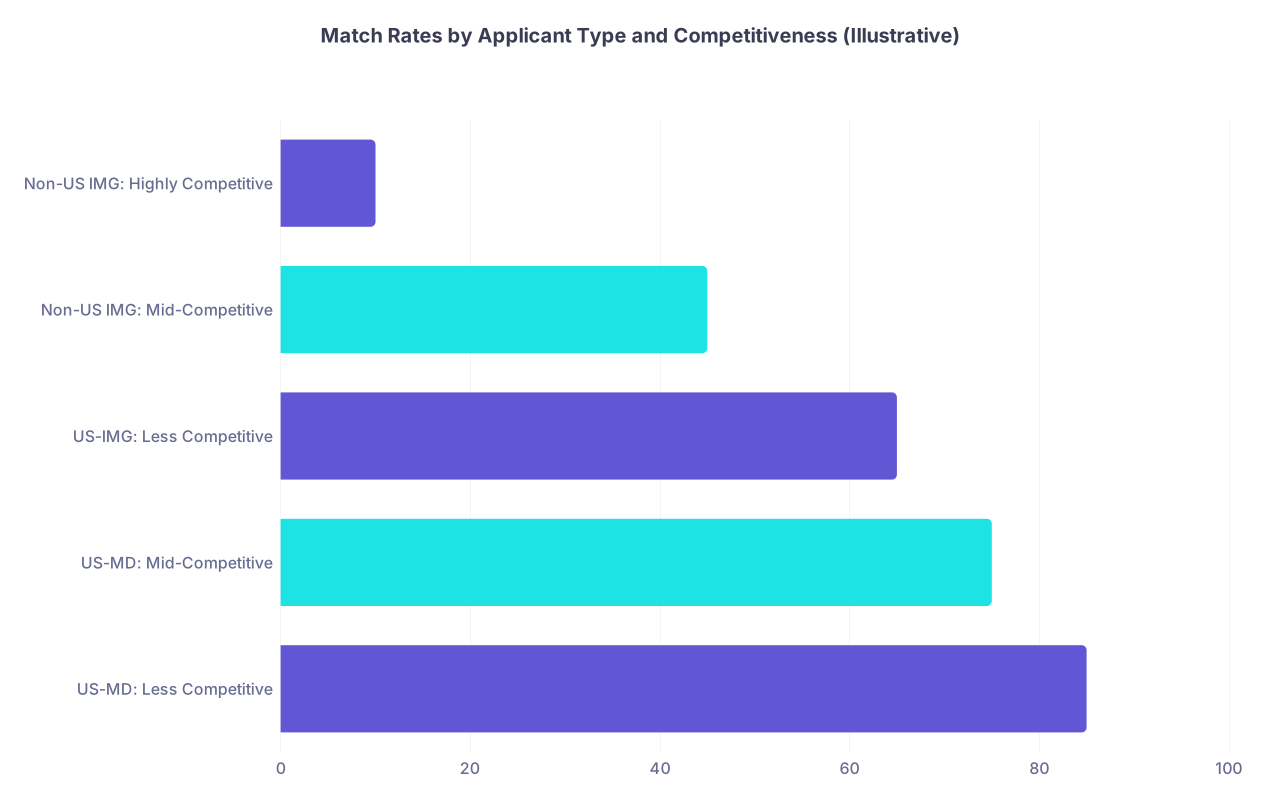
| Category | Value |
|---|---|
| US-MD: Less Competitive | 85 |
| US-MD: Mid-Competitive | 75 |
| US-IMG: Less Competitive | 65 |
| Non-US IMG: Mid-Competitive | 45 |
| Non-US IMG: Highly Competitive | 10 |
You need to see yourself realistically in this kind of distribution.
6. Concrete Improvement Domains and How to Fix Them
Now the meat of your plan. Domain by domain.
A. Clinical Experience and Recency
If your last meaningful US clinical experience was more than 12–18 months ago, that is a problem. PDs want to know: can you function on a ward now, not in 2019.
Your improvement plan should specify:
- Number of months of new clinical work before next ERAS
- Setting: inpatient vs outpatient, community vs academic
- Supervisors: attendings who actually write letters and talk to PDs
- Clear goal: at least 1–2 new, strong, specialty-specific letters
Example plan statement:
Between March and August, complete 4 months of inpatient internal medicine observerships / hands-on roles in community programs that historically rank IMGs, with the explicit goal of obtaining 2 LORs that speak to clinical reasoning, work ethic, and communication.
If you can get formal titles like “research fellow,” “clinical fellow,” or “visiting scholar” with consistent ward exposure, even better.
B. Letters of Recommendation (LORs)
Weak letters sink borderline candidates. And many reapplicants reuse the same mediocre letters.
Your letter strategy should be rewritten, not recycled:
- Minimum: 3 updated LORs, 2 from your target specialty
- At least 1 letter from within 1 year of application
- Prefer letters from people who can say: “I directly supervised X on Y service for Z weeks”
Ask for letters strategically:
- “Would you be comfortable writing me a strong letter for residency applications in [specialty]?”
- Provide your CV, personal statement draft, and specific examples of your work to them
- Follow up with gentle reminders; do not assume it is done until ERAS shows it
If you did not match after a prior cycle with certain LORs, you should ask yourself why you want to use those exact letters again.
C. Exam and Academic Profile
You cannot time-travel your Step scores. But you can:
- Take Step 3 (if appropriate) and score clearly above average to show improvement
- Add meaningful academic products: QI projects, case reports, small publications
Do not take Step 3 just to check a box if you are underprepared. A marginal Step 3 after marginal Step 2 does not help.
A common reapplicant pattern that actually helps:
Non-US IMG with Step 2 CK 219, strong clinical year + Step 3 score 225–230, plus 1–2 publications in the target field. That trajectory—upward—is the story.
D. Research and Scholarship
Research is not mandatory for all specialties. But for mid and high-competitive ones, it is rarely optional.
For a 9–12 month improvement period, realistic goals:
- Join 1–2 ongoing projects with a mentor in your specialty
- Aim for:
- 1 accepted or submitted manuscript where you are 1st–3rd author
- 1–2 posters or abstracts at a regional/national meeting
Choose substantive roles: data collection, analysis, writing. “Literature search only” is code for “did nothing.”
7. Fixing the Narrative: Personal Statement, CV, and Overall Story
Most reapplicants write the same personal statement with a few sentences swapped. PDs are not fooled.
Your story must answer three questions cleanly:
- Why this specialty? (With specific, believable experiences)
- Why should I trust this applicant to show up, learn, and not implode?
- What has changed since last time?
A. Personal Statement: Rebuild, Do Not Edit
You need a new outline:
- Opening: one concrete clinical moment that shows you in action, not just feelings
- Middle: 2–3 experiences that show competence, resilience, and specialty‑specific exposure
- Then: Explicit, concise acknowledgment of prior cycle and what you did about it
- Closing: What you bring to a program and your realistic career goals
You do not write: “I was devastated when I did not match.” PDs know that. You write something like:
I applied in 2024 with an application that lacked recent US clinical experience and letters. Over the past year, I have worked full-time on the inpatient medicine service at X Hospital, where I have… [concrete responsibilities]. This experience confirmed…
Honest. Mature. Focused on growth.
B. CV and Experiences: Clean, Precise, No Fluff
Every new entry must earn its place. Ask:
- Does this show reliability, growth, or specialty‑alignment?
- Would a PD actually care about this when choosing an intern?
Replace old generic entries (“shadowed various physicians”) with concrete, recent, supervised experiences.
8. Interview Performance: The Invisible Problem
If you had 6–10 interviews and did not match, you have an interview problem until proven otherwise.
The improvement plan here needs to be as concrete as Step 2 prep:
Do at least 3–5 structured mock interviews with:
- Someone who has sat on residency selection committees
- Or a faculty member + a brutally honest peer
Record yourself. Watch for:
- Rambling or vague answers
- Over-scripted, robotic responses
- Defensive explanations of red flags
- Poor structure: no clear beginning–middle–end to answers
Script and rehearse answers to:
- “Tell me about yourself.”
- “Why this specialty?”
- “Why our program?” (with actual content)
- “Explain your gap / score / failure.”
- “What did you change since last cycle?”
You should have 3–4 anchor stories you can adapt: a conflict, a challenge, a mistake, a leadership moment.
9. Timeline: Turn Your Plan into a Gantt Chart, Not a Vague Intention
Time matters. If ERAS opens in September, back‑plan from that.
Here is an example timeline for a March start:
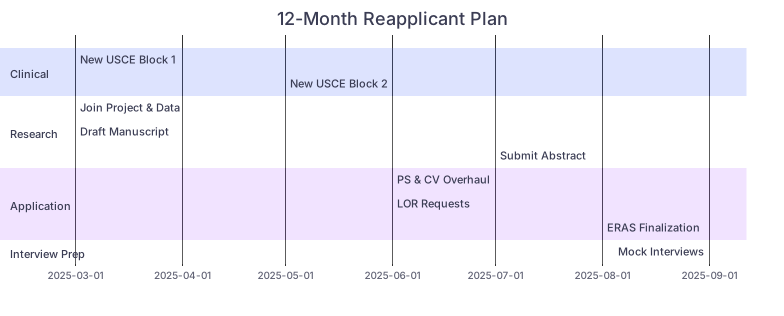
| Task | Details |
|---|---|
| Clinical: New USCE Block 1 | a1, 2025-03, 2m |
| Clinical: New USCE Block 2 | a2, 2025-05, 2m |
| Research: Join Project & Data | b1, 2025-03, 3m |
| Research: Draft Manuscript | b2, after b1, 3m |
| Research: Submit Abstract | b3, 2025-07, 2m |
| Application: PS & CV Overhaul | c1, 2025-06, 1m |
| Application: LOR Requests | c2, 2025-06, 2m |
| Application: ERAS Finalization | c3, 2025-08, 1m |
| Interview Prep: Mock Interviews | d1, 2025-09, 2m |
You should actually draft your own version with real dates and tasks. Then treat it like a serious rotation schedule.
10. Match Alternatives: Using Non‑Traditional Paths Intelligently
This is the “MATCH ALTERNATIVES” category, so let us actually talk about those.
Alternatives are not all equal. Some help you come back stronger. Some are dead-ends dressed up pretty.
A. Prelim / Transitional Year
Good when:
- You can secure a solid prelim IM or TY at a program that historically transitions interns into categorical slots (IM/FM/Psych, sometimes anesthesia)
- You know you can perform well clinically and get strong letters
Risk:
- You work 80 hours a week and have no energy left to improve anything else
- You end the year with “average” evals and no one strongly advocating for you
The plan here must include:
- Clear goals for evaluations and letters
- A realistic strategy to still attend interviews (time off, coverage)
B. Dedicated Research or “Junior Faculty” Roles
These can work if:
- You are embedded with a real team in your specialty
- You gain meaningful mentorship, visibility, and ideally Step 3, plus clinical exposure
- The institution has a history of converting research fellows to residents
This is ideal for someone targeting academic IM, neurology, psych, or anesthesia.
Pure research in a completely unrelated field with zero clinical contact? Less useful.
C. Non‑Resident Clinical Roles (Hospitalist Assistant, Physician Extender, etc.)
These vary wildly.
Good roles:
- Titles like “clinical fellow,” “hospitalist associate,” “resident substitute” in community hospitals with high IMG presence
- Direct responsibility: notes, orders (under supervision), daily patient management
Bad roles:
- Purely administrative or scribe-type jobs sold to IMGs as “clinical fellowships” but in practice no resident-level work, no letters from PDs, and no path to residency
Your improvement plan should name the exact role you are targeting and what you expect to get: “2 letters, US inpatient experience, local networking.”
D. Non‑Clinical Gap Fillers
If you are out of clinical environments entirely, doing something else full time:
- Public health degree
- Industry work
- Teaching or basic science research
These can be neutral or mildly positive if framed correctly, but they do not replace recent clinical work. They are supplemental at best.
11. Putting It All Together: A One-Page Improvement Plan Template
By now you should not be thinking “general improvements.” You should be crafting a document you could hand to a PD and say: this is my reapplication plan.
Here is the structure I recommend:
Applicant Snapshot (Top Box)
- Name, grad year, specialty target(s), key metrics (Step 2, attempts, IMG status)
Problem List (bulleted, max 8 items)
- Each problem clearly stated, no excuses
Prioritized Objectives (3–6 items)
Example:- Obtain 2 new, strong IM LORs from recent US inpatient experiences
- Demonstrate academic upward trend via Step 3 and 1–2 publications
- Rewrite personal statement and reframe narrative with clear growth story
- Enhance interview performance with 5 structured mocks and feedback
Action Plan by Domain
Clinical, research, exams, application materials, interviewTimeline
A simple month-by-month outline up to ERAS submissionContingency / Specialty Strategy
- Primary: Categorical IM
- Secondary: FM or Psych in specific regions
- If no categorical by Jan: aggressively pursue SOAP + plan for next cycle
Once you draft this, run it by:
- One PD or APD
- One advisor familiar with your school’s match outcomes
- One peer who successfully matched in your target field
Refine. Then execute relentlessly.
12. Quick Visual: Where Your Effort Should Go
Most reapplicants spend far too much energy worrying about “number of programs” and far too little on the core application.
Here’s how I would roughly allocate improvement effort for a typical reapplicant with clinical and narrative weaknesses:
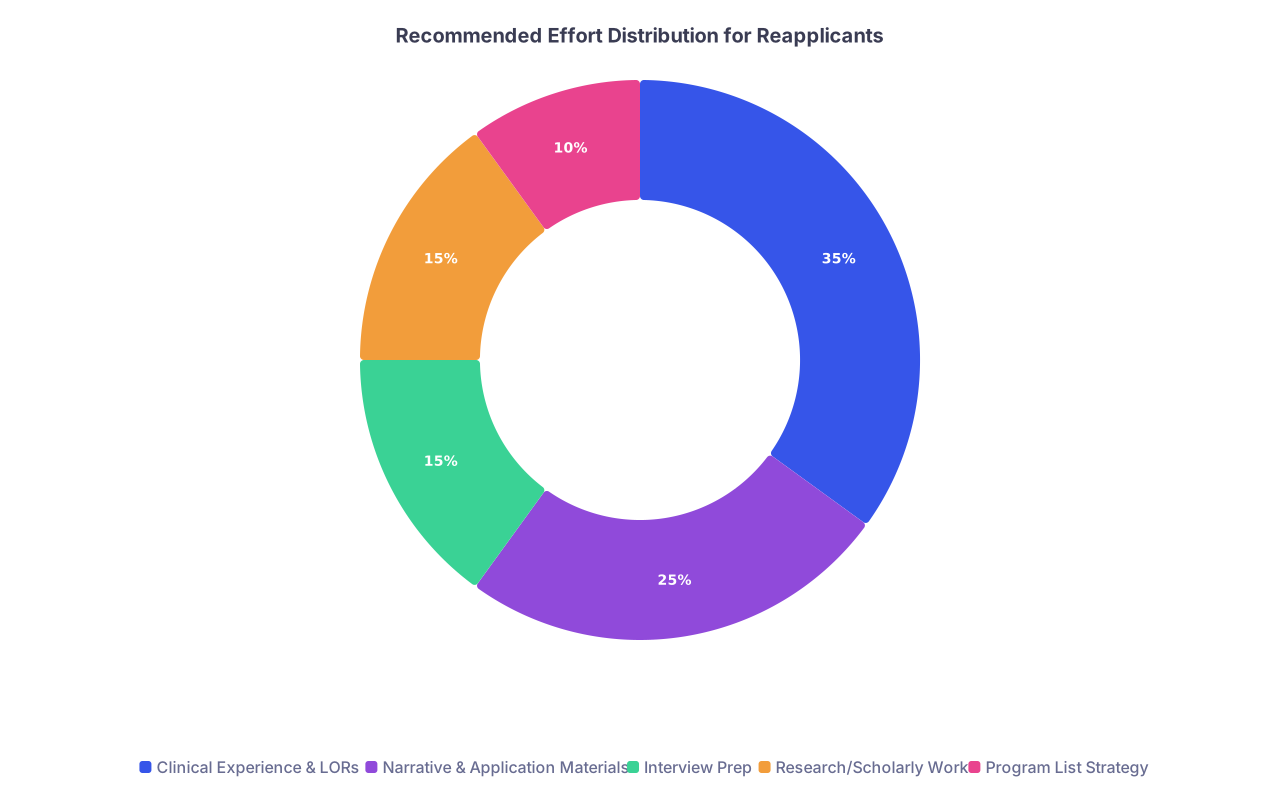
| Category | Value |
|---|---|
| Clinical Experience & LORs | 35 |
| Narrative & Application Materials | 25 |
| Interview Prep | 15 |
| Research/Scholarly Work | 15 |
| Program List Strategy | 10 |
If you are spending 50% of your time fiddling with your program list and 5% practicing interviews, you are doing it backwards.
FAQ (Exactly 6 Questions)
1. Should I mention that I am a reapplicant in my personal statement?
Yes, in most cases. You do not lead with it, but you include a concise, mature acknowledgment in the later part of the statement. Focus on what you learned and how your application is materially stronger now. PDs hate mystery more than they hate red flags.
2. How many new LORs do I need as a reapplicant?
Aim for at least 2 new letters, ideally 3, with at least 2 in your target specialty and dated within 12 months of application. Reusing all old letters screams “nothing changed.” Reusing 1 truly outstanding letter can be acceptable, but it should not be the majority of your file.
3. Is taking Step 3 mandatory before reapplying?
No. But for IMGs and for applicants with marginal Step 2, Step 3 can be a strong signal of academic recovery if you prepare properly and score clearly better. Do not rush into Step 3 unprepared just to tick a box; a mediocre or low score with prior struggles does not help.
4. I got 0 interviews last cycle. Is it even realistic to try again?
It can be, but only if you change something substantial. If your prior application had clear deficits (no USCE, weak or missing LORs, incomplete regions, extremely competitive specialty) and you can fix those, then a second attempt can be reasonable. If you plan to send essentially the same application again, expecting a different result is fantasy.
5. Should I apply more broadly geographically or focus on specific regions?
If you struck out previously, you usually need to broaden. That means community programs, smaller cities, and regions with higher IMG acceptance if applicable. However, “broadly” does not mean random. Your plan should include a reasoned list: programs that historically interview applicants like you, places where you have new connections, and locations tied to your new experiences.
6. When should I stop reapplying and move on?
Harsh but necessary: after two cycles with a genuinely improved application and broad, realistic program list, persistent failure is a loud signal. If your red flags are severe (multiple Step failures, long gaps with no meaningful clinical work, >7–8 years since graduation), there is a point where continued attempts are more self-harm than strategy. At that stage, alternative careers in clinical research, industry, public health, or allied health roles may be a better long-term path.
Key points, and then I am done:
- Treat reapplication like a structured clinical problem: clear problem list, targeted interventions, defined outcomes.
- Change something real. New letters, recent clinical work, improved narrative, better interview skills. Cosmetic tweaks do not move the needle.
- Be strategically honest about specialty choice and alternatives; persistence is useful, denial is not.


