

It is 10:47 p.m. on Tuesday of SOAP week. Your phone is finally quiet. The last “no longer under consideration” email came through 3 hours ago. The dust has settled in the worst possible way: you did not match, and SOAP did not rescue it.
ERAS is open on your laptop. You are staring at the “Experiences” section. Same entries you labored over last summer. Same bullet points you showed to your advisor, your mentor, your roommate. You are asking yourself a very reasonable question:
“Do I have to burn this to the ground and start over?”
Let me be direct: you do not need to start from zero. But you absolutely cannot recycle the same application and hope for a different outcome. Programs already voted on that version of you. Next cycle, you must look like a stronger, clearer, more purposeful candidate—especially in how you frame your experiences.
So let’s break this down clinically. What went wrong, what needs to change, and how to reconstruct your ERAS Experiences section with surgical precision instead of cosmetic fluff.
1. Before You Rewrite: Diagnose What Actually Failed
You do not treat a GI bleed and an acute MI the same way. Same with “unmatched.” The label is the same, the underlying problem is not.
Step 1: Hard data check
Pull your actual numbers and outcomes:
| Metric | Value / Status |
|---|---|
| USMLE Step 1 | |
| USMLE Step 2 CK | |
| Attempts (any Step) | |
| Number of Programs Applied | |
| Number of Interviews | |
| Specialty Applied To |
Now be brutally honest: where are you on the competitiveness curve for your specialty?
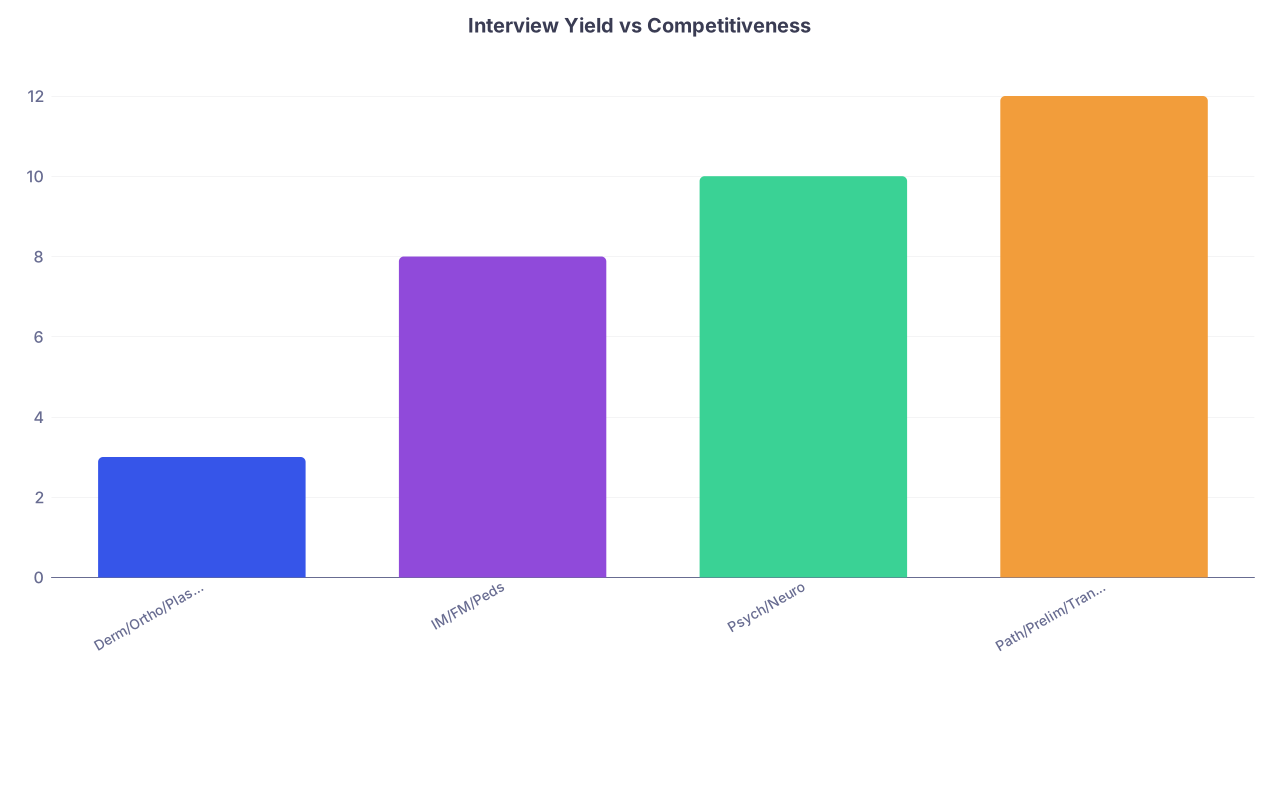
| Category | Value |
|---|---|
| Derm/Ortho/Plastics | 3 |
| IM/FM/Peds | 8 |
| Psych/Neuro | 10 |
| Path/Prelim/Transitional | 12 |
If you applied to a hyper-competitive specialty (derm, ortho, plastics, ENT) with below-average metrics and only a handful of interviews, your Experiences section is part of the story, but probably not the main villain. You may need to re-target specialties or add a preliminary year.
If you applied to IM, FM, peds, psych, or neuro and had reasonable scores and decent geographic spread but still got very few or no interviews, your written application—especially Experiences and Personal Statement—likely underperformed.
That is where reconstruction matters.
Step 2: Pattern recognition from feedback
If any program director, faculty mentor, or advisor gave you feedback, do not hand-wave it away. I have seen the same themes over and over:
- “We could not tell why they wanted our specialty.”
- “Experiences were generic; nothing stood out.”
- “It read like a med student CV, not a future resident’s.”
- “Too many activities, not enough depth.”
- “Red flags under-explained” (LOA, exam failure, gap year, etc.)
Notice those last three. That is your Experiences section. That is fixable.
2. The Real Job of the ERAS Experiences Section
Most unmatched applicants misunderstand what this section is supposed to do.
They think: “List everything I ever did so I look busy and impressive.”
Programs think: “Show me evidence that this person will be a capable, reliable, specialty-appropriate intern.”
Your job now is to rebuild your Experiences section with a very narrow agenda:
- Prove you function well on a team in a clinical environment.
- Prove you can handle responsibility, not just show up.
- Make your specialty interest unavoidable and credible.
- Reduce any concerns raised by scores, gaps, or weak letters.
- Show growth from last cycle.
If an entry does not move one of those needles, it is probably padding.
3. Triage Your Existing Experiences: What Stays, What Goes, What Evolves
Open your last ERAS PDF. Go line by line.
A. Categorize each experience clinically
For each entry, label it with what it actually proves:
- Clinical competence (direct patient care, procedures, triage)
- Systems / leadership (Q.I., chief roles, call scheduling, clinic ops)
- Research productivity (publications, presentations, serious projects)
- Specialty commitment (anything that screams “I live in this field”)
- Character under stress (working through adversity, long-term commitments)
Now ask: did your old application lean too heavily in one direction?
Common problems I see:
- All research, minimal real patient care.
- Tons of shadowing, very thin real responsibility.
- Random short-term volunteering with no continuity.
- Non-clinical hobbies listed at the same “weight” as core experiences.
B. Decide what to delete vs condense
Here is the part people resist: you probably need to delete some things.
Clear candidates for deletion:
- One-off 4–8 hour volunteering events with no clear story.
- Shadowing with no meaningful reflection or takeaways.
- “Member at large” in 6 different student organizations with no concrete duties.
- Generic community service unrelated to your narrative, especially if you just “showed up once a month.”
Better to have 8–12 strong, deep entries than 20+ shallow ones.
If you feel emotionally attached to something but it does not prove future-resident value, consider merging it into a broader “Community Engagement” or “Medical School Activities” umbrella with a shorter description.
4. How to Rewrite Each ERAS Experience: From Fluff to Resident-Level
This is where most unmatched applicants leave a ton of value on the table. They write like college students, not like physicians in training.
Let’s break the anatomy of a strong ERAS entry.
A. Stop writing job descriptions
Bad style I see constantly:
“Served as treasurer for the Internal Medicine Interest Group. Responsibilities included creating budgets, sending emails, organizing meetings.”
No one cares. That could be anyone at any school.
You need three things instead:
- A clear, specific action (what you actually did).
- A concrete outcome (something changed / improved).
- A resident-relevant skill or insight (what this shows about you as a future intern).
B. Use mini-clinical narratives, not bullet-point soup
You have a hard character limit. But you can still write like a human.
Weak clinical experience:
“Volunteered at free clinic once a week, took histories and vitals, worked with attendings to provide care.”
Rewritten for power:
“Student clinician at a weekly free clinic serving uninsured adults. Independently gathered focused H&P’s for ~6–8 patients per shift, then presented to supervising residents. Learned to prioritize problems quickly in a 15–20 minute encounter and close the loop with patients on their plan in plain language.”
Now the reader sees how you function in a clinic. Not just that you stood there.
C. Translate everything into residency language
Take whatever you did and push it one step toward how it plays out as an intern.
For example, research:
Old:
“Worked in cardiology lab studying heart failure. Collected data and assisted with manuscript preparation.”
Rebuilt:
“Cardiology outcomes research focusing on readmission predictors in heart failure patients. Cleaned and managed a dataset of 1,200+ encounters and independently ran multivariate regressions (under faculty supervision). This sharpened my ability to ask specific clinical questions and use data to challenge my assumptions—exactly how I want to approach complex admissions on a busy cardiology service.”
Same work. Different frame. Now it sounds like someone who will actually engage with cases, not just chase lines on a CV.
5. Specialty Pivot or Not: Aligning Experiences With Your Next Move
After not matching, some of you will reapply to the same specialty. Some will pivot. The Experiences section must reflect that choice clearly.
A. If you are reapplying to the same specialty
Your job: show growth and deeper commitment since last cycle.
You need:
- New or expanded clinical experiences in that field (electives, observerships, part-time work, scribe, research year in department).
- Clear progression: “last year I was interested; this year I have lived in this specialty.”
Example shift:
Last cycle entry:
“Completed a 4-week sub-internship in general surgery, participated in pre- and post-operative care and assisted in the OR.”
Next cycle:
“Returned for a second 4-week sub-internship in general surgery at [Program], requested by the attending after prior rotation. Functioned at near-intern level: carried 6–8 patients on rounds, wrote daily progress notes, drafted post-op orders for resident review, and was first call for floor pages on my patients during the day. This confirmed that I enjoy and can sustain the pace of a high-volume surgical service.”
That sounds different. That sounds like growth.
B. If you are pivoting specialties
You must rebuild your Experiences to explain the pivot credibly without sounding like you are “settling.”
Common scenario: You went for a competitive field (ortho, derm, ENT), did not match, now considering IM, FM, psych, etc.
You need to:
- Retain the strongest experiences, but reinterpret them in the light of your new specialty.
- Add at least 1–2 targeted experiences in the new field in this gap year (observership, research, outpatient clinic, hospitalist shadowing with real involvement).
Example: Ortho → IM
Old entry (still useful, but needs translation):
“Completed acting internship in orthopedic surgery. Managed pre- and post-op patients, assisted in joint replacements and trauma cases.”
Rebuilt for IM focus:
“Sub-internship on orthopedics with responsibility for perioperative medical optimization and post-operative management of internal medicine issues (diabetes control, anticoagulation, pain management). This rotation reframed for me how essential strong internal medicine is to safe surgical care and contributed directly to my decision to pursue internal medicine as the foundation of my career.”
Same experience, different lens. That is how you pivot without sounding disoriented.
6. Using the Gap Year / Post-Unmatched Time Intelligently
Programs will absolutely scrutinize what you did between “did not match” and “reapplied.” List it. Shape it. Do not hide it.
A. Clinical work: gold standard if you can get it
Ideal options:
- Categorical prelim or transitional year (if you secured one).
- Non-categorical prelim surgery/med if you are ready to pivot or reapply same field.
- Hospital-based job: inpatient scribe, clinical research coordinator, hospitalist assistant.
- Outpatient heavy clinical work: primary care clinic coordinator, MA-type role (where allowed), PA/NP support.
When you write these, emphasize:
- Volume (roughly how many patients / encounters per shift).
- Responsibility level (triaging calls, prepping charts, reconciling meds, etc.).
- How this made you more “day-1 ready” than last cycle.
B. Research or non-clinical years: how to frame them correctly
A pure research year after an unmatched cycle can look like hiding—unless you present it properly and pair it with some degree of clinical proximity.
Do not write:
“Took a year for research in cardiology. Wrote papers and abstracts.”
Instead:
“Post-match research year in cardiology with >40 hours/week in the cardiology department. Split time between outcomes research and shadowing inpatient consult rounds 1–2 days weekly. The constant exposure to complex heart failure and ACS cases, along with weekly case conferences, has deepened my understanding of the clinical decision-making I hope to be part of as an internal medicine resident.”
The research is fine. The clinical integration is what makes it defensible.
C. Explaining non-clinical work (family, financial, or visa constraints)
Sometimes you simply could not get clinical work. Visa issues. Family obligations. Location constraints.
Do not ignore the gap. Use an entry to name it succinctly and pull out whatever growth is honest:
“Family caregiver for ill parent from March 2025–December 2025. Coordinated medications, appointments, and home health services while managing complex insurance and social work logistics. This period reinforced the vulnerable side of being a patient and sharpened my empathy for caregivers I will work with as a resident. During this time I maintained involvement in [X small research/volunteer activity] to stay connected to medicine.”
You are not excusing; you are explaining. Big difference.
7. Red Flags and Awkward Stories: Where Experiences Help You (and Where They Do Not)
You may have:
- A failed Step attempt.
- A leave of absence.
- Course or clerkship failures.
- Disciplinary issues.
ERAS Experiences is not your confessional. But it can support the narrative you should mainly handle in the Personal Statement and, if applicable, the “Education” interruption/LOA explanation fields.
Use Experiences to:
- Show consistent, reliable performance after the red flag.
- Highlight long-term commitments pre- and post-issue.
- Demonstrate you function well in settings that resemble residency.
Example:
If you failed Step 1 but then passed CK with a solid score, having several experiences that show responsibility, attention to detail, and follow-through helps programs believe the failure was a blip, not a trait.
“Clinical research coordinator in oncology, responsible for consent, protocol adherence, and meticulous data entry” does more for you than “occasional volunteer at blood drives.”
8. Concrete Before/After Rewrites: What This Actually Looks Like
Let me show you some real transformations. These are the kinds of changes that move an application from “generic” to “this person might actually function on our service.”
Example 1: Generic volunteer → clinically meaningful
Before:
“Volunteer at student-run clinic, helped with triage and patient flow.”
After:
“Student-run free clinic volunteer for 18 months (weekly shifts). Led triage for 10–15 patients per shift: obtained focused chief complaints, vitals, and brief histories, then prioritized which patients needed urgent evaluation by the attending. Learned to recognize red-flag symptoms and communicate them succinctly, which mirrors the rapid decision-making interns use during busy call shifts.”
Notice: time commitment, volume, specific tasks, and connection to residency behavior.
Example 2: Leadership fluff → residency-relevant
Before:
“President of Surgery Interest Group. Organized events and lectures for students interested in surgery.”
After:
“President of Surgery Interest Group (elected by peers). Coordinated a 10-session skills workshop series in partnership with the surgery department, doubling attendance compared to prior years (avg 40+ students/session). Managed faculty schedules, room bookings, and supply logistics. This role taught me to anticipate problems, communicate clearly across teams, and keep a busy schedule organized—skills I rely on during call-heavy rotations.”
Now it sounds less like “I held a title” and more like “I have run something complicated before.”
Example 3: Research reframe for a different specialty
Before (for Derm):
“Dermatology research assistant. Studied psoriasis treatment outcomes, assisted with data collection and manuscript writing.”
After (for IM pivot):
“Outcomes research assistant in a psoriasis clinic, focusing on systemic comorbidities (metabolic syndrome, cardiovascular risk) in moderate-to-severe disease. Extracted chart data on blood pressure, A1c, cholesterol, and treatment regimens from 400+ patients. The constant interplay of systemic disease and skin findings pushed me toward internal medicine, where I can manage the full scope of these patients’ health.”
Same raw activity, re-aligned to the new target.
9. Strategic Ordering, Grouping, and Labeling: Subtle but Powerful
Most applicants just throw experiences into ERAS roughly in chronological order and call it a day. That is lazy. You are competing against people who did not do that.
Here is how to be intentional.
A. Order by impact, not just date
Within each category (Work, Research, Volunteer), you can choose the order. Put the heaviest-hitter first.
For a reapplicant, that usually means:
- Most recent and substantive clinical work
- Specialty-specific experiences that anchor your narrative
- Then earlier med school activities
If your strongest experience is technically older but clearly the best demonstration of your abilities, put it top in that category.
B. Use titles intelligently
Do not undersell or oversell.
Bad:
“Volunteer” for a role where you essentially ran clinic flow and managed other students.
“Research assistant” for a position where you were essentially a full-time coordinator.
Better:
“Student clinician and shift lead, free clinic”
“Clinical research coordinator (full-time)”
Still honest. Far more accurate reflection of responsibility.
C. Group short-term things when possible
If you have 5 tiny volunteering roles, consolidate:
Instead of:
- “Health fair volunteer”
- “Flu shot clinic volunteer”
- “Community BP screening volunteer”
Do:
“Community health outreach volunteer (3 events/year). Participated in longitudinal health fairs, vaccination drives, and BP screenings in underserved neighborhoods around [City] over 3 years. These recurring events helped me understand barriers to primary care access and the importance of meeting patients where they are.”
Now it reads as sustained commitment, not scattered busywork.
10. Sanity Check: How Programs Actually Read Your Experiences
Programs are not reading your application like a literary manuscript. They skim under time pressure.
A rough reality check:
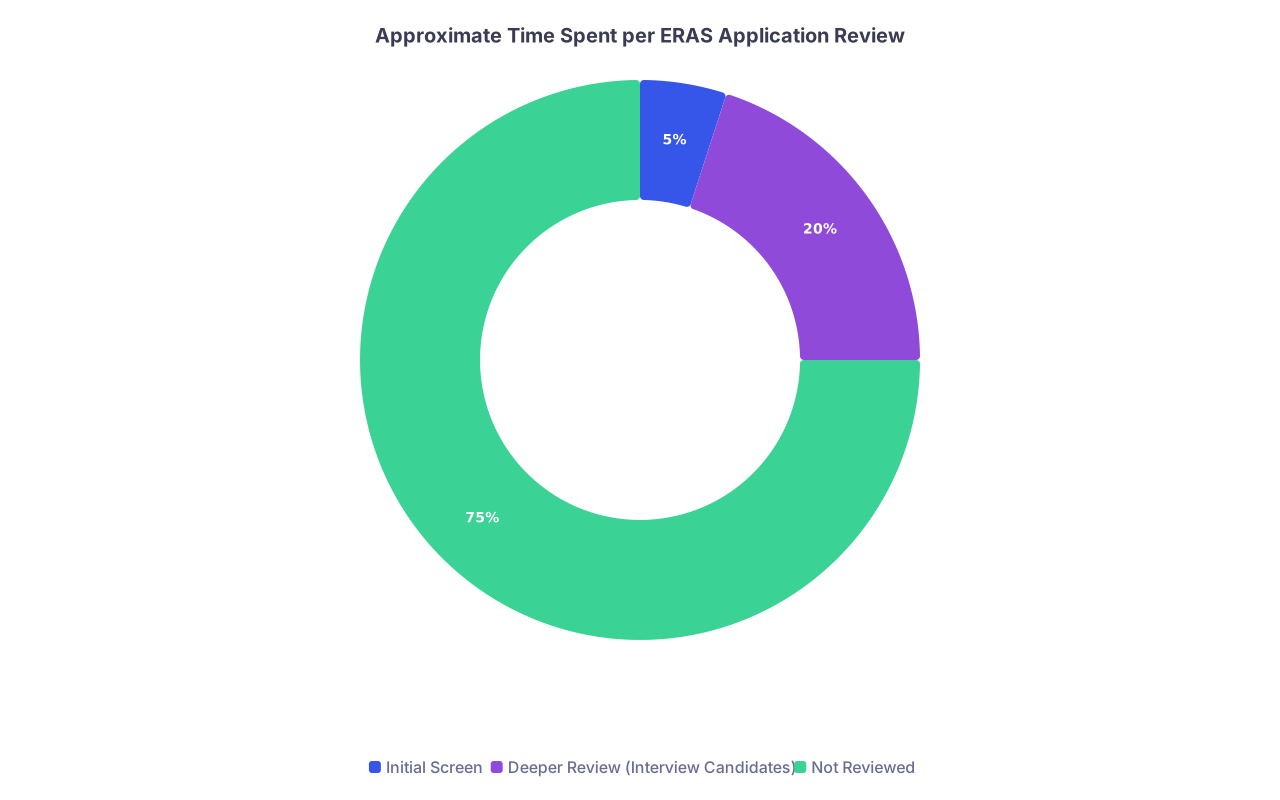
| Category | Value |
|---|---|
| Initial Screen | 5 |
| Deeper Review (Interview Candidates) | 20 |
| Not Reviewed | 75 |
Most applications get 2–5 minutes in the first pass. Many never get a deep read. That first pass is where your reconstructed Experiences have to do their job.
Your test question when rewriting any entry:
“If someone read only this line and my score report, would they see me as:
(a) Generic med student, or
(b) Someone who actually looks like an intern in my chosen specialty?”
If the answer is consistently (b), you are on the right track.
11. Concrete 4–6 Week Plan to Rebuild Your Experiences
Here is what I would tell an unmatched applicant sitting in my office in March.
Week 1–2:
- Print your old ERAS.
- Mark each experience: keep as is, keep but rewrite, merge, delete.
- Decide specialty strategy (reapply vs pivot) with at least one data-informed advisor.
- Start or secure at least one substantial new clinical or research role aligned with your plan.
Week 3–4:
- Rewrite every “keep but rewrite” entry using the action–outcome–resident skill frame.
- Draft new entries for gap-year roles as they start (do not wait 6 months, you will forget the details).
- Reorder entries within categories for maximum narrative punch.
Week 5–6:
- Have a brutally honest person (not your nicest friend) read only your Experiences section and tell you, specialty by specialty: “Does this read like a [X] applicant?”
- Tweak language that sounds too generic, too cliché, or too undergraduate.
- Make sure everything aligns with your Personal Statement and LoR strategy.
At the end of that process, your Experiences section should feel almost unrecognizable compared to last cycle—built on the same skeleton, but functionally a different body.
12. The Bigger Picture: Experiences as Evidence of Trajectory
You are not trying to trick programs into forgetting that you did not match. That is unrealistic and counterproductive. You are showing them something else:
“I took a hit, and here is exactly how I responded. Here is what I built. Here is how I am closer to being a safe, effective intern than I was 12 months ago.”
That is what a reconstructed ERAS Experiences section should communicate:
- Depth, not just breadth.
- Intentionality, not randomness.
- Growth, not stagnation.
If you do this right, a program director looking at your file next season should think something like:
“I see why they had trouble last year. But this is not the same candidate anymore.”
That is the goal.
You are in the ugly part of the story right now—the part no one glamorizes on Match Day posters. But this is where people either harden into better clinicians or quietly fade out. With a clear plan and a reconstructed application, you give yourself a real shot at the former.
With these foundations in place, you are ready to start working on the next pillars—your personal statement, your letters, your specialty targeting. That is where we go next, once you have rebuilt the skeleton of your application here.


