
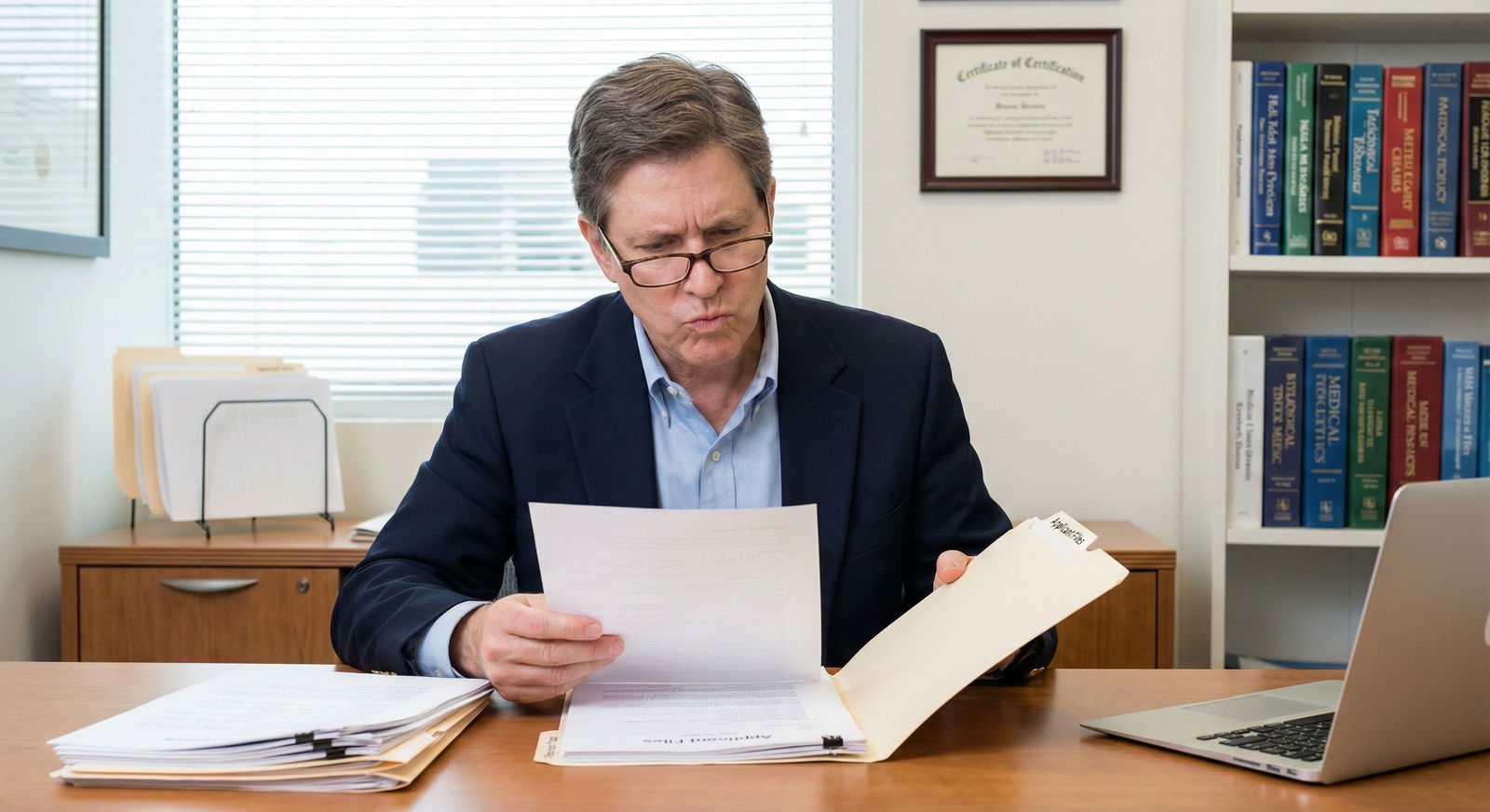
You’re in the interview. Things are going fine. You’ve answered why this specialty, why this city, why this program. Then the interviewer glances down at your file and says:
“I noticed a lower-than-expected clerkship grade on surgery. Can you tell me about that?”
Or:
“There was a professionalism comment in your evaluation. What happened there?”
This is the moment applicants botch all the time. Not because the original issue was fatal. Usually it isn’t. They botch it because they answer the wrong question.
Program directors are not just listening to the story. They are listening for something underneath the story:
- Do you take ownership?
- Do you understand how you were perceived?
- Can you accept coaching?
- Are you the kind of resident who gets better after feedback?
That’s the whole game.
I’ve watched applicants turn a minor issue into a major red flag just by sounding slippery, offended, or weirdly rehearsed. I’ve also seen applicants explain a genuinely ugly evaluation in a way that actually built trust. Same basic problem. Very different delivery.
Here’s how to fix it.
The rule for this entire article is simple:
- Acknowledge the issue
- Explain it briefly
- Redirect to growth
That’s it. Not a courtroom defense. Not a ten-minute autobiography. Not a blame-the-attending monologue. Short. Clean. Adult.
Opening Scenario: The Bad Eval That Suddenly Matters
The frustrating part about a bad eval is that it can sit quietly in your file for months, then suddenly become the center of the interview. One line in the MSPE. One odd clerkship grade. One comment about timeliness, communication, “professionalism,” or “variable engagement.” Suddenly, that’s the thing in the room.
And yes, it feels unfair. Sometimes the eval was based on a bad week, a mismatch with one supervisor, or a rotation where you were struggling quietly and trying not to drown. I get it. I’ve seen all of those.
But in the interview, fairness is not the main question. Judgment is.
The program director is asking: If this happens again during residency, what will you do?
Will you get defensive? Will you blame the system? Will you spin? Or will you identify the issue, take the feedback, and correct course fast?
That’s why your explanation matters more than most applicants realize.
A strong answer does four things:
- names the issue plainly
- gives just enough context
- shows insight
- ends with evidence of change
A weak answer does the opposite:
- gets vague
- blames someone else
- tries to minimize everything
- never shows what improved
Keep one rule in your head for every bad-eval question: acknowledge, explain briefly, and redirect to growth. If you do that well, you can survive a lot. If you don’t, even a small blemish can sound like a recurring problem.
What Program Directors Actually Hear Under the Surface
Let’s translate what applicants say into what program directors often hear. This is where people get burned.
If you say, “That evaluator just didn’t really get me,” the PD hears:
You struggle with feedback and externalize blame.
If you say, “It was only one comment, and I don’t think it was a big deal,” the PD hears:
You minimize concerns instead of addressing them.
If you say, “There were a lot of things going on personally at the time,” and then stop there, the PD hears:
You may be hinting at instability without showing coping or recovery.
If you say, “I got that feedback, and while it was hard to hear, I realized I needed to be more proactive about communicating with the team,” the PD hears:
You can process criticism and improve. Good.
That’s the difference.
Program directors are usually listening for four signals.
1. Accountability
Did you name your part clearly? Not performatively. Not with fake martyrdom. Just honestly.
Good:
- “I was inconsistent with follow-up communication.”
- “I was slower than I should have been in asking for help.”
- “My stress showed up as being too quiet and less engaged.”
Bad:
- “People interpreted me the wrong way.”
- “That service was chaotic.”
- “I think it was mostly a personality fit issue.”
2. Pattern Recognition
One bad eval is survivable. A pattern is dangerous. PDs are trying to figure out which one they’re hearing.
If your answer suggests:
- this happened multiple times
- you still don’t understand why
- you haven’t changed your approach
…then the concern grows fast.
3. Professionalism
Professionalism isn’t just punctuality and dress shoes. It’s how you handle friction. How you talk about other people. How much emotional control you have when discussing disappointment.
Trash an attending in an interview? Bad move.
Sound bitter about a clerkship director? Also bad.
Even if you were right, you still lose.
4. Ability to Improve
This is the part many applicants forget. The interview is not a trial about the past. It’s a prediction about the future.
A strong explanation sounds:
- honest
- concise
- reflective
- forward-looking
That’s what trust sounds like.

The 3-Part Fix: How to Explain a Bad Eval Without Making It Worse
Here’s the protocol I want you to use. Memorize it. Practice it. Use it almost word-for-word if you need to.
Step 1: State the issue plainly
Open with the truth. No throat-clearing.
Examples:
- “I received feedback that I was not communicating updates consistently with the team.”
- “I had a lower clerkship grade than I expected because my performance early in the rotation was uneven.”
- “I received a professionalism comment related to being late twice during a difficult stretch of that block.”
Simple. Direct. Calm.
This immediately tells the interviewer you’re not going to play games.
Step 2: Give brief context without overexplaining
Context matters. Excuses don’t.
Your goal is one to two sentences. That’s it.
Examples:
- “At the time, I was trying too hard to stay out of the team’s way, and I ended up being less proactive than I should have been.”
- “Early in that rotation, I was slower to adapt to the pace and expectations than I should have been.”
- “There was some miscommunication around responsibilities, but I also should have clarified expectations earlier.”
Notice the pattern. Context plus ownership. Not context instead of ownership.
Step 3: Describe what changed afterward
This is the money part. If you skip it, your answer dies.
Tell them:
- what you changed
- how you practiced it
- what improved
Examples:
- “After that feedback, I made a point of giving concise updates before being asked, and my later evaluations specifically mentioned stronger communication.”
- “I started checking in at the beginning of each day about priorities and asking for feedback midway through the rotation instead of waiting until the end.”
- “Since then, I’ve been much more deliberate about time management and backup planning, and I haven’t had that issue recur.”
Then stop. Don’t keep digging.
A script you can memorize
Use this structure:
“I did receive that feedback. The issue was ________. At the time, ________. Looking back, my part in it was ________. I responded by ________, and in subsequent rotations ________. It ended up being an important learning point for me.”
That structure works for almost everything.
Common situations and acceptable framing
Miscommunication
Good:
- “There was miscommunication about expectations, and I should have clarified roles earlier rather than assume I understood the workflow.”
Why it works: You acknowledge the confusion without pretending you were helpless.
Performance inconsistency
Good:
- “My performance improved over the course of the rotation, but the early inconsistency affected the final evaluation. That was fair feedback.”
Why it works: Mature. No drama. No fake outrage.
Trouble adapting to feedback
Good:
- “I was initially too focused on avoiding mistakes, and that made me hesitant. Once I got direct feedback, I changed my approach and became more proactive.”
Why it works: It shows self-awareness, not fragility.
Single lapse
Good:
- “It was a single lapse, but it was still something I needed to own. I adjusted my system right away so it wouldn’t repeat.”
Why it works: You don’t deny the problem just because it was isolated.
What to avoid
Here’s the stuff that reliably makes things worse:
1. Blaming the evaluator
Even if the evaluator was unfair, don’t make your answer sound like Yelp for attendings.
Bad:
- “She was known for being hard on students.”
- “He gave everyone bad evals.”
- “The resident just didn’t like me.”
That kind of answer makes you sound hard to supervise.
2. Giving a long defensive narrative
If your answer has seven side quests, you’ve lost.
Program directors are not looking for every timestamp and witness statement. They’re looking for maturity. Keep it under a minute.
3. Minimizing the concern
Saying “it wasn’t really a problem” is dumb if it’s in the file. The file exists. They can read.
Better:
- “It was a valid concern, even though it reflected a limited period of time.”
4. Sounding rehearsed
Practice, yes. Scripted robot energy, no.
You want polished, not programmed. If your answer sounds memorized down to the comma, it loses credibility. Practice your structure, not a theatrical monologue.
How to Tailor Your Answer to the Type of Problem
Not every bad eval should be answered the same way. A professionalism concern is not the same as a knowledge gap. Treat them differently.
If it was a professionalism concern
Examples: tardiness, communication tone, reliability, responsiveness.
What to emphasize:
- ownership
- specific correction
- no recurrence
Say:
- “I took that feedback seriously because reliability matters. I changed my system immediately by building in earlier arrival time and confirming responsibilities proactively.”
Professionalism concerns scare programs more than academic ones. So your answer has to sound especially steady and corrective.
If it was a knowledge or performance gap
Examples: low shelf, weak presentations, slow clinical reasoning.
What to emphasize:
- concrete improvement plan
- study/process changes
- evidence of growth
Say:
- “That rotation showed me that my preparation method wasn’t translating well to clinical performance. I changed how I prepped patients and presented, and my later evaluations were stronger.”
If improvement came late
This is common. You struggled early, got better, but the final grade stayed mediocre.
Say:
- “My growth happened later than I wanted, so the final evaluation reflects that early inconsistency. The lesson for me was to seek feedback earlier and adjust sooner.”
That answer works because it’s true and adult.
If there was conflict with a team member
Be careful here. This is where applicants get petty.
Say:
- “There was tension in communication style on that team, and I learned I needed to address misunderstandings earlier and more directly.”
Don’t say:
- “The resident was toxic.”
- “They were out to get me.”
- “It was all politics.”
Maybe true. Still a bad answer.
If the evaluation was unfair or biased
Here’s the safest move: acknowledge without endorsing the entire judgment.
Try:
- “I don’t think that feedback reflected my overall performance across training, but I still took seriously the part of it that pointed to communication and clarity.”
- “That evaluation came from a difficult working dynamic, but I focused on what I could learn from it and made changes in how I checked expectations early.”
That keeps you from sounding accusatory while still protecting yourself from fully confessing to something distorted.
Isolated issue vs pattern
If it was isolated, say so briefly and support it:
- “That was an isolated issue, and it wasn’t repeated in later rotations.”
If it was part of a broader pattern, don’t lie. Own it and show trajectory:
- “I had a pattern early on of being too hesitant to ask questions. Once I recognized it, I worked on being more proactive, and that improved meaningfully.”
Pattern plus insight is survivable. Pattern plus denial is not.
Examples of Strong vs Weak Explanations
Here’s what this looks like in real interview language.
Prompt: “Tell me about this lower clerkship grade.”
Weak:
“Honestly, I thought I performed much better than that, and the grading on that service was inconsistent.”
Strong:
“I had an uneven start on that rotation and was slower than I should have been to adapt to the service’s pace. Once I got feedback, I changed how I prepared and checked in more proactively, and my later rotations were much stronger.”
Prompt: “What happened with this professionalism comment?”
Weak:
“It was really blown out of proportion.”
Strong:
“I did receive that comment, and I took it seriously. I had a lapse in communication during a busy stretch, and I should have handled that better. Afterward, I built a more deliberate habit of updating the team early, and that issue didn’t recur.”
Prompt: “Was there a conflict on this rotation?”
Weak:
“The resident and I just didn’t click.”
Strong:
“There was a communication mismatch on that team, and I learned I needed to clarify expectations earlier instead of assuming things would smooth themselves out. That changed how I approach new teams now.”
Prompt: “Why did your performance improve later?”
Weak:
“I’m just someone who takes time to warm up.”
Strong:
“My improvement came later than I wanted, and that taught me I need feedback earlier, not after the rotation is basically over. Since then, I’ve been more intentional about asking for midpoint feedback and adjusting in real time.”
Mini self-edit checklist
Before interview day, check your answer against this list:
- Did I name the issue clearly?
- Did I keep context to 1–2 sentences?
- Did I own my part?
- Did I describe a specific change?
- Can I say it in under 60 seconds?
- Did I remove blame, bitterness, and oversharing?
If not, tighten it.
How to Recover If the Interview Starts Going Sideways
Sometimes you start answering and realize you’re rambling. Or your voice tightens. Or you can feel yourself getting defensive. It happens. Fix it fast.
Recovery protocol
Pause Take one breath. A two-second pause feels long to you, not to them.
Reset with a clean sentence Try:
“Let me answer that more directly.”Return to facts Name the issue in one sentence.
End with growth Show what changed and stop talking.
Rescue phrase
Use this if you’re drifting:
“The short version is: I got that feedback, I took it seriously, and I changed how I handled it.”
That sentence can save a messy answer.
Then close strong:
- “It made me more deliberate about feedback.”
- “It improved how I function on teams.”
- “I’m better prepared for residency because of that experience.”
That’s the move. Calm. Clean. Forward.
Conclusion: Turn the Bad Eval Into a Trust-Building Moment
Program directors do not need a perfect applicant. They need a trustworthy one.
A bad eval does not automatically sink you. A defensive, blame-filled, rambling explanation absolutely can.
So prepare your answer now. One clear explanation. One lesson learned. One concrete example of improvement. That’s enough.
Say it out loud. Trim the extra words. Get someone blunt to listen and tell you where you still sound defensive. Then practice again until the answer feels natural and steady.
That’s how you turn an awkward file detail into evidence that you can take feedback, recover, and grow. Which, frankly, is a lot closer to real residency than pretending you’ve never struggled.