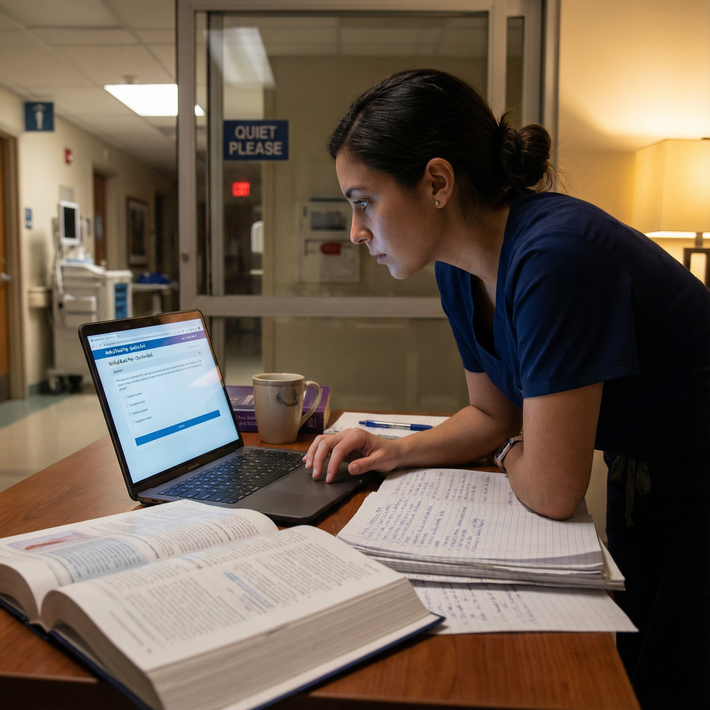
You passed your In-Training Exam. Congrats. Now your brain won't shut up about how you're still going to fail the real boards and tank your entire career. I get it. I've been that resident refreshing the score report at 2 a.m., convinced one mediocre percentile means the match was a fluke and I'll be the cautionary tale everyone whispers about.
This isn't another "just study harder" pep talk. It's the panicked, worst-case-driven survival guide I wish someone had shoved at me when my ITE felt like a death sentence. Because the fear is real, and if you let it run the show, it becomes a self-fulfilling prophecy.
The Panic Attack: Why Your ITE Score Feels Like a Death Sentence
Seeing that number hit like a gut punch. You open the email, scan the percentile, and suddenly every attending who ever praised you was just being polite. Your residency is over. You'll never get a fellowship. You'll fail boards, lose your license, and end up explaining medical terms to your Uber passengers. I know the spiral. I've lived it.
Here's the brutal truth nobody says out loud: that single ITE score does not equal automatic board failure. Failing boards is almost never about one bad day of testing. It's the slow drip of bad habits, skipping weak topics, passive rereading, sleeping four hours and calling it "dedication", that compound until the real exam exposes them. Your ITE is a diagnostic, not a verdict. Treat it like one.
But the anxiety loop is vicious. You panic → you freeze → you avoid the material that scares you → you walk into boards even less prepared. I've watched residents spiral exactly this way. They stare at their total score for weeks, convinced they're broken, and never open a single UWorld block. That paralysis, not the original number, is what actually tanks people.
Reality check from the trenches: most residents who bomb an early ITE recover. They don't magically get smarter. They get targeted. You're not defective. You're underprepared in specific, fixable ways. The residents who never recover are the ones who stay stuck in the "I'm doomed" fog instead of doing the ugly triage work.
Stop rehearsing the catastrophe. Start treating the score like a map of where you're bleeding.
Triage Your Weaknesses: The Data You're Ignoring
Obsessing over the overall percentile is useless theater. It feels productive, like if you just stare hard enough the number will improve, but it keeps you from seeing the actual holes. I wasted an entire month after my PGY-2 ITE doing exactly that. Total score haunted me. Content breakdown? Ignored.
Look at the sections. Where did you hemorrhage points? Cardiology? Biostats? Ethics? Then go deeper. Are you missing those questions because you literally don't know the guidelines, or because you rush the stem and pick the first shiny distractor? Pattern matters more than the raw count.
Watch for the false-confidence trap that tanks board prep. Those topics you "know" but keep missing? That's ego talking. I thought I owned heart failure management until I realized I was consistently choosing outdated diuretic strategies. Humbling. Necessary.
Actionable step this week, no excuses: pull your score report and build a Red Flag list of 3-5 topics that account for most of your misses. Not twenty. Three to five. Write them on a sticky note and put it on your laptop. Those are your non-negotiables until the next assessment.
That chart is what actually matters. Knowledge gaps are fixable with targeted reading. Application errors need deliberate practice under timed conditions. Anxiety/rushing needs slower stems and sleep. Pretending it's all "I'm just bad at tests" keeps you stuck.
Survival Mode Study Tactics for Clinical Years
You don't have protected study months anymore. You're on service, exhausted, and the board date is still coming. So stop pretending you can read every Amboss explanation like it's Step 1. Apply the 80/20 rule ruthlessly: identify the high-yield concepts that show up repeatedly and master those. The obscure zebra can wait.
Active recall is non-negotiable when time is short. Flashcards. Self-quizzing. Closed-book teaching to an empty call room. Passive review feels safer, you're "covering material", but it evaporates under pressure. I learned this the hard way after rereading the same cardiology chapter three times and still blanking on the exam.
Integrate with whatever rotation you're on. See a CHF patient? That night you review the latest HF guidelines and hammer ten related UWorld questions before you crash. The knowledge sticks because it's attached to a real face and a real note you wrote. This is the only efficient system that survives 80-hour weeks.
And protect your sleep like it's a controlled substance. Sacrificing another hour of rest for "just twenty more questions" is dumb. Cognitive decline is real. Retention tanks. You wake up dumber than when you started. I've done the math on myself: six solid hours plus focused blocks beats four hours of zombie scrolling every single time.
Here's the loop that actually works when you're rotating:
Run that cycle every week and the gaps close without requiring a sabbatical.
Preventing Burnout: The Silent Board Killer
Chronic fatigue. Snapping at nurses. Staring at a question stem for five minutes and absorbing nothing. Those aren't badges of honor. They're warning lights that your brain is offline and boards will expose it.
I used to wear exhaustion like a medal until I realized I was retaining almost nothing. Strategic disconnection is not optional. Schedule actual non-medical breaks, walk outside without a podcast, cook something that isn't protein bars, text a non-medicine friend. Mandatory. Put it in the calendar the same way you put in Q banks.
Talk to the other residents who are also quietly panicking. The shame shrinks fast when you realize half the call room is in the same boat. Isolation feeds the worst-case stories. Connection starves them.
And if you need professional help, counseling, coaching, meds for the anxiety that won't quit, get it. Asking is resilience, not weakness. The residents who refuse help are the ones who crater hardest. I've seen both outcomes. Choose the one that keeps you functional.

Your ITE score is a diagnostic tool, not a verdict. Focus on the specific content gaps rather than the overall percentile. Consistency beats intensity during clinical years, integrate board prep with daily patient care so you're not inventing extra hours that don't exist. Burnout actively impairs memory retention, so sleep and mental health are study strategy, not luxuries. Seek support early; connecting with peers and mentors normalizes the struggle and hands you solutions instead of shame.
You've already survived worse nights than this. The boards are coming whether you spiral or not. So open the report, build the red-flag list tonight, and start the loop tomorrow. Worst case you're still here, still fighting. Best case you walk out of that exam knowing you closed the gaps instead of feeding the panic.
Do the triage. Protect the sleep. Talk to someone. You've got this, even if your brain is currently screaming otherwise. Now go fix one red flag before the dread wins again.