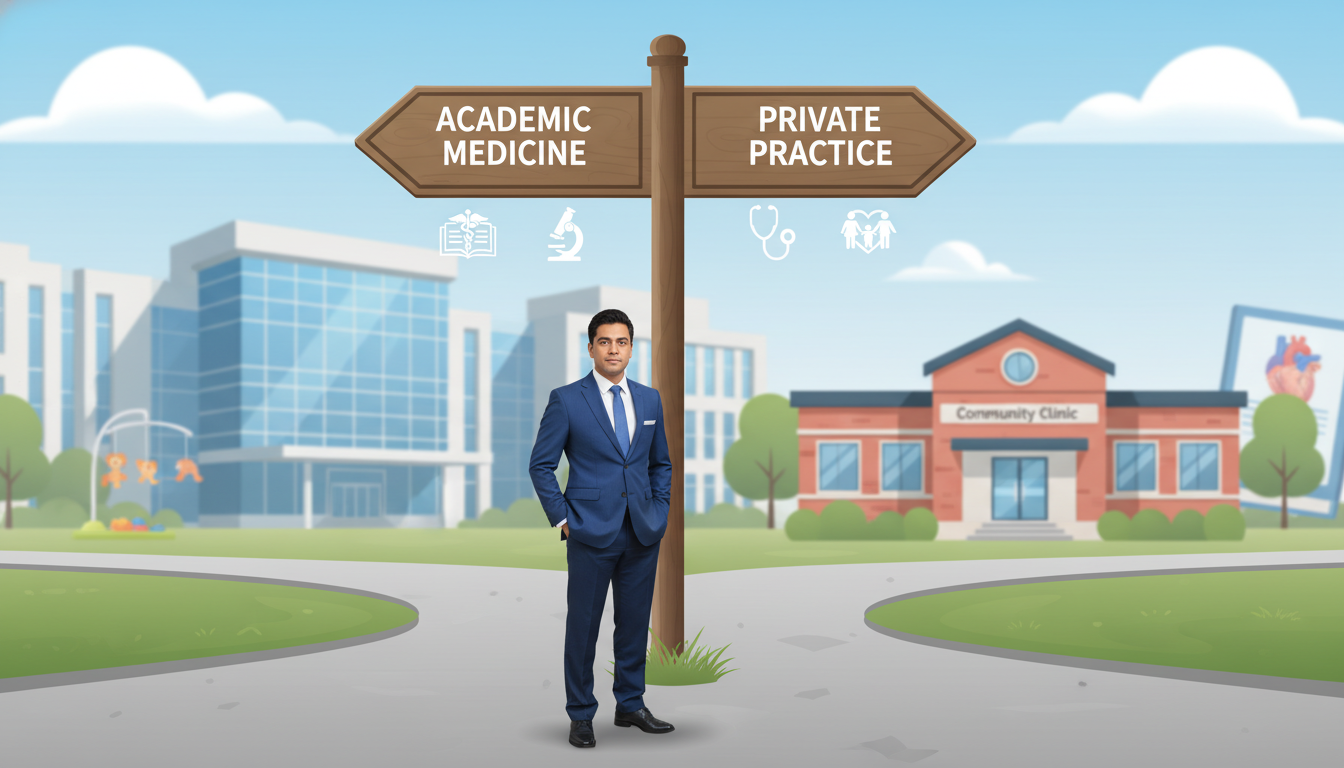
Understanding Your Options as an IMG in Medicine-Pediatrics
For an international medical graduate (IMG) who has matched or is planning to match into med peds residency, one of the biggest long-term decisions is choosing between an academic medicine career and private practice. Both paths can be highly rewarding, but they differ significantly in daily work, expectations, income, immigration implications, and long-term growth.
This IMG residency guide focuses specifically on Medicine-Pediatrics (Med-Peds) physicians and walks through how to think about academic vs private practice in the United States, with a special lens on IMG realities.
We will cover:
- What “academic” vs “private” practice actually mean in Med-Peds
- Typical workdays, responsibilities, and compensation
- Visa and green card considerations for each path
- How to align your choice with long-term career goals
- Practical steps during residency to position yourself for either track
Throughout, remember: there is no universally “better” option. The right choice is the one that fits your values, risk tolerance, family situation, and career aspirations.
Academic Medicine in Med-Peds: Structure, Pros, and Cons
Academic medicine is usually defined as working in a setting where the core missions are clinical care, teaching, and research, often within a university-affiliated or teaching hospital system.
For a Med-Peds physician, this can include:
- University hospitals
- Children’s hospitals with academic affiliations
- Large teaching community hospitals
- VA systems and some large integrated health systems
What Does an Academic Med-Peds Job Look Like?
A typical academic Med-Peds position may include:
Clinical care
- Adult medicine (often in a hospital-based clinic, continuity clinic, or inpatient service)
- Pediatric medicine (similarly split between outpatient and inpatient)
- Combined Med-Peds clinics (transition clinics, complex care, young adult clinics)
- Possible focus areas: hospitalist, primary care, subspecialty, urgent care, or combined roles
Teaching
- Supervising residents (IM, Pediatrics, Med-Peds) in clinic or on wards
- Bedside teaching, morning reports, case conferences
- Lectures or small-group sessions for medical students
- Curriculum development or quality improvement teaching projects
Scholarship/Research
- Quality improvement projects
- Clinical research or outcomes research
- Educational scholarship (curriculum, simulation, assessment projects)
- Publications, conference presentations, and involvement in committees
Often, academic job descriptions reflect this mixed mission, such as:
0.6 FTE clinical, 0.2 FTE teaching, 0.2 FTE scholarly activities.
The exact distribution varies widely among institutions and even within departments.
Advantages of Academic Medicine for IMGs in Med-Peds
- Structured Mentorship and Professional Development
Academic institutions usually offer:
- Formal mentorship programs (peer, senior faculty, sometimes IMG-specific)
- Regular feedback, promotions pathways, and faculty development workshops
- Support to attend conferences (Med-Peds national meetings, ACP, AAP, etc.)
For IMGs, this can be particularly valuable because you are learning a new system culturally and administratively. Mentors can help you navigate:
- Promotion criteria (e.g., from Instructor to Assistant Professor to Associate Professor)
- Balancing clinical work with scholarly productivity
- Attending national conferences to build your network
- Clear Visa Sponsorship Opportunities
Many academic centers are experienced with IMG visas and immigration issues. They often:
- Sponsor H-1B visas for attending-level positions
- Are familiar with J-1 waiver programs (e.g., Conrad 30, Veterans Affairs, HHS)
- Have dedicated international office or HR immigration specialists
- May be able to sponsor employment-based green cards (EB-2, NIW in some cases)
While not universal, academic centers are often perceived as “safer” for IMGs regarding long-term immigration planning, especially for those interested in research or teaching that may support a strong academic medicine career and green card application.
- Opportunities in Education and Leadership
If you enjoy teaching and mentoring, academic medicine is the natural environment to:
- Become a residency core faculty member or associate program director
- Lead a Med-Peds continuity clinic or transition clinic
- Shape Med-Peds curriculum and simulation training
- Eventually pursue roles like program director, vice chair of education, or department chair
These roles can be particularly fulfilling if you aspire to:
- Influence training of future generations
- Advocate for Med-Peds as a specialty
- Improve transition care for youth with special healthcare needs
- Intellectual Environment and Research Support
Academic settings often provide:
- Access to statisticians, IRB submission support, and grant offices
- Opportunities to collaborate on multicenter studies, clinical trials, or QI networks
- Protected time (in some roles) for research, QI, or curriculum work
For IMGs interested in building a research-oriented CV to support an academic medicine career or long-term leadership roles, this environment can be extremely advantageous.
- Brand and Pedigree
Having “University of X” or “Children’s Hospital of Y” on your CV can:
- Enhance credibility for future positions
- Help when applying for leadership posts, national committees, or fellowships
- Strengthen your professional identity, especially if you hope to return to your home country later in a leadership or academic role
Challenges of Academic Medicine for IMGs
- Lower Compensation Compared to Some Private Practice Jobs
Academic salaries are often lower than private practice (especially in high-demand or rural markets). As a Med-Peds academic physician:
- Salary may be closer to MGMA 25th–50th percentile
- Raises often tied to rank, years of service, and institutional policies
- Clinical productivity bonuses may be more modest
For IMGs who have financial responsibilities to family abroad or significant educational debt, this difference can be significant.
- Pressure to Produce Scholarship
Depending on your track (e.g., “clinician-educator” vs “research”), you may be expected to:
- Publish a certain number of papers or abstracts
- Present at national meetings
- Lead QI projects and document outcomes
If research is not your passion, these requirements may feel burdensome and time-consuming. Some IMGs may feel disadvantaged starting research careers later, especially if they had limited exposure before U.S. residency.
- Complexity of Academic Politics and Promotion
Academic environments can have:
- Complex hierarchies
- Unclear or shifting promotion metrics
- Competition for protected time, leadership roles, and resources
As an IMG, you may also need to navigate cultural differences in communication, negotiation, and self-promotion, which can impact your visibility and progression.
- Workload and Burnout Risk
Although academic roles can offer protected time, clinical demands are still high:
- Clinic plus resident supervision plus administrative tasks
- Night and weekend call (especially if hospitalist or inpatient-focused)
- Committee work, documentation, student evaluations, etc.
The combination of multiple roles and expectations can be exhausting if not well-managed.

Private Practice in Med-Peds: Models, Pros, and Cons
“Private practice” in the U.S. now covers a spectrum, from small physician-owned groups to large corporate or health-system–owned practices. For a Med-Peds physician, this might mean:
- Joining a community Med-Peds or primary care group
- Working in a multispecialty group with both adult and pediatric patients
- Partnering with hospital-affiliated clinics but as an employed physician
- Locums tenens positions (temporary assignments in multiple locations)
- Concierge or direct primary care (less common but possible)
What Does a Private Practice Med-Peds Job Look Like?
Common features:
Clinical focus
- High-volume outpatient clinic with mix of adults and children
- Potential inpatient rounding (newborn nursery, admissions for your own patients, etc.) depending on the model
- After-hours call rotation shared with partners
Business or productivity emphasis
- Compensation largely tied to RVUs, collections, or profit-sharing
- Attention to patient satisfaction, efficiency, and cost management
- Chance for partnership or ownership after a few years
Less formal teaching/research
- Some community precepting of students may occur, but not usually a main job expectation
- Research is uncommon unless done independently and unpaid
Advantages of Private Practice for IMGs in Med-Peds
- Higher Income Potential
Private practice often offers:
- Higher starting salaries than academic centers, especially in underserved or rural areas
- Productivity bonuses based on RVUs or collections
- Potential for partnership, which can significantly increase income
This can be especially important for IMGs who:
- Need to support family in their home country
- Are trying to pay off educational debts or relocation costs
- Want more flexibility with savings or investments
- Greater Clinical Autonomy
Private practice often allows more control over:
- Scheduling (visit length, clinic hours, number of patients per day)
- Clinic flow and staffing
- Choice of EMR, ancillary services, or clinical protocols (in smaller groups)
- Niche areas of interest (e.g., ADHD management, adult congenital conditions, obesity clinics)
Many Med-Peds physicians value the comprehensive continuity care of families across generations. Private practice can provide a consistent patient panel and long-term relationships, which can be deeply satisfying.
- Entrepreneurial Opportunities
If you enjoy entrepreneurship, private practice can allow you to:
- Become a partner or co-owner
- Open new clinic sites
- Add services (e.g., in-office procedures, telemedicine, group visits)
- Engage directly in marketing and practice growth decisions
This can be particularly attractive if you prefer tangible control and financial upside rather than academic titles and promotions.
- Less Pressure for Research and Publications
In private practice:
- You are primarily judged by patient outcomes, satisfaction, access, and productivity
- There is usually no expectation to publish or present at conferences
- Performance metrics focus on clinical and operational aspects
For many IMGs who did not enjoy research or felt forced into it for residency or fellowship applications, this can be a relief.
Challenges of Private Practice for IMGs
- Visa and Immigration Complexity
Many private practices:
- Are less familiar with sponsoring H-1B visas for IMGs
- May be hesitant about the paperwork and legal costs
- Might not offer J-1 waiver positions or may not qualify under some waiver categories
However, this is not absolute. Some private groups, especially in underserved areas, actively recruit J-1 waiver candidates and work closely with immigration lawyers. But you must verify this explicitly when considering offers.
In terms of long-term immigration:
- Green card sponsorship varies widely (some groups are willing, others are not)
- Some practices expect you to manage and fund immigration processes yourself
- Small groups may not have HR departments experienced in immigration
- Business and Financial Risk
Depending on the structure:
- If you become a partner, you may need to buy in (a substantial financial commitment)
- Your income may fluctuate based on patient volume, payer mix, and overhead costs
- Practice may be exposed to regulatory or reimbursement changes
For IMGs who are less familiar with U.S. business and legal frameworks, this can feel intimidating. It may require extra effort to understand contracts, malpractice coverage, and financial models.
- Fewer Formal Teaching and Academic Opportunities
If you are passionate about:
- Teaching residents daily
- Building education portfolios
- Developing curricula or leading scholarly projects
You may find private practice limiting. Some community practices precept medical students or collaborate with nearby residency programs, but the scale is smaller.
- Possible Isolation and Limited Mentorship
In a smaller group, especially in rural or remote areas, you may have:
- Fewer peers with Med-Peds background
- Limited access to subspecialist colleagues on-site
- Less exposure to formal mentorship or academic guidance
For an IMG adjusting to a new healthcare system and culture, the lack of structured support can be challenging unless the group is very consciously supportive.

Key Factors to Consider as an IMG: Academic vs Private Practice
When choosing a career path in medicine as a Med-Peds IMG, consider the following domains carefully.
1. Immigration Status and Long-Term Plans
- Current visa type
- J-1: You may need a waiver job in a designated underserved area. Both academic and private settings may qualify, but many J-1 waiver jobs are in community or hybrid settings.
- H-1B: Academic centers and some private practices can sponsor. Check cap-exempt vs cap-subject status.
- Green card goals
- Academic physicians may have smoother pathways (e.g., EB-2, National Interest Waiver) if they can demonstrate significant contributions in research or education.
- Private practice physicians can also obtain green cards, especially under standard employment-based categories, but you must ensure employer willingness and legal support.
Action step: During residency, talk early with your program director, institutional legal office, and senior IMGs to understand realistic pathways and how academic vs private practice may affect them.
2. Your Professional Identity: Clinician, Educator, Researcher, or Entrepreneur?
Ask yourself:
- Do I find joy in daily teaching, giving feedback, and mentoring?
- Am I excited by research questions, QI projects, and publications?
- Or do I primarily love clinical work and building long-term patient relationships?
- Do I enjoy thinking about business growth, operations, and efficiency?
Roughly:
- Academic medicine favors: Clinician-educators, clinician-researchers, and future leaders in training and systems improvement.
- Private practice favors: Clinician-entrepreneurs and those seeking maximum clinical time and autonomy.
You can still teach in private practice (e.g., precepting students) and do QI projects in community settings, but the emphasis is different.
3. Lifestyle and Family Considerations
Factors include:
Geographic flexibility
- Academic centers often cluster in large cities or regional hubs.
- Private practice opportunities are more widely distributed, including suburban and rural locations.
Work hours and call
- Academic: mixture of outpatient and inpatient. Call may be more structured with hospitalist teams but can involve nights, weekends, and supervising residents.
- Private: more variation. Some jobs have heavy call and inpatient duties; others are outpatient only with light call.
Family needs
- School systems, spouse/partner job opportunities, cultural/religious communities, immigration dependence—these may push you toward certain cities or regions where one type of practice is more available.
4. Financial Goals and Risk Tolerance
Think about:
- Required minimum income to support family and obligations
- Comfort level with variable income and business risk
- Timeline for major expenses (buying a home, supporting relatives, children’s education)
Academic jobs:
- Generally more predictable, with stable salary and benefits
- Lower peak potential but less direct business risk
Private practice:
- Often higher potential compensation, especially with partnership
- May require initial sacrifice (lower salary, buy-in, building patient panel)
- Higher risk if practice management is poor or market changes
When choosing career path medicine, run a simple budget for each scenario with realistic assumptions about income and cost of living.
5. Long-Term Career Vision
Consider where you see yourself in 10–15 years:
- Do you want to be a program director, lead a Med-Peds department, or shape national guidelines? Academic medicine gives you the infrastructure to get there.
- Do you want to own or co-own a thriving clinic serving multigenerational families in your community, with substantial autonomy and income? Private practice aligns better.
- Do you want a hybrid career—e.g., part-time academic teaching and part-time private practice? Some physicians eventually find niche arrangements or shift from one to the other over time.
Your first job does not lock you permanently, but switching from private practice to academic (or vice versa) can take effort—especially if promotion criteria, CV building, and research expectations are involved.
Practical Strategies During Residency to Prepare for Either Path
Building an Academic Medicine Career as an IMG in Med-Peds
If you lean toward academic medicine:
Engage in Teaching Early
- Volunteer to lead morning reports, journal clubs, or student teaching.
- Seek feedback and ask a faculty mentor to observe and coach your teaching.
Develop a Scholarly Niche
- Common Med-Peds areas: transitions of care, complex chronic disease management, care of adults with childhood-onset conditions, health equity across the lifespan.
- Join or start a QI or research project; aim for posters or publications.
Network Beyond Your Institution
- Attend national Med-Peds meetings, ACP, AAP, and Med-Peds–specific organizations.
- Connect with faculty who are also IMGs; they often understand your unique challenges.
Understand Promotion and Visa Synergy
- Ask mentors which achievements matter most for future promotion.
- If you are considering EB-2 NIW or similar, document your contributions carefully (papers, presentations, leadership in QI projects).
Preparing for Private Practice as an IMG in Med-Peds
If you are leaning toward private practice:
Maximize Clinical Breadth
- Seek rotations that give you exposure to:
- High-volume outpatient pediatrics and adult medicine
- Inpatient adult and pediatric admissions, if your future practice might include these
- Common procedures (e.g., joint injections, skin biopsies, IUD insertion)
- Seek rotations that give you exposure to:
Learn the Business Basics
- Ask attendings in community or private settings about:
- RVUs, payer mix, overhead
- Contracts, malpractice, partnership tracks
- Attend career talks or webinars on private practice models.
- Ask attendings in community or private settings about:
Cultivate Efficiency and Patient Communication Skills
- Private practice rewards:
- Time management
- Clear and empathetic communication
- Ability to manage full panels of complex patients
- Private practice rewards:
Network with Community Physicians
- Elective rotations in community settings
- Attend local medical society meetings
- Ask about their experience hiring and supporting IMGs, including visa sponsorship
Keeping Options Open: A Hybrid Approach
You can also intentionally prepare for both options:
- Build a modest scholarly and teaching record during residency (enough for academic competitiveness)
- Simultaneously deepen your clinical experience and understanding of practice management
- Focus on a strong professional reputation, adaptability, and communication skills—these are valued in both environments
This gives you flexibility, particularly while your visa and immigration situation is still evolving.
Frequently Asked Questions (FAQ)
1. As an IMG in Med-Peds, is academic medicine better for my visa and green card?
Not automatically, but academic centers often have more experience with IMG sponsorship and may be cap-exempt for H-1B visas. They can also better support research and academic achievements that strengthen EB-2 or NIW green card applications. However, many private practices—especially in underserved areas—also sponsor J-1 waivers, H-1Bs, and green cards. The key is to ask explicitly, review offers carefully, and consider an immigration attorney early.
2. Can I switch from private practice to academic medicine (or vice versa) later?
Yes, but it may require strategic planning:
- Private → Academic: You may need to show evidence of teaching, QI, or scholarship. This can be harder if you have no academic output in private practice, but some physicians build this through community projects, teaching students, or later enrolling in academic positions with a “clinician-educator” focus.
- Academic → Private: Usually easier. Your academic credentials can be attractive to community practices. However, salary expectations and culture will differ.
It’s wise to keep some engagement in teaching or QI regardless of your primary setting to preserve flexibility.
3. Is private practice too risky for IMGs unfamiliar with U.S. business systems?
It can feel risky, but it depends on the practice model. Many IMGs join established groups as employed physicians with clear salary and benefits, then later decide whether to pursue partnership. Before signing, ask detailed questions about:
- Financial stability of the group
- Buy-in terms
- Support for visa and green card
- Malpractice coverage and call expectations
If you are risk-averse, start in a more stable employed role (academic or large health system), gain experience, then reassess.
4. How can I decide between academic vs private practice before finishing med-peds residency?
Use residency years intentionally:
- Shadow both environments: Do electives in academic subspecialties and in community or private clinics.
- Talk to IMGs 5–10 years ahead of you: Their experiences will highlight realities you can’t see from inside residency.
- Reflect on daily satisfaction: When are you most energized—teaching on rounds, analyzing QI data, or seeing a full clinic of your own patients?
- Clarify your priorities: Rank visa security, income, location, teaching/research interest, and work-life balance. The pattern often points clearly toward one path.
Choosing between academic medicine and private practice as an international medical graduate in Med-Peds is a deeply personal decision. By understanding the structures, trade-offs, and unique IMG considerations for each, you can design a career in which your skills, values, and long-term goals align—whether that’s shaping the next generation of physicians in an academic center, building a thriving Med-Peds practice in your community, or eventually combining elements of both.