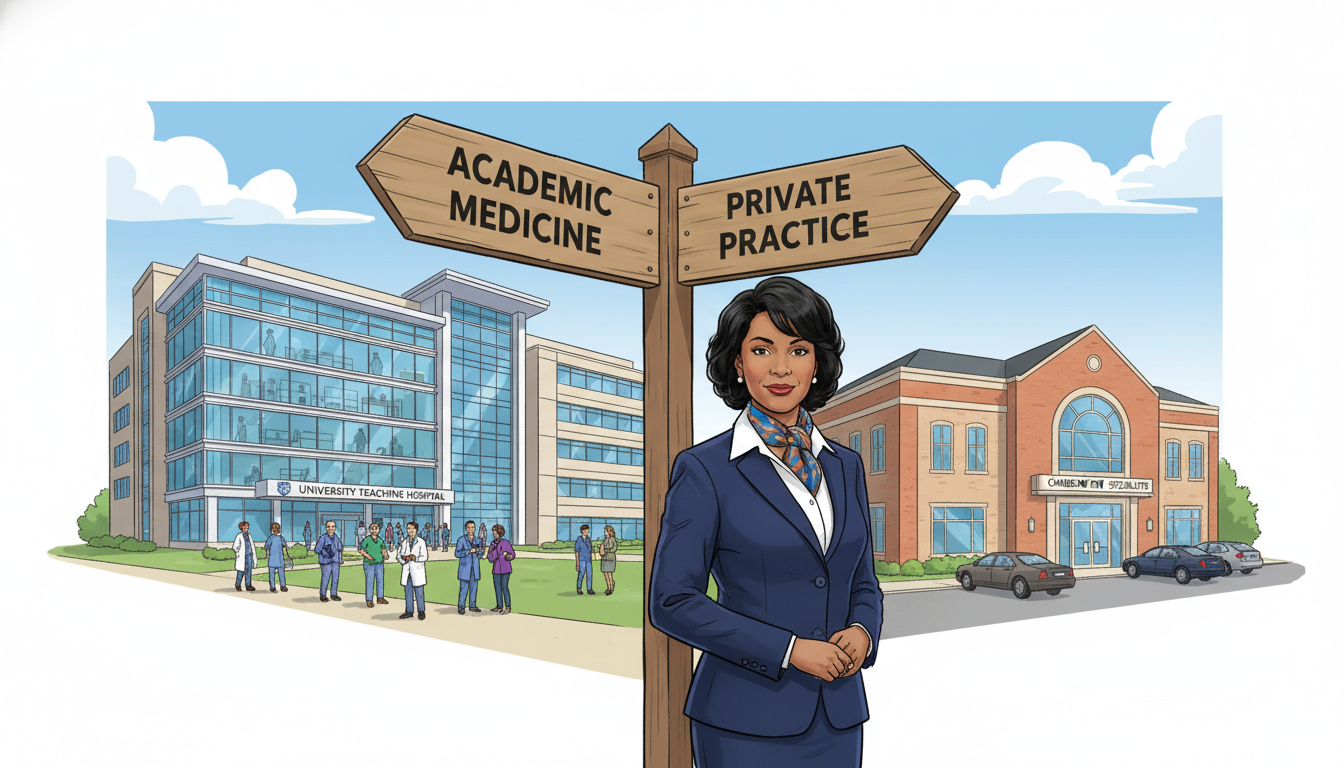
Understanding Your Career Fork in the Road: Academic vs Private Practice
As an MD graduate completing or considering a transitional year residency (TY program), you’re standing at an unusual but strategic point in your training. You’ve secured an allopathic medical school match into a transitional year, but your long-term direction may still feel uncertain—especially when it comes to deciding between academic medicine and private practice.
This decision doesn’t need to be final during your transitional year, but it’s smart to start thinking deliberately about it now. Your TY year can be a powerful launching pad if you understand how to use it to explore and prepare for both options.
This article will walk you through:
- How a transitional year residency fits into long-term career planning
- The core differences between academic medicine and private practice
- How each environment looks for common post-TY specialties (e.g., radiology, anesthesia, dermatology, ophthalmology, PM&R, neurology)
- Key factors in choosing your career path in medicine
- Concrete steps to take during your TY year to keep both doors open
Throughout, the focus is on you: an MD graduate in transitional year training trying to make a sound, deliberate career choice.
1. How Your Transitional Year Shapes Long-Term Career Options
A transitional year is often described as a “bridge year,” but it can be much more than that. Used thoughtfully, it can give you a structured way to clarify where you fit best along the spectrum of private practice vs academic careers.
1.1 What a Transitional Year Residency Really Offers
A transitional year residency is typically:
- Broad-based: Rotations across medicine, surgery, emergency medicine, electives, and sometimes ICU or subspecialties
- Flexible: Often more elective time than a categorical intern year
- Variable: Programs range from community-based to university-affiliated academic centers
Depending on the specific TY program, you may find yourself in:
- A community hospital TY with strong exposure to real-world private practice–style medicine
- An academic medical center TY with emphasis on teaching, research, and subspecialty services
- A hybrid TY program blending both academic and community settings
This makes the TY year uniquely positioned to let you compare academic vs private practice environments side by side, even if on a small scale.
1.2 Typical Post-Transitional Year Specialties and Career Trajectories
Many MD graduates entering a TY program already hold a reserved PGY-2 spot in another specialty. Common paths include:
- Diagnostic Radiology / Interventional Radiology
- Anesthesiology
- Dermatology
- Ophthalmology
- Neurology
- Physical Medicine & Rehabilitation (PM&R)
- Occasionally Radiation Oncology, Pathology, or other specialties
Each of these specialties has its own balance of academic medicine career opportunities versus private practice roles. For example:
- Radiology and anesthesia have large, well-developed private practice markets but also robust academic departments.
- Dermatology and ophthalmology often skew heavily toward private practice, but subspecialty and research-oriented careers are centered in academic centers.
- Neurology and PM&R often combine academic, research, and rehabilitative care missions.
Your transitional year is your chance to observe how attendings in different specialties and settings actually practice—and how they got there.

2. Defining Academic Medicine vs Private Practice
Before you can choose a path, you need a clear, realistic picture of what these worlds actually look like in day-to-day practice.
2.1 What Is an Academic Medicine Career?
An academic medicine career typically means holding a faculty appointment at a:
- Medical school
- University-affiliated teaching hospital
- Major academic health system
Core pillars of academic practice:
Clinical Care
- Serve as an attending on inpatient services or in specialty clinics
- Provide complex or tertiary-level care referrals from community physicians
Teaching
- Supervise residents, fellows, and medical students
- Lead small-group teaching, lectures, simulation sessions, and bedside rounds
Scholarship / Research (degree varies)
- Conduct clinical, translational, or basic science research
- Present at conferences, publish papers, apply for grants
- Engage in quality-improvement (QI) projects or educational research
Institutional Service & Leadership
- Serve on hospital or departmental committees
- Contribute to curriculum design, residency selection, and program development
Not all academics are heavily research-oriented. Many are primarily clinicians and teachers (sometimes called “clinician educators”) with a smaller scholarly footprint such as QI projects or education innovations.
2.2 What Is Private Practice?
Private practice exists on a spectrum, from:
- Traditional small group practices: independent or physician-owned
- Large multispecialty groups: sometimes integrated with hospital systems
- Contracted groups: radiology, anesthesia, emergency medicine, and others under contract with health systems
- Direct-care models: concierge practices, cash-based dermatology or aesthetics, etc.
Common features:
- Primary focus on clinical productivity and revenue generation
- Less formal teaching; some clinics may host students or residents, but not as a primary mission
- Business and operational considerations: partnership tracks, revenue distribution, overhead, hiring PAs/NPs, negotiating with health systems or payers
Some large hospital-employed groups blur the line between “private practice” and “academic” by having a clinical focus but limited research or teaching responsibilities. For many MD graduates, these are functionally private-practice-like roles within large health systems.
2.3 Hybrid and Nontraditional Roles
Many modern positions no longer fit neatly into “academic” or “private practice.” Examples:
- Academic-affiliated community hospitals: minimal research but regular teaching
- Community-based residencies: a teaching role with a community-practice pace and patient mix
- Physician–administrator roles: clinical practice combined with leadership in quality, informatics, or hospital operations
- Telemedicine or locums: highly flexible, often productivity-focused but with variable teaching/research opportunities
When choosing a career path in medicine, it’s more realistic to see “academic” and “private practice” as ends of a continuum. Your TY year can help you figure out where on that continuum you want to land.
3. Day-to-Day Life: Academic vs Private Practice After TY
For an MD graduate residency pathway that begins with a transitional year, your real question is: “What will my life look like after I finish my definitive residency or fellowship?” The answer differs meaningfully between academic and private practice roles.
3.1 Clinical Workload and Schedule
Academic Medicine
- Clinical load often structured in blocks:
- Inpatient weeks on service
- Outpatient clinics
- Protected research or academic days (varies heavily by institution and rank)
- More likely to have:
- Night-float systems and coverage by residents/fellows
- Complex, tertiary and quaternary referrals
- Call responsibilities may be shared among more faculty but can be intense in subspecialty services
Private Practice
- Clinical volume often higher, with strong emphasis on productivity (RVUs, wRVUs, or collections)
- Schedule may be more regular (e.g., 8–5 weekdays) but with:
- More frequent call or weekend responsibilities, depending on specialty and group size
- Less “protected time” during the week for non-clinical work
- More predictable, routine cases in many fields (though this can vary by referral base and region)
TY-Year Takeaway: On your inpatient and outpatient rotations, pay attention to how attendings talk about their schedules:
- Are they faculty who leave early for teaching or research?
- Are they community physicians juggling clinic volume, OR time, and call?
These are early clues about the trade-offs you’ll face.
3.2 Teaching and Mentorship Roles
Academic Medicine
- Teaching is part of your job description. You will:
- Precept residents and students
- Participate in formal teaching (lectures, conferences, morning report)
- Performance evaluations often include teaching quality, and promotion may require documented educational contributions
Private Practice
- Teaching is variable:
- Some private groups host students or residents, especially if affiliated with a medical school or residency program
- In many practices, teaching is occasional and informal
- Your value is primarily measured by patient care and efficiency
If you find yourself explaining pathology results to interns, drawing diagrams for medical students, or enjoying case-based teaching during your TY year, you may find greater fulfillment in academic settings.
3.3 Research, Scholarship, and Innovation
Academic Medicine
- Expectation (to varying degrees) that you contribute to:
- Clinical trials
- Retrospective chart reviews
- Educational research
- Quality improvement
- Promotion trajectories (assistant → associate → full professor) usually require:
- Publications
- Presentations
- Recognition at regional or national levels
Private Practice
- Research typically not required, but opportunities may arise in:
- Multicenter industry-sponsored trials
- Practice-based outcomes research
- Innovation is often focused on:
- Operational efficiency
- Patient satisfaction
- New service lines (e.g., opening a new imaging center or procedural suite)
If you enjoyed scholarly projects in medical school or want your name on manuscripts, academic medicine careers are usually better aligned with those aspirations.

4. Financial, Lifestyle, and Advancement Considerations
Understanding compensation and lifestyle trade-offs is central to thinking clearly about private practice vs academic careers.
4.1 Compensation Differences
Broadly (with many exceptions):
Private Practice tends to offer:
- Higher base and potential earnings, particularly for procedure-heavy or imaging-based specialties (e.g., radiology, anesthesia, derm, ophtho)
- Partnership tracks with buy-in options and profit sharing
- Higher link between productivity and income
Academic Medicine generally offers:
- Lower base salary compared to top-tier private practice roles in the same specialty and region
- Additional income through:
- Administrative roles
- Grants (for researchers)
- Extra call or moonlighting
- More stability in some cases, with institutional support for benefits, retirement, and protected time
For most MD graduates in specialties that follow a TY year, the highest-earning roles tend to be private practice or hybrid hospital-employed positions.
4.2 Lifestyle and Work-Life Balance
Lifestyle is less predictable and more dependent on group culture and specialty than on “academic vs private” alone. Still, some patterns hold:
- Academic roles may provide:
- More variation in weekly tasks (clinic, teaching, research, meetings)
- Some flexibility if you negotiate protected time and clear expectations
- Private practice may offer:
- More standardized clinic/OR hours but also:
- More weekend/evening call in some fields
- Less flexibility to decrease clinical volume without affecting income
- More standardized clinic/OR hours but also:
In both settings, burnout is a risk. During your transitional year rotations, listen carefully when attendings discuss:
- How they manage documentation and inbox work
- How much control they have over their schedule
- Whether they feel supported by their group or department
4.3 Promotion and Career Trajectory
Academic Path
- Titles and promotion (e.g., assistant → associate → full professor) based on:
- Clinical excellence
- Teaching and mentorship
- Scholarship (publications, grants)
- National or international recognition
- Advancement can be slow but structured; success often depends on mentorship and institutional support.
Private Practice Path
- Advancement is more financial and operational, typically involving:
- Partnership or shareholder status
- Leadership within the practice (e.g., managing partner, chairperson, service line director)
- Potential roles in hospital committees or system leadership
- Your value is measured largely by clinical productivity, efficiency, and business acumen.
Transitional Year Tip: Ask attendings explicitly:
- “What did your first five years out of residency look like?”
- “How did you progress into your current role (partner, program director, division chief)?”
Their answers will give you tangible examples of how each path unfolds.
5. Using Your Transitional Year to Explore and Decide
Your TY year is an ideal laboratory for choosing your career path in medicine. You may not lock in a final decision, but you can significantly narrow your preferences and prepare yourself either way.
5.1 Be Intentional with Rotations and Electives
If possible, structure your transitional year schedule to compare different practice environments:
Electives at academic centers
- Advanced specialty clinics
- Research-heavy attendings
- Participation in case conferences and grand rounds
Electives in community / private-practice-like settings
- Community hospital inpatient rotations
- Outpatient clinics run by private groups or hospital-employed clinicians
- OR/anesthesia days at non-teaching hospitals
Examples:
- Future radiologist: Try to arrange an elective with an academic radiology department and, if allowed, shadow in a community radiology group.
- Future anesthesiologist: Rotate through both a teaching OR at an academic medical center and a high-volume community OR where CRNAs/AA’s work with private anesthesiology groups.
5.2 Ask the Right Questions
During your TY year, attendings are your most valuable career resource. When you meet faculty and community physicians, ask:
- “What made you choose academic vs private practice?”
- “If you had to decide again today, would you make the same choice?”
- “What do you think people misunderstand about your career path?”
- “What skills or experiences helped you succeed in your current setting?”
You’ll often hear candid answers from physicians who vividly remember making these same decisions.
5.3 Build a Flexible CV for Either Path
Even if you lean strongly one way, it’s wise to keep both options open, especially early in your training. During your transitional year:
For Academic-Oriented Residents:
- Get involved in at least one manageable project:
- Case report or series
- Quality improvement project
- Retrospective chart review with a faculty mentor
- Aim for:
- A poster presentation at a regional or national conference
- A short publication (even as a co-author)
- Seek teaching opportunities:
- Leading sessions for medical students
- Peer teaching for interns or rotating students
For Private-Practice-Oriented Residents:
- Ask to shadow in private practice clinics or community hospitals.
- Learn about:
- Productivity metrics (RVUs, collections)
- Practice management (billing, staffing, contracts)
- Malpractice and risk management
- Consider a small QI or efficiency project related to patient throughput, documentation, or scheduling. These skills translate well to practice operations.
By the end of your TY year, aim to have:
- A network of academic and private-practice mentors
- At least one academic product (poster, paper, or QI project)
- First-hand exposure to both environments
This combination keeps you maximally flexible as you progress through your advanced residency.
6. Matching Your Values to the Right Environment
In the end, your choice between academic medicine and private practice isn’t primarily about prestige or salary; it’s about alignment with your values, interests, and temperament.
6.1 Reflect on What Energizes You
During and after your transitional year, notice when you feel most engaged:
You might be an “academic fit” if you:
- Feel energized by case discussions and literature reviews
- Enjoy mentoring and teaching junior learners
- Are curious about research questions and systems improvement
- Value being in a setting where new treatments and technologies are developed and tested
You might be a “private practice fit” if you:
- Feel most satisfied when efficiently solving patients’ problems all day
- Appreciate direct control over clinical decisions and workflow
- Are motivated by financial and operational aspects of practice
- Prefer minimizing meetings and academic requirements to focus on patient care
6.2 Consider Long-Term Personal Goals
Think beyond the next five years. For example:
Do you see yourself taking on leadership roles like program director, division chief, or department chair?
- More aligned with academic or large health-system practice.
Are you interested in building a high-volume subspecialty clinic, owning part of a practice, or growing a procedural business?
- More aligned with private practice and entrepreneurial opportunities.
Do you hope to relocate frequently (e.g., for a partner’s career)?
- You may value the portability and flexibility of private practice skills, though academic jobs also exist nationwide—just potentially fewer in number per city.
6.3 Recognize That You Can Change Paths
Many physicians change settings during their careers:
- Academic → Private practice: Often driven by desire for increased compensation, decreased academic pressure, or relocation.
- Private practice → Academic: Sometimes motivated by interest in teaching, professional burnout in high-volume settings, or desire for institutional support and stability.
Your decision post-residency or fellowship is important but not irrevocable. What matters during your transitional year residency is building self-knowledge, skills, and networks that will serve you in any environment.
FAQs: Academic vs Private Practice for MD Graduates in Transitional Year
1. Do I need to decide between academic and private practice during my transitional year?
No. Your transitional year is a discovery phase. You don’t need a firm decision yet, especially if you’re just starting your advanced specialty. Use this year to gain exposure to both settings, ask questions, and start building a CV that keeps both doors open. Most formal decisions occur closer to the end of your definitive residency or fellowship, when you’re applying for jobs.
2. If I’m interested in an academic medicine career, what should I prioritize during my TY program?
Focus on:
- Finding at least one mentor with an academic appointment
- Joining a manageable project (case report, QI, or small research project)
- Participating in teaching whenever possible (student lectures, bedside teaching)
This early exposure signals genuine interest when you apply to academic residency or fellowship programs and gives you a foundation for future scholarship.
3. Does choosing private practice mean giving up on teaching or research entirely?
Not necessarily. Many private practice physicians:
- Precept students or residents from nearby schools
- Participate in industry-sponsored trials
- Lead QI initiatives with publishable outcomes
However, teaching and research are usually secondary to clinical productivity, so you’ll need to pursue them intentionally rather than as built-in job expectations.
4. How does my specialty choice after a transitional year affect the academic vs private practice decision?
Some specialties (e.g., dermatology, ophthalmology, certain radiology or anesthesiology niches) have very robust private practice markets with significant earning potential and entrepreneurial opportunities. Others (e.g., certain neurology or PM&R subspecialties) maintain a stronger academic presence for complex care, multidisciplinary clinics, and research. As you progress into your PGY-2+ years, pay attention to where your specialty’s leaders and mentors practice; that will give you realistic expectations about your own options.
As an MD graduate in a transitional year residency, you’re in a uniquely flexible position. By intentionally exploring both academic medicine and private practice, asking targeted questions, and building a versatile skill set, you’ll be well prepared to choose a career path that aligns with your strengths, values, and long-term goals in medicine.