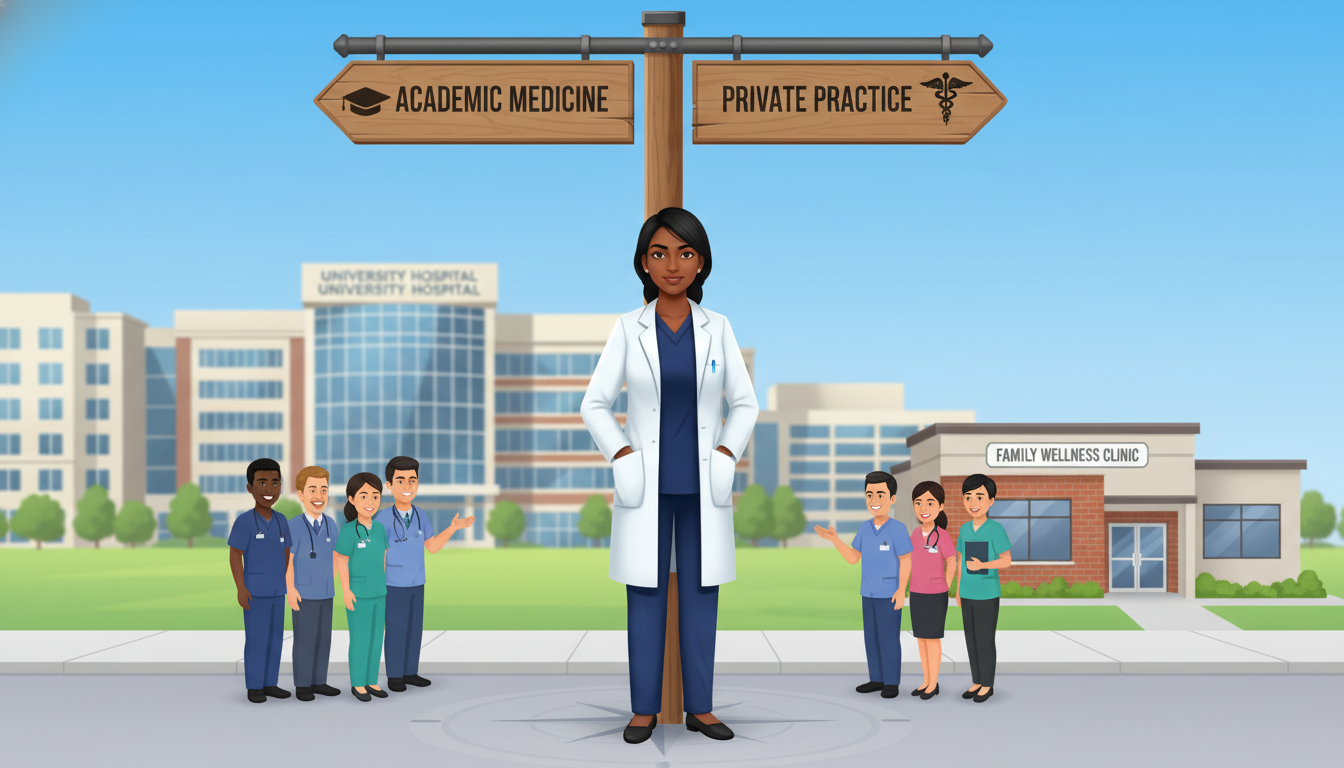
Understanding the Big Picture: Academic vs Private Practice in Family Medicine
For a non-US citizen IMG in family medicine residency or early training, choosing between academic medicine and private practice is one of the most consequential career decisions you will make. It affects your visa options, long-term immigration strategy, income, lifestyle, ability to teach and do research, and even where you can live.
In family medicine, both academic and private practice careers are viable and in high demand across the United States. But the decision is more complex for a non-US citizen IMG or foreign national medical graduate because immigration rules, sponsorship patterns, and institutional policies are layered on top of the usual career questions.
This article walks you step-by-step through:
- Core differences between academic medicine and private practice in family medicine
- How each pathway impacts visas (J-1, H-1B), J-1 waivers, and green card timing
- Typical work, lifestyle, and compensation patterns
- How to align your FM match experience, interests, and strengths with the right path
- Practical decision frameworks and timelines during residency
Throughout, we’ll focus specifically on the non-US citizen IMG perspective and the post-residency job market in family medicine.
Core Differences: Academic Medicine vs Private Practice in Family Medicine
What Is “Academic Medicine” in Family Medicine?
In family medicine, “academic medicine” typically refers to positions where your primary employer is:
- A university or medical school
- A residency program or teaching hospital
- A teaching-focused community health system affiliated with a university
Common job titles:
- Assistant Professor / Clinical Assistant Professor of Family Medicine
- Core Faculty, Family Medicine Residency
- Teaching Attending, Family Medicine
- Clinician-Educator in Family Medicine
Your work usually combines:
- Outpatient clinic (continuity clinic)
- Inpatient teaching service or newborn nursery/OB (depending on the program)
- Supervising residents and medical students
- Curriculum development, scholarly projects, and committee work
What Is “Private Practice” in Family Medicine?
“Private practice” can mean several models:
- Independent small group or solo practice – physicians owning or co-owning the practice
- Large multispecialty group – sometimes “private,” sometimes owned by a health system
- Hospital-employed outpatient practice – technically an employed model, but non-academic
- Federally Qualified Health Centers (FQHCs)/community health centers – often mission-driven, non-academic, but can involve some teaching
Private practice focuses primarily on:
- Direct patient care (mostly outpatient)
- Practice growth and efficiency
- Business operations (in smaller or physician-owned groups)
- Quality metrics, patient satisfaction, and financial performance
Teaching and research may be limited or informal unless there is a specific affiliation with a residency or medical school.
Key Dimensions of Difference
| Dimension | Academic Medicine | Private Practice |
|---|---|---|
| Primary mission | Teaching, patient care, scholarship | Patient care, access, business sustainability |
| Teaching | Central part of job | Optional / limited, varies by practice |
| Research | Expected or encouraged (esp. promotion) | Usually minimal; some quality projects |
| Governance | University / teaching hospital | Physician owners or corporate/health system |
| Compensation | Often lower base; more benefits + stability | Often higher earning potential, more RVU-driven |
| Productivity pressure | Moderate; balanced with teaching | Typically higher; volume and efficiency emphasized |
| Schedule | Often mix of clinic, teaching, admin | Mostly clinical; admin depends on role |
| Career ladder | Academic ranks (assistant/associate/full professor) | Partner track, leadership roles, or stable employee |
For a foreign national medical graduate, an additional dimension matters greatly:
- Immigration sponsorship culture – academic centers and large systems are more accustomed to handling H‑1B/green card processes than many small practices.

Visa and Immigration Realities: Academic vs Private Practice
For a non-US citizen IMG, one of the most practical filters for choosing an academic medicine career versus private practice is what is realistically possible given your visa status.
Common Starting Point: J‑1 Visa for Residency
Most non-US citizen IMGs in the FM match train on an ECFMG-sponsored J-1 visa. This requires:
- Returning to your home country for 2 years or
- Completing a J‑1 waiver service job (usually 3 years full-time) in a designated underserved area
When comparing academic vs private practice for your first job after residency, ask:
- Can this employer sponsor or support a J‑1 waiver?
- Can they sponsor an H‑1B, if needed?
- Do they commonly file employment-based green cards?
Academic Medicine and J‑1 Waivers
Academic institutions can be excellent employers for J‑1 waiver positions, but there are nuances.
Pros:
- Many are in or near underserved areas and qualify for Conrad 30 or other state/federal waiver programs.
- Larger academic health systems often have dedicated immigration teams and experience with J‑1 → H‑1B → green card transitions.
- Some university-based jobs qualify for cap-exempt H‑1B, meaning you are not restricted by the national H‑1B lottery if they are:
- Affiliated with or part of a university
- Classified as a non-profit or research institution
Cons:
- Not all academic departments are comfortable navigating waiver paperwork or may have limited slots.
- These positions can be competitive, especially in popular cities or coastal areas.
- Some academic roles may expect significant scholarly work in addition to clinical duties, which can be demanding during a waiver period.
Private Practice and J‑1 Waivers
Many private practices or community-based employers (including FQHCs and rural hospitals) actively recruit J‑1 waiver candidates, especially in family medicine.
Pros:
- More numerous waiver options in underserved and rural areas
- Often strong need for primary care, making them eager to sponsor you
- Some FQHCs and community systems are very experienced with international hires
Cons:
- Small, physician-owned groups may have limited immigration experience and may be reluctant to handle complex processes.
- H‑1B sponsorship may be cap-subject, depending on employer type and timing.
- Some private practices may prefer J‑1 waiver → H‑1B but be slow or hesitant to start employment-based green card processes.
H‑1B vs J‑1 Waiver: Impact on Career Choice
If you matched into family medicine on an H‑1B visa (less common but possible), your path is different:
- No J‑1 home residency requirement
- After residency you need a job that can:
- Continue your H‑1B, and
- Potentially sponsor a green card
In this scenario:
- Academic medicine can be attractive due to cap-exempt H‑1B options and institutional experience.
- Private practice is still possible but may require navigating the H‑1B lottery (if cap-subject) and ensuring the employer is comfortable with long-term sponsorship.
Strategic Immigration Considerations by Path
If you prioritize long-term US stay and green card stability:
- Academic centers and large health systems (academic or non-academic) are often safer choices than very small private practices.
- Ask directly during recruitment:
- “Do you sponsor H‑1B for non-US citizen IMG family physicians?”
- “What is your typical timeline for starting a green card process?”
- “How many international physicians have you sponsored in the last 5 years?”
If you’re flexible about location and want the fastest waiver/green card progress:
- High-need rural or underserved private practices (especially FQHCs) can move quickly and may start green card sponsorship early, sometimes within the first year.
- Some community-based “teaching practices” give you a blend: non-academic employment with opportunities to precept residents and students.
Work, Lifestyle, and Compensation: What to Expect in Each Path
Clinical Duties and Scope of Practice
Academic Family Medicine:
- Outpatient clinic with a mix of your own patients and supervision of residents
- Inpatient service coverage supervising residents (often in rotations or blocks)
- Maternity care and newborn nursery work if you trained and choose to include OB
- Structured teaching: morning reports, didactics, case conferences
- Administrative/academic time: curriculum, research, scholarship, committees
Private Practice Family Medicine:
- Primarily outpatient clinic patient care
- Some hospital work (inpatient or newborn) in certain markets, but trend is more outpatient-only with hospitalists covering admissions
- Minor procedures, chronic disease management, preventive care
- Variable on-call duties depending on group and after-hours coverage model
- Administrative time often focused on practice operations, quality metrics, and documentation
Typical Weekly Schedule
A sample academic medicine week (early-career assistant professor):
- 5–7 half-days of clinic (residents + your own panel)
- 2–4 half-days of teaching/academic time (didactics, precepting, curriculum)
- Periodic inpatient weeks (e.g., 4–8 weeks/year) covering family medicine service
- Committee meetings, quality projects, and scholarly work spread through the month
A sample private practice week (employee physician in a group):
- 8–10 half-days of clinic
- 18–24+ patients per day (varies by practice and region)
- Limited teaching (maybe occasional students/shadowing if affiliated)
- Business or partnership meetings if you’re an owner or partner-track
- Less formal expectation for research or publications
Compensation and Financial Considerations
In family medicine, the broad pattern is:
- Private practice (especially high-volume or partnership-track):
- Higher earning potential, particularly after several years
- Income strongly tied to RVUs or productivity
- Partnership often adds profit-sharing and ancillary revenue
- Academic medicine:
- Typically lower base salary than high-volume private practice in the same geographic area
- More predictable salary, structured raises with academic rank
- Stronger benefits: retirement contributions, health insurance, CME funds, tuition discounts, etc.
For a non-US citizen IMG, factor in:
- Some academic and large-system employers may be more transparent and consistent with contracts.
- Small or rapidly changing private practices might carry more financial and job-security risk, which matters during a J‑1 waiver or green card process.
Lifestyle and Burnout Risk
Academic Medicine:
- Pros:
- Variety in week (mix of clinic, teaching, admin)
- Intellectual engagement, interaction with learners
- Collegial environment with faculty peers
- Cons:
- Even with lower clinic volume, total work hours can be long due to meetings, curriculum work, and research expectations.
- Promotion criteria (scholarship, publications) may feel like extra pressure.
Private Practice:
- Pros:
- Clear focus: clinical care and patient relationships
- Potential for more control over practice style once established or if an owner
- In some communities, predictable schedule and minimal inpatient duties
- Cons:
- High patient volume and documentation burden
- Business and administrative stress (especially in physician-owned groups)
- Less formal peer support for teaching and scholarship interests
A balanced way to view it:
- Academic medicine offers diversity of roles but layered responsibilities.
- Private practice offers financial upside and focus on clinical care, but volume and business realities can be intense.

Matching Path to Personality, Interests, and Long-Term Goals
Who Typically Thrives in Academic Medicine?
You may be well suited for an academic medicine career in family medicine if you:
- Enjoy teaching and often find yourself explaining concepts to juniors
- Like discussing evidence, guidelines, and complex cases in a team environment
- Are curious about quality improvement, research, or curriculum design
- Can tolerate slower short-term financial growth in exchange for stability, mentorship, and academic promotion
- Value being part of a broader institution with many trainees and specialties
For a non-US citizen IMG, academic medicine can also be a good foundation if you are considering:
- Leadership roles in education (Program Director, Clerkship Director)
- An academic medicine career that may later expand to national-level teaching or research initiatives
- Working in major metropolitan or university-based settings where academic positions are concentrated
Who Typically Thrives in Private Practice?
You may be better aligned with private practice vs academic if you:
- Primarily love clinical medicine and one-on-one patient care
- Are comfortable with a business mindset: efficiency, revenue, expenses, growth
- Prefer clear productivity metrics rather than academic promotion criteria
- Want to maximize earning potential, especially after completing your waiver or early-career years
- Desire control over your practice style, schedule (once established), and possibly ownership
Non-US citizen IMGs often choose private practice if they:
- Are willing to work in underserved or rural locations (common site of J‑1 waivers)
- Hope eventually to own a practice or join a stable high-income group after getting a green card
- Value strong community ties and continuity of care in one setting over many years
Hybrid and Transitional Options
Many family physicians follow a hybrid path over time:
- Start in a community private practice for J‑1 waiver, then move to academic medicine after waiver completion.
- Begin in academic primary care to secure cap-exempt H‑1B and a green card, then later join or start private practice with immigration secure.
- Work in community health centers that are not fully academic but allow limited teaching and research projects.
When thinking about choosing career path in medicine, remember it doesn’t need to be permanent:
- The first job after residency is rarely your last.
- The FM job market is flexible, and family medicine skills are transferable between academic and private settings.
Practical Planning During Residency: How to Decide and Prepare
PGY-1: Explore and Observe
Actions:
- Notice which settings energize you more:
- Clinic days with teaching and feedback?
- Busy community rotations where you just see patients all day?
- Seek mentors: at least one in academic leadership and one in community/private practice.
- Begin to understand your visa status clearly: J‑1 vs H‑1B, waiver options, and typical timelines.
Questions to ask yourself:
- Do I feel excited or drained when I’m teaching juniors or presenting in conferences?
- Am I naturally interested in project work (Q.I., research, curriculum), or do I avoid it?
PGY-2: Intentional Skill Building
If you’re leaning toward academic medicine:
- Ask for elective time in medical education, QI, or research.
- Get involved in scholarly projects (case reports, QI presentations, poster abstracts).
- Take leadership roles (chief resident, committee work, curriculum redesign).
If you’re leaning toward private practice:
- Spend electives in high-volume community clinics or FQHCs.
- Ask attendings about productivity, RVUs, and practice operations.
- Learn basics of billing, coding, and outpatient efficiency.
Visa planning:
- Identify states and programs known for J‑1 waivers in family medicine (Conrad 30, Appalachian programs, rural health systems, FQHCs).
- Learn which academic centers in your region actually sponsor waivers for FM.
PGY-3: Targeted Job Search
By early PGY-3, you should be actively deciding between:
- Academic track applications – faculty positions, clinician-educator roles
- Private practice track applications – FQHCs, rural practices, hospital-employed groups
Practical steps:
Clarify your priority order:
- Immigration stability (H‑1B, GC)
- Location preferences
- Academic vs private practice environment
- Compensation needs
Prepare two versions of your CV:
- Academic-focused: highlight teaching, QI, research, leadership
- Clinical-focused: highlight volume, diverse clinical exposure, procedures, languages
During interviews, ask employer-specific questions:
- “How is physician performance measured here?”
- “What percent of time would I spend on teaching vs direct patient care?”
- “What is your experience sponsoring visas and green cards for non-US citizen IMG physicians?”
Long-Term View: You Can Change Paths
Many physicians switch from:
- Academic to private practice (often driven by compensation or lifestyle)
- Private practice to academic (often driven by interest in teaching and a more structured environment)
When evaluating early job offers, ask:
- “Does this path keep doors open for both academic medicine career and private practice later?”
In family medicine, the answer is usually yes—as long as you maintain strong clinical skills and continue some engagement with learning and improvement.
FAQs: Academic vs Private Practice for Non-US Citizen IMG in Family Medicine
1. Is it harder for a non-US citizen IMG to get an academic medicine job in family medicine than a private practice job?
Not necessarily. Academic FM departments often value IMG perspectives, especially if you’re already known to the institution from residency. However, some academic centers in highly desirable cities are more competitive. Private practices in underserved or rural areas may be easier to access and more urgently recruiting. The bigger constraint is often visa sponsorship readiness, not your IMG status alone.
2. Which path is better for getting a green card faster: academic or private practice?
It depends on the specific employer, not just the category:
- Many academic centers and large health systems have streamlined green card processes and start them early.
- Some FQHCs and rural systems in private practice settings also initiate green card sponsorship quickly because they heavily rely on international physicians.
- Small, independent private practices may be slower or reluctant due to cost and complexity.
Always ask about typical timelines and how many international physicians they have successfully sponsored.
3. If I start in private practice, can I still move into academic medicine later?
Yes. In family medicine this is very common. To keep the door open for academic roles:
- Maintain strong clinical documentation of your experience.
- Participate in small QI projects or CME teaching at your practice if possible.
- Stay active in professional societies (AAFP, state academies) and look for opportunities to precept students.
- When applying later to academic jobs, highlight your community experience, outcomes, and any teaching you have done.
4. I enjoy teaching but also want higher income. Is there a middle ground?
Yes. Several options offer a blend of academic vs private practice benefits:
- Community-based practices heavily affiliated with residency programs where you can precept 1–2 sessions per week.
- Hospital-employed practices with opportunities for adjunct faculty appointments and periodic teaching.
- After establishing your income base in private practice, you can take on part-time academic roles, such as lecturing, precepting, or serving as adjunct faculty.
The key is to be intentional: discuss your interests in both income and teaching during interviews and seek employers who can support a hybrid role.
As a non-US citizen IMG in family medicine, both academic medicine and private practice can lead to a stable, fulfilling, and impactful career in the United States. Use your residency years to explore, understand your immigration realities, and align your strengths and values with the environment where you will grow best.