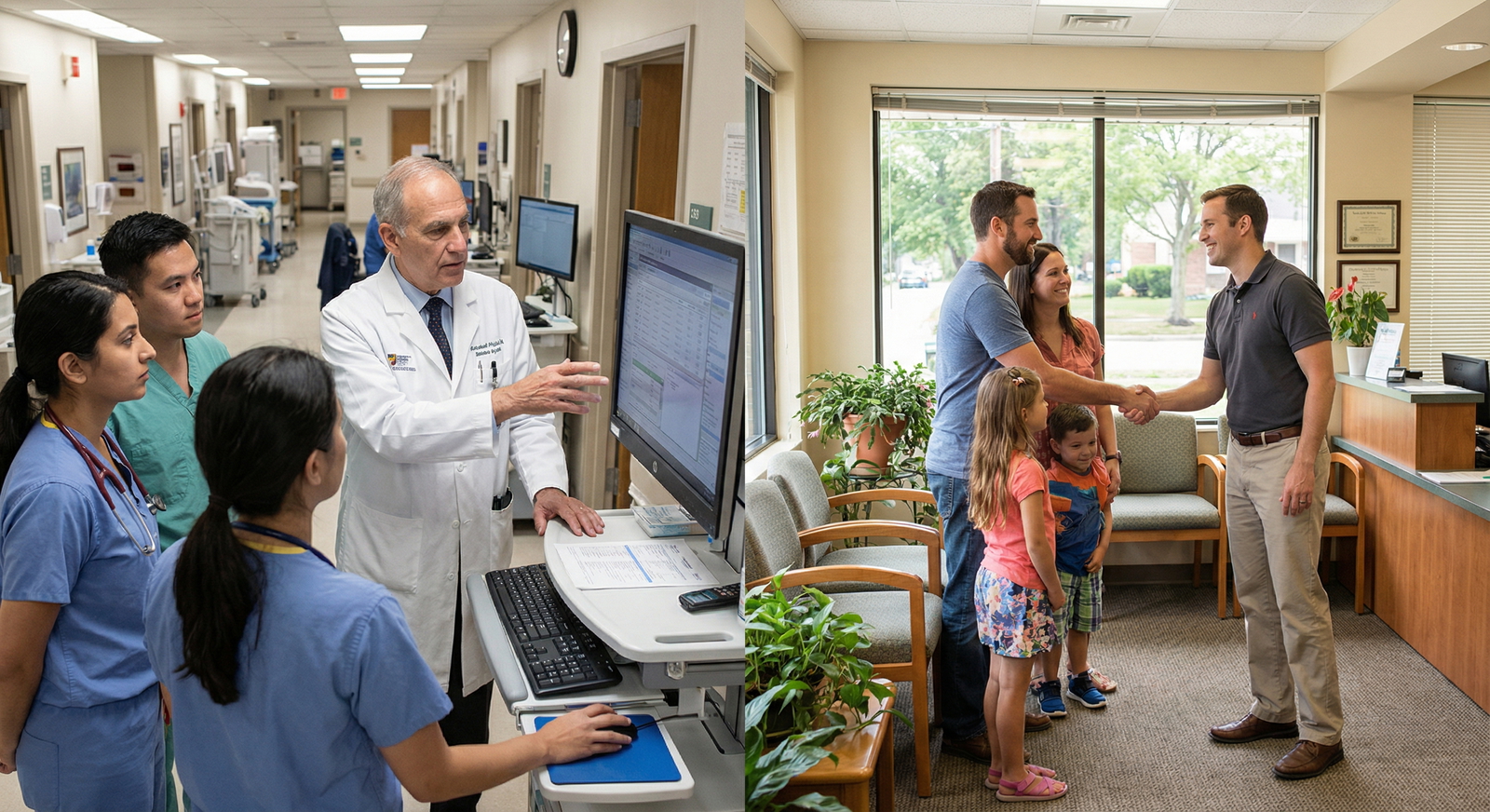
Understanding the Landscape: Why Career Planning Matters Even in a Preliminary Surgery Year
A preliminary surgery year is often described as a “transitional” step, but for many residents it can feel more like standing at a fork in the road without a map. You may be:
- A designated prelim aiming for a categorical surgery spot
- An undesignated prelim exploring other specialties (anesthesia, radiology, EM, etc.)
- A future specialist (e.g., urology, IR, integrated vascular) completing a required prelim surgery residency year
Regardless of your situation, you’re already being exposed to two broad models of surgical careers:
- Academic medicine career – based largely in university or teaching hospitals
- Private practice – based primarily in community hospitals or office-based practices
Even if you’re convinced you’ll end up in a different specialty, the skills and perspectives you develop during your prelim year will shape how you approach choosing a career path in medicine overall. Understanding academic vs private practice in preliminary surgery now will help you:
- Make better use of your rotations and mentors
- Align your research, networking, and electives with your future goals
- Ask sharper questions on interviews for your next position (categorical spot or fellowship)
This guide breaks down the key differences, dispels myths, and offers concrete strategies tailored specifically to prelim surgery residents.
Defining the Paths: What “Academic” and “Private” Really Mean
Academic Surgery: More Than Just a University Logo
An academic medicine career in surgery typically centers on:
- Institution type: University hospital, large tertiary referral centers, VA hospitals, or major teaching hospitals
- Primary missions:
- Patient care
- Teaching medical students, residents, fellows
- Research (clinical, translational, outcomes, education)
Common features of academic surgery jobs:
- Protected or semi-protected research or academic time
- Involvement in teaching conferences, simulation labs, M&M, journal club
- Formal academic titles (Instructor, Assistant Professor, Associate Professor, Professor)
- Expectations to produce scholarship (papers, presentations, QI projects, textbooks, grants)
- Multidisciplinary teams and subspecialty services
- Complex, high-acuity patients referred from wide geographic regions
Academic jobs themselves often fall on a spectrum:
- Clinician-educator track: heavier on teaching, clinical care, educational leadership
- Clinician-scientist track: heavier on research, grants, lab time
- Clinician-only or “academic community” track: primarily clinical with some teaching, minimal research expectations
For a preliminary surgery resident, this is usually the environment you’re already in if your program is university-based or has a strong teaching culture.
Private Practice Surgery: Diverse Models Under One Label
Private practice is often shortened to “PP,” but it actually spans several business and practice models:
- Traditional independent group: Surgeon-owned practice, multiple partners, shared overhead
- Hospital-employed model: Surgeons salaried by a health system; technically “private” in terms of market orientation but with some academic-like features
- Single-specialty group: All general surgeons (or all vascular, all colorectal, etc.)
- Multi-specialty group: Surgeons working alongside internists, cardiologists, etc.
- Hybrid or “privademic” model: Community-based practice with some teaching or research through affiliation with a teaching hospital
Typical private practice priorities:
- Efficiency, productivity, and financial viability
- High volume of bread-and-butter cases
- Patient and referring-physician satisfaction
- Potential for partnership and practice ownership (depending on model)
You may get glimpses of this environment during community rotations in your preliminary surgery residency, elective months, or moonlighting (later in training).
Where Does a Preliminary Surgery Resident Fit?
A preliminary surgery year doesn’t lock you into either path—but it does:
- Expose you to institutional cultures (some are strongly academic, others more community-focused)
- Shape your early mentors (who may strongly identify with one model)
- Influence the letters of recommendation and experiences on your CV
Your goal during the prelim year is not to finalize every career decision, but to collect data: see how academic vs private practice actually function day-to-day, and how that aligns with who you are and what you want.

Key Differences: Academic vs Private Practice Through a Prelim Lens
1. Clinical Workload and Case Mix
Academic surgery:
- Higher proportion of complex cases (advanced cancer, re-operations, transplant, trauma)
- More subspecialization (HPB, colorectal, endocrine, surgical oncology, etc.)
- Involvement of learners in nearly every encounter
- Often more call-heavy at junior levels (ICU, trauma, night float)
- Bureaucratic layers: tumor boards, multidisciplinary rounds, complex EMR
Private practice:
- More bread-and-butter cases (lap chole, hernia, basic colorectal, appendectomies)
- Potentially higher OR volume and shorter case times once established
- Fewer learners involved (unless affiliated with a residency program)
- On-call can be heavy too, but often more predictable in mature groups
- More direct relationship between your efficiency and your income
For a preliminary surgery resident, this difference appears mainly as:
- Academic rotations = more teaching and complex patients, but less autonomy early
- Community/private rotations = more straightforward cases, often more autonomy in basic procedures and ward management
2. Teaching and Mentorship
Academic settings are built around teaching:
- You attend grand rounds, M&M, didactics, skills labs
- Staff expect to supervise and coach you
- Residents at multiple levels (PGY1–5) provide a layered learning environment
Private practice teaching varies widely:
- Some private surgeons are passionate educators and volunteer at teaching hospitals
- Others have little time or incentive to teach beyond necessary supervision
- You might still rotate with them as a prelim, but the teaching may be more informal and focused on practical “how to get things done” pearls
Implication for prelims:
- If you’re leaning toward an academic medicine career, seek out rotations and mentors who model strong teaching roles. Notice: Do you enjoy giving presentations, guiding medical students, and participating in conference discussions?
- If teaching drains you or feels peripheral, that’s an important data point when considering your long-term career environment.
3. Research and Scholarly Expectations
Academic surgery:
- Strong expectation for scholarship – publications, QI, presentations
- For promotion and job competitiveness, you’ll likely need:
- Peer-reviewed articles
- Regional/national conference presentations
- Involvement in research networks or multicenter studies
Private practice:
- Research is typically optional and often minimal
- Some surgeons participate in industry-sponsored trials or registry-based research
- Most scholarship is informal: local QI, case reports written with trainees, or none
For a preliminary surgery resident, this has concrete implications:
- If you want a categorical surgery spot in an academic program or a competitive fellowship later, research productivity during your prelim year can be pivotal.
- If you anticipate a future in private practice (even in another specialty), research is still valuable for:
- Strengthening your ERAS/CV
- Demonstrating perseverance and academic rigor
- Learning critical appraisal skills that improve your clinical decision-making
But your long-term job may not require ongoing research if you choose private practice.
4. Lifestyle, Compensation, and Autonomy
This is often how residents frame private practice vs academic decisions.
Academic surgery:
- Salary: Often lower base pay relative to high-volume private practice peers, but compensated by:
- Job stability
- Institutional benefits
- Access to cutting-edge technology and cases
- Lifestyle:
- Can be intense—major academic centers are busy
- Some academic groups emphasize work-life balance more than others
- Call and nights may be heavier early on due to larger hospital responsibilities
- Autonomy:
- Shared decision-making within large systems
- More administrative oversight and committees
Private practice:
- Income potential: Frequently higher, especially for high-volume general surgeons in community settings
- Lifestyle:
- Highly variable; some groups structure schedules to protect personal time
- More control over clinic hours, vacation, and OR block time—once established
- Autonomy:
- Greater control over how you practice, but also increased responsibility for business decisions
- Must be comfortable making practice-level decisions (contracts, equipment, partnerships)
As a prelim, your immediate lifestyle is mostly fixed by your program, but pay attention to:
- How your attendings talk about their own satisfaction and trade-offs
- Whether you’re drawn to the intellectual stimulation and academic growth of complex centers, or the independence and practicality of community environments
5. Career Security and Advancement
Academic track:
- Advancement is tied to promotion criteria: publications, teaching evaluations, institutional service
- Job security often linked to your department’s financial health and your productivity
- Clear, structured ladder (Assistant → Associate → Professor), though timelines vary
Private practice:
- Security tied to market forces and group dynamics
- Early years may involve proving yourself before partnership
- Long-term stability can be excellent if you build a strong referral base and community reputation
For prelims, this mostly matters in how you’re positioning yourself:
- Academic aspirations: Seek mentors who can guide you on promotion paths, research, and networking in societies.
- Private practice aspirations: Ask attendings how they evaluated groups, contracts, and partnership terms.

Using Your Preliminary Surgery Year to Explore Both Paths
Rotate Strategically
If your program allows any flexibility in rotations or electives during your preliminary surgery residency:
- Academic-focused rotations:
- Complex subspecialty services (surgical oncology, HPB, transplant, colorectal)
- ICU with strong multidisciplinary rounds
- Trauma at a level I center
- Community/private-focused rotations:
- Community general surgery
- Rural surgery experiences
- Rotations at affiliated non-university hospitals
During each, intentionally observe:
- How attendings talk about their work and institutional culture
- How decisions are made (team-based vs individual)
- The balance of teaching vs productivity pressures
Build a Dual-Network: Academic and Community Mentors
Even if you think you know your preferred direction, cultivate mentors in both worlds:
Academic mentor(s):
- Guide research or QI projects
- Provide letters highlighting your potential as an educator/researcher
- Help you navigate applications for categorical positions or fellowship-oriented paths
Community/private mentor(s):
- Offer candid insight into private practice vs academic trade-offs
- Help you understand contracts, partnership models, and productivity metrics
- Provide letters that speak to your real-world clinical reliability and work ethic
As a prelim, you may worry that attendings see you as transient. Counter that by:
- Being reliable and prepared on every rotation
- Requesting a meeting near the end of a rotation to discuss your goals
- Asking, “Given my interests, what steps would you recommend over the next 12–24 months?”
Align Your Scholarly Work with Your Future
Even in a single-year preliminary surgery year, you can produce meaningful scholarship:
If leaning academic:
- Join or initiate a clinical research project that can realistically result in a poster or paper within 12–18 months
- Focus on topics that align with your target specialty or subspecialty
- Seek chances to present at local or regional meetings
If leaning private practice:
- Participate in quality improvement projects (ERAS pathways, infection prevention, enhanced discharge processes)
- Help write practical case reports or brief clinical series
- This still strengthens your CV and demonstrates you understand outcomes and systems of care
Either way, use research to develop skills in:
- Critical reading of literature
- Data interpretation
- Presenting succinctly—skills equally valuable in M&M, tumor board, and private practice decision-making.
Clarify Your Core Values and Long-Term Goals
When choosing a career path in medicine, especially from the vantage point of a prelim year, ask yourself:
How important is teaching to me?
- Do I enjoy supervising students and junior residents?
- Am I energized by preparing talks, or is it just one more task?
How much do I value complex vs bread-and-butter surgery?
- Do high-acuity, high-stakes cases excite me or drain me?
- Would I rather master a narrower set of procedures and do them often?
How comfortable am I with research and academic expectations?
- Do I want scholarship to be a central part of my career or just an occasional activity?
What degree of financial upside do I want or need?
- Am I willing to trade higher income for more academic engagement and job stability?
- How do my personal and family financial goals factor in?
How do I feel about institutional vs business risk?
- In academics, my income is more stable but subject to institutional policies.
- In private practice, I gain autonomy but take on some business and market risk.
Your preliminary year is an ideal time to reflect on these questions while experiences are still fresh.
Practical Scenarios: How Different Residents Might Decide
Scenario 1: The Prelim Who Loves Teaching and Complex Cases
- Thrives on busy trauma nights and high-acuity ICU rounds
- Enjoys giving chalk talks to medical students and presenting at M&M
- Already working on a clinical paper with the transplant team
Likely better suited to: Academic medicine career in surgery or another specialty, perhaps with a clinician-educator focus.
Action steps during prelim year:
- Prioritize rotations on complex academic services
- Seek strong academic letters from subspecialty attendings
- Complete and submit at least one abstract or manuscript
- Explore 1–2 national meetings to start networking (e.g., ACS, specialty societies)
Scenario 2: The Prelim Drawn to Efficiency and Practical Care
- Loves straightforward laparoscopic cases and early discharge planning
- Finds large academic bureaucracy frustrating
- Enjoys direct patient relationships and continuity of care
Likely better suited to: Private practice in general surgery or another procedure-oriented specialty.
Action steps during prelim year:
- Seek community-based rotations and mentors enthusiastic about private practice
- Ask those surgeons about evaluating job offers, partnership models, and productivity expectations
- Still complete strong clinical work and, ideally, one QI project to strengthen applications for next steps (e.g., categorical spots in more community-oriented programs, or reapplication into another field)
Scenario 3: The Undecided Prelim Aiming for Another Specialty
- Currently in a preliminary surgery residency but planning to reapply to anesthesiology, EM, radiology, or another field
- Wants to make sure this intense year still opens doors, not closes them
Action steps:
- Use academic rotations to build letters commenting on work ethic, resilience, and clinical reasoning
- Use community rotations to understand workflow differences and discuss private practice vs academic patterns in the target specialty (many anesthesiologists, radiologists, and EM physicians face similar choices)
- Complete flexible research or QI work that is relevant across fields (perioperative outcomes, handoff quality, infection prevention)
Even if your ultimate specialty changes, the insights into academic vs private practice from surgery will be highly transferable.
FAQs: Academic vs Private Practice for Preliminary Surgery Residents
1. Does doing a preliminary surgery year push me toward an academic surgery career?
Not inherently. Many prelims go on to:
- Categorical general surgery in academic or community programs
- Other specialties in either academic or private practice settings
What matters more is how you spend the year—which mentors you cultivate, what experiences you seek, and how you present your story in future applications. If you take advantage of academic opportunities (research, conferences, teaching), you keep academic options open. If you also build connections in community settings, you maintain insight into private practice.
2. Is research mandatory if I want a private practice surgical career?
No, research is not mandatory for a private practice career. Many successful community surgeons have minimal formal research. However, during a preliminary surgery residency, research can still be very helpful because it:
- Strengthens your application for categorical positions or other specialties
- Demonstrates perseverance, curiosity, and ability to complete projects
- Gives you tools to interpret evidence-based guidelines—critical in any setting
Think of research as an investment in your early career mobility, not as a life sentence to academia.
3. How can I tell if I’m better suited for academic vs private practice surgery?
During your preliminary year, pay attention to:
- Your energy level after academic vs community rotations
- Whether you’re naturally drawn to teaching, giving talks, and attending conferences
- How you feel about high-complexity cases and high-acuity environments
- Your comfort with long-term research and institutional service
If you consistently thrive in teaching-intensive, high-complexity settings and enjoy scholarly work, an academic medicine career may fit you well. If you prefer efficient, high-volume clinical work with more autonomy and less institutional overhead, private practice may be a better fit.
4. As a prelim, what’s the single most important thing I can do to keep both academic and private options open?
Deliver outstanding clinical performance and build strong, diverse mentorship. If attendings (academic and community) see you as:
- Hardworking
- Reliable
- Teachable
- Good with patients and teams
They will support you with strong letters and honest guidance. Layer on at least one scholarly or QI project, and you’ll be well-positioned to pursue either an academic or private path—whether in surgery or another specialty.
A preliminary surgery year is demanding, but it’s also a powerful vantage point for understanding how different medical careers really work. By intentionally exploring academic vs private practice models now—through rotations, mentors, and honest self-reflection—you’ll make smarter, more confident decisions about your future in medicine.