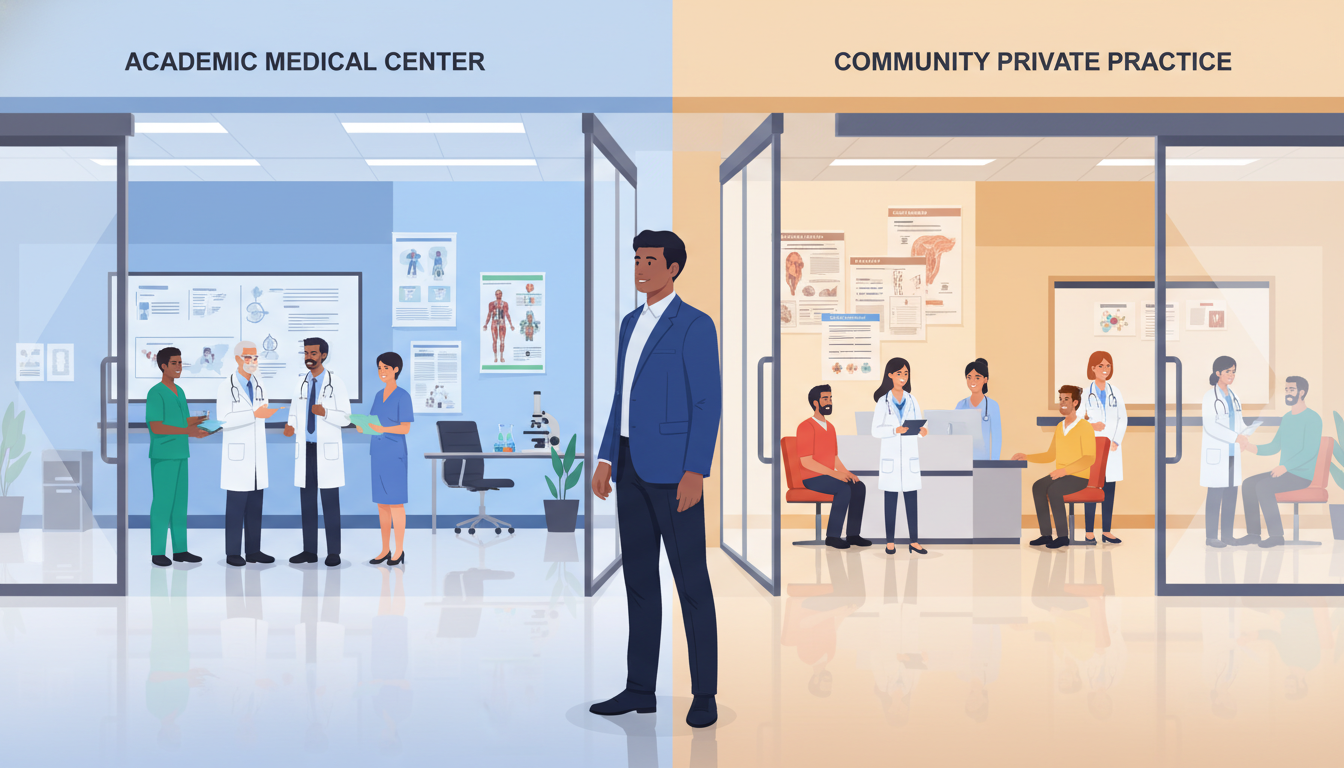
Residency is only the beginning of your life as an attending physician. As a Caribbean IMG, you’ve already navigated unique challenges to earn your spot in a U.S. residency program. Now comes another major decision: aligning yourself with an academic medicine career or entering private practice (or some hybrid of the two).
This choice shapes your day-to-day life, income trajectory, visa options, leadership opportunities, and long‑term satisfaction. Understanding the differences, trade‑offs, and strategies specific to Caribbean medical school residency graduates is crucial.
Understanding the Landscape: Academic vs Private Practice
Before diving into strategy, it’s important to clarify what “academic” and “private practice” really mean in the current U.S. healthcare system.
What Is an Academic Medicine Career?
An academic medicine career usually means working within:
- A university hospital or medical school–affiliated teaching hospital
- A Veterans Affairs (VA) medical center with trainees
- A large tertiary or quaternary care center with active residency and fellowship programs
Core features of academic positions:
- Primary missions: patient care, teaching, research, and institutional service
- Teaching: supervising residents, medical students, and sometimes fellows
- Research: clinical trials, outcomes research, quality improvement, basic science, educational research
- Titles: Instructor, Assistant Professor, Associate Professor, Professor
- Compensation: often lower base pay than high-earning private practice roles, but with benefits like job stability, loan repayment opportunities, and protected time
- Culture: emphasis on scholarly output, mentorship, committee work, and institutional reputation
For a Caribbean IMG, an academic role can provide credibility, mentorship, and networking that may help overcome early career stigma about non‑U.S. schools.
What Is Private Practice?
Private practice is broader and more diverse than many residents realize. It can include:
- Solo practice: one physician running an independent office
- Small group practice: 2–10 physicians sharing overhead and patients
- Large multi-specialty groups: dozens to hundreds of physicians, sometimes owned by physicians, sometimes by hospitals or private equity
- Employed positions: hospital-employed physician roles can feel like a blend of academic and private, depending on how teaching-oriented the hospital is
Key characteristics of private practice:
- Primary mission: clinical care and financial sustainability
- Teaching: optional and often limited; some practices precept students or residents
- Research: usually minimal or pragmatic/industry-supported; not a formal expectation
- Compensation: often higher earning potential, especially over time with productivity incentives
- Culture: emphasis on efficiency, patient satisfaction, revenue cycle, and autonomy
For a Caribbean IMG, private practice can represent faster financial rewards and more control over location and lifestyle, but may require more deliberate effort to build academic credibility or secure visas.
Evaluating Your Priorities: How to Choose Your Path
Before you compare job offers, you need to understand yourself. The right choice between academic vs private practice depends on clear self-assessment.
Key Questions to Ask Yourself
How important is teaching to me?
- Do I enjoy explaining concepts to juniors?
- Do I feel energized when I supervise procedures or discuss cases?
- Have faculty or co-residents told me I’m a strong teacher?
How do I feel about research and scholarship?
- Have I completed or enjoyed research during medical school or residency?
- Am I interested in publishing, presenting at conferences, or doing QI projects?
- Do I want my name on guidelines, book chapters, or major papers?
What are my financial and family obligations?
- Do I have significant loans from a Caribbean medical school residency pathway and undergraduate education?
- Am I supporting family back home or in the U.S.?
- Do I need high income quickly, or can I accept slower growth for a few years?
What type of day-to-day structure do I prefer?
- Do I like a predictable schedule with defined clinic/surgery and teaching blocks?
- Am I comfortable with RVU-based or productivity-based compensation?
- Do I prefer academic meetings and committees, or more time for patient care and business decisions?
How important is prestige, title, and institutional recognition?
- Do I care about being “Dr. X, Assistant Professor at [University]”?
- Would I rather be known locally as a high-volume, successful community physician?
What are my long-term goals?
- Academic leadership? Program director, division chief, department chair?
- Subspecialty niche expert or thought leader?
- Practice owner, business entrepreneur, multi-site group leader?
Matching Priorities to Settings
- If you strongly value teaching, mentorship, and scholarship, and you’re comfortable with modest starting salaries relative to some private practice roles, academic medicine is likely a good fit.
- If your primary focus is clinical practice, income growth, and autonomy, and you’re less interested in research or formal teaching, private practice or hospital-employed practice may be better.
- If you want elements of both, look for hybrid roles: academic-affiliated community hospitals or private groups with teaching contracts.

Academic Medicine for Caribbean IMGs: Opportunities and Strategies
Caribbean IMGs may find the idea of an academic medicine career both attractive and intimidating. While academic centers can be more competitive, they also offer strong pathways to leadership, visa options, and institutional support.
Advantages of Academic Medicine for Caribbean IMGs
Institutional Legitimacy and Network
Working at a well-known academic center can soften biases about Caribbean schooling. Colleagues often judge you more by your performance and publications than by your diploma once you’re on faculty.Visa Sponsorship
- Many academic centers are cap-exempt and have experience sponsoring H-1B or O‑1 visas and supporting permanent residency applications.
- For J‑1 waiver jobs, academic positions at university hospitals or affiliated centers may qualify depending on the location.
Career Development & Mentorship
- Protected time for teaching and research
- Formal mentoring programs and promotion pathways
- Funding for conferences, courses, and advanced degrees (MPH, MEd, MS in Clinical Research)
Professional Identity & Impact
- Ability to shape new generations of physicians, including future IMGs
- Opportunities to affect guidelines, curricula, and public health initiatives
- Pathways into national organizations, editorial boards, and speaking engagements
Challenges for Caribbean IMGs in Academia
Competition and Bias
- Some institutions still prefer U.S. grads for faculty roles, especially in competitive specialties.
- Publication record and fellowship pedigree may matter more if your school is less familiar.
Pay vs. Private Practice
- Academic salaries are often lower than high-earning private roles, especially in procedural specialties.
- Incentives may be more RVU-neutral and focused on balanced missions (clinical + academic).
Metrics and Promotion Pressure
- Expectation to publish, present, and serve on committees
- “Publish or perish” pressure in research-heavy departments
Practical Steps to Secure an Academic Position
If you are in residency or fellowship now:
Clarify Your Academic Niche Early
Examples:- Clinical niche (e.g., heart failure, IBD, high-risk obstetrics)
- Educational niche (simulation, curriculum design, remediation)
- QI/Patient safety (sepsis protocols, handoff improvement)
- Research area (health disparities, telemedicine, outcomes research)
Build Your Academic CV Now
- Aim for at least one to three publications or abstracts by graduation
- Present posters at national meetings (e.g., ACP, ACOG, ACC, CHEST)
- Get involved in curriculum projects, journal clubs, or resident teaching sessions
- Seek out a faculty mentor who understands promotion criteria
Leverage Your Caribbean Background as an Asset
- Focus on projects around health equity, immigrant health, or global health
- Highlight your unique understanding of international training, cultural barriers, and bilingual/bicultural care
- These themes align well with many academic missions and grant priorities.
Network Aggressively
- Introduce yourself to visiting professors, fellowship directors, and academic leaders at conferences
- Use alumni networks from your Caribbean school (e.g., SGU, Ross, AUC) who have academic roles
- Ask your program director for introductions at their alma mater or partner institutions
Target Academic-Friendly Institutions
For Caribbean IMGs, academic roles may be more accessible at:- Regional university-affiliated community hospitals
- Newer or expanding medical schools and residency programs
- Health systems in less saturated markets (Midwest, South, rural academic hubs)
Look at institutions that already have a history of SGU residency match or Caribbean IMG hires; they are more likely to understand your training trajectory.
Private Practice for Caribbean IMGs: Financial and Lifestyle Considerations
Private practice remains a major avenue for career and financial growth, especially for residents who prefer clinical work over scholarship.
Types of Private Practice Environments
Traditional Community Group Practice
- 3–15 physicians
- Shared call, overhead, and decision-making
- Partnership track (often 1–3 years) then profit sharing
Large Multi-specialty or Single-specialty Groups
- Dozens to hundreds of physicians
- Structured contracts, HR, compliance, marketing teams
- Often have sophisticated compensation models and referral networks
Hospital-Employed Positions
- Technically “private” in that you are not part of a university faculty
- Salaried plus productivity bonus
- Less administrative hassle than true independent practice
Direct Care Models
- Direct primary care (DPC), concierge medicine, telemedicine-based practices
- More autonomy in panel size and practice style, but also more entrepreneurial risk
Advantages of Private Practice for Caribbean IMGs
Higher Income Potential
- Especially in procedural fields (e.g., cardiology, GI, ortho, anesthesia)
- Profit-sharing and partnership can significantly increase earnings after a few years
- Ability to negotiate contracts, productivity bonuses, and ancillary income streams
Lifestyle Flexibility and Autonomy
- Choose your practice location (urban, suburban, rural)
- Potential to tailor your schedule, call burden, and clinical focus
- Freedom to design patient experience and office culture
Entrepreneurial Opportunities
- Ownership in ambulatory surgery centers, imaging centers, labs, or urgent care centers
- Ability to develop side ventures: consulting, medicolegal review, telehealth platforms
Challenges of Private Practice for Caribbean IMGs
Visa and Sponsorship Limitations
- Smaller practices may be unfamiliar or uncomfortable with sponsoring H‑1B or handling J‑1 waivers.
- Many J‑1 waiver opportunities are in underserved rural private practice settings, which may limit geographic choice.
Perceived Prestige and Academic Detachment
- Less built‑in teaching and research; may feel professionally isolated if you enjoy academia.
- Harder (but not impossible) to transition back into academic medicine without deliberate effort.
Business and Administrative Complexity
- Understanding billing, coding, compliance, staffing, and malpractice coverage
- Risk from changing reimbursement models and payer contracts
Strategies to Enter and Succeed in Private Practice
Prioritize Contract Literacy
- Understand compensation structures: salary vs RVU vs collections
- Clarify partnership track: timeline, buy‑in, voting rights, non‑compete clauses
- Seek legal review by a healthcare attorney before signing
Ask Directly About Visa Support (If Applicable)
- “Have you sponsored H‑1B or J‑1 waivers for physicians before?”
- “Do you work with an immigration attorney?”
- Be transparent about your needs early to avoid late surprises.
Build a Strong Referral and Patient Base
- Provide excellent, accessible care; communities talk
- Engage with primary care networks, hospitalists, and community leaders
- Use professional but compliant online presence (website, reviews, patient education content)
Maintain a Lifelong Learning and Teaching Mindset
Even in private practice, you can:- Precept medical students or residents from nearby schools
- Participate in CME conferences and present local talks
- Collaborate in industry or outcomes research projects
This keeps doors open if you ever wish to move closer to an academic environment.

Hybrid Paths and Career Transitions: You Don’t Have to Choose Forever
One of the most overlooked truths about choosing career path medicine is that your first job does not lock you into a single lane for life. Many physicians move between academic and private practice settings throughout their careers.
Common Hybrid or Transitional Models
Academic-Affiliated Community Hospitals
- Hospital-employed positions with residents but limited research expectations
- Often combine good income with teaching opportunities
- A strong option for Caribbean IMGs who want a balanced role
Clinical Faculty or Volunteer Faculty Roles
- Private practice physicians hold courtesy appointments at a medical school
- Precept students or residents a few days a month
- Titles like “Clinical Assistant Professor” provide academic affiliation without full-time commitment
Research or QI Leadership Within Private Systems
- Large systems may employ community physicians who lead QI initiatives, registries, or guideline implementation
- This can serve as a bridge back into academia later
Part-Time Academic, Part-Time Private
- Some physicians split their time between a university hospital and a private clinic or locums
- Requires careful contract negotiation to manage conflicts of interest and scheduling
Moving from Academic to Private Practice
Reasons: financial goals, burnout from committees and promotion pressure, geographic preferences.
Strategies:
- Leverage your academic credentials to negotiate better private offers.
- Clarify expectations for call, RVUs, and partnership early—private groups may assume academics are “less busy” and expect rapid ramp-up.
- Maintain professionalism when leaving; academic colleagues can be your referral or consulting network.
Moving from Private Practice to Academic Medicine
Reasons: desire to teach, interest in research, burnout from production pressure, professional stagnation.
Challenges for Caribbean IMGs:
- Academic centers may ask: “What have you done academically in recent years?”
- Gaps in publications or teaching may make it harder to compete.
Strategies:
- Stay academically visible in private practice:
- Precept students/residents
- Participate in local hospital committees and QI initiatives
- Present at regional meetings or publish practice-based studies
- Target hospitals that value community expertise, especially where clinical volume and unique patient populations are crucial.
- Consider non-tenure clinical tracks, which may have lower research requirements.
Strategic Planning for Caribbean IMGs: Putting It All Together
As a Caribbean IMG nearing residency completion or already in practice, use a structured framework to plan your path.
Step 1: Map Your 5–10 Year Vision
Write down:
- Where you’d like to live (region, urban/suburban/rural)
- Whether you envision yourself teaching regularly
- Your must-have financial or family milestones (debt paid, home purchase, supporting parents)
- Your appetite for research, leadership, or entrepreneurship
Step 2: Reality-Check Against Visa and Market Constraints
- If you’re on a J‑1, you may need to prioritize waiver positions, which are commonly in underserved or rural settings—sometimes academic, often private.
- If you already have a green card or citizenship, you have more flexibility to choose based on lifestyle and interest.
Step 3: Build a Competitive Profile During Residency
For academic-focused IMGs:
- Publications, QI projects, conference presentations
- Teaching evaluations and letters highlighting educational contributions
- Mentorship relationships with academically active faculty
For private-practice-focused IMGs:
- Strong procedural and clinical skills; high-volume rotations
- Good relationships with community attendings at your training sites
- Rotations in outpatient community settings, if possible
Step 4: Use the Job Search to Test Assumptions
When interviewing:
Ask academic employers:
- “What is the balance of clinical, teaching, and research time in this role?”
- “What are realistic promotion expectations for someone with my background?”
- “How has your institution supported other IMGs or Caribbean graduates?”
Ask private employers:
- “What does a typical schedule and call pattern look like for new associates?”
- “What is the realistic compensation trajectory over the first 3–5 years?”
- “Have you previously sponsored IMGs for visas or green cards?”
Step 5: Accept That Iteration Is Normal
You might:
- Start academic, build your CV, then transition to private practice to meet financial goals.
- Start in a rural J‑1 waiver private practice, then move into academic-affiliated roles after your waiver period.
- Remain in a hybrid environment indefinitely, balancing teaching with robust clinical practice.
What matters most is intentionality—choosing each step with a clear understanding of what you’re gaining and what you’re giving up.
FAQs: Academic vs Private Practice for Caribbean IMGs
1. As a Caribbean IMG, is it realistic to aim for an academic medicine career in the U.S.?
Yes, it is realistic, but it requires strategic preparation. Many Caribbean IMGs hold academic positions, especially in internal medicine, family medicine, pediatrics, psychiatry, and some subspecialties. To improve your chances:
- Match into a residency with a strong SGU residency match or Caribbean IMG track record at academic centers.
- Build academic output (publications, presentations, teaching) early in residency.
- Seek mentors who are familiar with IMG challenges and can advocate for you.
2. Will starting in private practice close the door to academic positions later?
Not necessarily. It becomes harder over time if you do nothing academic, but you can keep options open by:
- Precepting students/residents
- Participating in QI and hospital committees
- Publishing case reports or practice-based research
- Staying active in professional societies
When transitioning back, aim for clinical track roles at institutions that value community experience.
3. Which path—academic or private practice—pays more in the long run?
In most specialties, private practice has higher income potential, especially after partnership. However, academic roles can be competitive in some fields and regions, particularly:
- Subspecialties with high procedural volume within academic centers
- Institutions offering loan repayment, housing support, or leadership stipends
Consider not just salary, but also:
- Job stability
- Benefits (retirement contributions, CME, protected time)
- Burnout risk and lifestyle fit
4. How should I factor my visa status into choosing my first job?
Visa status is a major practical determinant:
- J‑1 visa holders usually must complete a waiver in a designated underserved area; these jobs are disproportionately in rural private practice or community hospitals, but academic options exist in some states.
- H‑1B candidates may find academic employers more experienced with sponsorship, especially in large university systems.
Be upfront about your status early in job discussions and prioritize employers who have a history of successfully sponsoring IMGs.
Choosing between academic vs private practice is less about right vs wrong and more about alignment: matching your talents, values, and constraints to the environment where you can thrive. As a Caribbean IMG, you’ve already demonstrated adaptability and resilience. Use that same intentionality to build a career—academic, private, or hybrid—that fits both who you are now and who you plan to become.