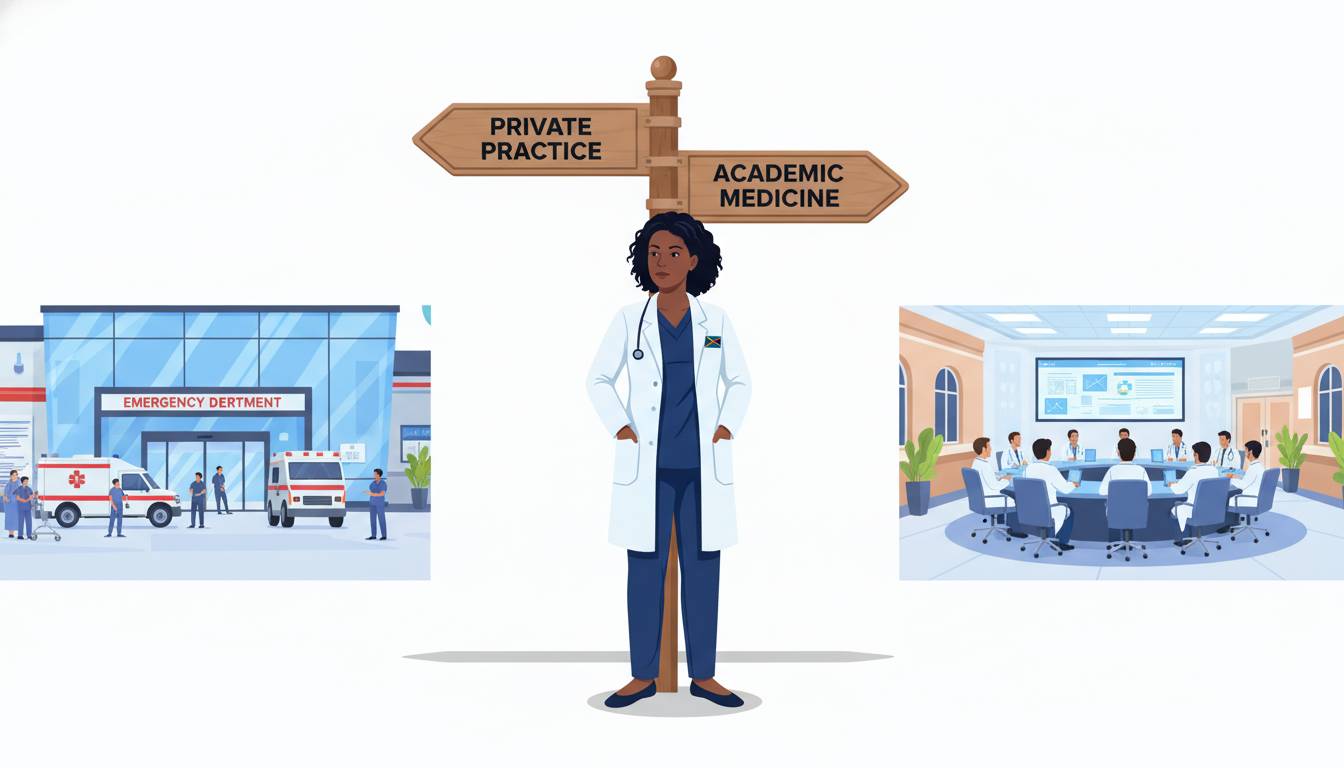
Understanding the Landscape: EM-IM for Caribbean IMGs
Emergency Medicine–Internal Medicine (EM-IM) is a powerful combined training pathway that opens multiple doors: acute care, critical care–style practice, hospital medicine, ambulatory IM, and leadership roles in complex health systems. As a Caribbean IMG, you’ve already navigated the challenges of the Caribbean medical school residency pipeline and the SGU residency match or another Caribbean school’s match process. Now, as you approach the end of residency (or early attending life), the next big question emerges:
Should you build your career in academic medicine or private practice?
For EM-IM physicians, this decision is more complex than for single-boarded colleagues, because you:
- Are marketable to both EDs and hospitalist groups
- Often have strong critical care and procedural skills
- Frequently enjoy teaching and systems-based roles (because EM-IM residents often gravitate to these programs for their breadth)
This article breaks down academic vs private practice in an honest, EM-IM–specific way, tailored to Caribbean IMGs. We’ll cover lifestyle, compensation, visas, advancement, and what each path looks like in real life.
Defining the Paths: What “Academic” and “Private Practice” Really Mean
Before choosing a career path in medicine, you need clear definitions. In reality, “academic” and “private” exist on a spectrum rather than as rigid categories.
What Is Academic Medicine for an EM-IM Physician?
Academic medicine usually means you’re employed by (or strongly integrated with):
- A university-affiliated teaching hospital
- A residency program (EM, IM, or EM-IM)
- Sometimes a medical school directly
Common characteristics:
- Teaching: Residents, medical students, advanced practice providers
- Scholarly activity: Research, QI projects, curriculum development, publications, national talks
- Committee work & leadership: Protocols, hospital quality committees, residency or clerkship leadership
Typical EM-IM academic roles:
- Split practice:
- ED shifts + hospitalist shifts
- ED + dedicated teaching services (IM)
- Core or associate program faculty for EM, IM, or combined EM-IM
- QI or operations–focused positions: sepsis pathways, ED-ICU border control, observation unit, cross-department handoff improvement
What Is Private Practice for an EM-IM Physician?
Private practice in EM or IM usually means you’re working for:
- A democratic physician group
- A contract management group (CMG) or large staffing company
- A multispecialty private practice group
- Sometimes a hospital-employed but non-academic group
Key features:
- Primary focus on clinical volume and efficiency
- Minimal formal scholarship expectations
- Teaching may be optional or informal (nurse practitioners, PAs, or off-service rotators)
- Income often tied to productivity (wRVUs, number of shifts, or collections)
EM-IM private practice roles:
- Full ED: 100% Emergency Medicine, often in community hospitals
- Full IM: Hospitalist, sometimes with ICU or step-down responsibilities
- Hybrid arrangements:
- Hospitalist with ED moonlighting
- ED physician with IM moonlighting in smaller communities
The Grey Zone: Hybrid and “Community Academic” Models
Many jobs blur the line:
- “Community academic” hospitals with EM or IM residency but no major research infrastructure
- Hospital-employed EM-IM physicians who teach students but are evaluated mainly on clinical productivity
- ED or hospitalist groups that support informal teaching and QI but are not a classic “university” setting
For a Caribbean IMG in EM-IM, these hybrids can be extremely attractive:
- They value clinical strength and procedural skill
- They may be more flexible about visa sponsorship
- They allow teaching without full academic bureaucracy

Academic Medicine Career: Pros, Cons, and Fit for Caribbean IMGs
If you’ve ever enjoyed presenting at morning report, leading sim sessions, or advising juniors on the SGU residency match or similar pathways, you may be drawn to an academic medicine career.
Benefits of Academic Medicine for EM-IM
- Protected Teaching and Mentorship
Academic roles formally protect and value:
- Bedside teaching in the ED and on IM wards
- Morning report, M&M conferences, case-based discussions
- Supervision of procedures (airway, central lines, LPs, ultrasound)
EM-IM attendings are particularly valued in academic centers because:
- You can supervise both acute resuscitations and complex inpatient management
- You’re trained to think across ED–inpatient–ICU transitions
- Scholarly Identity and Long-Term Growth
Academic environments support:
- Research: clinical, operational, education, or quality improvement
- Educational scholarship: curricula, podcasts, simulation programs
- Leadership tracks:
- Associate Program Director or Program Director (EM, IM, EM-IM)
- Medical Director of ED or hospitalist service
- Vice Chair for Education, Quality, or Diversity, Equity & Inclusion
For Caribbean IMGs, scholarly work can help:
- Build a national reputation (talks at ACEP, SAEM, SHM, AAIM)
- Offset biases about Caribbean medical school residency backgrounds by demonstrating expertise and impact
- Structured Mentorship and Networking
Academic centers often have:
- Multiple EM-IM or dual-trained attendings
- Formal mentorship programs and faculty development
- Networking opportunities with leaders who influence:
- National guidelines
- Fellowship placements
- Leadership recruitment
- Non-Clinical Time (in Some Positions)
While not universal, some EM-IM academic jobs offer:
- 0.1–0.3 FTE of protected time for:
- Research
- Educational roles
- Administration
- This can reduce burnout by allowing variety in your week:
- 7–8 clinical shifts + 1–2 days of project or education time
- Pathway to Subspecialty or Niche Roles
Academic fields love “niche expertise.” EM-IM lends itself to:
- Observation medicine / CDU director
- Sepsis or rapid response team leadership
- ED-ICU hybrid models
- Hospital throughput and flow optimization
These roles can enhance job security and satisfaction.
Downsides and Challenges of Academic Medicine
- Lower Starting Compensation (Often)
In many markets, academic salaries:
- Are 10–30% lower than comparable private practice roles
- May lag in annual raises
- Increase with promotions (assistant → associate → full professor) but slowly
This can impact:
- Loan repayment timelines
- Ability to support family or extended family abroad
- Savings and investment potential early in your career
- Promotion Pressure and “Hidden Curriculum”
Promotion criteria may include:
- Peer-reviewed publications
- National-level presentations
- Leadership in committees or organizations
- Teaching evaluations
As a Caribbean IMG, you might:
- Have fewer early-career mentors who share your background
- Feel pressure to “prove yourself” more
- Need to be strategic about what you say “yes” to:
- Avoid being the “go-to” for every committee without academic credit
- Institutional Politics and Bureaucracy
Academic organizations are often:
- Slower to change
- Heavy on meetings, committees, and approvals
- Sensitive to hierarchy and titles
This can frustrate EM-IM physicians who are trained to act quickly and practically.
- Less Control Over Schedule and Practice Style
Academic EDs and IM services may:
- Have less flexibility in shift trading or self-scheduling
- Emphasize education even when the ED is saturated
- Require a balance of “teaching cases” vs “fast-track” or observation coverage
If you thrive on high-efficiency, fast-paced, purely clinical work, this may feel constraining.
Visa, Green Card, and IMG Considerations in Academic Jobs
For Caribbean IMGs on J-1 or H-1B:
- Academic centers are often familiar with H-1B sponsorship
- Many are cap-exempt, making visa logistics easier
- University-affiliated jobs may have established:
- Legal teams
- Immigration staff
- Experience with physician-specific immigration issues
However:
- Purely academic, non-service-heavy roles may not qualify for certain J-1 waiver programs because they’re not in shortage areas
- You may need to combine academic work with a service-heavy clinic or hospital to meet waiver requirements
Actionable tip: When interviewing, ask explicitly:
- “Do you sponsor H-1B for faculty?”
- “Do you support green card applications within the first 1–2 years?”
- “How many IMGs are on faculty, and what visas are they on?”

Private Practice: Pros, Cons, and Unique EM-IM Opportunities
On the other end of the spectrum is private practice vs academic EM or IM. For many Caribbean IMGs, private practice offers rapid financial stabilization and a straightforward focus: excellent clinical care.
Benefits of Private Practice for EM-IM Physicians
- Higher Earning Potential
In many regions:
- Base salary + productivity incentives exceed academic salaries
- You can increase compensation by:
- Taking more shifts
- Working higher-acuity or higher-volume sites
- Night shifts and weekends often come with differentials
For an EM-IM Caribbean IMG:
- Higher early income can:
- Accelerate loan repayment
- Support family obligations at home or abroad
- Build savings and investments faster
- Simpler Metrics: Volume, Efficiency, Patient Care
Evaluation is usually based on:
- Patient satisfaction and quality metrics
- Throughput, documentation, and wRVUs
- Teamwork and reliability
You’re less likely to be judged by:
- Number of publications
- National talks
- Academic titles
- Schedule Flexibility and Autonomy
Depending on the group:
- You may have significant control over:
- Number of shifts per month
- Preferred sites (higher acuity vs lower acuity)
- Day vs night balance over time
- EM-IM physicians can sometimes negotiate hybrid roles:
- Certain number of ED shifts + hospitalist shifts
- Occasional ICU coverage if comfortable and credentialed
- Opportunities in Underserved and Rural Areas
Community and rural hospitals often:
- Desperately need EM or IM physicians
- Are open to creative arrangements:
- ED coverage + inpatient coverage
- “Doc of the day” models in critical access hospitals
- May offer:
- Loan repayment
- Strong J-1 waiver or H-1B sponsorship
Here EM-IM training is particularly valuable:
- You can stabilize critically ill patients in the ED
- You can manage complex medical inpatients
- You may act as a de facto intensivist in some settings (with caution and appropriate support)
- Less Academic Bureaucracy
You’ll spend more time:
- Seeing patients
- Leading teams
- Improving local processes informally
And less time:
- Writing promotion dossiers
- Chasing IRB approvals
- Navigating academic politics
Downsides of Private Practice
- Less Formal Teaching and Scholarship
While some community hospitals host:
- Off-service residents
- NP/PA students
- Occasional medical students
You usually won’t get:
- Protected time for teaching
- Formal titles tied to teaching roles
- Institutional support for major research projects
If teaching and scholarship are core to your identity, this may feel unfulfilling long-term.
- Job Security Depends on Contracts and Markets
Private EM and IM groups may:
- Lose hospital contracts to competitors
- Restructure compensation based on hospital finances
- Face pressure from CMGs or hospital administration
You must:
- Understand your contract structure
- Know what happens if the hospital changes vendors
- Clarify whether there’s a path to partnership and what that truly means
- Variable Support for Visa and Immigration
Some community and private groups:
- Are very supportive of J-1 waivers and H-1B sponsorship
- Others have no experience with IMG hiring
As a Caribbean IMG, you must:
- Ask detailed questions about visa history
- Speak with current IMG physicians in the group
- Ensure the group has competent legal support
- Potential for Isolation
Small groups or rural settings may mean:
- Few or no colleagues with EM-IM training
- Limited mentoring for long-term career growth
- Fewer academic or specialty networking opportunities
You may need to maintain:
- External professional societies (ACEP, SHM, etc.)
- Online or virtual mentorship
- Conferences and CME as primary networking channels
EM-IM–Specific Career Configurations: Academic vs Private in Real Life
For EM-IM physicians, choosing career path medicine is rarely a binary “academic vs private practice” decision. It’s more about choosing the configuration that best fits your skills, values, and constraints (loans, visas, family).
Below are realistic models EM-IM Caribbean IMGs commonly pursue.
Model 1: Academic ED + Academic IM (Full Academic Duality)
Setting:
- University-affiliated hospital with:
- EM residency
- IM residency
- Possibly EM-IM combined program
Your role:
- Split FTE between:
- ED clinician–educator
- IM teaching hospitalist
- Participate in:
- Resident education (both specialties)
- Curriculum development
- Interdepartmental QI projects
Pros:
- Rich environment for teaching and scholarship
- Natural alignment with EM-IM training identity
- Easier access to academic promotion and leadership
Cons:
- Salary may be at the lower end of the spectrum
- Schedule complexity (balancing ED and IM days)
- High committee and administrative load over time
Best for:
- Those strongly drawn to academic medicine careers
- EM-IMs who love teaching and systems projects
- Caribbean IMGs aiming to counteract bias with a robust academic CV
Model 2: Academic ED + Community Hospitalist (Hybrid Academic–Private)
Setting:
- Academic ED in a city or tertiary center
- Nearby community hospital employing hospitalists
Your role:
- Academic ED shifts with residents and students
- Community hospitalist work (days or nights) in a primarily clinical role
Pros:
- Keeps one foot in academia, one in higher-paying community practice
- Diversifies income streams and job security
- Offers teaching and scholarship opportunities through the ED
Cons:
- Commute and schedule coordination can be challenging
- Two different employer cultures and expectations
- Possible fatigue from switching mindsets and documentation systems
Best for:
- EM-IMs who want teaching but also need stronger earnings
- Those wanting flexibility for loans, family, and immigration while preserving an academic profile
Model 3: Pure Community ED or Hospitalist with Teaching Component
Setting:
- Community hospital with:
- Off-site residency rotations
- Clinical campus for a medical school
- NP/PA training programs
Your role:
- Core ED physician or hospitalist
- Optional preceptor for:
- Students
- Rotating residents (e.g., from a nearby academic center)
Pros:
- Higher pay than many academic roles
- Moderate teaching that doesn’t dominate your schedule
- Some scholarly/QI work possible without heavy promotion pressure
Cons:
- Teaching opportunities may be inconsistent
- Less formal recognition for education roles
- Limited infrastructure for large research projects
Best for:
- Caribbean IMGs who enjoy clinical work first, with occasional teaching
- Those wanting to live in smaller cities or suburbs with good compensation
Model 4: Rural EM-IM “Swiss Army Knife” Physician
Setting:
- Rural or critical access hospital
- Possibly the only physician onsite at times
Your role:
- Provide ED coverage
- Admit and manage inpatients
- May oversee:
- Stabilization of critical patients
- Tele-ICU or transfer coordination
Pros:
- Exceptional autonomy and procedural volume
- Very strong earning potential in some regions
- J-1 waiver–friendly; often enthusiastic about sponsoring IMGs
Cons:
- Professional isolation (few EM-IM peers)
- Limited formal academic opportunities
- High responsibility and need for comfort with broad practice
Best for:
- EM-IM physicians who like broad-spectrum medicine
- Those urgently needing a J-1 waiver or strong financial package
- Caribbean IMGs comfortable with rural living and smaller communities
Making the Decision: A Step-by-Step Framework for Caribbean EM-IM IMGs
When facing academic vs private practice options, use this framework:
Step 1: Clarify Your Non-Negotiables
List what is absolutely non-negotiable in the next 3–5 years:
- Visa needs:
- Need J-1 waiver or H-1B within 1 year?
- Need cap-exempt H-1B?
- Family needs:
- Spouse’s job opportunities?
- School systems for children?
- Proximity to extended family or diaspora communities?
- Financial needs:
- Minimum salary to cover loans and obligations?
- Timeline for becoming debt-free?
This may automatically eliminate certain pure academic or low-paying markets, or certain private groups with weak visa support.
Step 2: Define Your Professional Identity
Ask yourself:
- On a scale of 1–10, how important is teaching to you?
- On a scale of 1–10, how important is research or significant scholarship?
- How much do you enjoy:
- QI/operations?
- Committee work?
- National involvement (societies, speaking)?
If:
- Teaching/scholarship ≥ 7/10 → Lean toward academic or hybrid roles
- Income/flexibility ≥ 7/10 → Lean toward private practice or community–academic hybrids
Step 3: Explore Real Job Descriptions, Not Just Labels
Avoid deciding based purely on the word “academic” or “private.” Instead:
- Request sample schedules
- Ask about:
- Expected shifts per month
- Committee and teaching expectations
- Promotion criteria and typical timelines
- Existing EM-IM or IMG faculty
For community/ private jobs:
- Clarify:
- Compensation structure (base vs productivity)
- Partnership track, if any
- History of contract stability
- Current or past IMG physicians and their visa journeys
Step 4: Talk to Caribbean IMG Physicians in Each Environment
Your most valuable data will come from people like you:
- Reach out via:
- Alumni networks (e.g., SGU, AUC, Ross, Saba)
- Social media physician groups
- National conferences (ACEP, SAEM, SHM)
- Ask:
- “What surprised you after leaving residency?”
- “If you could redo your first job choice, what would you change?”
- “How supportive was your institution with visas and green card?”
Step 5: Plan for Flexibility
Your first job is not your last job.
Many EM-IM Caribbean IMGs:
- Start in high-paying private practice to stabilize finances and visas
- Later transition to more academic roles once:
- Loans are smaller
- Green card is secured
- Family situation is stable
Others:
- Start in academic medicine, build a strong CV
- Then negotiate better private or community–academic roles using that background
Design your first 3–5 years not as a permanent label, but as Phase 1 in your long-term career plan.
FAQs: Academic vs Private Practice for Caribbean EM-IM IMGs
1. Is it harder for Caribbean IMGs to get academic jobs in EM-IM?
It can be more competitive, but not impossible. Factors that help:
- Strong performance in residency (chief resident role, awards)
- Early involvement in:
- QI projects
- Education initiatives
- Research with publications or national presentations
- Mentors who will strongly advocate for you
Academic centers may carry biases about the Caribbean medical school residency pathway, but a solid EM-IM residency track record and demonstrated productivity often matter more.
2. Can I move from private practice to academic medicine later?
Yes, but you’ll need to be intentional:
- Maintain some scholarly activity if possible (case reports, QI work, local teaching)
- Stay involved with professional societies and conferences
- Be prepared to accept:
- Lower compensation
- A more junior academic rank initially
- Network with academic EM-IM leaders to understand what they look for when hiring.
Many academic departments value experienced clinicians who bring real-world perspectives from community practice.
3. How does an EM-IM background affect my earning potential in each setting?
In academic medicine, EM-IM may:
- Offer slightly higher compensation than pure IM roles due to ED shifts
- Create opportunities for stipended leadership roles:
- Observation unit director
- Associate Program Director
- Sepsis or throughput director
In private practice, EM-IM’s value varies:
- In ED-only roles, you’ll be paid like other EM attendings
- In hybrid or rural roles, you may negotiate premium packages for covering multiple service lines (ED + inpatient)
Overall, EM-IM offers more flexibility to chase higher-paying niches, especially in community and rural settings.
4. Should I choose EM IM combined training if I already know I want private practice only?
If you are already in EM-IM, you’re well-positioned regardless. But for those still deciding:
- If you’re 100% certain you want to do only ED shifts in a private community setting, pure EM may be more efficient.
- EM-IM is ideal if you:
- Want flexibility between ED and IM
- Are open to academic medicine or leadership roles
- Like the idea of broad-spectrum internal medicine alongside acute care
For Caribbean IMGs, EM-IM can be a strategic hedge: it expands job options in both emergency medicine internal medicine domains, helpful in navigating visa, market, and geographic constraints.
Choosing between academic and private practice as a Caribbean IMG in EM-IM is less about finding the “right” answer and more about aligning your skills, values, and constraints with the right environment. Understand what each path offers, talk to people living those realities, and design your first attending role as a thoughtful launchpad, not a lifelong sentence.