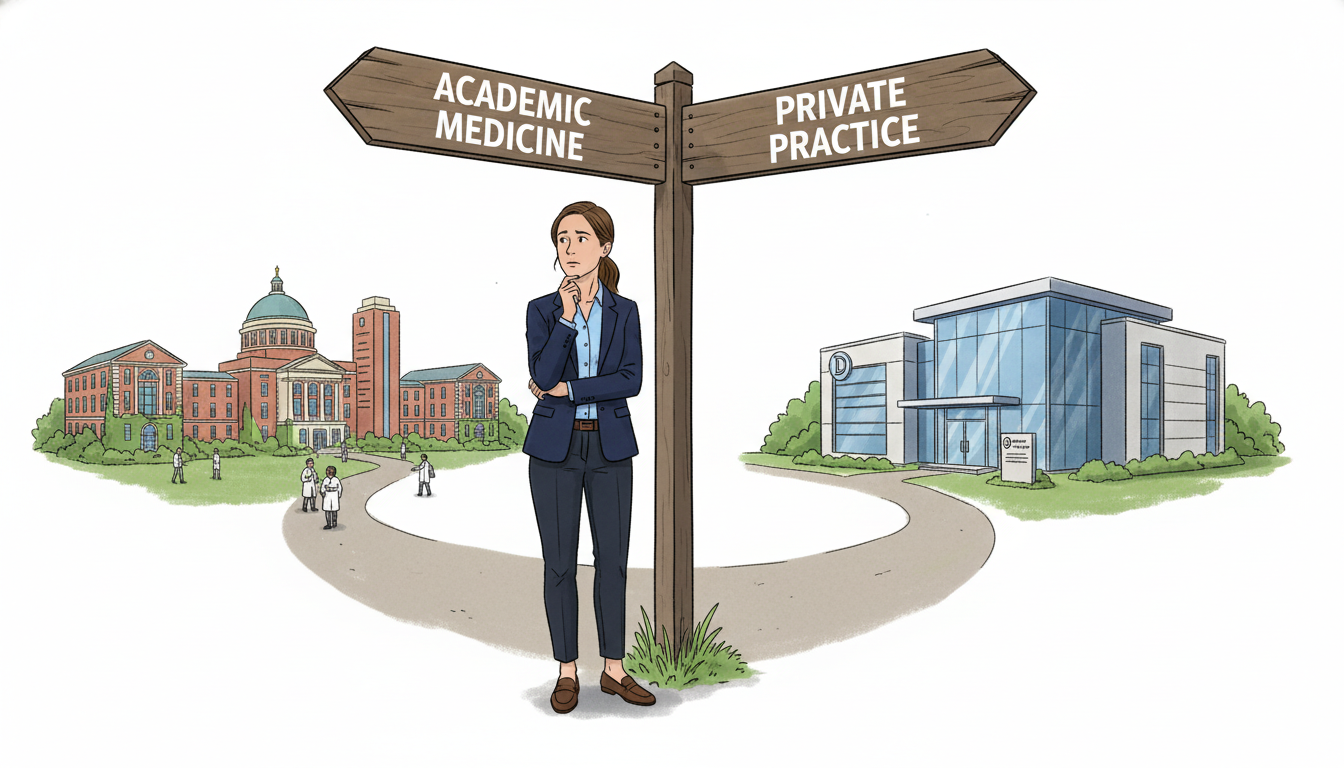
Dermatology residency is competitive, and many applicants focus intensely on the derm match. But an equally important decision comes later: choosing between an academic dermatology career and private practice. This choice shapes your daily work, income trajectory, research opportunities, and even your identity in medicine.
This guide walks you through the core differences between academic vs private practice in dermatology, with practical examples, questions to ask yourself, and strategies to explore both paths during and after residency.
Understanding the Two Main Paths in Dermatology
Before comparing in detail, it helps to define what we mean by academic dermatology and private practice dermatology, along with several hybrid models.
What is Academic Dermatology?
Academic dermatology typically means working within:
- A university-affiliated hospital or medical school
- A large teaching hospital with residents/fellows
- An integrated health system with a robust education or research mission
Core features:
- Tripartite mission: clinical care, teaching, and research
- Employed position: salaried through a university or hospital
- Title structure: Instructor, Assistant Professor, Associate Professor, Professor
- Institutional responsibilities: committees, conferences, academic governance
Clinical practice can still be very busy, but your week is usually divided among:
- Outpatient clinics (general derm, subspecialty, or procedural)
- Resident and medical student teaching
- Scholarly activity (research, QI projects, publications, lectures)
- Administrative/leadership roles
What is Private Practice Dermatology?
Private practice dermatology generally means working in a setting not primarily tied to a medical school. This includes:
- Solo practice: one dermatologist, possibly with mid-level providers
- Small group practice: a few dermatologists sharing resources
- Large group practice / supergroup: multi-site, multi-physician organizations
- Private equity–backed groups: dermatology corporations with investor ownership
Core features:
- Predominantly clinical: most time is direct patient care and procedures
- Business orientation: revenue generation, practice management, efficiency
- Ownership potential: opportunity to buy in or build your own practice
- Flexibility: often more control over schedule, services offered, location
Private practice may be:
- Insurance-based: contracts with commercial payers, Medicare, Medicaid
- Concierge / direct-pay: patients pay a retainer or fee-for-service directly
- Cosmetic-focused: high proportion of cash-pay aesthetic services
Hybrid and Non-Traditional Models
Many careers don’t fit neatly into “pure academic” or “pure private practice.” Examples:
- Academic affiliation while in private practice: volunteer faculty teaching residents one half-day per week
- Hospital-employed dermatology: community hospital job with some teaching but limited formal academic track
- Part-time roles: splitting time between an academic institution and private practice
- Industry/consulting plus clinical: working with pharma or device companies while maintaining a clinic
When choosing a career path in medicine, especially in dermatology, recognize that your path can evolve. Many dermatologists move from academic to private practice (or vice versa) over the course of a career.
Clinical Work, Case Mix, and Lifestyle
When residents think about academic vs private practice in dermatology, they often focus on lifestyle and day-to-day work. These differences are real, but often more nuanced than stereotypes suggest.

Clinical Case Mix
Academic Dermatology:
- More complex medical dermatology:
- Autoimmune bullous diseases
- Complex psoriasis or atopic dermatitis requiring biologics
- Cutaneous lymphoma
- Severe drug eruptions
- Inpatient consults
- Procedures: still common, but often integrated with teaching
- Referrals: from community dermatologists and specialists for difficult cases
- Subspecialization: you may focus on:
- Dermpath
- Pediatric dermatology
- Procedural/cosmetic dermatology
- Mohs surgery
- Complex medical dermatology
Private Practice Dermatology:
- Bread-and-butter dermatology:
- Acne, rosacea, eczema, psoriasis
- Benign lesions (nevi, SKs, warts)
- Skin cancers and precancers
- High procedural volume: biopsies, excisions, cryotherapy, cosmetic procedures (depending on practice)
- Cosmetics potential: Botox, fillers, lasers, peels—especially in more affluent or urban markets
- Less inpatient work: rarely do hospital consults unless contracted
In many markets, complex cases still appear in private practice, but the proportion of rare and severely ill patients is typically higher in academic centers.
Clinic Flow and Productivity Expectations
Academic:
- Moderate to high volume, depending on institution
- Session templates may include additional time for teaching
- Productivity measured in RVUs, but often balanced with academic expectations
- Some flexibility to block time for specialized clinics or research
Private Practice:
- Higher emphasis on productivity and efficiency
- Templates can be quite full (e.g., 30–45 patients/day, sometimes more)
- Strong pressure to minimize no-shows, optimize scheduling, and streamline documentation
- Your income is more directly tied to how many patients you see and what procedures you perform
Lifestyle and Schedule
Both paths can offer reasonable lifestyle compared with other specialties, but the balance differs.
Typical Academic Pattern (example):
- 3–4 days/week of clinic
- 0.5–1 day/week for research, writing, or administrative work
- Regular teaching commitments: grand rounds, journal clubs, lectures
- Inpatient consult weeks or call (varies widely)
Typical Private Practice Pattern (example):
- 4–5 days/week of clinic (often full days)
- Small proportion of admin time, typically squeezed between or after patients
- Less formal teaching; may precept students/residents occasionally if affiliated
Call responsibilities:
- Academic: may cover hospital consults, complex inpatient cases; more structured call coverage
- Private practice: often phone triage, urgent visits, ER callbacks; in some markets, almost no formal call
Work-life balance can be excellent in either setting, but:
- Academics may have more control over non-clinical days but experience pressure to publish and perform academically.
- Private practitioners may have more autonomy over total hours, but revenue pressures may nudge them toward busier clinics.
Compensation, Job Security, and Business Considerations
For many residents, the income difference between academic medicine careers and private practice is striking.

Compensation: Academic vs Private Practice
Academic Dermatology Compensation:
- Generally lower base salary than private practice, especially early and mid-career
- Often includes:
- Base salary
- Incentive component tied to RVUs or departmental performance
- Academic bonuses (for grants, publications, leadership roles)
- Benefits may be strong:
- Robust retirement contributions
- Subsidized health insurance
- Tuition benefits for children (in some institutions)
- Paid sabbaticals (late career, at some universities)
Private Practice Dermatology Compensation:
- Often substantially higher income potential, especially with:
- High-volume medical derm
- Procedural and cosmetic services
- Partnership/ownership
- Common models:
- Straight salary (early employment, especially in large groups)
- Salary + productivity bonus
- Pure productivity (percentage of collections or net profit)
- Partnerships with buy-in after a trial period
- Benefits vary widely; large groups may match or exceed academic benefits, while small practices may offer more modest packages but higher take-home pay.
At a broad level, private practice dermatologists often out-earn academic dermatologists, sometimes by a large margin, particularly when they are partners or owners in thriving practices.
Job Security and Risk
Academic Setting:
- Relative job stability once you are established and performing adequately
- Long-term “tenure-track” positions still exist in some institutions, though the landscape is changing
- Income is less sensitive to local economic swings or short-term practice metrics
- Grant-funded research components can add some financial uncertainty for research-heavy roles
Private Practice:
- Early stability if employed by a large group or health system
- More income volatility and business risk, especially if you:
- Start your own practice
- Buy into a small group
- Operate in a saturated market
- However, equity and ownership can significantly increase long-term financial security and wealth accumulation
Business Skills and Administrative Burden
Academic Dermatology:
- Less direct involvement in billing, contracting, and day-to-day business operations
- More administrative work related to:
- Committees
- Curriculum development
- Residency leadership roles
- Research administration and IRB processes
Private Practice Dermatology:
- Varies greatly:
- Employed dermatologist in a large group: modest business involvement
- Practice owner: substantial leadership responsibilities
- Owners may manage:
- Hiring and staffing
- Negotiating with insurers
- Marketing and branding
- Capital investments (lasers, office expansion)
- Legal and regulatory compliance
Your tolerance for—and interest in—business and entrepreneurship is central to the private practice vs academic decision.
Teaching, Research, and Professional Identity
The dermatology residency environment naturally leans toward academic culture—grand rounds, journal clubs, conferences—which shapes how you think about your future role in medicine.
Teaching Opportunities
Academic Dermatology:
- Teaching is a core component of your job:
- Daily resident and student teaching during clinic
- Formal didactic lectures
- Bedside teaching on inpatient consults
- Mentorship for case reports, QI, or research projects
- Strong culture of education and mentorship; your promotions often depend partly on teaching excellence
Private Practice Dermatology:
- Teaching opportunities vary:
- Community preceptorships for residents or students
- Volunteer or adjunct academic appointments to supervise residents one half-day weekly
- Lecturing at regional CME events or national meetings based on clinical expertise
- Teaching is typically optional and additive, not a primary job requirement
If you derive significant meaning from daily teaching and mentoring, academic dermatology may feel more naturally aligned—but you can still weave teaching into a private practice career via affiliations.
Research and Scholarly Work
Academic Dermatology:
- Wide spectrum, from clinically focused faculty with minimal research to physician-scientists with heavily protected research time
- Possible research activities:
- Clinical trials
- Translational research
- Epidemiology/public health
- Health services research
- Medical education research
- Often access to:
- Statistical support
- Grants offices
- Research coordinators
- Promotion and career advancement often depend on publications, grants, national recognition
Private Practice Dermatology:
- Less structured research infrastructure
- Common research roles:
- Participation in industry-sponsored clinical trials
- Case reports or small series based on unusual presentations
- Collaborative research with academic partners
- Time for research usually carved out from personal or non-clinical time
- Little formal pressure to publish; scholarly activity is more optional and entrepreneurial
If your primary career goal is to build a robust academic medicine career—publishing extensively, securing grants, and shaping guidelines—academic dermatology is the logical home base.
Professional Identity and Mission
Ask yourself:
- Are you most energized by:
- Direct patient care and procedures?
- Discovering new knowledge and participating in trials?
- Teaching the next generation of dermatologists?
- Building and leading a business?
Academic Dermatology often appeals to those who value:
- Being part of a visible, scholarly community
- Impacting guidelines and best practices
- Serving as an expert referral center for complex disease
- Mentoring and teaching
Private Practice Dermatology often appeals to those who value:
- High-volume, efficient clinical care
- Entrepreneurship and direct control over their practice
- Procedural and cosmetic focus
- Flexibility to shape their own professional brand and niche
Both paths allow meaningful, patient-centered work. The question is less “which is better?” and more “which best matches my strengths, motivations, and tolerance for trade-offs?”
How to Explore and Decide During Residency
You don’t need to decide your long-term career path in medicine on Day 1 of intern year. But you can make your decision easier by intentionally exploring both worlds during residency.
Use Rotations Strategically
- Academic rotations: Notice:
- Faculty schedules and burnout levels
- How much time they spend in clinic vs meetings vs research
- The culture around residents and students
- Community/private practice rotations: Ask:
- How they started their practice or joined the group
- What their typical day and week look like
- How compensation and partnership work
- What they would do differently if starting again
Keep a running list after each rotation:
- “What I liked”
- “What I didn’t like”
- “Questions this raises about my future”
Patterns will emerge.
Seek Mentors in Both Settings
Have at least one mentor in academic dermatology and one in private practice.
With each mentor, discuss:
- Their career decision process
- What they find most fulfilling and most challenging
- How their views on academic vs private practice have changed over time
- What they see in colleagues who are happy vs unhappy in each setting
Mentors can also help you understand evolving opportunities, such as hybrid roles, teledermatology, and nonclinical leadership positions.
Consider Your Financial Goals and Obligations
Your financial realities matter:
- Educational debt burden
- Family responsibilities
- Desired lifestyle (urban vs rural, cost-of-living considerations)
- Long-term aspirations (owning a practice, early retirement, philanthropy)
Higher initial income in private practice can be attractive, especially with large loans. But also consider:
- Academic loan repayment programs (for certain institutions or public service)
- Long-term wealth-building potential of practice ownership
- Your comfort with risk and delayed gratification
Reflect on Your “Day-in-the-Life” Preference
A practical exercise:
- Write a hypothetical weekly schedule for yourself in an ideal academic job:
- Number of clinic days
- Teaching commitments
- Research time
- Call responsibilities
- Then write a hypothetical weekly schedule for an ideal private practice job:
- Clinic volume and hours
- Procedures and cosmetics
- Admin/business time
- Call and after-hours work
Compare which schedule feels more energizing and sustainable. Mentors can help you calibrate your expectations to reality.
Remember: The Decision Isn’t Always Permanent
Many dermatologists:
- Start in academia, then move to private practice for higher income or flexibility.
- Start in private practice, then return to academia for more teaching/research or less business burden.
- Build hybrid careers: part-time academic, part-time private practice, plus consulting or industry roles.
When thinking about choosing a career path in medicine, especially in dermatology, allow for the possibility of career transitions. Focus on what’s best for your first 5–7 years, with an open mind about evolving later.
Putting It All Together: A Comparison Summary
Below is a concise side-by-side comparison to help you frame your thinking.
Academic Dermatology:
- Pros:
- Strong teaching and mentoring opportunities
- Access to research infrastructure and grants
- Regular exposure to complex medical dermatology
- Professional identity within academic medicine
- Competitive benefits and institutional resources
- Cons:
- Lower compensation on average
- Pressure to publish and maintain academic productivity
- Bureaucracy and administrative burden
- Less autonomy over clinic volume and operations
Private Practice Dermatology:
- Pros:
- Higher earning potential, especially with ownership
- Greater autonomy and business control
- Ability to shape practice focus (cosmetic vs medical, etc.)
- Flexible paths for location and lifestyle
- Cons:
- Business and administrative responsibilities (especially as owner)
- Income tied more directly to volume and efficiency
- Fewer built-in opportunities for formal teaching and research
- Vulnerability to market and payer changes
Ultimately, a satisfying dermatology career can emerge from either academic medicine or private practice—or a thoughtful combination of the two. The key is deep self-reflection, honest exposure to both environments, and ongoing mentorship as you progress through and beyond residency.
FAQ: Academic vs Private Practice in Dermatology
1. Can I switch from academic dermatology to private practice (or vice versa) later in my career?
Yes. Many dermatologists transition between settings. Academic to private practice is relatively common and often financially advantageous. Moving from private practice to academia can be more competitive—strong clinical reputation, ongoing teaching, or published work can help. Maintaining relationships and some involvement in teaching or scholarly activities while in private practice makes later academic transitions easier.
2. Is it possible to have a research career in private practice dermatology?
To a limited extent. Large private groups and some independent practices participate in industry-sponsored clinical trials, particularly in psoriasis, atopic dermatitis, acne, and other common conditions. However, basic science and NIH-funded translational research usually require an academic infrastructure. If serious, grant-funded research is central to your vision of an academic medicine career, academic dermatology is the better primary base.
3. How does private equity ownership affect private practice dermatology careers?
Private equity–backed dermatology groups can offer attractive initial salaries, reduced administrative burden early on, and access to capital (lasers, expansion). Trade-offs may include:
- Less control over scheduling and clinical protocols
- Productivity pressure
- Limited or more expensive equity opportunities
- Potential changes in culture with ownership turnover
If you’re considering such a group, ask specifically about decision-making authority, contract terms, buy-in options, and expectations for productivity.
4. What if I’m not sure yet which path fits me best?
That’s common, even late in residency. Practical steps:
- Prioritize elective time in both academic and community settings.
- Attend national dermatology meetings and talk to physicians in a variety of roles.
- Seek dual mentorship—one academic, one private practice.
- Consider starting in a more flexible or hybrid role (e.g., hospital-employed or academically affiliated community position) that leaves doors open.
Remember, your first job is not your final destination; focus on learning what you value and building skills that will be valuable in any setting: excellent clinical care, professionalism, communication, and adaptability.
By understanding the real-world differences between academic vs private practice in dermatology, and honestly assessing your own goals and preferences, you can chart a career path that is both professionally rewarding and personally sustainable—long after the excitement of the derm match has passed.