
Understanding Your Options: Academic vs Private Practice in Clinical Informatics
For a DO graduate entering or finishing residency and eyeing a future in clinical informatics, choosing between academic medicine and private practice can feel like standing at a major fork in the road. Both tracks can support a fulfilling career in informatics, but they differ meaningfully in culture, day-to-day work, compensation, and long‑term opportunities.
This article is designed specifically for the DO graduate residency audience—those who may have completed an osteopathic residency match in any specialty and are now exploring informatics, health IT training, and related pathways. We’ll walk through what “academic” and “private” really mean in the context of clinical informatics, how your DO background fits in, and concrete strategies for choosing a career path in medicine that aligns with your values and goals.
Clinical Informatics for DO Graduates: Where It Fits in Your Career
Clinical informatics is a relatively young but rapidly expanding field focused on how clinicians use data, information systems, and technology to improve patient care, quality, and efficiency. As a DO graduate, you bring several advantages to this space:
- Strong training in whole‑person, systems‑based thinking
- Comfort with multidisciplinary collaboration (e.g., PT, OT, social work)
- Experience with both manual and technology-driven approaches to care (OMM/OMT plus EHRs)
Common Entry Points into Clinical Informatics
For DO graduates, entry points generally include:
Clinical Informatics Fellowship
- ACGME-accredited, 2‑year program, often after residency
- Leads to board eligibility in Clinical Informatics (through your primary ABMS board)
- Many programs are housed in academic medical centers, but some are affiliated with large health systems that behave more like private practice environments
Health IT Training & On-the-Job Transition
- Taking on physician champion, CMIO advisor, or EHR super‑user roles during residency or early attending life
- Transitioning stepwise into more formal informatics responsibilities
Hybrid Clinical + Informatics Roles
- Example: 0.6 FTE clinical (hospitalist, EM, FM) + 0.4 FTE informatics work for a hospital system or vendor
Your eventual environment—academic vs private practice—will shape what these roles look like, but both paths can lead to robust informatics careers.
Defining “Academic” vs “Private Practice” in Clinical Informatics
Before comparing them, it’s important to clarify what we mean by each pathway in this particular niche.
Academic Clinical Informatics
Informatics in an academic medicine career usually means:
- Affiliation with a university or medical school
- Faculty appointment (Instructor, Assistant Professor, etc.)
- Participation in:
- Teaching (students, residents, fellows)
- Research or quality improvement
- Committee work (informatics, safety, quality, curriculum)
- Employment typically through:
- University hospital or faculty practice plan
- Large integrated health system with a strong academic mission
Academic roles can be full-time informatics, hybrid (clinical + informatics), or combined with other responsibilities like medical education or administration.
Private Practice / Non-Academic Clinical Informatics
“Private practice” for clinical informatics is broader than the traditional outpatient physician office. It usually includes:
- Large private health systems or community hospitals (non-university)
- Multispecialty groups with an internal informatics team
- Health IT vendors (EHR companies, clinical decision support tools, telehealth platforms)
- Consulting firms focused on healthcare technology, quality, or operations
- Startups and industry roles in digital health, AI, analytics
These roles are more business-driven, often with stronger focus on implementation, operations, ROI, and product development than on traditional academic outputs like publications and grants.
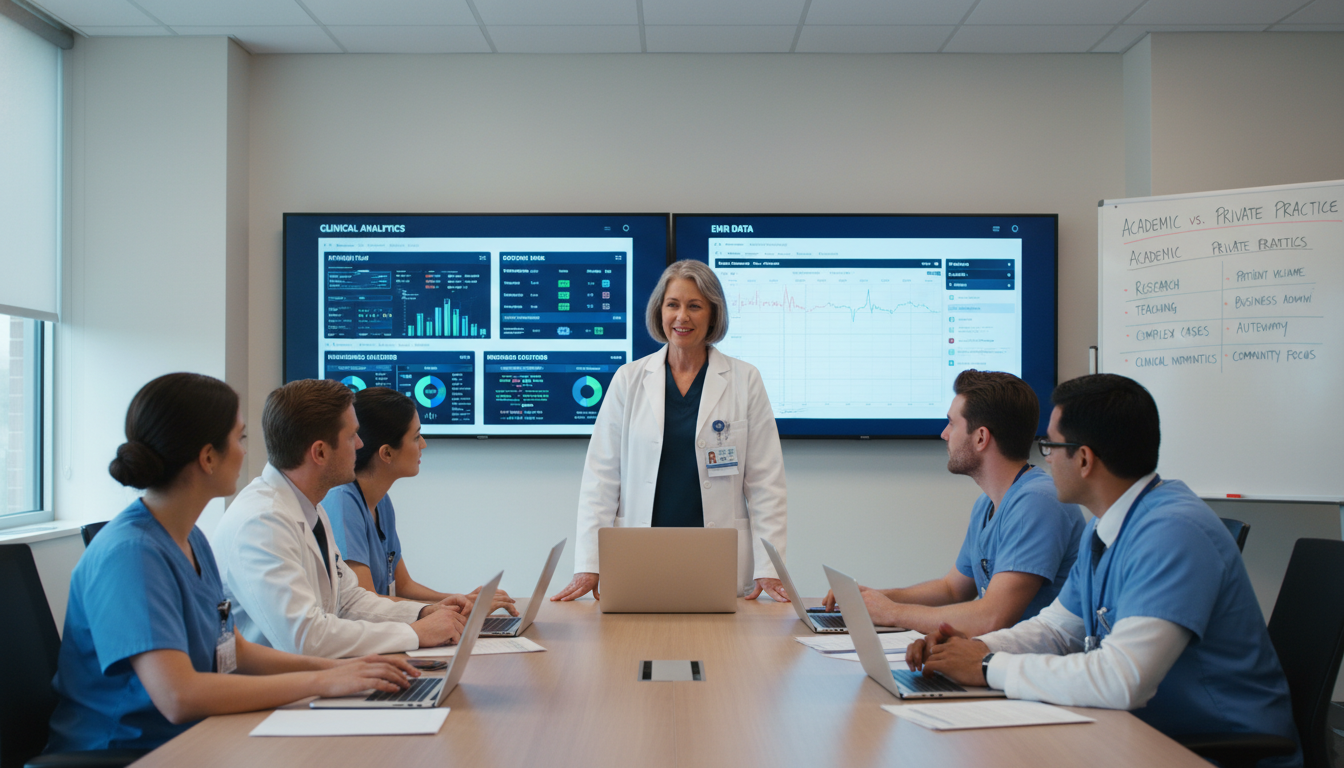
Academic Clinical Informatics: Pros, Cons, and Day-to-Day Reality
Core Features of an Academic Informatics Role
Teaching and Mentorship
- Lecturing on clinical decision support, EHR safety, documentation, and quality improvement
- Supervising residents and fellows on informatics-related QI projects
- Designing or updating curricula in digital health and clinical informatics
Research and Scholarship
- Participating in or leading:
- EHR usability studies
- Medication safety and CDS interventions
- Predictive analytics or AI pilots
- Writing abstracts, posters, and manuscripts
- Applying for internal or external grants
- Participating in or leading:
Organizational Leadership and Governance
- Serving on committees:
- EHR steering, clinical decision support, data governance, quality improvement
- Helping set institutional policies on EHR use, documentation, and digital tools
- Serving on committees:
Hybrid Clinical Practice
- Many academic informaticists still practice clinically:
- Hospital medicine, EM, IM, FM, Pediatrics, etc.
- Typical split could be 0.4–0.6 FTE clinical, 0.4–0.6 FTE informatics, depending on rank and funding
- Many academic informaticists still practice clinically:
Advantages of Academic Medicine for DO Clinical Informaticists
Ideal Environment for a Clinical Informatics Fellowship
- Most clinical informatics fellowships are embedded within academic centers
- Rich exposure to:
- Multi-specialty EHR use
- Data science, biostatistics, and quality teams
- Research mentors and formal coursework
- As a DO graduate residency alumnus, this can be your bridge from pure clinical to a blended academic informatics career.
Strong Platform for Teaching and Education Leadership
- If you enjoy:
- Explaining EHR workflows
- Teaching safe order entry
- Leading workshops on CDS or telehealth
- Academic roles give you:
- Protected teaching time
- Trainees eager to learn
- Structured feedback and recognition
- If you enjoy:
Research and Innovation Opportunities
- Access to data warehouses, IRB support, and statisticians
- Easier to:
- Publish work on informatics interventions
- Build a track record that supports promotion (and sometimes future industry roles)
- Ideal if you’re interested in long‑term leadership roles like CMIO in an academic center or national expert positions
Professional Identity and Title
- Faculty appointment lends weight to your profile:
- “Assistant Professor of Clinical Informatics” (title varies)
- Helpful for:
- Speaking invitations
- National committee participation
- Future transitions (even into industry)
- Faculty appointment lends weight to your profile:
Cultural Fit for Osteopathic Philosophy
- Academic teams often appreciate holistic perspectives:
- Systems thinking about patients and care environments
- DO graduates who lean toward education, whole-person care, and quality improvement may find this culture particularly rewarding.
- Academic teams often appreciate holistic perspectives:
Challenges and Trade-Offs in Academia
Compensation
- Academic salaries are often lower than:
- Private systems
- Health IT industry or consulting
- You may see:
- Modest base salary
- Possible RVU incentives for clinical time
- Limited bonuses relative to corporate roles
- Academic salaries are often lower than:
Promotion and Metrics
- Advancement often tied to:
- Publications
- Grants
- Educational leadership
- Informatics work that is mostly operational (e.g., build, optimization) may not always translate into traditional scholarly output unless you intentionally structure projects to be studied and published.
- Advancement often tied to:
Bureaucracy and Slow Change
- Larger committees and governance structures can slow:
- Implementation of EHR changes
- Adoption of innovative tools
- You may spend significant time in meetings and negotiation.
- Larger committees and governance structures can slow:
Workload and Time Fragmentation
- Balancing:
- Clinical practice
- Informatics projects
- Teaching and possibly research
- Can lead to schedule complexity and the sense of “wearing three hats” at once.
- Balancing:
Private Practice and Non-Academic Informatics: Pros, Cons, and Everyday Work
In the context of clinical informatics, “private practice” usually means non-university environments. This includes both care-delivery organizations and health IT companies.
Typical Settings for Private Informatics Roles
Private or Community Health Systems
- Regional or national hospital networks
- Multispecialty or large group practices
- Emphasis on:
- Efficiency
- Regulatory compliance
- Operational performance and ROI
Vendor and Industry Roles
- EHR developers
- AI/analytics platforms
- Clinical decision support or telehealth tools
- Digital therapeutics companies
Consulting Firms and Startups
- Healthcare IT consulting (workflow optimization, implementation, go-live support)
- Early-stage startups building new clinical technology solutions
Day-to-Day Work in Private/Industry Settings
- Designing and optimizing workflows for clinicians across a system
- Participating in or leading EHR implementation and upgrade projects
- Working with product teams to:
- Define clinical features
- Validate algorithms or CDS rules
- Translating between clinical, technical, and business stakeholders
- Measuring and reporting outcomes like:
- Throughput
- Quality metrics
- Provider satisfaction
- Financial impact
Advantages of Private Practice / Industry Informatics
Compensation and Financial Upside
- Private systems and industry roles often offer:
- Higher base salaries
- Performance bonuses
- Equity or stock options (especially in startups and tech companies)
- If debt load from medical school is a major concern, this may weigh heavily in private practice vs academic decisions.
- Private systems and industry roles often offer:
Operational Impact and Speed of Change
- Decision-making can be:
- Faster
- More directly tied to clear KPIs (cost, quality, growth)
- You may see:
- Faster implementation cycles
- Quicker feedback loops on your projects
- Decision-making can be:
Focused Scope of Work
- Less pressure to:
- Publish
- Teach formally
- Secure grant funding
- You can dedicate most of your energy to:
- Technical/operational informatics
- Product development
- Process optimization
- Less pressure to:
Alternative Career Trajectories
- Opportunities to advance into:
- CMIO or system-level informatics leadership in a private system
- Product manager, medical director, or VP roles in industry
- Entrepreneurship in digital health
- This can be especially appealing if you’re attracted to innovation, business strategy, or technology development.
- Opportunities to advance into:
Geographic Flexibility and Remote Work
- Many industry roles:
- Allow partial or full remote work
- Are not tied to academic hubs
- Helpful for:
- Family considerations
- Desire to live in specific regions without major academic centers
- Many industry roles:
Challenges and Trade-Offs Outside Academia
Less Emphasis on Teaching and Research
- If you love:
- Working with residents
- Designing curricula
- Writing papers
- You may miss the academic environment.
- Some private systems still support QI and internal projects, but formal promotion criteria differ.
- If you love:
Business and Productivity Pressures
- Goals are frequently:
- Financial (cost savings, revenue growth)
- Market-driven (user adoption, sales)
- Clinical perspectives must be balanced with strong business requirements; this can sometimes be frustrating if you see a safer-but-costlier option.
- Goals are frequently:
Professional Identity Shifts
- In some industry roles:
- You may practice little or no clinical medicine
- For a DO graduate, this can raise identity questions:
- “Am I still a physician first?”
- “Do I need to maintain board certification and licensure?”
- Requires intentional planning and acceptance of a potentially non-clinical trajectory.
- In some industry roles:
Job Security and Market Volatility
- Particularly in startups and some tech firms:
- Market shifts, restructuring, or funding issues can affect job stability
- Academic institutions are not immune to change, but industry cycles may be sharper.
- Particularly in startups and some tech firms:

Comparing Academic vs Private Practice for DOs in Informatics
Key Dimensions to Consider
Below are core areas where academic medicine and private practice differ, with specific implications for DO graduates pursuing clinical informatics.
1. Mission and Culture
Academic
- Mission: education, research, patient care
- Culture: collaborative, committee-driven, scholarly
- Better if you value:
- Mentoring trainees
- Intellectual inquiry
- Scholarly output
Private Practice / Industry
- Mission: service delivery, growth, innovation, financial sustainability
- Culture: performance-driven, business-focused, results-oriented
- Better if you enjoy:
- Rapid implementation
- Measurable operational gains
- Product and market impact
2. Compensation and Lifestyle
Academic
- Generally lower salary ceiling
- Possibly more predictable schedule, but with multiple roles
- May have more protected time for scholarly activities (depending on department)
Private
- Higher earning potential, bonuses, and possibly equity
- Can be demanding during implementation cycles or product launches
- Remote and flexible options more common in industry than in academic hospitals
3. Clinical Practice Balance
Academic
- Hybrid practice (clinical + informatics) is common and supported
- Helps you:
- Stay close to patients
- Maintain clinical skills
- Ground informatics decisions in real-world workflows
Private
- Some roles are hybrid, especially in health systems
- Industry roles may be largely non-clinical; clinical work (if any) is often separate, on your own time
- You’ll need to intentionally maintain licensure and board status if you want to keep a clinical foothold
4. Professional Development and Promotion
Academic
- Structured promotion criteria:
- Assistant → Associate → Full Professor
- Emphasis on:
- Publications
- Teaching evaluations
- Educational or research leadership
- Clear academic CV expectations
- Structured promotion criteria:
Private
- Career ladder may look like:
- Physician informaticist → Senior informaticist → Director/CMIO → VP/Chief role
- Evaluated on:
- Project outcomes
- Team leadership
- Business value contribution
- CV more focused on accomplishments, ROI, and leadership than on publications
- Career ladder may look like:
5. Fit with Osteopathic Training and Values
Academic
- Better platform to:
- Incorporate osteopathic principles (holistic care, prevention, systems thinking) into curricula and QI projects
- Mentor DO students and residents
- If you have a passion for advocating for DO representation in informatics leadership and education, academia gives you a voice.
- Better platform to:
Private
- DO vs MD distinction typically less emphasized in day-to-day tech or operations
- Your practical clinical experience and ability to collaborate usually matter more than degree type
- Potentially easier to be evaluated solely on current performance rather than academic pedigree
Practical Steps to Choosing Your Path (and Keeping Doors Open)
1. Clarify Your Long-Term Vision
Ask yourself:
- In 10 years, how much patient care do I want to be doing (0%, 20%, 50%)?
- Do I want to be known for:
- Publishing and teaching?
- Implementing and scaling solutions?
- Building products or companies?
- Which resonates more:
- “Professor and thought leader”
- “Operational leader and problem solver”
- “Product innovator and builder”
Write this vision down and revisit it annually; your answers may evolve.
2. Use Your Residency and Early Career as an Experiment
As a DO graduate residency trainee or new attending, you can:
- Volunteer as a physician champion for EHR optimization
- Join committees:
- Quality/improvement
- Informatics steering
- Documentation
- Take part in small QI or data projects and see what you enjoy:
- Teaching staff about new order sets (academic flavor)
- Redesigning discharge workflows to cut LOS and readmissions (operational flavor)
These experiences help you test whether you enjoy academic or private style work more.
3. Explore Clinical Informatics Fellowships Deliberately
If you’re considering a clinical informatics fellowship, pay attention to:
- Program setting
- University vs large community or private health system
- Alumni outcomes
- Academic roles vs industry vs system leadership
- Curriculum emphasis
- Research-heavy vs implementation-heavy
- Opportunities in AI, analytics, or digital health
Choosing a fellowship aligned with your eventual environment (academic vs private) can give you a head start, but many skills are transferable.
4. Network Across Both Worlds
- Attend conferences:
- AMIA (academic and industry mix)
- HIMSS (industry and operations focus)
- Join SIGs or working groups in:
- Clinical informatics
- Osteopathic digital health or IT interest groups if available
- Conduct informational interviews with:
- Academic informaticists (especially DOs)
- CMIOs in private systems
- Medical directors at EHR or digital health companies
Ask about their day‑to‑day, what they like and dislike, and what they would do differently early in their careers.
5. Keep Options Open Early
You do not have to permanently choose “academic vs private practice” in your first job. Consider:
- Starting in academia:
- Build scholarly and teaching credentials
- Then transition to industry with a robust evidence-based portfolio
- Starting in private systems or vendors:
- Gain deep implementation and product experience
- Later move into an academic role as a practice-based expert
Maintaining a minimal clinical presence (even 0.1–0.2 FTE) can make future transitions easier and keep your options broad.
Frequently Asked Questions (FAQ)
1. As a DO graduate, will I be at a disadvantage for academic clinical informatics positions?
Generally, no. For academic clinical informatics roles, board certification in a primary specialty, completion of an accredited residency, and informatics experience or fellowship training carry more weight than whether you are DO or MD. Some highly research‑intensive institutions may historically have more MD faculty, but this is changing. You can strengthen your application by:
- Participating in QI or informatics projects during residency
- Publishing case reports or QI studies related to EHR or data use
- Completing a clinical informatics fellowship with strong academic credentials
2. Can I pursue a clinical informatics fellowship and then work in private practice or industry?
Yes. Completing a clinical informatics fellowship opens doors across settings:
- Academic medical centers
- Integrated health systems
- EHR vendors and digital health companies
- Consulting firms
Your fellowship projects and mentors may steer you toward one environment, but the credential itself is highly portable. During fellowship, intentionally seek experiences in both academic research and real-world implementation so you remain competitive for either track.
3. Is it possible to move from private/industry back into academic medicine later?
It is possible, but easier if you:
- Maintain some clinical practice and board certification
- Stay engaged in:
- Presentations
- White papers
- Collaborative research or multi-center QI projects
- Document significant informatics accomplishments in a way that can be framed as scholarship (e.g., outcome data, innovations, system-level changes)
Academic departments increasingly value operational expertise; private or industry experience can be a major asset if you can articulate your impact and tie it to academic missions.
4. How do I decide between an academic medicine career and private practice in informatics if I like both?
If you feel torn:
Start with a hybrid environment
- Join an academic health system with strong ties to local or regional private partners
- Or work in a large health system that has teaching affiliations (community teaching hospitals)
Shape your role
- Negotiate time for:
- Teaching (residents/students)
- High-impact operational projects
- Negotiate time for:
Reassess every 2–3 years
- Track what gives you the most satisfaction:
- Teaching and publishing?
- Implementation and measurable operational gains?
- Use this insight to gradually tilt your career toward more academic or more private/industry roles over time.
- Track what gives you the most satisfaction:
Choosing between academic vs private practice for your clinical informatics career is not a one-time, irreversible decision. As a DO graduate, you bring a valuable perspective to either setting: a holistic understanding of patients and systems, and a strong grounding in clinical care. By understanding the distinct cultures, expectations, and opportunities of each environment—and by being intentional in your early choices—you can craft a career that balances meaning, impact, and financial sustainability in the evolving world of digital health.