Understanding Your Options as a DO Graduate in Neurosurgery
As a DO graduate in neurosurgery, you stand at a pivotal crossroads: pursue an academic medicine career or join (or build) a private practice. Both pathways can be highly rewarding, but they differ dramatically in day‑to‑day experience, income structure, autonomy, and long‑term opportunities.
This decision comes at the intersection of several big transitions:
- You’ve navigated the osteopathic residency match and completed a grueling neurosurgery residency (and possibly fellowship).
- You’re now shifting from survival mode to strategic thinking about your career path in medicine.
- You may still be balancing perceptions and realities of being a DO graduate in neurosurgery, including mentorship, bias, and representation in different practice settings.
This article breaks down the key differences between academic neurosurgery and private practice neurosurgery, specifically through the lens of a DO graduate, with practical examples, decision frameworks, and actionable steps to help you choose the best path for your long‑term goals.
1. Defining Academic vs Private Practice in Neurosurgery
Before comparing, it’s important to clarify what we mean by each path. In neurosurgery, “academic” and “private” sit on a spectrum, not a strict binary.
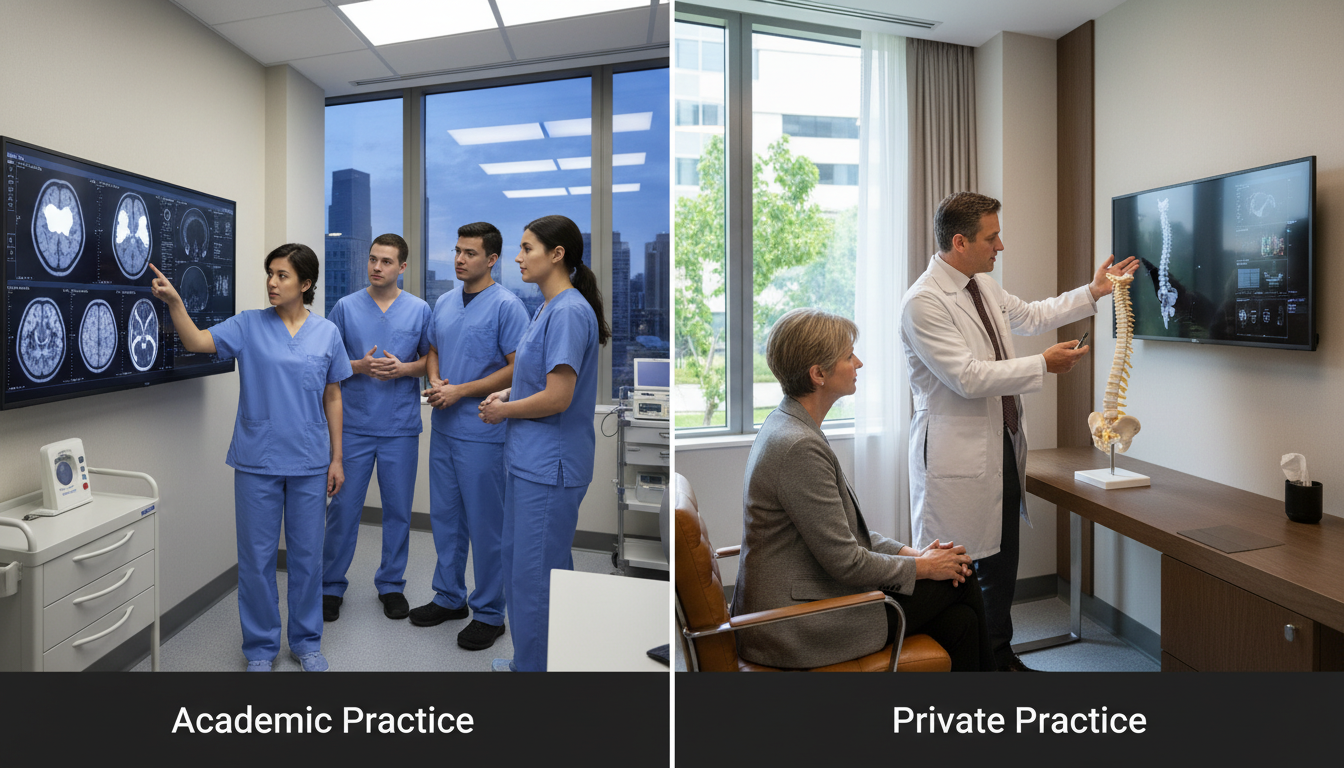
Academic Neurosurgery
Academic neurosurgery is typically based in:
- University hospitals
- Major teaching hospitals
- Large health systems with neurosurgery residency and/or fellowship programs
Core elements:
- Faculty appointment (assistant/associate/full professor)
- Involvement in resident and medical student education
- Potential for clinical and/or basic science research
- Institutional emphasis on publications, lectures, and professional leadership
- Multidisciplinary teams and subspecialized services (e.g., functional, spine, vascular, tumor, pediatrics)
For many, academic neurosurgery is synonymous with teaching, research, and complex cases in a tertiary or quaternary referral center.
Private Practice Neurosurgery
Private practice broadly includes:
- Independent neurosurgery groups
- Partnership or “hybrid” groups aligned with a hospital or health system
- Employed positions in community hospitals without formal residency programs
- Specialty surgical centers or spine-focused practices
Core elements:
- Revenue typically tied more directly to your clinical productivity (RVUs, collections)
- Limited or no formal teaching and research responsibilities (though these can exist in hybrids)
- Greater emphasis on efficiency, patient volume, and business sustainability
- Often more spine and general neurosurgery, less ultra‑rare pathology
Many DO neurosurgeons find private practice attractive for its income potential, autonomy, and flexibility—especially if they enjoy direct patient care more than research or teaching.
Hybrid and “Academic Private” Models
Realistically, many jobs fall somewhere in between:
- “Academic community” practices that teach residents but are not fully university-based
- Privademic models: faculty titles with heavy clinical load and modest research expectations
- Private groups that host rotating residents or students and support limited research
As a DO graduate, you may find hybrid roles particularly appealing: the chance to teach and collaborate academically without the full pressure of academic promotion and grant funding.
2. The DO Perspective: Opportunities and Challenges
For a DO graduate, the choice between academic and private practice intersects with unique considerations shaped by training pathways, mentorship, and perceived biases.
Historical Context: DOs in Neurosurgery
Neurosurgery has traditionally been one of the most competitive specialties, with early barriers for DO applicants. Over recent years:
- The single accreditation system unified ACGME and former AOA programs.
- More DO applicants matched into ACGME neurosurgery programs.
- DO graduates have increasingly entered both academic and private practice neurosurgery roles.
Nevertheless, DO representation is still smaller than MD representation in many academic departments, especially at “name-brand” institutions.
Potential Advantages for DO Graduates
Holistic, patient-centered approach
Your osteopathic training may align very well with patient satisfaction, communication skills, and bedside manner—highly valued in both settings but especially in private practice where patient experience drives referrals.Flexibility and resilience
DO graduates often have experience adapting to different systems and advocating for themselves, which can be an asset navigating complex group dynamics, politics, or institutional cultures.Growing acceptance in academic centers
Increasing numbers of DOs in academic neurosurgery are eroding old stigma. Strong performance, publications, and subspecialty expertise can override degree bias in many places.
Ongoing Challenges
Implicit bias in academic hiring
Some academic departments (particularly at elite research institutions) may still favor MD candidates or graduates from certain residency programs. As a DO, you may need a stronger track record—publications, strong letters, fellowship training—to be considered on equal footing.Mentorship gaps
You may find fewer senior DO faculty in academic neurosurgery to serve as role models. Seeking out mentors, even MDs who are DO‑friendly, becomes critical.Credential questions in highly research‑intense roles
For research-heavy academic positions (e.g., NIH‑funded labs), your osteopathic degree itself is usually not the issue; rather, it’s your research output compared to MD or MD/PhD counterparts. This gap can be closed with deliberate planning during residency/fellowship.
In private practice, degree bias is generally weaker; clinical skills, work ethic, and interpersonal reliability tend to matter more than whether you’re an MD or DO.
3. Day‑to‑Day Life: What Actually Feels Different?
Understanding the daily reality of neurosurgery residency vs practice is one thing; understanding how it differs between academic and private settings is another. This is often where the decision becomes clearer.
Clinical Workload and Case Mix
Academic neurosurgery:
- Tertiary and quaternary referrals: complex tumors, vascular lesions, functional and epilepsy surgery, rare pathology, redo surgeries.
- Subspecialization is common (e.g., 80–90% of your practice in one domain).
- Call often includes high‑acuity trauma and emergent brain surgery residency cases.
- May see fewer bread‑and‑butter spine cases relative to complex cranial work, depending on your role and service structure.
Private practice neurosurgery:
- Heavier proportion of spine: degenerative disease, stenosis, radiculopathy, spinal instrumentation.
- Cranial cases are often trauma, hemorrhage, common tumors, and emergencies—especially in community hospitals.
- More emphasis on efficiency, shorter LOS, outpatient and same‑day procedures when appropriate.
- Case mix can vary widely depending on the region, group structure, and local competition.
For many DO graduates, especially those drawn to hands-on, high-volume clinical care, the spine-heavy nature of many private practices is not a downside but a plus.
Teaching and Education
Academic:
- Regular involvement in resident and medical student education (rounds, didactics, simulation).
- Operating with learners: scrubbed cases may include a chief and junior resident, fellows, and students.
- Expectations to mentor, advise, and write letters.
- Participation in morbidity & mortality (M&M) conferences, grand rounds, and journal clubs.
Private:
- Limited formal teaching, except in practices affiliated with community residencies or medical schools.
- You may occasionally host rotating students or participate in CME events.
- Operative teaching usually involves PAs/NPs or junior partners, not residents.
If you genuinely enjoy teaching and training neurosurgeons, this can be a powerful pull toward academic practice.
Research and Scholarly Work
Academic neurosurgery:
- Explicit or implicit expectations to publish, present, and possibly obtain grant funding.
- Opportunities for clinical trials, translational research, quality improvement, innovation, device development.
- Time for research is often “protected” on paper but may compete with clinical demands.
- Promotion and tenure systems may weigh publications, citations, and national visibility.
Private practice neurosurgery:
- Research is optional and often limited by time and infrastructure.
- Some private groups participate in multicenter trials or industry-sponsored research.
- Case reports, retrospective series, and quality projects are more feasible than full-scale trials.
- Scholarly activities may be driven by personal passion, not institutional expectations.
If you imagine your long‑term identity as a neurosurgeon‑scientist, academic practice is usually the more realistic home.
Autonomy and Administrative Burden
Academic:
- Greater oversight by department chairs, division chiefs, and institutional policies.
- Metrics include RVUs, teaching evaluations, research output, and institutional service.
- Schedules and OR block time can be influenced by seniority and politics.
- More committees, institutional initiatives, and administrative responsibilities as you advance.
Private:
- Early in your career, you may have less autonomy while building your practice under senior partners.
- Over time, you may gain substantial control over schedule, operative focus, and partnership decisions.
- Administrative tasks include billing, contracts, payer negotiations, group governance—especially if you’re a partner or owner.
- You must be comfortable with the business side of medicine or partner with those who are.
Your tolerance for institutional politics vs entrepreneurial risk is a key factor in choosing between these paths.

4. Money, Lifestyle, and Long‑Term Growth
While few people choose neurosurgery primarily for lifestyle, the differences between academic and private practice in compensation and schedule are meaningful.
Compensation and Financial Structure
Academic neurosurgery:
- Typically structured as salary plus incentive (RVU-based or departmental bonus).
- Base salary may be lower than private practice but more predictable.
- Incentives often capped; large upside is limited by institutional policies.
- Additional income possible from administrative roles, speaking, consulting, or funded research (indirectly via protected time).
Private practice neurosurgery:
- Often starts with salary + RVU/collections bonus or income guarantee.
- Many practices move toward partnership after a few years, with shared profits.
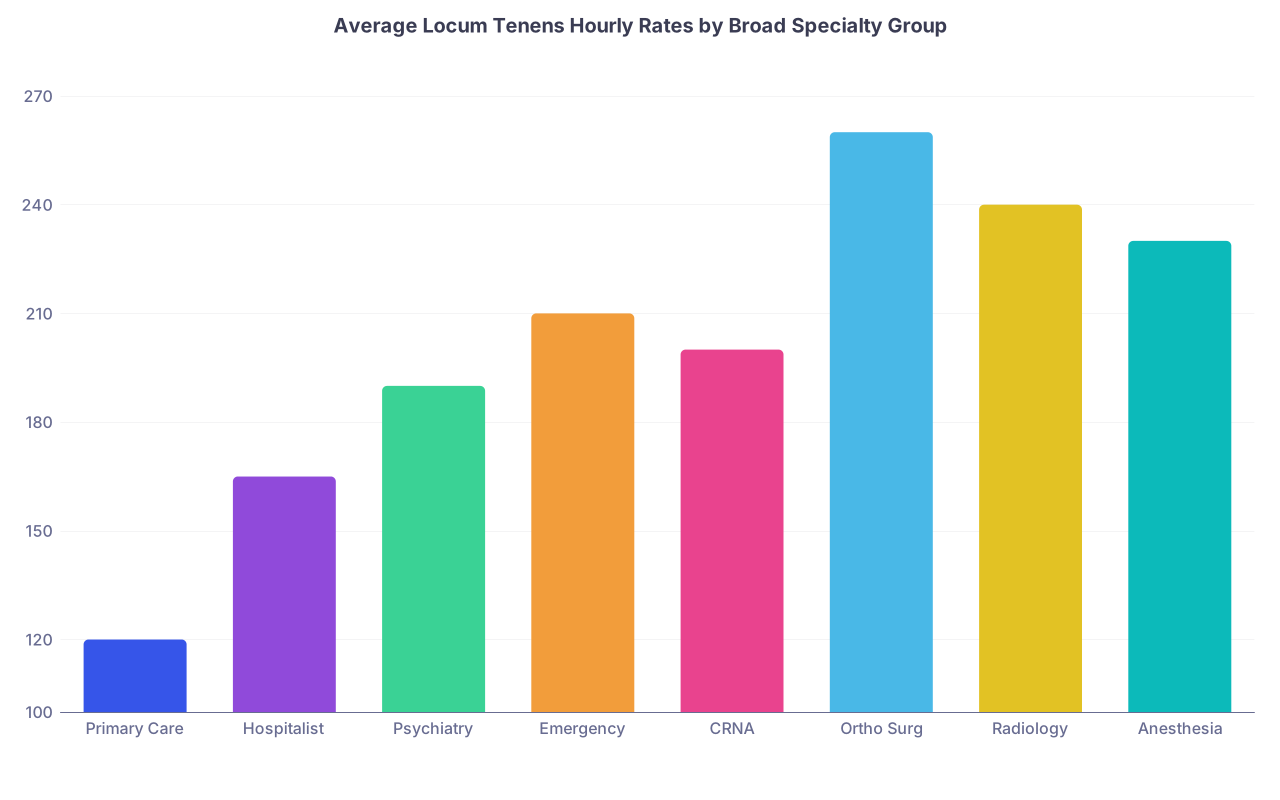
- Income potential can be significantly higher, especially in high‑volume spine practices or underserved regions.
- Variability and risk are higher—reimbursement changes, payer mix, and local competition all matter.
While numbers vary widely, it is common for established private practice neurosurgeons to earn substantially more than their academic counterparts, especially when they are partners in a profitable group.
Lifestyle, Call, and Flexibility
Academic:
- Call may be more frequent due to trauma and tertiary referral responsibilities, but is shared among a larger faculty group.
- Nights and weekends often filled by residents, with attending backup.
- Academic and conference schedules can add to workload.
- More opportunities for sabbaticals, academic travel, and conferences (often funded).
Private:
- Call burden depends on practice size and hospital coverage arrangements. Solo or small-group neurosurgeons can have intense call responsibilities.
- Practice volume is closely tied to income, so taking time off has more direct financial consequences.
- Greater flexibility to shape your schedule once established; however, early years may feel demanding as you build your referral base.
For DO neurosurgeons considering family planning, geographic preferences, or dual‑career households, these lifestyle differences should be part of early discussions—not after signing.
Career Trajectory and Professional Identity
Academic neurosurgeon:
- Titles: Assistant → Associate → Full Professor
- Milestones: publications, leadership roles, national presentations, society leadership.
- Identity: surgeon‑educator, surgeon‑scientist, departmental leader.
Private practice neurosurgeon:
- Titles: Associate → Partner → Senior Partner or Group Leader
- Milestones: partnership, leadership in practice or hospital committees, financial independence.
- Identity: surgeon‑clinician, entrepreneur, community leader.
Neither path is inherently superior. The key is aligning the path with what you want your professional obituary to say: Were you the person who trained a generation of surgeons? The surgeon who brought top-tier neurosurgical care to an underserved region? The innovator who changed practice with an idea? Each is valid.
5. Decision Framework: Which Path Fits You as a DO Neurosurgeon?
Instead of asking “Which is better, academic or private practice?”, reframe the question as “Which is better for me, now and long‑term?”
Step 1: Clarify Your Core Motivators
Ask yourself:
What aspects of training energized me most?
- Teaching juniors? Publishing? Complex rare cases? Or high-volume procedures and clinic?
How important is income potential vs stability?
- Are you driven by maximizing earnings, or are you more comfortable with steady, predictable compensation?
Do I thrive in structured hierarchies or independent environments?
- Are you comfortable with academic politics, or do you prefer fewer layers of bureaucracy?
What does “success in medicine” mean to me?
- Academic titles and publications, or building a thriving practice and community reputation?
Write down your answers. Patterns often emerge quickly.
Step 2: Map Your Training and Strengths
As a DO graduate, consider:
- Did you complete residency in a highly academic, research‑heavy program or a more clinically focused one?
- Do you already have publications, presentations, or grants that make you competitive for academic jobs?
- Were your mentors primarily academic or private practice neurosurgeons, and which stories resonated with you most?
If your training and CV are research‑lean but clinically heavy, it’s still possible to enter academic neurosurgery, but you may need a research‑oriented fellowship or 1–2 “bridge” years to build your profile.
Step 3: Conduct Reality‑Testing
During late residency or fellowship:
Do targeted electives: Spend time at both academic and private practice sites. Compare how your days feel.
Ask frank questions:
- Academic attendings: “What would you do differently if you were choosing again?”
- Private practice attendings: “What are the biggest hidden downsides to your model?”
Shadow clinic days and OR days: It’s easy to be inspired by a grand rounds talk; it’s harder to ignore how you feel after watching six consecutive spine fusions in private practice—or, conversely, after six meetings and three lectures in an academic center.
Step 4: Consider Geography and Family
Sometimes the choice is driven by location:
- Major academic centers cluster in cities.
- Private practices are distributed more widely, including suburbs and mid‑sized towns.
If you or your family have strong geographic preferences, that may narrow your options for academic vs private considerably.
Step 5: Remember You Can Change Course
Your first job need not lock you into a lifelong path:
- Academic → Private: Many neurosurgeons move from academic to private practice seeking higher income, autonomy, or a different lifestyle.
- Private → Academic: Less common, but possible, especially for those who maintain scholarly activity and networks.
Think in 5–10 year horizons: “What do I want my next decade to look like?” You can always re‑evaluate later.
6. Practical Steps and Negotiation Tips for DO Graduates
Once you have a sense of your direction—academic neurosurgery, private practice, or hybrid—approach the job market strategically.
For DO Graduates Targeting Academic Neurosurgery
Maximize your neurosurgery residency years
- Aim for meaningful research with clear authorship.
- Present at national meetings (AANS, CNS, NASS, etc.).
- Seek mentors who are well‑connected in academic neurosurgery and DO‑friendly.
Consider a subspecialty fellowship
- Vascular, skull base, tumor, functional, pediatrics, spine—fellowship can enhance your academic appeal.
- Fellowship can also mitigate any subtle degree bias by showcasing elite subspecialty training.
When interviewing for academic jobs ask about:
- Protected time: “How is it protected in practice?”
- Promotion criteria: publications, grants, teaching portfolio, clinical metrics.
- Mentorship: Is there structured support for junior faculty?
- Diversity and inclusion: Are DOs represented on faculty? Are there formal initiatives that might support your growth?
Negotiate wisely
- Aim for realistic protected time early on (e.g., 20–50% depending on your role).
- Clarify expectations for RVUs and research output.
- Seek startup resources if you plan to run a lab (space, staff, seed funding).
For DO Graduates Targeting Private Practice Neurosurgery
Build clinical reputation early
- Be the resident or fellow who is dependable, efficient, and technically solid.
- Develop strong relationships with referring services and community surgeons.
Educate yourself on business basics
- Understand RVUs, payer mix, collections vs charges, overhead.
- Learn about partnership tracks: buy‑in, buy‑out, non‑compete clauses, decision‑making governance.
When evaluating offers, scrutinize:
- Call schedule and coverage hospitals.
- OR block time, clinic support (PAs, NPs, nursing, schedulers).
- Path to partnership, if offered: timeline, criteria, financial expectations.
- How new surgeons receive referrals: rotation, assignment, or self-driven?
Protect yourself contractually
- Engage a healthcare attorney experienced with physician contracts—especially for complex partnership agreements.
- Clarify non‑compete clauses, tail coverage for malpractice, and exit terms.
Maintaining Academic Ties in Private Practice
If you choose private practice but still value an academic medicine career flavor:
- Seek adjunct or volunteer faculty appointments at nearby medical schools.
- Host students or residents on elective rotations.
- Participate in multicenter registries or trials.
- Continue to publish case series, technical notes, or review articles.
This blend can give you the best of both worlds: income and autonomy from private practice plus professional fulfillment from teaching and scholarship.
FAQs: Academic vs Private Practice for DO Graduates in Neurosurgery
1. As a DO graduate, am I at a disadvantage for an academic neurosurgery position?
You may face some subtle bias in certain institutions, but it is far from insurmountable. The most important factors for academic hiring are:
- Strength of your residency and/or fellowship training
- Publications and research experience
- References from respected neurosurgeons
- Fit with departmental needs and culture
A strong, research‑active DO neurosurgeon can absolutely build a successful academic career, particularly at institutions that value diversity in training backgrounds.
2. Can I do research and teach if I choose private practice?
Yes, though usually at a smaller scale. Many private practice neurosurgeons:
- Participate in clinical registries and industry‑sponsored studies
- Publish case reports and retrospective series
- Teach through adjunct faculty roles or by hosting learners
You likely won’t have extensive protected time or laboratory infrastructure, but you can still contribute meaningfully to neurosurgical education and research with deliberate planning.
3. Which path typically offers better work‑life balance: academic or private practice?
It depends more on specific job structure than on label alone. Trends:
- Academic roles may have more call coverage and resident help but can add time-consuming academic and administrative responsibilities.
- Private practice roles may offer more autonomy in scheduling but tie your income to clinical volume, which can incentivize longer hours—especially early on.
Talk to current faculty or partners about their actual weekly schedule, vacation, and how often they feel “on” even when not on call.
4. If I start in academic neurosurgery, can I later move to private practice (or vice versa)?
Yes, transitions are possible in both directions:
- Academic → Private: Common move, especially for those seeking higher earnings or lifestyle changes. Your academic record can be an asset in recruiting patients and building credibility.
- Private → Academic: Less common but achievable if you maintain some scholarly activity, attend meetings, and keep professional networks active.
If you suspect you may want options later, intentionally maintain a minimal academic footprint (e.g., occasional presentations or publications) regardless of which side you start on.
Choosing between academic vs private practice as a DO graduate in neurosurgery is not about ranking one as better; it’s about carefully aligning your values, skills, and aspirations with the realities of each path. If you stay honest with yourself, actively seek mentorship, and approach the decision methodically, you can build a neurosurgical career—academic, private, or hybrid—that is both successful and deeply fulfilling.