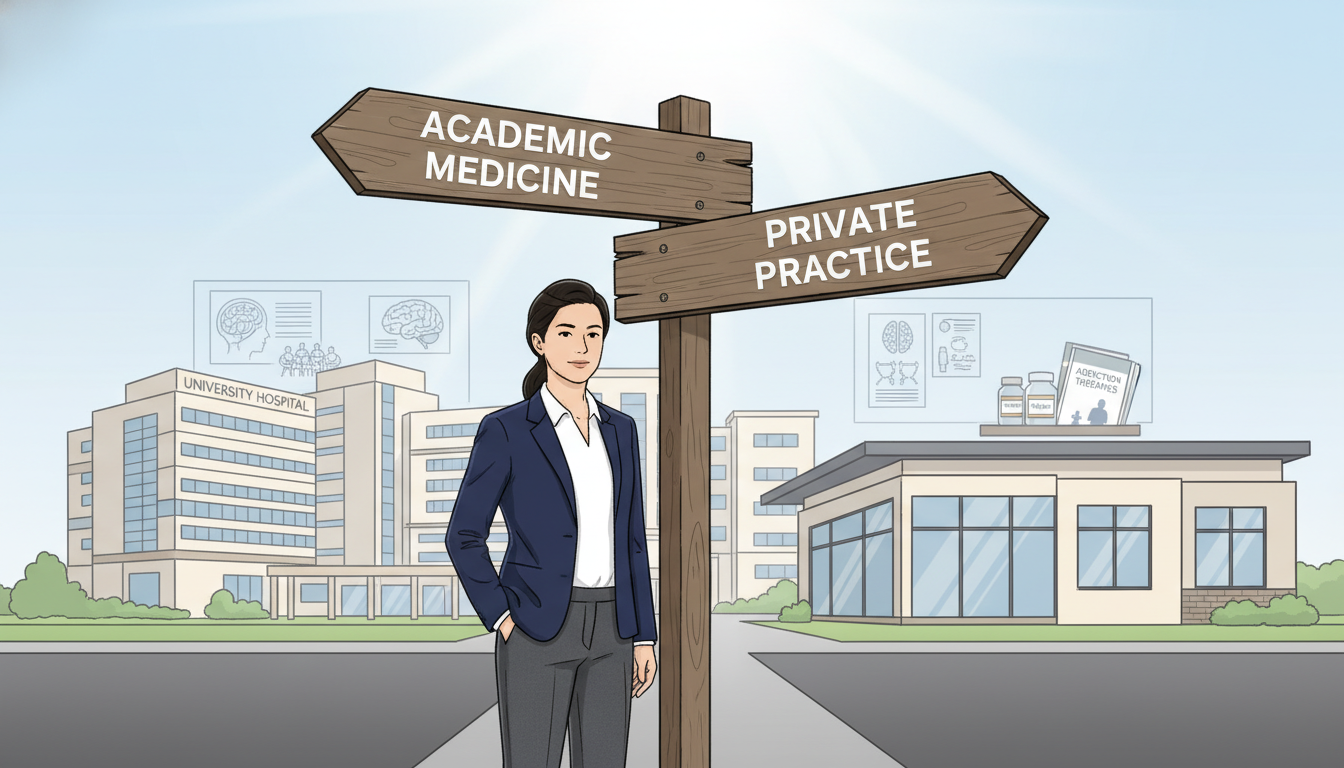
As a DO graduate entering addiction medicine, you’re stepping into a field where your training in holistic, patient-centered care is a genuine asset. One of the first big career questions you’ll face is whether to build your career in academic medicine or private practice—or some combination of the two.
This decision affects your daily schedule, income, teaching and research opportunities, and long-term professional identity. This guide will walk you through the key considerations, specifically for a DO graduate in addiction medicine, and help you align your next step with your values and long-term goals.
Understanding the Landscape: How Addiction Medicine Careers Are Structured
Before comparing academic vs private practice, it helps to understand how addiction medicine training and career pathways are typically organized—especially for DO graduates.
Training Pathway for DOs in Addiction Medicine
Most DOs in addiction medicine follow a path like:
- Medical School (DO)
- Residency in a core specialty, commonly:
- Internal Medicine
- Family Medicine
- Psychiatry
- Emergency Medicine
- Pediatrics (less common, but possible)
- Addiction Medicine Fellowship
- ACGME-accredited addiction medicine fellowship (increasingly common for both MD and DO)
- Some may enter addiction practice through alternative certification routes, but fellowship training is rapidly becoming the standard, especially for competitive academic roles.
As a DO graduate, your osteopathic background is well-aligned with addiction medicine’s biopsychosocial-spiritual model. Programs are increasingly DO-friendly, and many addiction medicine fellowships and departments intentionally recruit osteopathic graduates.
Academic vs Private Practice: Core Definitions
Academic Medicine (for an addiction medicine physician):
- Employed by a university, teaching hospital, or academic medical center
- Work often includes:
- Patient care (inpatient consults, outpatient clinics, partial programs)
- Teaching residents, fellows, medical students (including DO and MD)
- Research and quality improvement
- Curriculum development, grand rounds, and academic committees
Private Practice (in addiction medicine):
- May be:
- Solo practice
- Group practice/private clinic
- Physician-owned or corporate-owned (e.g., large addiction treatment organizations)
- Work is more heavily oriented toward:
- Direct patient care (outpatient, IOP/OP programs, sometimes inpatient contracts)
- Practice management and business decisions (especially if you become an owner or partner)
- Less formal teaching and research (though still possible through community roles)
Many physicians ultimately land in hybrid models, such as:
- Working at an academic center but also moonlighting at community rehab centers or tele-addiction platforms
- Joining a private practice while maintaining a volunteer faculty role and teaching addiction medicine fellows or family medicine residents
Understanding that the choice is not always purely binary can help reduce pressure. Still, clearly seeing the differences will help you design your own mix intentionally.
Academic Addiction Medicine: Pros, Cons, and Day-to-Day Reality
Academic medicine offers structure, mentorship, and opportunities that can be particularly attractive to a new graduate finishing an addiction medicine fellowship.
What Academic Addiction Medicine Looks Like
A typical week in academic addiction medicine might include:
- Outpatient clinics
- General addiction clinic (MAT, counseling integration, co-occurring disorders)
- Specialty clinics (pregnant patients with OUD, pain + addiction, adolescent addiction, dual diagnosis)
- Inpatient consult service
- Rounds on hospitalized patients with substance use disorders
- Liaising with hospitalists, psychiatrists, surgeons, social work, and case management
- Teaching
- Supervising residents, fellows, and medical students
- Precepting in clinic
- Giving lectures, case conferences, journal clubs
- Research and scholarly work
- Clinical trials, implementation science, educational research
- Quality improvement projects (e.g., buprenorphine initiation in ED)
- Presenting at conferences (ASAM, AAAP, state societies)
- Administrative and committee work
- Building substance abuse training curricula
- Developing protocols for inpatient withdrawal management
- Working on hospital initiatives related to opioid stewardship
For a DO graduate interested in an academic medicine career, this environment can accelerate your growth.
Advantages of Academic Addiction Medicine
Structured Mentorship and Early-Career Support
- Senior faculty to guide:
- Clinical decision-making in complex SUD + medical/psychiatric comorbidity
- How to build an academic portfolio (CV, publications, talks)
- Pathways to promotion (assistant → associate → full professor)
- Helpful for DO graduates transitioning from fellowship into their first real attending role.
- Senior faculty to guide:
Deep Involvement in Substance Abuse Training
- You can shape how future physicians learn to treat addiction:
- Develop addiction medicine rotations for internal medicine or family medicine residents
- Create simulation curriculum on overdose management and motivational interviewing
- Co-lead X-waiver (now DEA-required) training for trainees and staff
- This aligns powerfully with osteopathic values of whole-person and community-focused care.
- You can shape how future physicians learn to treat addiction:
Protected Time for Scholarship
- Many academic jobs provide:
- 0.1–0.4 FTE (or more) for research, QI, or curriculum work
- Access to statisticians, grant offices, IRB, and research mentors
- You can become a subject matter expert on SUD in special populations, tele-addiction, or integration with primary care.
- Many academic jobs provide:
Professional Reputation and Network Building
- Easier access to:
- Speaking opportunities (grand rounds, conferences)
- Committee roles in professional organizations
- Collaboration on multi-site trials or educational initiatives
- These networks are extremely useful if you later want leadership roles or national influence in addiction policy.
- Easier access to:
Financial Stability and Benefits
- Salary is usually more predictable (especially as a new attending).
- Benefits often include:
- Robust retirement contributions
- Tuition discounts for family
- CME funds and conference travel
- Public Service Loan Forgiveness (PSLF) eligibility at many institutions
Strong Fit for DO Philosophy
- Academic addiction medicine emphasizes:
- Multidisciplinary care
- Biopsychosocial approach
- Integration of mental health, primary care, social determinants
- Many DOs find that academic teams embrace and leverage their osteopathic perspective, even if OMT is not central to daily practice.
- Academic addiction medicine emphasizes:

Challenges and Tradeoffs in Academic Medicine
Lower Earning Potential (at least initially)
- Relative to high-volume private practice or medical director roles, academic salaries are typically:
- Moderate to good, but rarely top of the market
- Over time, leadership roles (fellowship director, division chief) can increase compensation, but pure clinical productivity is not usually the main driver.
- Relative to high-volume private practice or medical director roles, academic salaries are typically:
Promotion and Scholarship Expectations
- Academic tracks often expect:
- Publications
- Regional/national presentations
- Committee participation and teaching evaluations
- If research and scholarship don’t appeal to you, these expectations can feel burdensome.
- Academic tracks often expect:
Administrative and Institutional Constraints
- Slower pace of change (e.g., adopting new medications or protocols)
- Complex bureaucracy around:
- IRB
- Grant management
- Scheduling and staffing
- Less autonomy in clinic design and appointment length compared to a well-run private practice.
Less Control Over Patient Mix and Schedule
- You may be assigned to:
- Specific teaching clinics
- Inpatient services
- Rotating call schedules
- Some academic settings have high acuity and complex psychosocial situations, which can increase emotional load and burnout risk if not balanced.
- You may be assigned to:
Geographic Limitations
- Academic addiction medicine jobs are clustered where there are large medical centers and fellowships.
- If you have strong geographic constraints (family, partner career), the academic options may be fewer than private practice or telehealth roles.
Who Tends to Thrive in Academic Addiction Medicine?
You might be an excellent fit for academic medicine if you:
- Enjoy teaching and mentoring future physicians
- Are curious about research, QI, and systems-level interventions
- Want to influence policy and best practices in substance use care
- Value collegiality, multidisciplinary collaboration, and institutional resources
- Are comfortable with moderate, stable income rather than maximizing earnings immediately
For a DO graduate, academic medicine can also be a way to become a visible osteopathic leader in the field, modeling holistic care in an evidence-based framework.
Private Practice in Addiction Medicine: Independence, Income, and Realities
Private practice in addiction medicine ranges from boutique clinics to large, multi-site treatment centers. Your experience will vary widely depending on the model you choose.
Common Private Practice Models in Addiction Medicine
Solo or Small Group Outpatient Practice
- Office-based buprenorphine, naltrexone, and sometimes methadone (if partnered with an OTP)
- May offer:
- Individual and group therapy
- IOP/OP programs
- Telehealth visits
- Often a mix of insurance and cash-pay.
Multi-Site Private or Corporate Addiction Centers
- Residential treatment facilities
- Partial hospitalization (PHP) and intensive outpatient programs
- Physician roles may focus on:
- Medical evaluation and management
- Withdrawal management
- Medication for addiction treatment (MAT)
- Sometimes with strong administrative and marketing infrastructure.
Hybrid Practice: Addiction + Primary Care or Psychiatry
- Combine addiction care with general internal medicine, family medicine, or psychiatry services.
- This can be very appealing if your residency core specialty is family medicine or psychiatry.
Telehealth Addiction Medicine
- Rapidly expanding, especially for buprenorphine and alcohol use disorder medications.
- Can be fully remote; allows geographic flexibility.
- Typically more templated workflows, sometimes high volume.
Advantages of Private Practice in Addiction Medicine
Higher Income Potential
- Well-run addiction medicine practices can achieve high productivity and earnings.
- Multiple revenue streams:
- Outpatient visits
- Group visits
- Testing (e.g., drug screens—though compliance and ethics must be carefully managed)
- Procedural interventions (e.g., long-acting injectables)
- As a partner or owner, you benefit from practice profits in addition to your clinical compensation.
Greater Autonomy
- More control over:
- Clinic design (visit length, schedule structure, multidisciplinary staffing)
- Patient population focus (e.g., professionals, pregnant patients, co-occurring pain)
- Practice policies and clinical pathways (within legal and ethical standards)
- You can align operations with your osteopathic philosophy, emphasizing whole-person care and integrated behavioral health.
- More control over:
Flexibility in Work-Life Balance
- While building a practice is intense, established private practice physicians can:
- Reduce clinical days
- Job-share or use nurse practitioners/physician assistants
- Structure call coverage in flexible ways
- Especially valuable if you anticipate caregiving responsibilities or want location flexibility.
- While building a practice is intense, established private practice physicians can:
Room for Entrepreneurship and Innovation
- You can create:
- New group programs (relapse prevention, trauma-focused SUD, professionals’ program)
- Telehealth offerings
- Community outreach or employer-based addiction services
- Business skills developed here (marketing, leadership, operations) can open doors to leadership roles in larger systems.
- You can create:
Less Formal Academic Pressure
- No requirement for:
- Publications
- Academic promotion
- Grant writing
- You can still teach (e.g., hosting residents in your clinic as a community preceptor), but it’s on your terms.
- No requirement for:

Challenges and Risks in Private Practice
Business and Administrative Burden
- If you are an owner or partner:
- Hiring and managing staff
- Dealing with billing, coding, compliance, and audits
- Negotiating with insurers and managing denials
- Even as an employed physician, you may feel pressure related to revenue and productivity.
- If you are an owner or partner:
Ethical and Regulatory Complexity
- Addiction medicine is heavily regulated:
- DEA rules, especially around controlled substances
- State regulations for OTPs, residential programs, and telehealth
- Misalignment between clinical best practices and business motivations (e.g., overuse of expensive tests or unnecessary admissions) can create ethical tension.
- Addiction medicine is heavily regulated:
Isolation and Limited Mentorship
- Depending on your setting, you might be the only addiction medicine specialist on site.
- Less built-in mentorship compared to academic programs.
- You’ll need to be proactive about networking through professional organizations to avoid practice silos.
Variability in Job Quality
- Not all private treatment centers adhere to evidence-based addiction care.
- Red flags:
- Aggressive marketing practices
- Overemphasis on high-cost, low-evidence services
- Lack of MAT or hostility toward medications
- As a DO with strong training, you must evaluate whether a given practice aligns with your standards.
Financial Risk
- If you start your own practice:
- Upfront costs (space, IT, staff, legal, billing)
- Time to build patient volume
- Requires risk tolerance and some business literacy.
- If you start your own practice:
Who Tends to Thrive in Private Addiction Medicine Practice?
You may be a great fit for private practice if you:
- Are motivated by clinical independence and practice design
- Have an interest in entrepreneurship or leadership in community-based care
- Want to maximize earning potential to pay down loans or achieve financial goals
- Prefer to be judged primarily on patient care and patient satisfaction, not publications
- Are willing to learn (or partner with) the business and regulatory sides of medicine
For a DO graduate, private practice can be a platform to create a truly holistic, integrated addiction care model that reflects osteopathic principles in a nimble, patient-centered environment.
Key Decision Factors: Matching Your Goals to the Right Setting
1. Your Long-Term Career Vision
Ask yourself:
- Do you see yourself as:
- A teacher and academic leader, shaping how addiction medicine is taught?
- A clinical expert and practice builder, designing innovative, patient-focused systems?
- Are you drawn to:
- Writing, presenting, and contributing to national guidelines?
- Or primarily to day-to-day patient care and growing a thriving clinical practice?
If your vision centers on an academic medicine career—becoming a program director, division chief, or major voice in addiction medicine education—an early commitment to academic roles is often beneficial.
If your vision centers on clinical excellence, patient relationships, and autonomy, a private practice track may be more satisfying.
2. Financial Goals and Debt Load
Your DO student loan burden and personal financial goals matter:
- If you have very high debt and:
- Want quick, substantial income:
- Private practice (especially high-demand markets or tele-addiction roles) may be attractive.
- Are open to PSLF and stable, moderate income:
- Academic or safety-net hospital positions may set you up well.
- Want quick, substantial income:
Run realistic projections:
- Academic: Lower starting salary, strong benefits, PSLF potential, more predictable growth.
- Private practice: Higher upside but more variance; can be excellent if you manage business and productivity well.
3. Interest in Teaching and Scholarship
If teaching is central to your sense of purpose:
- Academic medicine offers:
- Daily opportunities to teach trainees
- Formal recognition and career advancement for educational contributions
- Private practice:
- May allow part-time or volunteer teaching as community faculty
- Requires proactive outreach to residency and fellowship programs
Similarly, if you want to conduct meaningful research in substance abuse training, treatment outcomes, or policy, the infrastructure of academic centers makes this far more feasible.
4. Tolerance for Institutional vs Business Constraints
- Academic:
- Slower institutional change, committee-heavy, policy-driven
- Clear HR support and infrastructure
- Private:
- Faster implementation, more control
- Greater exposure to business and regulatory risk
Consider which type of constraint you’re more comfortable navigating: bureaucracy or business risk.
5. Lifestyle and Location Needs
- Academic jobs:
- Often clustered in larger cities or academic hubs
- May require specific schedules (e.g., teaching blocks, call)
- Private practice:
- Available in a wider variety of settings, including smaller communities
- Potential for more input into your hours once established
If you need to practice in a specific region or town, your options in academic vs private practice may be determined largely by local opportunities.
Building a Hybrid or Evolving Career Path in Addiction Medicine
Your choice is not once-and-for-all. Many addiction medicine physicians—especially DO graduates—intentionally combine elements of both worlds across different career stages.
Early Career: Academic Foundation, Private Flexibility
One strategic approach after finishing an addiction medicine fellowship:
Start in an academic position:
- Solid mentorship, protected learning time, structured environment
- Build a strong clinical and teaching foundation
- Publish or engage in QI projects to strengthen your CV
Add moonlighting or part-time private practice:
- Gain exposure to different practice models
- Boost income
- Explore tele-addiction or local treatment centers to see what resonates
This preserves options while you clarify your ideal choosing career path in medicine.
Mid-Career: Pivoting and Customizing Your Mix
Later, you might:
- Transition from full-time academic to:
- Majority private practice + adjunct faculty appointment
- Lead a private practice while continuing to teach 1–2 half-days per week
- Or go the other direction:
- Move from private practice into an academic leadership role
- Use your real-world experience to inform substance abuse training curricula
Because addiction medicine is relatively young and rapidly evolving, there is room for creative, non-linear careers. Your DO background can be especially valuable in bridging academic rigor with community-based, patient-centered practice.
Practical Steps to Keep Both Doors Open
- Maintain active involvement in professional societies:
- ASAM, AAAP, state addiction medicine societies
- Go to conferences, present posters, network.
- Stay engaged in some form of teaching or mentoring:
- Even in private practice, host students or residents briefly.
- Keep your CV updated with both clinical and scholarly/teaching contributions.
- Seek out a mentor in each setting:
- One academic mentor
- One private practice or medical director mentor
This makes it much easier to shift toward whichever pathway aligns best with your evolving goals.
FAQs: Academic vs Private Practice for DOs in Addiction Medicine
1. As a DO graduate, will I be at a disadvantage in the academic addiction medicine match or job market?
In most addiction medicine fellowships and academic departments today, DO and MD graduates are considered on essentially equal footing. What matters most is:
- Strong clinical performance in residency
- Demonstrated interest in addiction (rotations, electives, research)
- Letters of recommendation from addiction-focused mentors
Once you’ve completed an addiction medicine fellowship, your DO degree is rarely a limiting factor in academic hiring. Many institutions value the osteopathic emphasis on holistic, patient-centered care, which aligns closely with addiction medicine.
2. Can I work in academic medicine and still have a small private practice?
Yes. Many physicians blend academic medicine with part-time private work. Common arrangements:
- Academic primary job (0.6–0.8 FTE) + 0.2–0.4 FTE in:
- Tele-addiction
- Community clinic or treatment center
- Personal consulting practice
You’ll need to:
- Review your academic contract and institutional conflict-of-interest policies
- Ensure no competition with your primary employer
- Clarify malpractice coverage across settings
Done thoughtfully, this can give you the stability and mentorship of academic life while testing the waters of private practice and increasing income.
3. Does choosing private practice mean I can’t have an academic medicine career later?
Not necessarily. Many addiction medicine programs welcome experienced clinicians as:
- Community preceptors
- Volunteer faculty
- Part-time clinical faculty
If you anticipate possibly returning to academia:
- Maintain teaching activity (even informally)
- Stay connected to local training programs
- Participate in professional societies, committees, and conferences
- Consider publishing case reports or QI work, even from private practice settings
A well-documented record of quality clinical care, teaching, and leadership can support a later transition to a more formal academic medicine career.
4. Which path is better for long-term career satisfaction in addiction medicine?
Neither academic nor private practice is universally “better.” Satisfaction tends to be highest when:
- Your daily work reflects your core motivations:
- Teaching vs pure clinical care vs business building vs policy work
- Your work environment aligns with your values:
- Evidence-based practice
- Ethical standards in addiction treatment
- Respect for your osteopathic philosophy
For many DO addiction medicine physicians, a hybrid or evolving career—starting academic, moving toward private, or maintaining roles in both—provides balance, flexibility, and fulfillment across different life stages.
Choosing between academic and private practice as a DO graduate in addiction medicine is ultimately about designing a career that serves both your patients and your own long-term well-being. Use your training, mentors, and early career experiences to experiment, reflect, and adjust. Addiction medicine needs thoughtful physicians in both academic and private settings—and your osteopathic background positions you well to thrive in whichever path you choose.