As an international medical graduate (IMG) completing or planning a preliminary medicine year (prelim IM), you stand at a major crossroads: Should you aim for an academic medicine career or private practice?
This decision is complicated by visa issues, financial pressures, competitiveness for categorical spots, and uncertainty about your long‑term specialty. This IMG residency guide will unpack the trade‑offs and help you make a deliberate, strategic choice.
Understanding the Context: What Makes Prelim Medicine Unique for IMGs?
A preliminary internal medicine year is different from a categorical IM residency:
- Length: 1 year only (PGY‑1)
- Goal: Often a transitional year before advanced specialties (neurology, anesthesiology, radiology, ophthalmology, etc.)
- Outcome: You do not become board‑eligible in IM with only a prelim year
- Program types:
- Academic medical centers: University‑affiliated, strong research/teaching emphasis
- Community hospitals & private systems: Primarily service and clinical care focus
For an international medical graduate, this year is often:
- A gateway into the U.S. system
- A chance to prove yourself for future categorical or advanced positions
- A time‑limited opportunity to build a profile—research, mentorship, US letters, and networking
Your professional brand starts with how you navigate this year. And part of that is understanding early whether you are leaning toward academic medicine or private practice in your eventual career.
Academic Medicine: What It Looks Like for an IMG
Academic medicine combines clinical care, teaching, research, and leadership within a university‑affiliated setting.
Core Features of an Academic Medicine Career
Most academic internal medicine or subspecialty positions include:
Clinical Work
- Inpatient wards, consult services, possibly outpatient clinics
- Often caring for complex, high‑acuity patients
- Structured teaching rounds with residents and students
Teaching Responsibilities
- Bedside teaching, case discussions, morning reports
- Lectures/small groups for students and residents
- Supervision and evaluation of trainees
Scholarship & Research
- Clinical or translational research
- Quality improvement (QI) projects
- Education scholarship (curriculum design, assessment research)
- Writing papers, abstracts, and presenting at conferences
Leadership & Administration
- Roles like program director, clerkship director, division chief
- Committee work: curriculum, residency selection, hospital quality
Specific Advantages for IMGs
For an international medical graduate, academic medicine offers distinct benefits:
Structured mentorship:
- Academic centers often have formal mentoring for research, career development, and teaching.
- Many departments have a history of supporting IMGs and understand visa needs.
Visa sponsorship:
- University hospitals more commonly sponsor H‑1B and sometimes support long‑term pathways for O‑1 or even green card sponsorship.
- They are familiar with requirements of J‑1 visa waivers, Conrad 30 positions, and timelines.
CV building and career mobility:
- Research and teaching make your profile stronger for:
- Subspecialty fellowships
- Future academic promotions
- Moves between institutions in different states
- Research and teaching make your profile stronger for:
Professional network:
- More exposure to national societies, conferences, and multi‑center collaborations
- Easier to get letters from recognized leaders in your field
Common Challenges for IMGs in Academic Medicine
However, academic careers are not without trade‑offs:
Lower starting salary compared to private practice
- Academic compensation often lags by 15–30% initially, depending on specialty and location.
- Loan burden (if you have U.S. or private loans) can make this painful.
Pressure to produce scholarship
- Expectation to publish, present, or secure grants (depending on track).
- Balancing clinical load with research/teaching can lead to burnout.
Promotion criteria may be opaque
- Titles like “Assistant Professor” and “Associate Professor” come with expectations in publications, teaching evaluations, and service.
- IMGs unfamiliar with U.S. academic norms may need explicit mentorship to navigate this.
Competitive entry for certain specialties
- If your goal is something like cardiology, GI, heme/onc, or academic neurology, strong scholarly work during residency (or before) is almost mandatory.
What Academic Medicine Can Look Like After a Prelim Year
Your preliminary medicine year can be your first real step into this environment. Some scenarios:
You match prelim IM at an academic center while aiming for:
- Neurology, anesthesiology, radiology, PM&R, ophthalmology, etc.
- You impress faculty, engage in research, and later secure an academic‑track position in your advanced specialty.
You realize during your prelim year that you like inpatient IM and decide to:
- Apply for a categorical internal medicine spot (at the same institution or elsewhere).
- Use your relationships and academic productivity from prelim year to strengthen your application.
You use your prelim IM year to:
- Build a research portfolio
- Obtain strong letters from academic faculty
- Position yourself for a competitive fellowship later, if you transition into categorical or advanced training.
Private Practice: What It Looks Like for an IMG
Private practice generally means working for a physician‑owned group, hospital‑employed model, or large multi‑specialty organization primarily focused on clinical care rather than research and formal teaching.
Core Features of a Private Practice Career
Clinically Driven Role
- High patient volumes
- Focus on efficiency and productivity (RVUs, billing, metrics)
- Less time allocated to non‑clinical work (research, teaching, committees)
Practice Types
- Small, physician‑owned groups
- Large multi‑specialty groups (e.g., regional networks)
- Hospital‑employed positions
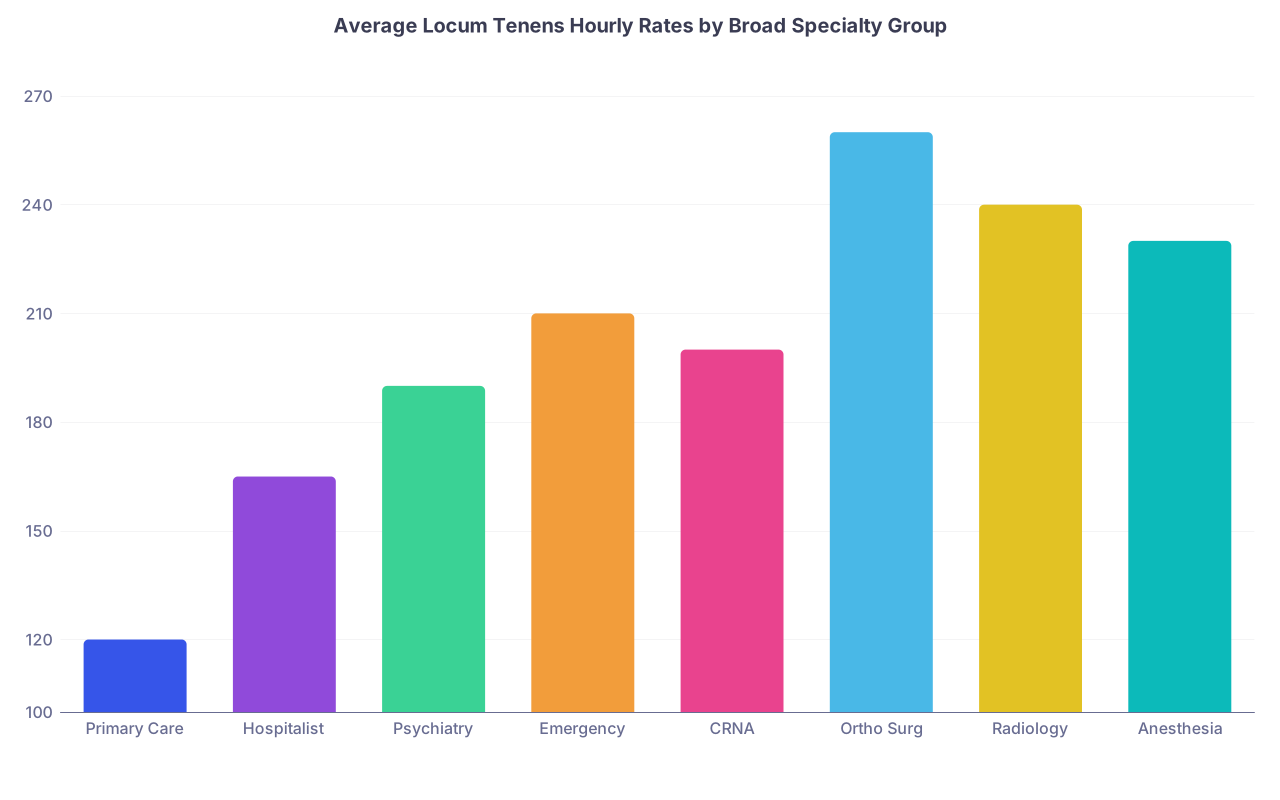
- Locums tenens roles (for flexibility and higher pay, but less stability)
Less Formal Teaching and Research
- May occasionally mentor students or residents if affiliated with a teaching program, but usually not the primary focus.
- Research is uncommon unless you make a special effort or join an academically affiliated community practice.
Advantages for IMGs in Private Practice
Higher earning potential
- Faster path to higher income after residency/fellowship.
- Productivity‑based bonuses can significantly increase compensation.
More control over work style (in some settings)
- Choose between outpatient‑only, inpatient‑only (hospitalist), or mixed.
- Potential for partnership and equity in the practice.
Geographic flexibility
- Greater ability to choose where to live, especially in suburban/rural areas with higher need.
Less pressure for academic output
- No expectation to publish or secure grants.
- Focus is on patient care and service quality.
Challenges for IMGs in Private Practice
Visa sponsorship may be more complex
- Some private practices are inexperienced with J‑1 waivers, H‑1B, or green card processes.
- Many IMGs initially secure J‑1 waiver jobs in underserved areas that may not match their ideal practice model.
Less structured mentorship
- Limited exposure to national academic leaders or formal career‑development resources.
- Networking is more local and specialty‑specific.
Career mobility and subspecialty prospects
- If you change your mind and decide to pursue academic positions or fellowships later, the lack of research/teaching experience can be a barrier.
- Not impossible—but requires strategic planning (e.g., QI projects, society involvement, CME presentations).
Business & management aspects
- In smaller groups, understanding contracts, productivity, payer mix, and practice finances becomes essential.
- IMGs unfamiliar with the U.S. health system may find this initially intimidating.
After a Prelim IM Year: How Private Practice Fits
Because a preliminary medicine year alone does not confer board eligibility, you cannot go directly from a prelim IM year to independent private practice in internal medicine. However:
If your advanced specialty (e.g., radiology, anesthesiology, neurology) is your main focus:
- Your future job market will largely be private practice vs academic in that specialty, not internal medicine per se.
- Your prelim year is about strong clinical training and building a professional reputation that follows you.
If during your prelim year you pivot and pursue categorical internal medicine and complete 3 years total:
- You can then choose:
- Hospitalist or outpatient private practice roles
- Or move toward an academic faculty position
- You can then choose:

Key Comparison: Academic vs Private Practice for IMGs in the Prelim IM Context
Below is a strategic comparison tailored specifically for IMGs doing or considering a preliminary medicine year.
1. Long‑Term Career Goals
Ask yourself: What do you want your day‑to‑day career to look like 10 years from now?
You might be better suited to academic medicine if:
- You enjoy teaching and explaining complex concepts.
- You are curious about research or quality improvement.
- You value being in a university‑based environment with residents and students.
- You anticipate wanting subspecialty training (especially competitive fellowships).
You might lean toward private practice if:
- You enjoy high‑volume clinical work and fast‑paced patient care.
- You prioritize higher income and financial stability more quickly.
- You are less interested in research and formal teaching.
- You would like geographic flexibility and potentially a more stable lifestyle.
2. Visa and Immigration Realities
For an international medical graduate, visa strategy is inseparable from career planning.
Academic centers:
- Often more experienced with H‑1B sponsorship and academic J‑1 pathways.
- More likely to understand the Conrad 30 J‑1 waiver framework and guide you.
- Can provide letters and evidence for O‑1 or EB‑1/NIW green card cases based on academic achievements.
Private practice:
- Some groups sponsor visas, but experience varies widely.
- Many waiver jobs are in rural or underserved regions, which may affect your ideal lifestyle or practice setting.
- Non‑academic employers may be less familiar with complex green card strategies based on scholarly achievements.
If your top priority is securing long‑term U.S. immigration stability, academic medicine may offer a more robust support structure—especially if you can build a strong scholarly profile.
3. Competitiveness of Your Intended Specialty
The preliminary medicine year is often part of a pathway to another field. The role of academic vs private practice depends on your ultimate goal:
Highly competitive specialties / fellowships (cardiology, GI, heme/onc, interventional radiology, etc.):
- Strongly favor having academic credentials—research, publications, strong letters from academic faculty.
- Your prelim IM year at an academic center can be a launchpad.
Moderately competitive specialties (anesthesiology, radiology, neurology, PM&R, etc.):
- Academic involvement still helps, but clinical performance and USMLE scores carry heavy weight.
- You may end up in private or academic practice later—keep options open by engaging in at least some scholarly or educational activities.
General internal medicine / hospitalist medicine:
- Both academic and private practice pathways are available.
- An academic prelim year might give you a stronger brand that can be leveraged for future faculty or leadership roles.
4. Lifestyle and Burnout Considerations
Both academic and private practice roles can be demanding, but the stressors differ:
Academic:
- Juggling multiple responsibilities: clinical, teaching, research, admin.
- Less predictable schedule sometimes due to academic commitments and meetings.
- But: camaraderie with colleagues, residents, and students; intellectually stimulating environment.
Private practice:
- High workload, productivity targets, and business pressures.
- More predictable structure in many settings, but call schedules and patient volumes may be intense.
- Less administrative “extra” work related to academia, but more focus on efficiency and revenue.
As a prelim resident, pay attention to:
- What energizes you more: teaching and case discussions, or fast‑paced clinical throughput?
- Does research/QI feel meaningful or like a chore?
- How do attendings in each environment seem to feel about their careers?
Using Your Preliminary Medicine Year Strategically
Your prelim IM year is short, but powerful if you use it intentionally. Whether you eventually choose academic medicine or private practice, there are concrete steps you can take.
1. Clarify Your Direction Early
During the first 3–4 months:
Set up meetings with program leadership and mentors:
- Ask about academic vs private practice career paths of former residents.
- Share your tentative interests (e.g., “I’m an IMG interested in an academic medicine career vs private practice, and I want to keep options open.”)
Observe the work lives of:
- Academic hospitalists vs community‑based attendings
- Subspecialty faculty vs those in hybrid community‑academic roles
Keep a brief career journal: what kind of days feel most fulfilling? teaching? clinics? research meetings? quiet reading time? fast‑paced wards?
2. Build a Transferable Portfolio
Regardless of your final choice, focus on activities that are valuable in both academic and private practice:
Quality Improvement (QI) projects
- Improves care, fulfills ACGME requirements, and can be presented at conferences.
- Attractive to academic employers and private practices focused on efficiency and outcomes.
Clinical excellence
- Strong evaluations from your prelim IM year are crucial.
- Good communication and teamwork are universally valued.
Professionalism and reliability
- As an IMG, this is especially important: show up prepared, avoid last‑minute issues with documentation or visa paperwork, respond promptly to emails.
Networking
- Connect with faculty and alumni who now work in both settings.
- Ask them directly about private practice vs academic experiences.
3. If You Lean Toward Academic Medicine
During your prelim year, prioritize:
Research or scholarship
- Join ongoing projects; don’t try to start from zero mid‑year.
- Aim for at least one poster, abstract, or manuscript, even if small.
- Consider education scholarship (e.g., designing a teaching tool, simulation case).
Teaching involvement
- Offer to tutor medical students, lead case discussions, or help with journal clubs.
- Ask for feedback on your teaching skills.
National society engagement
- Join relevant societies (ACP, subspecialty societies).
- Submit abstracts to national or regional meetings—excellent for visibility and CV building.
Mentorship trio
- Seek at least:
- One mentor in your intended specialty or area of interest
- One mentor for career and visa strategy
- One mentor familiar with IMG‑specific challenges in academic medicine
- Seek at least:
4. If You Lean Toward Private Practice
You can still use the prelim year effectively:
Focus on clinical performance
- Learn efficient workflow, documentation, and communication.
- Ask attendings about real‑world challenges like dealing with insurance, referrals, and outpatient coordination.
Seek exposure to community‑based rotations
- If your program has community affiliates, request elective time there.
- Observe how private practice attendings run their day.
Learn basic business and systems concepts
- Billing and coding fundamentals
- Relative value units (RVUs)
- Quality metrics and pay‑for‑performance
- Practice management basics (even high‑level)
Talk with alumni now in private practice
- Ask about:
- Contract negotiation
- Partnership tracks vs hospital employment
- Visa sponsorship experiences
- Ask about:
Putting It Together: Choosing Your Path as an IMG
There is no single correct answer to academic medicine career vs private practice vs hybrid. Many physicians move between these worlds over time. As an international medical graduate in a prelim IM setting, think in phases:
Prelim Year (PGY‑1):
- Prove yourself clinically.
- Explore environments (academic vs community).
- Start building portable skills and experiences.
Residency/Fellowship Years (PGY‑2+):
- Solidify your specialty choice.
- Deepen either:
- Academic track (research, teaching, leadership), or
- Clinically focused, efficiency‑oriented track.
Early Career (Post‑training):
- Your first job need not be permanent.
- You might start in:
- Academic medicine to build CV and visa stability, then move to private practice.
- Private practice for income and location, then pivot to academic or hybrid if you develop an interest in teaching or research later.
The key is to make conscious trade‑offs rather than drifting into a path by default.
Frequently Asked Questions (FAQ)
1. As an IMG with only a preliminary medicine year, can I work in private practice internal medicine?
No. A prelim IM year alone does not make you board‑eligible in internal medicine. To practice independently as an internist in the U.S., you generally need:
- Completion of a 3‑year categorical internal medicine residency, and
- Eligibility for (and typically passage of) ABIM board certification.
Your preliminary year is usually a prerequisite for an advanced specialty (e.g., neurology, anesthesiology, radiology) or a stepping stone into a full categorical IM track, not a terminal training route.
2. If I know I want academic medicine, should I avoid private‑practice‑heavy prelim programs?
Not necessarily, but academic prelim programs may align better if your goal is an academic career. They usually offer:
- More research opportunities
- Closer contact with subspecialty faculty
- A culture that values scholarship and teaching
However, even in community‑focused or private‑practice‑affiliated prelim programs, you can:
- Start QI or small scholarly projects
- Network with academic faculty during electives
- Use strong clinical evaluations to transition to a categorical or advanced academic program later
When ranking programs, weigh:
- Availability of research and mentorship
- Track record of graduates entering academic residencies/fellowships
- Visa and IMG support structures
3. Does choosing private practice mean I can never return to academic medicine?
No. Many physicians move from private practice into academic roles, especially in:
- Hospitalist medicine
- Community‑based academic affiliates
- Roles focused on medical student or resident teaching
However, re‑entering a university‑based academic track is easier if you:
- Maintain some involvement in:
- QI projects
- CME presentations
- Local teaching roles (students, PA/NP programs)
- Stay active in professional societies and conferences
- Document your contributions (teaching evaluations, QI outcomes, leadership roles)
The more scholarly and educational activities you maintain, the easier it is to pivot back toward academia later.
4. As an IMG on a J‑1 visa, is academic medicine or private practice better for long‑term immigration stability?
Both can work, but the pathways differ:
Academic medicine advantages:
- University hospitals are often comfortable with H‑1B sponsorship and permanent residency processes.
- Strong academic achievements can support O‑1 or EB‑1/NIW applications.
- More predictable institutional infrastructure for visa management.
Private practice advantages:
- Many J‑1 waiver jobs (Conrad 30, etc.) are in community or private practice settings, often in underserved areas.
- You can secure a stable income and location while fulfilling waiver requirements.
In practice, many IMGs follow a hybrid path:
- Academic or mixed setting for residency/fellowship to build credentials.
- J‑1 waiver job (often in a private or community setting).
- Later transition to their preferred long‑term academic or private practice role after waiver and green card are secured.
Working with an experienced immigration attorney alongside your career mentors is strongly recommended.
By approaching your preliminary medicine year as a strategic launchpad—rather than “just” a service year—you can position yourself for success in both academic medicine and private practice. Your status as an international medical graduate is not a limitation; it’s a perspective that, when paired with clear planning and deliberate choices, can become a significant professional strength.