
For an international medical graduate (IMG) entering or completing a clinical informatics fellowship, the question of academic vs private practice is more complex than in many other specialties. Clinical informatics sits at the intersection of patient care, data science, health IT, and organizational leadership. The setting you choose—academic medicine vs private sector roles—will shape not only your daily work but also your visa options, long‑term stability, and growth as a physician‑informatician.
This IMG residency guide will walk you through the real differences between academic and private practice pathways in clinical informatics, with a focus on practical decision‑making for international medical graduates.
Understanding Clinical Informatics Career Settings as an IMG
Clinical informatics is different from traditional specialties in that many jobs are not classic “practice” roles but hybrid physician–executive–IT positions. For IMGs, the landscape often divides into three broad buckets:
Academic clinical informatics
- University hospitals, academic medical centers (AMCs)
- Children’s hospitals affiliated with universities
- VA hospitals with academic ties
- Safety‑net hospitals with teaching programs
Private health system / large group practice informatics
- Large non‑academic hospital systems
- Regional health networks and accountable care organizations (ACOs)
- Large multi‑specialty groups (e.g., Kaiser, Mayo Health System sites that are non‑university, big community systems)
Industry and consulting (often considered “private practice” in informatics)
- EHR vendors and digital health companies
- Consulting firms (Big 4, boutique health IT consulting)
- Health plans, payers, and analytics companies
- Startups in digital health, AI, and health IT
When people say academic vs private practice in clinical informatics, they usually mean:
- Academic = university‑based clinical informatics roles with teaching and scholarly work
- Private = hospital system, group practice, or health IT industry roles focused on implementation, operations, and product work, not formal academic promotion tracks
As an IMG, your choice is influenced not only by career goals but also by:
- Visa and immigration constraints
- Board certification pathway in clinical informatics
- Prior specialty and clinical work expectations
- Your appetite for teaching, research, and leadership vs operations and product execution
Academic Clinical Informatics: Structure, Pros, and Cons for IMGs
Academic clinical informatics roles are often tied to departments such as internal medicine, pediatrics, pathology, radiology, or emergency medicine, with a joint appointment in a Division of Clinical Informatics or Department of Biomedical Informatics.
Typical Academic Clinical Informatics Job Structure
A common full‑time academic role after clinical informatics fellowship:
0.3–0.6 FTE clinical work
- Practicing in your primary specialty (e.g., internist, pediatrician, pathologist)
- Inpatient, outpatient, or mixed depending on specialty
- Generates RVUs and clinical revenue that partially fund your salary
0.4–0.7 FTE informatics work
- EHR optimization, decision support, order sets, documentation workflows
- Quality improvement and patient safety projects
- Data analytics for population health or research
- Supporting clinical decision support (CDS), order sets, alerts
- Teaching residents, fellows, and students
- Conducting or supporting research (clinical, translational, or informatics research)
Academic expectations (vary by institution and rank)
- Publishing papers, conference abstracts, book chapters
- Presenting at AMIA, HIMSS, and other meetings
- Mentoring trainees
- Serving on committees (EHR governance, quality, graduate medical education)
Advantages of Academic Medicine for Clinical Informatics IMGs
1. Structured clinical informatics fellowship and mentorship
Academic centers are the primary sites of ACGME‑accredited clinical informatics fellowships, which are particularly important if you need the fellowship pathway for board certification (vs the practice pathway, which is time‑limited and complex for IMGs).
- Robust mentorship from experienced informaticians
- Exposure to governance structures, enterprise IT strategy, and cross‑department projects
- Formal health IT training and didactic curricula (informatics, biostatistics, leadership, project management)
2. Easier to build a recognizable academic medicine career profile
For IMGs interested in an academic medicine career, university settings offer:
- Clear promotion tracks (Assistant → Associate → Full Professor)
- Opportunities for grants and funded projects (AHRQ, NIH, PCORI, etc.)
- Roles like Program Director, Division Chief, or CMIO at an academic center
- Reputation building through publications and national presentations
This path is especially attractive if you enjoy scholarship and want to be recognized as a thought leader in clinical informatics.
3. Rich teaching environment
Academic medical centers have:
- Medical students, residents, and often clinical informatics fellows
- Opportunities to design curricula in health IT, data literacy, and quality improvement
- Teaching credit and teaching awards that support promotion
For IMGs who value education and constant learning, the academic environment is stimulating and collaborative.
4. Complex, data‑rich environments
AMCs often:
- Use advanced EHR configurations and decision support
- Participate in multi‑site research networks (e.g., PCORnet, CTSA consortium)
- Run clinical trials and complex care programs (transplant, oncology, advanced ICU)
These settings are ideal for those interested in advanced analytics, AI/ML projects, and cross‑institution collaborations.
5. Potential visa sponsorship stability
Many academic institutions are accustomed to sponsoring:
- J‑1 waivers (especially in underserved or rural academic centers)
- H‑1B visas
- O‑1 visas for individuals with extraordinary ability
- Eventually, employment‑based green card petitions
They also understand foreign medical graduate pathways and credentialing, which can make the process smoother.
Challenges of Academic Clinical Informatics for IMGs
1. Salary and earning potential
Academic salaries in clinical informatics–combined roles are often:
- Lower than private health system or industry roles
- Based partly on your clinical productivity
- Enhanced by grants or stipends, but still not at private market levels in many regions
For an IMG with significant education debt (U.S. or home country), or family obligations often seen in international contexts (supporting parents or extended family), slower salary growth can be a limitation.
2. Heavy expectations: clinical + informatics + scholarship
In practice, academic informaticians juggle:
- Clinical shifts or clinics
- Core informatics responsibilities
- Teaching commitments
- Scholarly productivity (“publish or perish” pressure varies but is real)
For newly graduated IMGs still refining clinical skills in a new system, the overall load can be stressful.
3. Complex promotion and politics
Promotion often requires:
- Publications in peer-reviewed journals
- Invited talks, committee service, national recognition
- Sometimes formal teaching evaluations and involvement in curriculum development
As an IMG, building a network and visibility may take extra time if you are starting from zero in the U.S. or another new country.
4. Limited geographic flexibility
Top academic clinical informatics roles cluster around:
- Major cities with large university hospitals
- Areas where cost of living is high (Boston, San Francisco, New York, Seattle, Chicago)
If your family or visa situation constrains where you can live, this may limit options.

Private Practice and Health System Roles: Structure, Pros, and Cons for IMGs
In clinical informatics, “private practice” usually means non‑university hospital systems or group practices, and often blends into health IT industry roles. These roles still rely on your MD background, but may be less explicitly tied to a traditional academic medicine career structure.
Typical Non‑Academic Health System Informatics Roles
Common titles:
- Medical Director of Clinical Informatics
- Associate CMIO or CMIO
- Physician Informaticist / Physician Builder
- Medical Director of EHR Optimization, Clinical Decision Support, or Population Health Analytics
Typical role components:
- Mostly informatics/administration (0.7–1.0 FTE)
- Limited or optional clinical time (0–0.3 FTE), depending on system needs and your board certification
- Focus on EHR implementation, optimization, regulatory compliance (e.g., meaningful use/MIPS), and quality initiatives
- Close collaboration with CIO, CMO, nursing informatics, and IT analysts
Typical Health IT Industry Roles for Physician‑Informaticians
Roles at vendors, consulting firms, and digital health companies:
- Clinical Informaticist / Physician Informaticist
- Medical Director, Product or Medical Affairs
- Clinical Solutions Architect
- Medical Director, Data Science or Clinical Analytics
- Chief Medical Officer (startups or growth‑stage companies)
These focus on:
- Product design and clinical safety review
- Workflow design and customer implementation support
- Data strategy and analytics
- Regulatory compliance (FDA, HIPAA, clinical validation)
- Business development and strategy
Advantages of Private and Industry Roles for IMGs
1. Higher earning potential
Compared to academic positions, private health systems and industry often offer:
- Higher base salaries
- Bonuses tied to organizational performance or product success
- Equity or stock options in startups or public companies (especially in digital health and AI)
This is especially relevant for IMGs balancing financial responsibilities, relocation costs, or remittances to family abroad.
2. Clear operational impact
Private health systems and companies typically have:
- Faster decision cycles
- Clear metrics (e.g., reduced length of stay, improved documentation, ROI on IT projects)
- Projects that move from idea to implementation quickly
If you’re motivated by visible, operational results rather than papers and grants, this environment can be satisfying.
3. Broader exposure to health IT training and tools
In industry and large systems, you’ll likely gain:
- Deep exposure to specific EHR platforms (Epic, Cerner, etc.)
- Experience with cloud analytics platforms, APIs, FHIR, and interoperability projects
- Training in product management, agile methodologies, and business strategy
This can significantly strengthen your health IT training, especially if you are considering a career that may move outside direct patient care over time.
4. Geographic and career flexibility
Private systems and companies:
- Exist in a wider range of cities, including lower cost‑of‑living areas
- Allow lateral moves between systems or from health system to industry and back
- Provide pathways to executive roles like CMIO, CMO, or VP of Clinical Strategy
This flexibility can be valuable if your personal life, partner’s job, or immigration status requires mobility.
5. Lower emphasis on traditional academic metrics
Your performance may be measured more by:
- Project completion and adoption metrics
- Financial and quality outcomes
- Product success and customer satisfaction
There is less pressure to publish or compete for grants, which some IMGs find liberating after years of exams, licensing, and training transitions.
Challenges of Private and Industry Paths for IMGs
1. Visa and immigration complexity
Some private health systems are comfortable with:
- Sponsoring H‑1B or O‑1 visas
- Supporting permanent residency processes
However, smaller hospital systems and many private practices may be unfamiliar with IMG needs. In industry:
- Some companies sponsor H‑1B/O‑1, but caps and lotteries can be a barrier
- Early‑stage startups may not have the infrastructure or legal support to sponsor visas
You need to ask detailed questions about visa sponsorship early in the process.
2. Less formal academic identity
If you value the title “Professor” and see yourself in a classic academic medicine career, private roles may not offer:
- Formal academic ranks
- Tenure or promotion committees
- Long‑term scholarly projects or mentorship structures
You can still publish and teach (e.g., adjunct faculty roles), but it is less built into your job.
3. Potentially less structured mentoring
While some systems have strong CMIO mentorship traditions, others may:
- Expect you to be self‑directed and operate independently
- Have fewer physician‑informaticians as role models
- Focus more on execution than long‑term career development
For an IMG new to the health system and culture, this can be both a challenge and an opportunity.
4. Risk and volatility (especially in startups and consulting)
Industry roles come with:
- Business cycles, mergers, and acquisitions
- Leadership changes and strategy pivots
- Layoff risk in downturns
For IMGs tied to employer‑based visas, sudden changes can be particularly stressful.
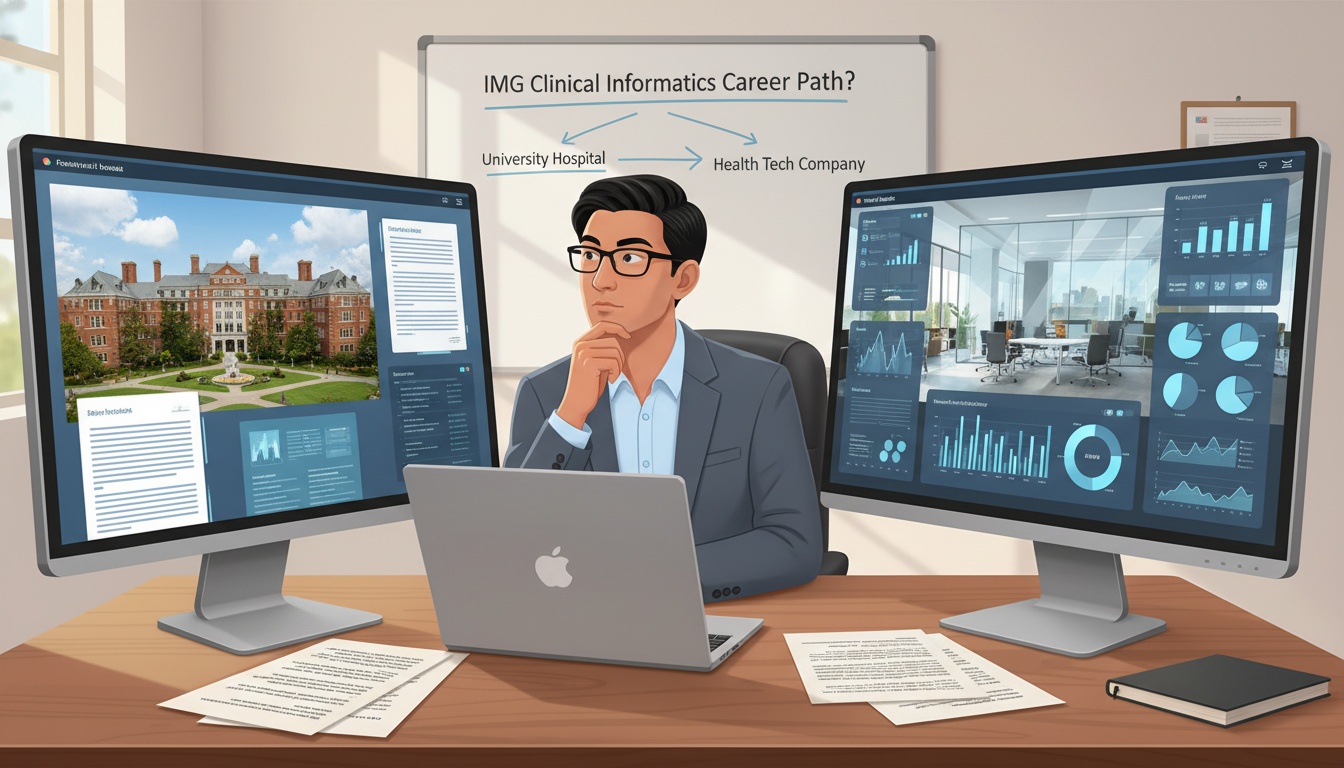
Academic vs Private Practice: Key Dimensions for IMGs in Clinical Informatics
To make these differences concrete, it helps to compare the two along specific axes that matter to IMGs.
1. Visa and Immigration
Academic:
- Often more experienced with IMGs
- More likely to have legal teams handling J‑1 waiver, H‑1B, O‑1, and green card processes
- University sponsors may be exempt from H‑1B caps (“cap‑exempt”)
Private / Industry:
- Large systems and established companies may sponsor H‑1B and green cards, but policies vary
- Smaller practices may prefer US citizens/green card holders due to perceived complexity
- Startups and small vendors may have limited visa capacity
Actionable tip:
When interviewing, explicitly ask:
- “Do you currently sponsor H‑1B or O‑1 visas for physicians?”
- “How many clinicians are currently on visas?”
- “Do you support employment‑based permanent residency applications?”
2. Clinical vs Non‑Clinical Balance
Academic:
- Typically require ongoing clinical practice in your base specialty
- Better if you want to keep strong clinical identity and bedside skills
- Important if you may want to shift back to pure clinical roles later
Private / Industry:
- Health systems may offer limited clinical time or purely non‑clinical informatics roles
- Industry roles are often 100% non‑clinical
- Good if you are moving toward an informatics or health IT leadership identity and away from day‑to‑day clinical work
Actionable tip:
Clarify the exact FTE split: “What percentage of my time is expected to be clinical vs informatics, and can this change over time?”
3. Training and Skill Development
Academic:
- Strong in research methods, study design, and academic writing
- Exposure to clinical informatics fellowship curricula and conferences
- More likely to involve formal didactics or degrees (MS in Biomedical Informatics, MPH, etc.)
Private / Industry:
- Strong in project management, EHR implementation, workflow redesign
- Exposure to business operations, ROI calculations, and stakeholder management
- Often practical “hands‑on” health IT training: build tools, deploy solutions, measure impact
Choosing career path in medicine means deciding whether you prefer:
- Research and pedagogy (academic)
- Execution and systems change (private/industry)
4. Leadership and Career Trajectory
Academic:
- Leadership roles: Fellowship Director, Division Chief, Vice‑Chair of Informatics, academic CMIO
- Promotions based on scholarship, teaching, and institution service
- National leadership through AMIA committees, guideline panels, etc.
Private / Industry:
- Leadership roles: CMIO, CMO, VP of Clinical Informatics, Product VP, or CEO in startups
- Promotions based on performance, impact, and business outcomes
- Potential to move into health system C‑suite (CIO/CMO/Chief Quality Officer) or corporate leadership (VP, SVP)
Actionable tip:
Ask interviewers to describe the career path of prior informaticians in the organization: Where did they go in 3–5 years?
5. Work Culture and Lifestyle
Academic:
- Culture of inquiry and debate; slower decision cycles
- Multiple responsibilities (clinical, teaching, research, committees)
- Conferences and academic calendar rhythms (abstract deadlines, grant cycles)
Private / Industry:
- Often faster pace, strong operational or commercial focus
- Clear, outcome‑oriented milestones and deliverables
- May offer remote or hybrid work, especially in industry roles
Lifestyle will depend more on specific organization than sector, but overall:
- Academic roles may feel more “multi‑directional,” less neatly contained
- Private/industry roles may feel more like standard full‑time jobs with project deadlines
Practical Decision‑Making Framework for IMGs in Clinical Informatics
Step 1: Clarify Your Primary Identity
Ask yourself:
- Do I primarily see myself as a clinician who uses informatics?
- Or as an informatician/health IT leader who happens to be a physician?
If the first, academic medicine or a health system with significant clinical time may be best.
If the second, industry or a heavily informatics‑weighted health system role may be ideal.
Step 2: Map Your Immigration Timeline
List:
- Current visa status and expiration
- Eligibility for J‑1 waiver (if relevant)
- Time to green card and whether you qualify for EB‑1 or NIW categories
Then examine which organizations:
- Are cap‑exempt (universities, some research hospitals)
- Have a track record of successful sponsorship for IMGs
- Can offer you stability during your immigration process
Step 3: Assess Financial Needs and Risk Tolerance
Consider:
- Your debt, obligations, and family responsibilities
- Desired salary range and timeline
- Willingness to accept volatility (e.g., startup equity vs stable salary)
Academic roles may be more stable but lower‑paid; industry roles may pay more but be more volatile.
Step 4: Evaluate Your Appetite for Scholarship
Be honest about:
- Whether you enjoy writing papers, designing studies, and presenting at academic conferences
- How important formal academic recognition and titles are to you
- Whether you thrive under “publish and present” expectations
If your passion lies in improvement and building systems, not in publication, private sectors may better match your intrinsic motivations.
Step 5: Actively Explore Both Paths During Training
During residency and clinical informatics fellowship:
- Rotate with the CMIO team and hospital IT in both academic and community hospitals if possible
- Attend both academic meetings (AMIA) and industry‑oriented events (HIMSS, vendor user groups)
- Conduct at least one research project and one large operational/implementation project
This exposure will give you real insight into whether you enjoy the academic or operations/industry culture more.
Hybrid and Evolving Models: It Doesn’t Have to Be Either/Or
An important nuance: in clinical informatics, academic vs private practice is not always a strict binary. Common hybrid models include:
- Academic physicians with industry advisory roles or part‑time consulting
- Health system CMIOs holding adjunct academic appointments and teaching intermittently
- Industry physician‑informaticians serving as guest lecturers or holding unpaid adjunct titles
- Transitions over time: academic → CMIO in private system → CMO at a health IT startup
For IMGs, a practical pathway might look like:
- Residency + Clinical Informatics Fellowship at an academic center (strong training, visa stability).
- Early career academic post with 50–50 clinical/informatics role to gain experience and publications.
- Transition to a health system or industry role with higher informatics focus and compensation once your immigration status is secure and your portfolio is strong.
This flexible approach allows you to leverage the strengths of both environments across different career stages.
FAQs: Academic vs Private Practice for IMGs in Clinical Informatics
1. As an international medical graduate, is it harder to get a clinical informatics job in industry than in academia?
It depends more on your skills and experience than on your IMG status, but practically:
- Academia is often more accustomed to IMGs, given their experience with GME and visa sponsorship.
- Industry roles may place heavier emphasis on prior U.S. or local system experience, communication skills, and product or implementation achievements.
- If you complete a recognized clinical informatics fellowship and build a portfolio of impactful projects, industry can be very accessible—especially once your immigration status is more secure.
Starting in academia for fellowship training and early career, then moving into industry or health system leadership, is a common pattern for IMGs.
2. Do I need a clinical informatics fellowship if I plan to work in private practice or industry and not in an academic job?
Not strictly, but it is highly beneficial:
- ACGME‑accredited fellowships provide structured health IT training, mentorship, and credibility.
- Board eligibility in clinical informatics (through fellowship) is increasingly important even outside academia.
- For IMGs, fellowship can also provide time to adjust to the healthcare system, build a network, and stabilize your visa situation.
Some experienced physicians can qualify through the practice pathway, but that route is time‑limited, more complex for IMGs, and may be less compelling for future employers as time goes on.
3. If I want an academic medicine career in clinical informatics, can I still work with industry or private companies?
Yes, many academic informaticians:
- Serve on advisory boards for health IT companies
- Partner on funded implementation or research studies with industry
- Participate in product evaluation and clinical validation studies
However, you must:
- Follow your institution’s conflict of interest and disclosure policies
- Obtain appropriate approvals for paid consulting work
- Be transparent in publications and presentations
This hybrid approach can give you the intellectual satisfaction of academia while staying close to real‑world health IT innovation.
4. How should I present myself on my CV and in interviews if I’m undecided between academic and private practice paths?
Focus on transferable skills important in both sectors:
- Leading multidisciplinary teams and governance committees
- Designing, implementing, and evaluating informatics interventions (CDS, order sets, workflows)
- Using data and analytics to improve quality, safety, and efficiency
- Teaching and communicating complex concepts to non‑technical stakeholders
On your CV, emphasize:
- Quantifiable outcomes from your projects
- Any experience that crosses boundaries (e.g., collaborating with vendors, participating in multi‑center academic studies)
In interviews, you can be honest that you appreciate both environments but tailor your emphasis: scholarship and mentoring for academic roles; operational impact and product/implementation outcomes for private or industry roles.
Choosing between academic vs private practice in clinical informatics as an IMG is less about a single “correct” answer and more about aligning your career with your values, immigration timeline, risk tolerance, and desired professional identity. With careful planning and openness to hybrid paths, you can build a fulfilling, flexible, and impactful career at the intersection of medicine and health IT—regardless of where you start.