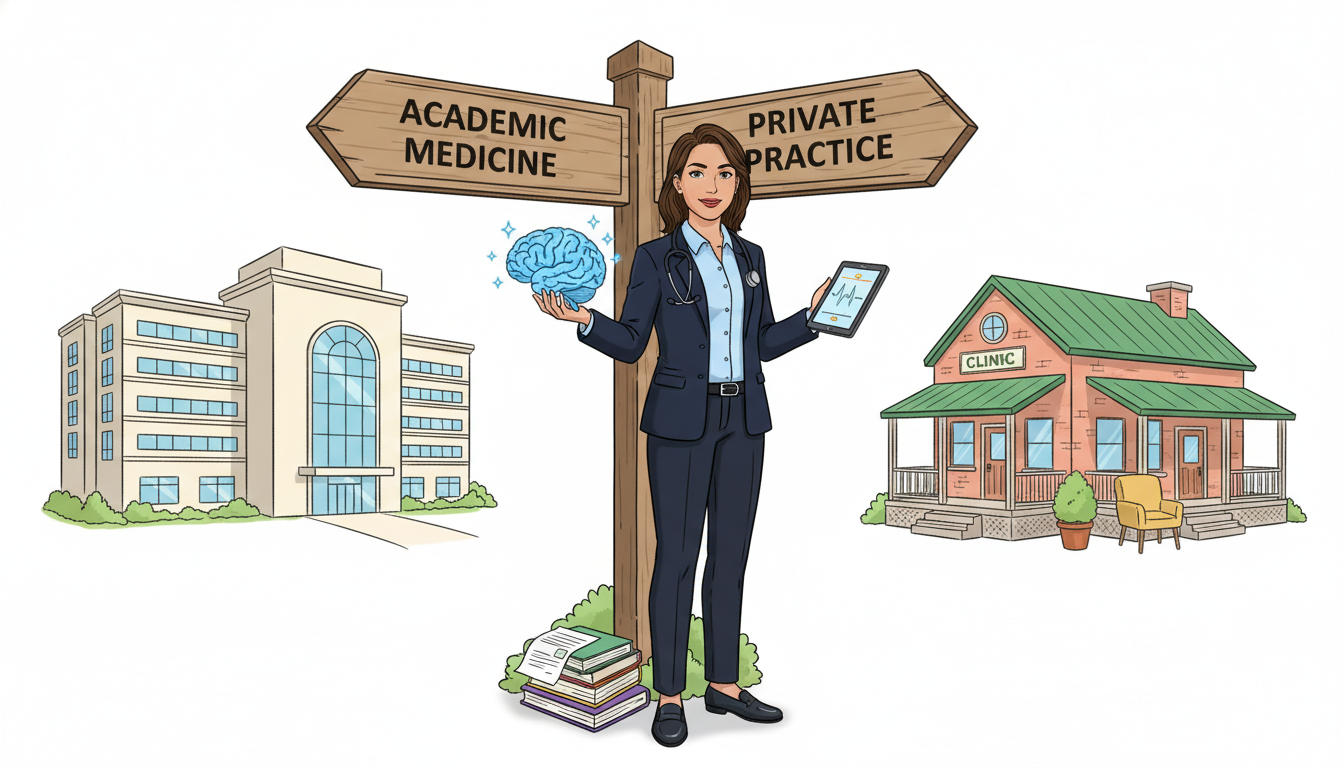
Choosing between academic medicine and private practice is one of the most consequential decisions you’ll make after completing a Pediatrics–Psychiatry–Child & Adolescent Psychiatry (Triple Board) residency. As a US citizen IMG or an American studying abroad, you’re navigating not just a specialty choice, but also questions of credibility, long‑term stability, and professional identity in a niche field.
This guide breaks down how academic vs private practice plays out specifically in peds psych residency graduates and triple board–trained physicians, with a focus on the realities, advantages, and challenges unique to US citizen IMGs.
Understanding Your Niche: Triple Board and Pediatrics–Psychiatry
Before dissecting practice settings, it helps to ground yourself in what makes pediatrics-psychiatry and triple board so distinctive.
What Triple Board Training Prepares You For
Triple board or combined pediatrics-psychiatry training equips you to:
- Diagnose and manage medical and psychiatric conditions in children and adolescents
- Bridge care between:
- Pediatric clinics and psychiatric services
- Inpatient pediatric units and child psych units
- Lead integrated care and consultation-liaison services:
- Pediatric consults on child psych units
- Psychiatric consults on pediatric floors, PICUs, and NICUs
- Work with highly complex populations:
- Autism, neurodevelopmental disorders
- Chronic illness with comorbid anxiety/depression
- Eating disorders, somatic symptom disorders
- Trauma, foster care, and child welfare systems
That dual (or triple) expertise is highly valued in academic centers, but also increasingly attractive for large multidisciplinary private practices and hospital-employed group models.
Why This Decision Is Particularly Important for US Citizen IMGs
As a US citizen IMG or American studying abroad, you may be:
- More conscious of perception and legitimacy in the US system
- Highly motivated to build a strong profile for fellowships, leadership, or academic medicine careers
- Considering geography carefully (family in the US, spouse’s job, loan repayment, etc.)
- Interested in visa-free flexibility (a major advantage compared with non‑US IMGs)
This makes choosing a career path in medicine—especially academic vs private practice—less about “which is better” and more about which aligns with your long-term identity and goals.
Academic Medicine in Pediatrics–Psychiatry: Structure, Pros, Cons, and Fit
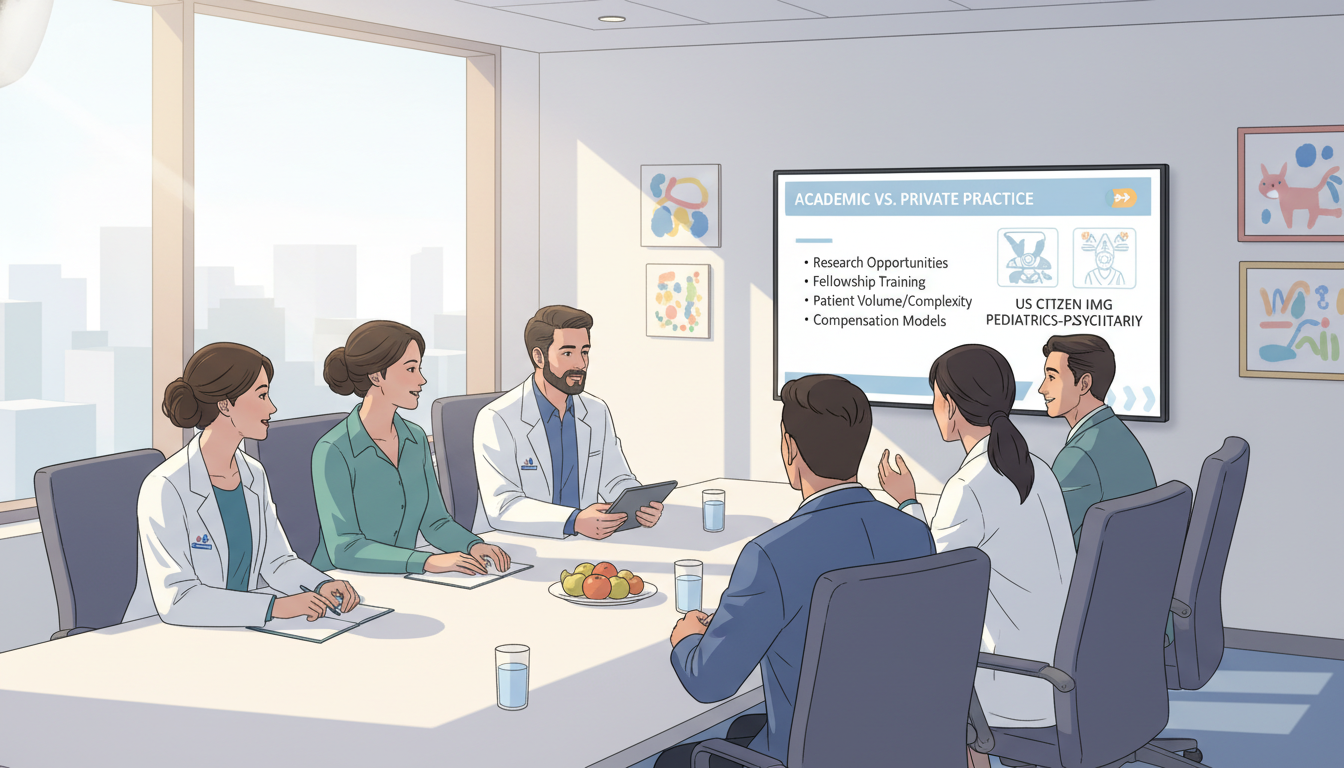
Academic medicine usually means working at:
- University-affiliated children’s hospitals
- Academic medical centers with combined peds/psych departments
- Institutions that host triple board or child & adolescent psychiatry fellowships
You’re typically employed by a hospital or medical school, your practice is often salaried, and your role blends clinical, teaching, and (sometimes) research activities.
Typical Academic Roles for Triple Board / Peds-Psych Physicians
Common roles include:
- Inpatient pediatric consultation-liaison psychiatry
- Child and adolescent psychiatry inpatient or partial hospitalization
- Outpatient integrated clinics, e.g.:
- ADHD, autism, and developmental clinics
- Behavioral pediatrics
- Psychopharmacology for medically complex kids
- Teaching and supervision:
- Medical students (especially at children’s hospitals)
- Residents (peds, psych, triple board)
- Fellows (child & adolescent psychiatry)
- Program leadership and administration:
- Triple board program director or associate PD
- Pediatric CL service director
- Clinic medical director
- Scholarly work:
- Quality improvement (QI) projects
- Educational research
- Clinical research in integrated care, chronic illness and mental health, etc.
Advantages of Academic Medicine for US Citizen IMGs
1. Credibility and Visibility
For a US citizen IMG in a niche field, academic medicine can:
- Provide an institutional “stamp” of credibility
- Put you in highly visible roles where your combined skillset stands out
- Allow you to publish, teach, and present—activities that can quickly establish you as a national voice in pediatrics-psychiatry or integrated behavioral health
If you’re thinking about an academic medicine career—program leadership, research, or national committees—this visibility is crucial.
2. Structured Career Development
Academic centers usually offer:
- Formal mentorship (career mentors, research mentors, teaching mentors)
- Promotion tracks (assistant → associate → full professor)
- Protected academic time, especially early-on if your role is designed that way
- Access to:
- Teaching academies
- Medical education certificate programs
- Grants or pilot project funding
For someone still refining their long-term career path in medicine, this structure can be reassuring and developmental.
3. Natural Alignment with the Triple Board Skillset
Academic children’s hospitals are built for:
- Complex kids with overlapping medical and psychiatric issues
- Multidisciplinary teams: social work, psychology, pediatrics, psychiatry, OT, PT, speech
- Integrated clinics that actually need someone who can “speak both languages”
Your dual training is maximally leveraged here—both clinically and in system design.
4. Easier Entry for New Graduates
As a new graduate, especially as a US citizen IMG, academic medicine may:
- Be more comfortable about hiring you straight out of training
- Value your training trajectory and unique skills over business or marketing experience
- Provide an easier transition with:
- Colleagues readily available for consultation
- Structured onboarding
- Gradual ramp-up of clinical volume
Disadvantages and Challenges of Academic Medicine
1. Compensation and Financial Tradeoffs
In general:
- Academic salaries are lower than high-earning private practice roles, particularly in psychiatry.
- Pediatrics alone is often on the lower side financially; peds-psych blends a lower-paying field (peds) and a higher-paying one (psychics) but the academic environment often “averages” this out.
You might see:
- Lower base salary vs private practice child psychiatry
- More predictable pay but fewer opportunities for major income spikes
- Faculty incentive plans tied to:
- RVUs (clinical productivity)
- Teaching and service
- Academic output (sometimes)
For US citizen IMGs with significant loans or family obligations, this is an important consideration.
2. Administrative and Bureaucratic Burden
Academic environments may involve:
- Frequent committee work, meetings, and compliance tasks
- Institutional politics around:
- Space
- Staffing
- New program development
- Slower decision-making compared with nimble private practices
If you crave autonomy and rapid execution of your ideas, this can be frustrating.
3. Variable Protected Time and Burnout Risk
Not all academic jobs are equal:
- Some genuinely protect research or teaching time
- Others are “academic in name” but expect near-full clinical productivity with limited time for scholarship
In high-demand services (e.g., child psychiatry consult), workload can be intense. Without clear boundaries, burnout is a serious risk.
4. Geography Constraints
Academic jobs are clustered:
- Often in large cities or regional academic hubs
- Less flexible geographically than private practice roles
If you need to be near certain family members or prefer rural/suburban life, academic options may be limited.
Example Academic Career Path: A US Citizen IMG
- US citizen attends medical school in the Caribbean (American studying abroad)
- Matches into a triple board program at a university‑affiliated children’s hospital
- Stays on after residency as:
- Assistant professor
- Pediatric CL psychiatrist with 0.7 FTE clinical, 0.3 FTE teaching/QI
- Over 5–7 years:
- Leads integrated behavioral health in a complex care clinic
- Publishes on somatic symptom disorders and chronic pain in adolescents
- Becomes associate program director for the triple board program
- Later career trajectory:
- Promotion to associate professor
- Consideration for program director role or section chief
This kind of path is highly plausible and often more easily accessible in academic medicine than in private practice.
Private Practice and Non-Academic Employment: Flexibility, Income, and Autonomy

“Private practice” in pediatrics-psychiatry does not always mean solo ownership. It exists on a spectrum:
- Solo private practice (you own everything)
- Small group practice (shared overhead, partnership track)
- Large multi-specialty private groups (including pediatrics and psychiatry)
- Hospital-employed or health system–employed outpatient roles that behave like private practice but with W‑2 employment
- Telepsychiatry or hybrid models
For a peds psych residency graduate or triple board physician, private practice can be primarily:
- Child & adolescent psychiatry outpatient work
- Combined pediatric and psychiatric consultation for specific populations (e.g., autism, ADHD)
- Behavioral pediatrics in collaboration with pediatric groups
Advantages of Private Practice for US Citizen IMGs
1. Higher Earning Potential
Child psychiatry is already one of the better-compensated areas in mental health; combine that with:
- High demand for child psychiatrists nationwide
- Long waitlists in most regions
- Willingness of families to self-pay for specialized services
This means:
- Higher hourly rates
- Greater total income potential, especially if you:
- Optimize your scheduling
- Minimize no-shows
- Efficiently manage documentation
For a US citizen IMG trying to build financial stability, pay down loans, or support family, this can be significant.
2. Autonomy and Control Over Practice
You can control:
- Which patients you see:
- Only child psychiatry
- A mix of medical and psychiatric consultations
- Specific niches (e.g., autism, ADHD, eating disorders, blended family issues, medically complex kids)
- How you schedule:
- 50-, 60-, or 90-minute intakes
- 20- or 30-minute follow-ups
- Telehealth vs in-person mix
- Where you practice:
- Suburban areas with high demand
- Regions with low competition
- States with favorable reimbursement climates
This level of control over your clinical environment can be deeply satisfying.
3. Geographic Flexibility
Private practice roles are available:
- In nearly every state
- In a wide range of communities (urban, suburban, even rural through telehealth)
If you want to live near family or in a particular region, private practice vs academic may give you far more options.
4. Ability to Design a Life-Friendly Schedule
Part of choosing a career path in medicine is choosing a daily lifestyle. Private practice can offer:
- Part-time work
- 4‑day weeks
- School-hour schedules if you have young children
- Evening-only telepsychiatry if that fits your life
You can modulate intensity over the years, ramping up or down as circumstances evolve.
Disadvantages and Challenges of Private Practice
1. Business and Administrative Burden
If you own or help run a practice, you must deal with:
- Billing and coding (or paying someone to handle it)
- Insurance paneling and prior authorizations
- Lease negotiations, malpractice coverage, HR issues
- Marketing and referral relationships
Even if you join an established group, you’ll have productivity expectations and may have less institutional support for non-clinical interests.
2. Professional Isolation and Fewer Built-in Teaching Roles
You may miss:
- Daily contact with residents, fellows, and a broad interdisciplinary academic team
- Protected time for formal teaching or research
- The stimulation of a large institutional environment
That said, some private practitioners still:
- Teach part-time at nearby medical schools
- Take students into their clinics
- Collaborate on research as adjunct faculty
But it’s not built-in; you have to seek it out.
3. Less Formal Academic Career Progression
If you see yourself as:
- A program director
- A full professor
- A national academic leader in pediatrics-psychiatry
Then staying exclusively in private practice may limit some pathways, or at least make them less straightforward.
You can still:
- Become a regional expert
- Lead CME programs, contribute to guidelines, and present nationally
- Serve on professional society committees
But your title might be “Dr. X, private practice child psychiatrist” rather than “Associate Professor, Department of Psychiatry and Pediatrics.”
4. Risk Exposure and Financial Volatility
Particularly early on:
- Building a patient base takes time
- Revenue can fluctuate with no-shows, panel changes, or payer issues
- Economic downturns or policy changes can impact reimbursement
As a US citizen IMG, you may feel more pressure to maintain stability if you are a primary breadwinner or supporting family abroad or domestically.
Example Private Practice Career Path: A US Citizen IMG
- US citizen attends med school abroad, matches into a peds psych residency / triple board program
- Completes training and works 2–3 years in an academic center to solidify skills
- Joins a large child psychiatry group practice in a major metro area
- Focuses on:
- ADHD, mood and anxiety disorders
- Medically complex kids referred from local pediatricians
- Over 5–10 years:
- Negotiates partnership with profit-sharing
- Adds a part-time educational role as volunteer faculty at a nearby university
- Builds a reputation as the “go-to” integrated pediatric-psychiatric expert in the region
This pathway can provide higher personal income and lifestyle flexibility, while still allowing some academic flavor if desired.
How to Decide: Matching Your Goals, Personality, and Values
Whether you choose academic vs private practice should reflect:
- Your core professional identity
- Your tolerance for bureaucracy vs business risk
- Your desire for teaching, research, and leadership
- Your financial and geographic priorities
Here’s a structured decision framework.
1. Clarify Your Long-Term Vision
Ask yourself:
- In 10–15 years, do I want others to see me as:
- A professor and educator
- A clinical leader and program builder
- A highly skilled, in-demand clinician with a flexible life
- How important is title, such as “director,” “professor,” or “division chief”?
- Do I see myself writing papers, textbooks, or guidelines?
If academic identity matters deeply, starting—and possibly staying—in academia makes sense. If you’re more drawn to clinical mastery and life design, private practice may be more congruent.
2. Evaluate Your Appetite for Teaching and Scholarship
You should lean toward academic medicine if you:
- Love explaining complex concepts to trainees
- Enjoy supervising cases and shaping how others think
- Are curious about research or QI projects
You might lean toward private practice if you:
- Prefer direct patient care to group teaching
- Find research writing draining or unappealing
- Want immediate clinical impact without publish-or-perish pressure
3. Consider Financial and Family Realities
Reflect on:
- Your educational debt level
- Dependents and family financial needs
- Spouse/partner’s career flexibility
- Desired standard of living and timeline to reach it
A reasonable strategy for many US citizen IMGs is:
- Start in academics for 3–5 years to:
- Polish skills
- Build reputation
- Obtain board certifications and some publications
- Then transition to private practice if finances or lifestyle needs demand it
Or the reverse:
- Start in private practice to stabilize finances
- Later add significant adjunct academic roles if you miss teaching and scholarship
4. Think About Geography and Support Systems
If your top priority is:
- Being in a specific city or state near family
- Living in an area without a major academic center
Then private practice vs academic may largely be decided by geography.
But if you’re mobile and want:
- A major children’s hospital
- Trainees involved in your work
- Vibrant academic community
Academic medicine remains a strong choice.
5. Plan for Hybrid or Evolving Careers
Your first post-residency job is not your final destination. Many physicians in pediatrics-psychiatry (especially triple board grads) eventually create hybrid careers, for example:
- 0.7 FTE academic inpatient work + 0.3 FTE private practice
- Four days hospital-employed + one day independent consults or telepsychiatry
- Primarily private practice but with:
- Adjunct faculty appointment
- Teaching half-day per week
- Occasional research collaboration
As a US citizen IMG, remaining open to evolution lets you course-correct if early assumptions about academic vs private practice prove wrong.
Strategic Steps During Residency and Early Career
To keep both doors—academic and private practice—open as a US citizen IMG in peds-psych, use residency and early post-training years strategically.
During Peds Psych / Triple Board Residency
Engage in Teaching Early
- Volunteer to give didactics to junior residents or medical students
- Seek feedback to improve your teaching skills
Participate in at Least One Scholarly Project
- Could be a QI project on integrated care, delirium prevention, or psych screening in pediatric clinics
- Aim for a poster or short publication—especially valuable for academic prospects
Gain Exposure to Diverse Practice Types
- Choose electives in:
- Community child psychiatry
- Private practice shadowing
- Telepsychiatry services
- Ask attendings about their real income, workload, and job satisfaction
- Choose electives in:
Network with Both Academic and Community Mentors
- Academic mentor for scholarship and teaching skills
- Community/private mentor for business and lifestyle perspectives
Early Post-Residency (First 5 Years)
Negotiate Thoughtfully
- In academia: clarify expectations for teaching, research, and promotion criteria
- In private practice: understand compensation models (salary vs productivity vs partnership track)
Keep a Foot in Both Worlds (If Possible)
- Academic job? Consider a one-day-a-week moonlighting shift in community or telepsych
- Private practice job? Pursue adjunct faculty status and occasional teaching
Reassess Every 2–3 Years
- Are your academic aspirations growing or fading?
- Are your financial and lifestyle needs being met?
- Are you trending toward burnout in your current setting?
Adjust accordingly—this is an iterative, not a one-time, decision.
FAQs: Academic vs Private Practice for US Citizen IMG in Pediatrics-Psychiatry
1. As a US citizen IMG, is it harder to get an academic position than a private practice job?
Not necessarily. If you completed:
- An ACGME-accredited peds psych or triple board residency (and possibly a child psychiatry fellowship), and
- Built basic academic credentials (teaching, QI, a few presentations),
then many academic centers will seriously consider you, especially given the shortage of child psychiatrists and integrated-care experts. Private practice roles are also widely available, but the barrier is often less about your IMG status and more about your interest in the business side.
2. Does starting in academia limit my ability to move into private practice later?
No. Starting in academia often enhances your value in private practice because:
- You bring strong training in complex cases
- You may have a strong referral network
- Your academic title and experience can be used in marketing
Just be mindful of any non-compete clauses and ensure you maintain strong outpatient skills if your academic role is heavily inpatient-based.
3. If I choose private practice, can I still have an academic medicine career?
Yes, but it will likely be part-time or adjunct rather than a traditional full academic track. You can:
- Teach a half-day each week at a medical school
- Serve as volunteer faculty supervising residents
- Collaborate on research projects as a community partner
- Present at conferences and join national committees
You may not progress as quickly to professor-level titles, but you can still be influential in academic medicine, particularly in shaping how integrated pediatrics-psychiatry care is delivered in the community.
4. Which path—academic or private practice—is better for long-term career satisfaction?
There’s no single “better” path. For most US citizen IMG physicians in pediatrics-psychiatry:
- Academic medicine tends to suit those who value teaching, scholarship, and institutional roles, even at the cost of some income and autonomy.
- Private practice tends to suit those who prioritize income, flexibility, and control, even if it means fewer formal academic titles.
Many find the greatest satisfaction in hybrid models over time: starting in one world, integrating elements of the other, and adjusting as their professional and personal lives evolve.
Ultimately, choosing between academic vs private practice as a US citizen IMG in pediatrics-psychiatry is less about picking a single lane and more about designing a career that can adapt. Use your uniquely broad triple board skillset, seek mentors in both arenas, and give yourself permission to pivot as your goals—and your life—change.