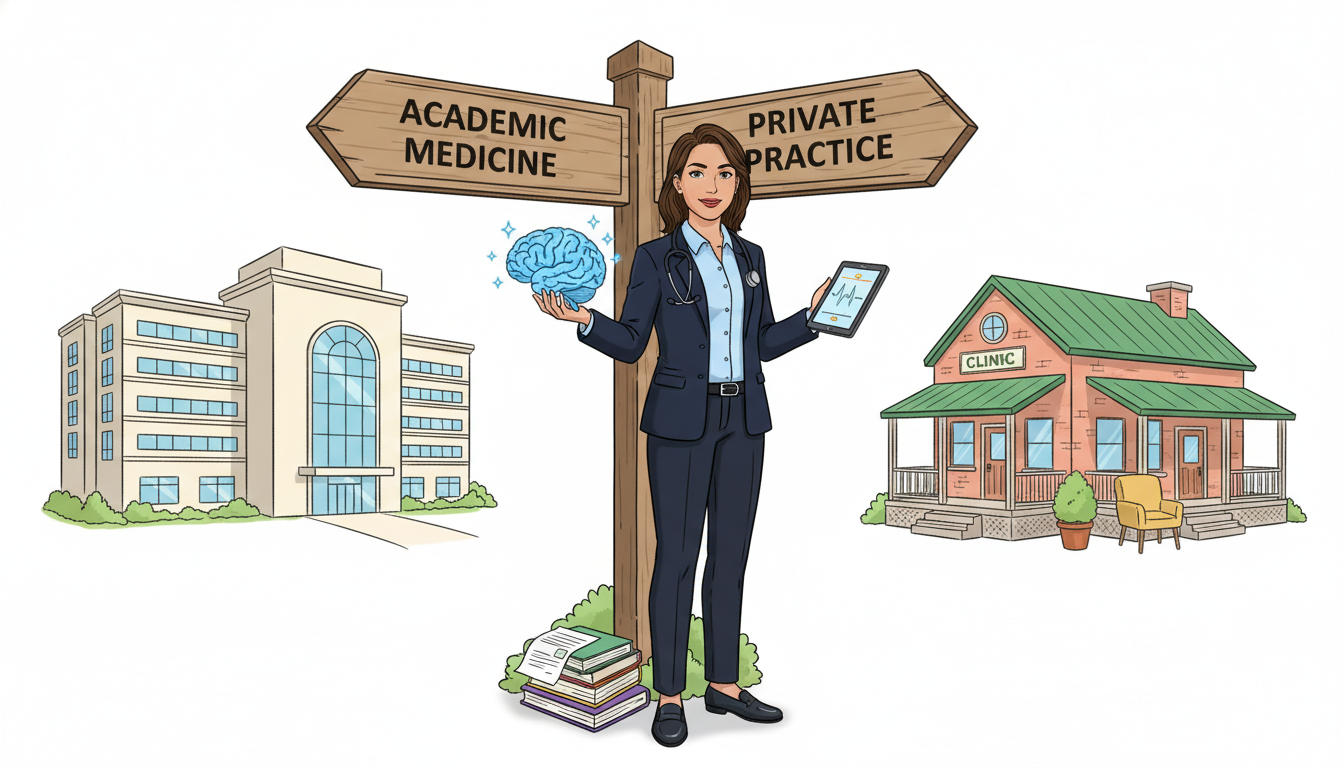
Pediatrics-psychiatry is uniquely positioned at the intersection of child health and mental health, and that dual focus shapes your career decisions in powerful ways. One of the most important choices you’ll make after training is whether to build your career in academic medicine, private practice, or some hybrid model.
This guide is designed for residents and fellows in peds psych residency and triple board programs who are actively choosing a career path in medicine and trying to understand how “academic vs private practice” actually looks day to day in Pediatrics-Psychiatry.
Understanding the Pediatrics-Psychiatry Career Landscape
Pediatrics-Psychiatry training (through triple board or other combined pathways) opens several distinct career directions:
- Pure academic medicine career at a university or children’s hospital
- Traditional private practice (solo or small group)
- Large group or multispecialty practice (quasi-private, sometimes health-system owned)
- Hybrid roles (e.g., part-time faculty + part-time private work)
- Institution-based roles (state hospitals, residential programs, community mental health centers, integrated pediatric systems)
While this article focuses on academic vs private practice, most real-world careers sit somewhere along a spectrum. Especially in pediatrics-psychiatry, many physicians:
- Hold a faculty appointment while doing mostly clinical work
- Have an academic base but moonlight in private practice
- Work in academic-affiliated clinics that run like private groups
Understanding the range is critical before you lock yourself into a narrow mental model of what “academic” or “private” must look like.
Core Questions to Clarify for Yourself
Before comparing academic medicine vs private practice, clarify what matters most to you:
- How much do you want to teach learners?
- How important is research or scholarly work?
- Do you want to subspecialize (e.g., autism, eating disorders, neurodevelopmental disorders)?
- How much control do you want over your schedule and patient panel?
- How comfortable are you with business, billing, and operations?
- How heavily do you prioritize income vs flexibility vs prestige vs mission?
Keep these in mind as you read; they’ll help you map each option to your values and needs.
Academic Pediatrics-Psychiatry: Structure, Pros, and Cons
Academic positions usually mean working at:
- A university hospital or academic children’s hospital
- A residency or fellowship training site
- A medical school or large health system with teaching programs
You may be hired into a pediatrics-psychiatry division, a child and adolescent psychiatry department, or a pediatrics department with a strong behavioral health arm.
Typical Academic Roles and Tracks
Most academic centers have some version of these career tracks:
- Clinician-Educator Track
- Majority clinical care + teaching
- Scholarship often in education, QI, or clinical innovation
- Clinician-Researcher / Physician-Scientist Track
- Protected time for research (often 40–80%)
- Grant-writing, publications, multi-site studies
- Clinical Track (Service-Focused)
- Heavy clinical load, less expectation for research
- Often the backbone of service lines (inpatient, consults, outpatient)
Your mix of responsibilities may include:
- Direct patient care (inpatient, consult-liaison, outpatient, specialty clinics)
- Supervision of residents, fellows, psychology trainees, students
- Didactic teaching and curriculum development
- Quality improvement and program development (e.g., building an integrated pediatric primary care mental health program)
- Administrative work (committee service, leadership roles)
- Research and publications (depending on track)
Advantages of an Academic Medicine Career
- Teaching and Mentorship
If you enjoy explaining complex concepts, debriefing difficult cases, and watching trainees grow, academia gives you daily opportunities. In peds psych and triple board, you may:
- Teach pediatric residents to screen for depression and anxiety
- Supervise consults on medically complex children with behavioral dysregulation
- Serve as the “bridge” between pediatrics and psychiatry programs
- Mentor learners considering combined training or child psychiatry
- Clinical Breadth and Complexity
Academic settings often see:
- More medically complex children and adolescents
- Rare or severe psychiatric presentations
- Co-occurring developmental, neurological, and medical conditions
This can be intellectually satisfying and keeps your combined skillset sharp. You’re more likely to:
- Run integrated clinics (e.g., cystic fibrosis + mental health, oncology + psychiatry)
- Lead care for children with multiple specialists and psychosocial complexities
- Be consulted on complicated diagnostic dilemmas
- Structured Career Development
Universities typically offer:
- Formal promotion pathways (assistant → associate → full professor)
- Faculty development workshops (educator skills, leadership, grant writing)
- Mentoring programs and protected time (in better-resourced departments)
- Opportunities to build niche expertise (e.g., pediatric psychopharmacology, autism, trauma systems of care)
- Research and Innovation Opportunities
If you’re drawn to questions like:
- “How can we better integrate behavioral health into pediatric primary care?”
- “What improves adherence in adolescents with chronic illness and depression?”
- “How do trauma and social determinants affect pediatric medical outcomes?”
…then an academic environment provides a fertile ground for inquiry, collaboration, and dissemination. Even as a primarily clinical faculty member, you can:
- Lead QI projects and publish results
- Partner with PhD researchers on grants
- Participate in multi-site clinical studies
- Institutional Support and Infrastructure
Academic centers typically provide:
- Billing and scheduling infrastructure
- Colleagues across many disciplines
- Built-in referral networks
- Access to social work, psychology, therapies, and case management
- IT support, EMR optimization, telehealth platforms
- On-site continuing education and grand rounds
You’re often less responsible for the nuts and bolts of running a business and more focused on clinical, teaching, and scholarly work.
Challenges and Trade-Offs in Academia
- Compensation and Earning Potential
Compared to high-earning private practice:
- Base salaries in academic pediatrics-psychiatry are often lower
- Some institutions offer bonuses, productivity incentives, or loan repayment
- Long-term, pure academics may not match the peak income of strong private practices
For many, the trade-off is acceptable given the stability, benefits, and mission-driven work. But if maximizing income is your main goal, pure academic roles may feel limiting.
- Administrative Burden and Institutional Politics
Academics can come with:
- Committees, compliance requirements, and mandatory trainings
- Documentation expectations that align with teaching and research metrics
- Departmental politics affecting promotions, leadership roles, and resources
Triple board and combined-trained physicians also sometimes navigate unclear “home department” loyalties (pediatrics vs psychiatry), which can impact:
- Call expectations
- Space and resource allocation
- Promotion pathways
- Less Control Over Schedule and Panel
You may have:
- Less autonomy in setting clinic hours
- Assigned clinics based on departmental needs (e.g., more consult weeks than you prefer)
- Limited ability to “opt out” of under-resourced service lines (e.g., inpatient or emergency coverage)
- Pressure to Produce Scholarship (Depending on Track)
Promotion criteria can require:
- Published papers
- National presentations
- Evidence of educational or clinical innovation
If you primarily want to see patients and go home, this may feel like extra, unpaid work. On the other hand, if you crave impact beyond the individual patient, this expectation can be a motivator and structure for growth.

Private Practice in Pediatrics-Psychiatry: Models, Pros, and Cons
Private practice is not a single entity; there is a continuum of setups, all relevant to pediatrics-psychiatry:
- Solo practice (you run everything)
- Small group child psychiatry or peds psych practice
- Multispecialty group practices (e.g., pediatricians, psychologists, social workers, and you)
- Health-system–owned group practices (private feel but employed)
- Concierge / retainer models
For child and adolescent or pediatric psychiatrists—with especially for those with triple board training—patient demand is high. That creates robust opportunities for outpatient private practice.
Key Features of Private Practice in Peds-Psych
- Clinical Focus and Autonomy
You often have:
- Control over your patient population (e.g., anxiety/mood only vs full-spectrum, neurodevelopmental focus)
- Autonomy in scheduling (session lengths, early/late hours, telehealth vs in-person)
- Control over practice policies (no-show fees, intake processes, communication boundaries)
A Pediatrics-Psychiatry clinician might, for example:
- Build a practice focused on children with chronic illness and comorbid anxiety or depression, marketed through pediatric subspecialists
- Run a consultation practice for pediatricians seeking psychopharm guidance
- Provide integrated care in a pediatric primary care office as an independent contractor
- Income Potential
Private practice can offer:
- Significantly higher earning potential, especially cash-pay or efficient insurance-based models
- Ability to scale income with additional clinicians (if you build a group and supervise)
- Direct alignment between clinical productivity and compensation
Triple board–trained physicians can also market:
- Their expertise in complex medical-psychiatric cases
- Their ability to communicate easily with pediatricians and other physicians
- Their understanding of both developmental stages and family systems
- Lifestyle Flexibility
You can:
- Decide how many days per week you work
- Adjust your practice size to match your family or personal needs
- Choose telehealth-heavy models (helpful for rural/underserved outreach)
- Take vacations without “academic calendar” constraints (balanced with business realities)
- Reduced Academic and Administrative Overhead
You’re not obligated to:
- Serve on multiple institutional committees
- Meet promotion requirements
- Publish or present at national conferences (unless you want to for your brand)
Your responsibility is primarily to your patients, your ethics, and your practice operations.
Challenges and Responsibilities in Private Practice
- Business and Operational Burden
In solo or small-group settings, you (or a hired manager) must handle:
- Credentialing and contracting with insurers (if you accept them)
- Billing, coding, and collections
- Office leasing or telehealth infrastructure
- Staff hiring, training, and supervision
- Malpractice coverage, compliance, and risk management
- Marketing and brand building
Not all physicians enjoy or are naturally inclined to business management. Some embrace it; others find it draining.
- Professional Isolation
Compared to academic departments:
- Fewer built-in colleagues to debrief difficult cases
- Less spontaneous collaboration with pediatric subspecialists and therapists
- You must be deliberate about building a professional network
For a combined-trained physician used to multidisciplinary care, the transition can feel unexpectedly lonely if not planned well.
- Clinical Scope Limitations
Most private practices are outpatient only. You may:
- Lose regular contact with inpatient or consult-liaison work
- See fewer severe cases and fewer medically complex patients
- Gradually narrow your skill set if you don’t deliberately maintain breadth
For some, this is a desired narrowing; for others, it feels like a loss of the rich complexity that drew them to Pediatrics-Psychiatry.
- Financial Risk and Variability
Especially early on:
- You may have months of low income while building your panel
- Economic or insurance shifts can affect reimbursement
- Vacation or parental leave directly reduces revenue unless you plan for coverage and reserves
Many physicians mitigate this by:
- Joining established groups
- Starting part-time while still employed
- Building telehealth-based or niche consult practices with lower overhead
Side-by-Side: Academic vs Private Practice in Pediatrics-Psychiatry
This comparison assumes a typical early- to mid-career attending who completed peds psych residency or a triple board program.
Daily Work and Patient Mix
Academic:
- Mix of inpatient, consult-liaison, and outpatient depending on role
- More medically complex children: oncology, transplant, neurology, complex developmental syndromes
- Frequent team meetings with pediatricians, social workers, therapists
- Teaching incorporated into daily work (e.g., turning cases into mini-lectures for residents)
Private Practice:
- Largely outpatient
- Case mix shaped by your marketing, location, and referral network
- More longitudinal relationships with families
- Less formal teaching, but possibly some informal community education (talks for schools, pediatric practices)
Teaching and Scholarly Activity
Academic:
- Formal teaching responsibilities
- Opportunities to design curricula on integrated care, psychopharm, trauma-informed pediatrics
- Structured paths to publish QI projects or case series
- Potential to shape the future landscape of combined training
Private:
- Limited formal teaching, unless you arrange it (e.g., volunteer faculty role)
- Lower pressure to publish
- Some clinicians still write, blog, or present regionally to support their brand
Income, Benefits, and Security
Academic:
- Predictable salary, institutional benefits (health, retirement, disability)
- Possible loan repayment or public service loan forgiveness (PSLF) if nonprofit
- Smaller gap between good and great clinicians in pay (less tied to volume)
Private:
- Higher upside potential, but more variability
- Benefits either self-funded or through a group plan
- Income tightly tied to your clinical volume, payer mix, and business acumen
Autonomy and Influence
Academic:
- Less control over schedule and clinic structure
- More influence on systems: developing clinical programs, influencing hospital policy for behavioral health, advocating at institutional level
- Ability to mentor and indirectly impact thousands of future patients via trainees
Private:
- High control over micro-level practice decisions
- Less knee-deep in institutional politics
- Systems-level influence more likely via professional societies, advocacy, or community partnerships
Work-Life Integration
Academic:
- Some roles include nights/weekends for inpatient or consult coverage
- Academic calendar rhythms (e.g., July turnover, conference seasons)
- Opportunities for flexible FTE arrangements in some departments
Private:
- No overnight call (unless chosen via hospital privileges)
- You choose your hours, but the practice requires ongoing attention
- Time off requires more proactive planning to balance patient needs and income

Hybrid and Evolving Models: It’s Not All or Nothing
The “academic vs private practice” dichotomy is increasingly outdated. Many pediatrics-psychiatry clinicians combine elements of both to build careers that better fit their values.
Common Hybrid Setups for Peds-Psych and Triple Board Graduates
- Academic Base + Private Side Practice
- Primary appointment at a university/children’s hospital
- 0.2–0.4 FTE private practice one or two evenings per week or on Fridays
- Benefits of teaching and institutional support plus supplemental income and autonomy
This can be particularly attractive if:
- You want a clear academic identity and teaching role
- You desire extra flexibility or income beyond your institutional job
- You enjoy outpatient work that differs from your academic clinical population
- Employed by Health System in a “Quasi-Private” Group
- Technically employed, not running your own business
- Work in a large group that includes pediatricians, psychologists, and social workers
- Less research/teaching but sometimes affiliated with a med school
These roles can offer:
- Higher salaries than core academic tracks
- Less pressure for scholarship
- A balance of team-based care and fewer business headaches
- Community or Integrated Care Leadership Roles
Triple board grads in particular may:
- Lead integrated behavioral health programs in pediatric primary care networks
- Work in large FQHCs or community pediatric systems
- Negotiate small teaching roles or adjunct appointments
Some of these roles behave like private practice clinically (high-volume outpatient care) but with population-health and program-development components more typical of academic medicine.
- Consultation-Only or Niche Practices
A Pediatrics-Psychiatry physician might:
- Offer consult-only services for pediatricians (no long-term medication management)
- Specialize in psychopharmacology consults for medically complex kids
- Combine this with part-time academic teaching or telehealth for rural systems
These models can keep your clinical work closer to your intellectual interests while controlling scope and volume.
How to Choose: A Framework for Decision-Making
When choosing a career path in medicine—especially in a subspecialty as nuanced as Pediatrics-Psychiatry—it helps to move from abstract pros/cons to concrete self-assessment.
Step 1: Clarify Your Core Motivators
Rank these (high/medium/low importance):
- Teaching and mentoring
- Research and scholarship
- High income potential
- Schedule autonomy
- Complex interdisciplinary cases
- Longitudinal relationships with families
- Desire to build/lead programs
- Appetite for business and entrepreneurship
- Institutional prestige and titles
- Geographic flexibility
Patterns often emerge:
- If teaching + complex interdisciplinary care + institutional impact are high → academic strongly fits
- If schedule control + high income + entrepreneurship are high → private practice leans more naturally
- If you’re high on all of the above, hybrid paths are likely to serve you best
Step 2: Test Your Assumptions During Training
Use residency and fellowship time to:
- Rotate through both academic and community practice settings
- Seek electives in private group practices or integrated pediatric networks
- Ask attendings about their actual weekly schedule, not just their title
- Moonlight (within program rules) in different clinical environments
Pay attention to:
- Where you feel most energized at the end of a week
- Which frustrations feel tolerable vs deal-breaking
- How much structure vs autonomy you prefer
Step 3: Model Concrete Scenarios
Build 3–4 realistic life scenarios for your first 5 years out:
Scenario A: Pure Academic
- 80% clinical, 20% teaching/admin at children’s hospital
- Some call, robust resident contact, moderate salary, strong benefits
Scenario B: Employed Group Practice
- Full-time outpatient peds psych in a health-system–owned practice
- No formal teaching, higher salary, modest committees, no business overhead
Scenario C: Private Group Practice
- Partnership-track pediatric psychiatry group
- Shared business responsibilities, high income, limited teaching unless sought
Scenario D: Academic + Side Practice
- 0.7 FTE academic; 0.3 FTE small telehealth practice focused on chronic illness + mental health
Write out:
- Typical daily schedule
- Income range
- Commute/telehealth balance
- How you’d explain your job to a non-medical friend
- What you might regret in each scenario
Step 4: Talk to People 5–10 Years Ahead of You
Seek out:
- Triple board and peds psych graduates in different environments
- People who left academia for private practice (and vice versa)
- Faculty who built hybrid or non-traditional roles
Questions to ask:
- “What surprised you about your current setting?”
- “What do you miss most about the alternative path?”
- “If you were me, with my interests, what would you consider carefully?”
FAQs: Academic vs Private Practice in Pediatrics-Psychiatry
1. Do I have to choose academic vs private practice permanently?
No. Careers in pediatrics-psychiatry are often nonlinear. Many clinicians:
- Start in academia, learn systems-based practice, build reputation, then move to private practice
- Begin in high-volume private practice, then shift to academic roles for more teaching and institutional impact
- Move between hybrid configurations as their family, financial, and professional needs change
Your first job is not your final destiny; focus on a strong fit for the next 3–5 years.
2. Is a triple board or peds psych residency more “suited” to academic careers?
Both pathways can lead to either academic or private practice careers. That said:
- Triple board training often emphasizes complex interdisciplinary care and systems thinking—skills highly prized in academic medicine and program-building roles.
- Many combined-trained physicians naturally gravitate toward academic settings initially, where they can leverage their broad training across pediatric and psychiatric services.
However, in private practice, your combined expertise is extremely marketable, especially if you build a clear niche and strong referral network.
3. Which path is better financially: academic medicine or private practice?
For most pediatric-psychiatry clinicians:
- Private practice (especially cash-pay or efficient group models) offers higher upper-limit earning potential.
- Academic positions provide more predictable and stable salaries, strong benefits, and sometimes loan repayment or PSLF.
Long-term, a well-run private or group practice usually out-earns pure academic roles. But factors like burnout, time flexibility, and non-clinical interests (teaching, research) may be at least as important as total compensation.
4. If I love teaching but also want autonomy and higher income, what should I consider?
You’re an excellent candidate for a hybrid career:
- Academic appointment at 0.5–0.8 FTE for teaching and program work
- Private practice for 0.2–0.5 FTE to increase autonomy and income
Other options:
- Join a teaching-oriented community hospital practice
- Become volunteer or adjunct faculty while working mainly in private practice
- Offer CME workshops and community education as part of your private practice brand
The key is to negotiate clear boundaries and time protection so neither side overwhelms the other.
Choosing between academic and private practice in Pediatrics-Psychiatry is less about “which is better” and more about which configuration best matches who you are—and who you’re becoming. Use your training years to explore, be honest about your priorities, and remember that you can redesign your career more than once over the span of a professional lifetime.