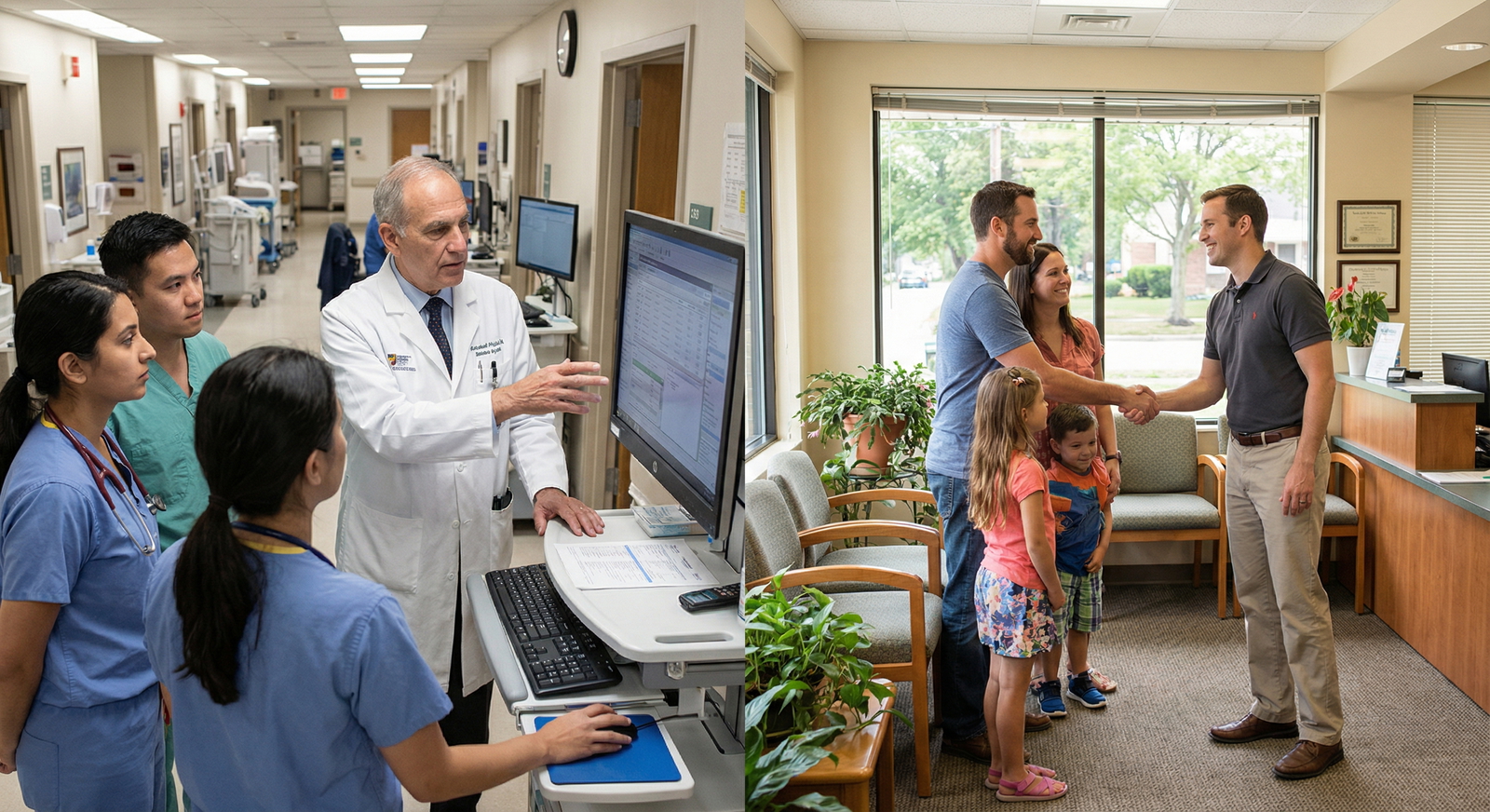
Understanding Your Options: Why This Decision Matters More for US Citizen IMGs
For any neurosurgeon, choosing between an academic medicine career and private practice is a major career-defining decision. For a US citizen IMG (American studying abroad), the choice can feel even more consequential: you may feel pressure to “prove yourself,” worry about job competitiveness, or wonder how your international background will affect opportunities in neurosurgery residency and beyond.
Neurosurgery is uniquely demanding—7+ years of residency, often followed by fellowship, and a career filled with high-stakes brain surgery and spine procedures. The settings in which you practice—academic vs private practice vs hybrid—will shape your daily work, compensation, lifestyle, research opportunities, and professional identity for decades.
This article breaks down:
- What “academic” and “private practice” actually mean in neurosurgery
- How each pathway looks day-to-day
- Pros, cons, and realistic trade-offs for a US citizen IMG
- How your status as an American studying abroad may influence hiring and advancement
- Practical steps to explore and position yourself for the path that fits you best
Throughout, we’ll focus on neurosurgery residency graduates who trained—or will train—in the United States, but who started medical school abroad.
Defining the Career Paths in Neurosurgery
What Is an Academic Neurosurgery Career?
An academic medicine career means your primary practice site is a university-affiliated or teaching hospital, often a large tertiary or quaternary center. Your role usually combines:
- Clinical care – complex brain, spine, and peripheral nerve surgery, inpatient consults, outpatient clinics
- Teaching – residents, fellows, medical students
- Research – basic science, translational, clinical trials, outcomes, or education research
- Institutional responsibilities – committees, quality projects, sometimes administrative leadership
Most academic neurosurgeons are employed by:
- University medical centers
- Major academic health systems
- Veterans Affairs medical centers with academic ties
- NCI-designated cancer centers or specialty research institutes
The emphasis is on advancing the field: new techniques, clinical trials in brain surgery residency programs, and training the next generation.
What Is Private Practice in Neurosurgery?
“Private practice” sounds simple, but in neurosurgery it includes several models:
Traditional private group practice
- Physician-owned group, often covering several community hospitals
- Emphasis on clinical volume, efficiency, and business viability
Hospital-employed neurosurgeon
- You’re directly employed by a hospital or health system
- Feels like private practice clinically, but you're a salaried employee
Large multispecialty or spine-focused groups
- May be partially or fully owned by a corporation or equity group
- Often high-volume spine surgery, some cranial depending on the site
Hybrid “academic lite” private practice
- Affiliated with a residency or medical school but primarily clinical
- Some teaching, occasional research, but productivity still drives compensation
In private practice, clinical productivity, procedural volume, and efficiency typically drive your income much more directly than in academia.
Where Do Hybrid and “Academic-Private” Models Fit?
In many regions, the line between academic and private practice is blurry:
- Private groups contracting to cover a teaching hospital
- Faculty appointments for community neurosurgeons supervising residents
- Research and clinical trials happening in “private” settings
For a US citizen IMG, these hybrid environments can be particularly attractive: exposure to academic opportunities without the full intensity of the academic promotion track.

Daily Life: Academic vs Private Practice in Neurosurgery
Clinical Workload and Case Mix
Academic neurosurgery:
- Often handles the sickest and most complex cases:
- Malignant brain tumors
- Complex spinal deformity
- Vascular lesions (aneurysms, AVMs)
- Functional neurosurgery (DBS, epilepsy surgery)
- Pediatric neurosurgery at children’s hospitals
- More likely to:
- Lead or join clinical trials (e.g., new brain tumor protocols)
- Use cutting-edge technology (intraoperative MRI, advanced navigation)
- Trauma call often heavier at academic level-1 centers
Private practice neurosurgery:
- Case mix depends heavily on local hospital needs:
- Often higher proportion of spine (degenerative, trauma, tumors)
- Cranial cases may be fewer except in larger community centers
- May see:
- High throughput spinal surgery with emphasis on efficiency
- Wider mix of bread-and-butter neurosurgery (lumbar stenosis, disc herniations, etc.)
- Trauma coverage varies—some community hospitals are busy trauma centers; others are not
For a US citizen IMG who loves complex cranial work and wants to push the frontiers of brain surgery residency–level cases after training, academics may better align. If you enjoy high-volume spine, efficient surgical flow, and a business-minded environment, private practice can be deeply satisfying.
Schedule, Call, and Lifestyle
Academic:
- Mix of:
- OR days
- Clinic days
- Research/administrative days (depending on your track)
- Call:
- Often busy at tertiary centers; you may take more call early in your career
- Shared by larger groups in many departments
- Lifestyle impact:
- Long hours, particularly for junior faculty
- Administrative and research expectations layered on top of clinical duties
Private practice:
- Schedule often more heavily geared toward:
- Clinic and OR volume
- Limited protected non-clinical time
- Call:
- Varies by group size and hospital coverage
- Some groups negotiate lighter call with higher clinic volume; others cover multiple hospitals and are constantly busy
- Lifestyle impact:
- Can be quite intense in early years while building a referral base
- Over time, some surgeons gain more control over schedule and which cases they accept
For a US citizen IMG, neither path is truly “lifestyle friendly,” but you may find more negotiating power in private practice once established, whereas academics offers structured expectations but often more fixed institutional demands.
Teaching and Mentorship
Academic neurosurgery:
- Teaching is central:
- Supervising residents and fellows in the OR and clinic
- Formal didactic sessions, case conferences, journal clubs
- Mentoring medical students, including other US citizen IMG candidates interested in neurosurgery
- Academic roles allow you to:
- Shape the culture and standards of training
- Build a legacy through your trainees
Private practice neurosurgery:
- Teaching varies:
- Some private or hybrid practices are tightly linked with neurosurgery residency programs
- Others have nurse practitioner/PA students or rotating medical students
- Many have limited formal teaching roles
- Mentorship may be:
- More informal (mentoring junior partners, PAs, NPs)
- Less structured academic career development
If part of your motivation for choosing a brain surgery residency was teaching and shaping the field, academics is usually the more direct route.
Money, Security, and Advancement: What US Citizen IMGs Need to Know
Compensation and Earning Trajectory
General trends (actual numbers widely variable by region and practice):
Private practice:
- Often higher earning potential, especially after 2–5 years once your practice is established
- Income tied to RVUs, collections, or partnership distributions
- Potential for ancillary income:
- Ownership in surgery centers, imaging, or real estate (depending on laws and ethics rules)
- Early years may include:
- Lower salary while ramping up or before partnership
- Higher financial risk if business is unstable
Academic neurosurgery:
- Generally lower base salary compared to high-volume private practice
- Income structure may include:
- Fixed base salary plus RVU incentives or bonuses
- Supplements for administrative roles, program directorships, etc.
- Less direct exposure to the business side, but also less financial risk
For a US citizen IMG, the financial calculus is essentially the same as for any neurosurgeon. Being an American studying abroad doesn’t inherently reduce earning potential, but it may affect how quickly you land top-paying positions, depending on your pedigree (medical school, residency, fellowships, research record).
Job Security and Marketability
Academic positions:
- Hiring committees often emphasize:
- Neurosurgery residency and fellowship prestige
- Research portfolio, especially for research-focused roles
- Fit with departmental needs (subspecialty, teaching gaps)
- As a US citizen IMG:
- Once you’ve trained at a reputable US neurosurgery program, your IMG status matters less than:
- Your research track record
- Letters of recommendation
- Subspecialty expertise
- Some top-tier institutions may subtly favor “traditional” paths (US MD/PhD with heavy research), but this is not universal
- Once you’ve trained at a reputable US neurosurgery program, your IMG status matters less than:
Private practice positions:
- Groups and hospitals prioritize:
- Clinical skill and reputation
- Ability to build and maintain referral networks
- Willingness to take call, cover underserved areas, and contribute to growth
- For US citizen IMGs:
- Board certification, residency pedigree, and interpersonal skills dominate hiring decisions
- Your citizenship helps; you avoid visa issues that can complicate recruitment
In both sectors, a strong US-based neurosurgery residency and fellowship, excellent references, and a clean professional record will matter more than where you went to medical school.
Promotion, Titles, and Long-Term Advancement
Academic:
- Structured ranks:
- Assistant Professor → Associate Professor → Professor
- Promotion criteria may include:
- Publications, grants, and research impact
- Teaching evaluations and educational leadership
- Service on committees and national societies
- Administrative pathways:
- Program Director, Division Chief, Department Chair, Dean roles
Private practice:
- Advancement is more about:
- Partnership track and buy-in
- Leadership roles in the group or hospital (e.g., Chief of Neurosurgery, OR committee chair)
- Building a strong regional reputation and referral base
- Titles are less standardized but can include:
- Managing partner
- Medical director of spine or neurosurgery services
For an American studying abroad who is academically inclined and enjoys scholarship, the formal structure of academic promotion can be appealing. If you’re more entrepreneurial and business-oriented, private practice offers different—but equally meaningful—types of advancement.

Aligning Pathway with Personality and Goals: Self-Assessment for US Citizen IMGs
Key Questions to Ask Yourself
How important is research in your future?
- Do you enjoy designing studies, writing manuscripts, and presenting at conferences?
- Are you willing to protect research time, even if it means lower clinical income?
How much do you value teaching?
- Does working with residents and medical students energize you or drain you?
- Can you see yourself running a curriculum, simulation course, or journal club?
What type of neurosurgical cases excite you most?
- Complex cranial oncology, vascular, pediatric, and functional → more common in academic centers
- High-volume spine, community-based cranial cases → often more available in private practice
How comfortable are you with business and financial risk?
- Does managing staff, negotiating contracts, and thinking about RVUs interest you?
- Or would you rather have institutional infrastructure and accept the trade-offs?
Where do you want to live and what lifestyle do you want?
- Academic centers cluster in large metropolitan or university towns
- Private practice opportunities exist in a wider range of communities, including suburbs and smaller cities
Special Considerations for US Citizen IMGs
As a US citizen IMG in neurosurgery, your path may have already required extra effort to match into a competitive brain surgery residency. That experience shapes how you approach career choices:
- Impostor feelings: You may feel pressure to choose academics to “prove” you are just as capable as US MD grads. Don’t let that alone drive your choice.
- Visa freedoms: Unlike non-citizen IMGs, you are not constrained by J-1 waivers or visa sponsorship. This opens both academic and private practice nationwide—take advantage of that flexibility.
- Network building: You may have started with fewer US contacts. Academic environments can be powerful for expanding national networks, but so can large private groups that are active in national societies.
Ultimately, choosing career path medicine in neurosurgery should come from your authentic interests, not from a need to compensate for your IMG background. Once you’ve completed US training and proven yourself clinically, the IMG factor diminishes significantly in day-to-day practice.
Practical Steps: Exploring, Preparing, and Deciding
During Residency: How to Explore Both Paths
Seek diverse rotations:
- Ask for electives at:
- High-volume academic departments different from your home program
- Community hospitals and private practice groups affiliated with your program
- Compare OR culture, case mix, documentation demands, and expectations.
- Ask for electives at:
Find mentors in both spheres:
- Academic mentor:
- Involved in research and national neurosurgery organizations
- Can advise on fellowships, K awards, or academic tracks
- Private practice mentor:
- In a successful group, ideally one who participates in national meetings
- Can explain contracts, partnership tracks, and real-world RVU realities
- Academic mentor:
Engage in research if academics interest you:
- Start research early in neurosurgery residency: clinical series, outcomes studies, QI projects
- Present at meetings (AANS, CNS, subspecialty societies)
- As a US citizen IMG, a strong research track record helps neutralize any residual bias from your medical school background.
Attend national meetings strategically:
- Talk with faculty who work in different practice models
- Attend sessions focused on private practice vs academic careers, negotiation, and contracts
Choosing Fellowships and Their Career Impact
In neurosurgery, many pursue fellowships:
- Academics-leaning subspecialties:
- Neuro-oncology
- Vascular neurosurgery
- Functional and epilepsy surgery
- Pediatric neurosurgery
- Private practice–friendly subspecialties:
- Complex spine
- General skull base and peripheral nerve (depending on region)
This is not absolute—complex spine can be very academic, and tumor surgeons can thrive in private practice—but certain fellowships naturally align with the type of center where those cases cluster.
As a US citizen IMG:
- Choosing an academic-heavy fellowship at a prestigious institution can:
- Open doors for academic neurosurgery jobs
- Strengthen your CV with publications and networks
- Selecting a high-volume spine fellowship can:
- Make you very attractive to private groups looking to grow spine programs
- Increase earning potential early in your career
Evaluating Job Offers: Academic vs Private Practice
When evaluating academic neurosurgery offers:
- Ask about:
- Protected research time (how much is truly protected?)
- Expected RVU thresholds and how they tie to bonuses
- Access to research support (coordinators, statisticians)
- Promotion criteria and timelines
- Call frequency and distribution among faculty
- Teaching responsibilities and role in the neurosurgery residency
When evaluating private practice offers:
- Clarify:
- Salary, bonus structure, and what “partnership track” actually entails (buy-in amount, timeline, what you’re buying into)
- Non-compete clauses and geographic restrictions
- Call burden and coverage requirements (number of hospitals, trauma call)
- Support staff, block time, and access to necessary technology
- Payer mix and stability of referral sources
For both settings, as a US citizen IMG, be attentive to informal signals:
- Do they value diverse backgrounds and non-traditional paths?
- How do they speak about trainees, colleagues, and prior hires?
- Are there leaders or successful faculty/partners who also came from IMG routes?
Hybrid and Evolving Models: It Doesn’t Have to Be Either/Or
Medicine is evolving, and so is neurosurgery:
- Many surgeons start in academics, then transition to private practice once they’ve:
- Built a reputation
- Clarified what case mix they enjoy
- Decided how much they want to focus on research vs clinical work
- Others start in private practice, then:
- Transition into academic roles (often “clinical faculty” without heavy research requirements)
- Take on teaching roles in community-based neurosurgery residency expansions
- Some create “academic-level” careers in private practice by:
- Leading clinical research and outcomes projects
- Participating in multicenter trials
- Holding volunteer faculty appointments
- Teaching at national courses and serving in professional societies
As a US citizen IMG, staying flexible can be a major advantage. You may:
- Use early academic roles to expand your network and portfolio
- Later pivot toward a more clinically focused, better-compensated private setting
- Or start in a hybrid group and gradually ramp up research and teaching responsibilities
The key is to build transferable skills—clinical excellence, professionalism, leadership, and collegiality—that make you valuable in any environment.
FAQs: Academic vs Private Practice for US Citizen IMG Neurosurgeons
1. As a US citizen IMG, am I at a disadvantage for an academic neurosurgery career?
Once you match into and complete a reputable US neurosurgery residency, your performance there carries far more weight than your international medical school. You may face slightly more scrutiny early on (especially for research-focused, grant-heavy positions), but strong clinical performance, solid publications, and strong letters of recommendation can offset any lingering bias. Your citizenship is a plus, since it removes visa barriers that sometimes concern departments.
2. Which path pays more in neurosurgery: academics or private practice?
Over a career, private practice generally has higher earning potential, particularly in high-volume spine or multi-hospital coverage groups. Academic neurosurgery usually offers lower base pay but may provide better institutional support, research resources, and academic prestige. There are exceptions—some academic surgeons with heavy clinical loads and leadership roles can earn incomes comparable to private practice—but if maximum compensation is your primary goal, private practice is more likely to meet that objective.
3. Can I do meaningful research if I choose private practice?
Yes, but it requires more initiative and is often more clinically focused. Many private practice neurosurgeons:
- Run outcomes registries and quality-improvement research
- Participate in device or drug clinical trials
- Collaborate with academic partners on multicenter studies
You may have less protected time and fewer built-in resources, but you can still publish and contribute to the field, especially if you’re deliberate about designing feasible projects around your clinical work.
4. Is it possible to switch from academics to private practice or vice versa?
Yes. Many neurosurgeons switch during their careers:
- Academics → Private practice: Common and usually straightforward, particularly if you have a strong clinical reputation and subspecialty skill set.
- Private practice → Academics: Possible, especially into clinical faculty roles. Transitioning into a research-intensive academic track is harder if you’ve been away from publishing for many years, but not impossible with effort and the right mentorship.
For a US citizen IMG, the flexibility to work anywhere in the United States (without visa concerns) makes transitions logistically easier; your success will depend more on your clinical track record, references, and how you’ve maintained academic or teaching engagement over time.
Choosing between academic and private practice neurosurgery isn’t about which is “better,” but which best fits your values, strengths, and vision for your life. As a US citizen IMG, you’ve already demonstrated resilience and adaptability—those same qualities will serve you well as you explore, decide, and, if needed, pivot during your neurosurgical career.