

What If I Don't Match? The Question That Keeps Me Up at Night
What happens if Monday of Match Week arrives, and my inbox doesn't say "Congratulations, you matched!" but instead delivers that soul-crushing notification that I have no job come July?
I ask myself this at 3:00 AM almost every single night. My ceiling fan spins, my heart races, and I scroll through Reddit threads from five years ago reading post-mortems of applicants with 250+ Step scores who inexplicably fell through the cracks. It's an obsessive loop. Four years of sleep deprivation, hundreds of thousands of dollars in tuition, thousands of clinical hours, all hanging on an algorithm that doesn't care about my anxiety.
The fear of going unmatched isn't just about career logistics. It's primal. It feels like standing on a ledge watching everyone else board the plane while you're left behind on the tarmac.
So, naturally, my brain demands a safety net. I need a backup plan for my backup plan. That search usually leads straight to two very different mechanisms: Pre-Match options (early match systems outside or ahead of the NRMP Main Match) and the Supplemental Offer and Acceptance Program (SOAP).
On paper, both look like lifeboats. But as someone currently drowning in "what-ifs," I need to know the truth. Is Pre-Match a legitimate refuge for the terrified, or just an early trap? Is SOAP a real safety net, or a chaotic, 48-hour meat grinder that leaves half its participants empty-handed anyway?
Let's dissect both. Because blindly trusting a system to catch you when you fall is the fastest way to hit the concrete.
Pre-Match: The Early Bird's Gamble
Pre-Match options, specifically early matching specialties like Urology, Ophthalmology, and San Francisco (SF) Match or Military match systems, operate on a completely different timeline from the main National Resident Matching Program (NRMP). They offer something every anxious applicant craves: early resolution.
Imagine knowing by January that you have a spot. You watch your peers hyperventilate through February while you quietly shop for apartments in your target city. Sounds like paradise, right?
The upside of securing a Pre-Match or early offer is obvious. It locks down your future before the high-stakes madness of March even begins. There is less total volume competing in these specialized pools compared to the massive deluge of ERAS applications in the main match.
But here's where my anxiety kicks into overdrive: Pre-Match is not a soft safety net. It's a high-wire act over a very specific safety net that you have to choose months in advance.
Here's the reality of Pre-Match options:
- The Exploding Offer Dilemma: Some off-match or specialty early offers come with aggressive deadlines. A program might give you 48 hours to accept. If you say no, expecting better interviews in the main match, that offer vanishes forever. If you say yes, you're bound to it, meaning you must immediately withdraw from the NRMP Main Match. You'll forever wonder, What if I could have matched at my top choice program?
- The Selectivity Wall: Pre-Match specialties (Urology, Ophtho, Plastics) aren't safety options for someone struggling to get interviews. They are insanely competitive. They demand high Step 2 CK scores, extensive specialty-specific research, and stellar letters of recommendation. You can't just "pivot" to Pre-Match in November because you're nervous about Internal Medicine.
- Zero Flexibility: If you don't match in an early specialty, you are abruptly thrown back into the main match timeline, often scrambling to submit rank lists for backup specialties with limited interview slots left.
I've seen applicants holding a decent Pre-Match offer in December panic, decline it out of hubris, and then watch their Main Match rank list crumble into dust by March. That scenario gives me actual physical chest pain.
SOAP: The Desperate Scramble After Match Day
If Pre-Match is an early gamble, SOAP is the emergency room after a catastrophic crash.
The Supplemental Offer and Acceptance Program takes place during the frantic four days of Match Week. It opens on Monday morning the moment you receive that devastating, brutal email: "We regret to inform you that you did not match to any program."
I can picture the room spinning. The immediate urge to throw up.
Then, the clock starts ticking.
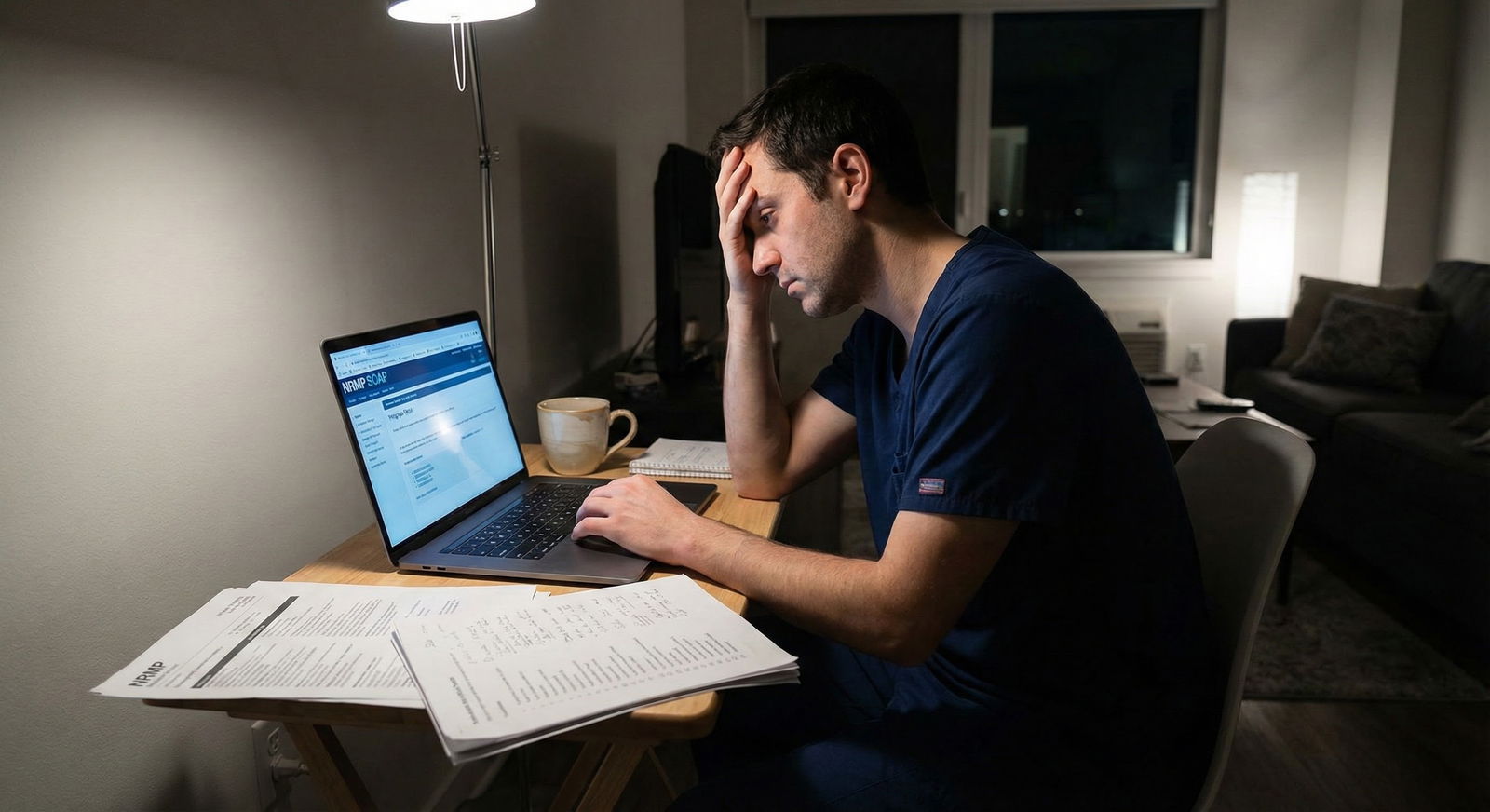
SOAP allows unmatched applicants to apply to programs that failed to fill their open slots during the regular match cycle.
The advantages? It's a guaranteed second chance inside the system. You don't have to wait an entire gap year to reapply. You can apply to up to 45 unfilled programs at no extra charge through ERAS, and the entire process is strictly regulated to prevent programs from exploiting applicants off-the-record.
The downsides? It's emotional torture disguised as an administrative process.
- Extreme Time Pressure: You have mere hours to research unfilled programs, rewrite or adjust personal statements, assemble applications, and submit them.
- Radio Silence and Cold Calls: Programs receive hundreds of SOAP applications for maybe one or two open slots. They initiate all contact. You are forbidden from calling or emailing them first. You just sit by your phone, flinching at every notification, praying for an interview invite.
- Desperation Mechanics: The specialties left open in SOAP are rarely competitive categorical positions. You are mostly looking at preliminary surgery spots, preliminary medicine spots, or rural Family Medicine programs. If your dream was Dermatology or Orthopedics, SOAP will hand you a Prelim Surgery spot that will work you 80 hours a week while you figure out how to reapply next year.
It's humiliating, exhausting, and statistically unforgiving.
Head-to-Head: Which Safety Net Catches More Unmatched Applicants?
Let me lay out the numbers because my anxious mind needs cold, hard data, not toxic positivity.
When we talk about match success, Pre-Match early specialty applicant pools (like Urology or Ophthalmology) boast overall match rates above 85-90% for US MD seniors who actually reach the rank list stage. Why? Because the applicant pool is heavily self-selected. People who aren't competitive usually get weeded out long before application submission.
SOAP, on the other hand, is where everyone who fell through the cracks gathers at once.
Every year, roughly 2,000 to 3,000 applicants enter SOAP fighting over around 2,500 to 2,800 unfilled positions. That sounds like good odds until you realize that over half of those available positions are preliminary non-categorical positions (one-year contracts that leave you unemployed again 12 months later).
Look at that chart. It tells a terrifying story.
While early match systems yield high match rates for their narrow, hyper-qualified pools, SOAP's true success rate for securing a full 3-to-5 year categorical position is shockingly low, around 28%. The overall 56% placement rate includes single-year prelim spots that don't solve your long-term problem.
See also: key factors for accepting a SOAP offer for more.
For an anxious applicant, here is the brutal comparison:
| Factor | Pre-Match / Early Match | SOAP (Main Match Safety Net) |
|---|---|---|
| Timing | Early (Dec-Jan) | Late (Match Week in March) |
| Control | Moderate (You choose to accept/reject early) | Extremely Low (Programs initiate all contact) |
| Specialty Options | Specialized, highly competitive fields | Unfilled leftover spots (mostly Prelim/FM/IM) |
| Stress Distribution | Spread out over winter months | Compressed into 96 chaotic hours |
| Success Rate | High (>85%) if you are a competitive applicant | Low (~28% for long-term categorical spots) |
If you are treating SOAP as your plan B, you are playing Russian roulette with your medical career. SOAP isn't a comfortable safety net; it's a emergency trampoline placed three stories down.
Final Reflection: The Only Real Safety Net Is Preparation
Neither Pre-Match nor SOAP will magically cure applicant anxiety. Relying on SOAP as a primary strategy is reckless, and assuming you can easily pivot into an early Pre-Match field without elite credentials is delusional.
I've realized that the only safety net that actually works for someone like me, someone plagued by worst-case scenarios, is proactive, cold-blooded preparation done months before applications open.

You don't defeat Match anxiety by hoping for a miraculous SOAP outcome. You defeat it by eliminating the conditions that lead to SOAP in the first place:
- Dual-Apply Without Shame: If you're applying to a competitive specialty (or if your Step scores are right on the bubble), apply to a less competitive secondary specialty (like Internal Medicine or Family Medicine) simultaneously. Have separate personal statements and letters ready.
- Cast a Ridiculously Wide Net: Don't let pride limit your program list. Apply to geographic locations you swore you'd never move to. I'd rather spend three years in a quiet Midwest town as a resident than spend three years applying again while working as a research assistant.
- Prepare a Emergency SOAP Packet in January: Write a general personal statement for Family Medicine or Prelim Medicine early. Have your updated CV saved on your desktop. If Monday of Match Week goes wrong, you shouldn't be spending your limited hours staring at a blank document while sobbing.
My anxiety hasn't vanished. I still check residency forums too late at night. But knowing the numbers, and admitting that SOAP is a last-ditch emergency maneuver rather than a comfortable cushion, forces me to take control of what I can right now.
Control the application list. Respect the odds. Treat your strategy as if your career depends on it, because it does.


