
The belief that “SOAP is only for desperate applicants” is nonsense. And the data backs that up.
SOAP isn’t a walk of shame. It’s a second, structured, often very rational path into residency that thousands of perfectly capable applicants use every single year—many of whom go on to have careers indistinguishable from those who matched on Monday.
Let’s dismantle the stigma with numbers, context, and a bit of reality.
What SOAP Actually Is (Not the Myth Version)
The Supplemental Offer and Acceptance Program (SOAP) is not some chaotic free‑for‑all for the “leftovers.” It’s a centralized, rules‑driven matching process run by NRMP during Match Week for applicants who are unmatched or partially matched and for programs with unfilled positions.

| Step | Description |
|---|---|
| Step 1 | Unmatched or Partially Matched Monday |
| Step 2 | NRMP Notifies SOAP eligibility |
| Step 3 | View list of unfilled programs |
| Step 4 | Submit up to 45 applications |
| Step 5 | Programs review and interview |
| Step 6 | Offer Rounds |
| Step 7 | SOAP Matched |
| Step 8 | Remain Unmatched |
Key structural points that destroy the “desperate scramble” narrative:
- It has strict timing and offer rounds. You’re not cold‑calling PDs at midnight.
- You can apply to up to 45 programs. That’s more than many people apply to in the main Match for some specialties.
- Programs choose you. It’s not automatic placement into any open hole.
- You accept or decline offers in controlled rounds. You are not forced into the first thing that moves.
SOAP is essentially a mini‑match compressed into four days. High stakes, yes. Desperate? No—unless you define “desperate” as “really wanting a residency spot,” in which case… sure, join the club.
The Numbers: Who Actually Uses SOAP?
Let me be blunt: more people SOAP than most applicants realize. You just do not hear about it because no one posts “#SOAPed” on Instagram.
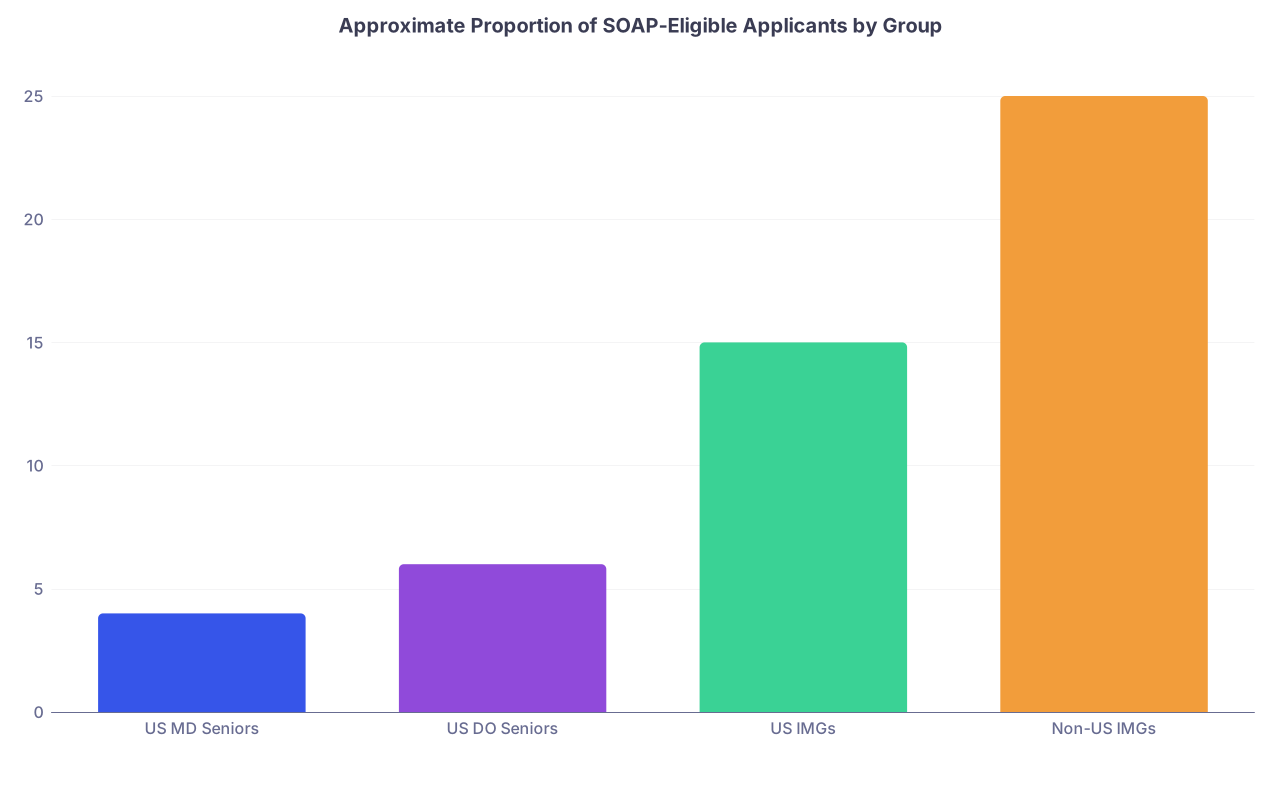
| Category | Value |
|---|---|
| US MD Seniors | 4 |
| US DO Seniors | 6 |
| US IMGs | 15 |
| Non-US IMGs | 25 |
Those percentages aren’t exact yearly values, but they reflect consistent patterns across NRMP data:
- A few percent of US MD seniors enter SOAP each year.
- Higher but still substantial chunks of DOs and IMGs do.
- Thousands of applicants overall are SOAP‑eligible and participate.
That means in any given class:
- You likely know several people who SOAPed.
- You just do not know they SOAPed, because the cultural script is “Matched!” or silence.
And the kicker: a large share of SOAP participants successfully obtain positions. For many groups, that’s most of them.
So if SOAP is “only for desperate, low‑quality applicants,” you’re implying a non‑trivial fraction of each graduating class is unworthy. That simply does not match how attendings talk about their residents—or how residents talk about their colleagues—once everyone is in the hospital instead of on Reddit.
Myth #1: “SOAP is for weak or uncompetitive applicants”
This myth survives because people confuse outcome with process risk.
I’ve seen the same pattern over and over:
- Student with a 245+ Step 2, decent research, and strong letters goes all‑in on derm, ortho, plastics, or ENT.
- Applies mostly to high‑tier or coastal programs, underestimates how brutal the specialty is.
- Gets a handful of interviews. Feels “okay.”
- Match Week: no position. Now they’re in SOAP.
Is this applicant “weak”? Or did they make a risky strategy choice in an ultra‑competitive specialty?
SOAP is full of people like this:
- Over‑specialized on one impossible field.
- Too location‑restricted (e.g., “I only applied to NYC and California”).
- Dual‑career/partner constraints.
- Did not understand how many programs they actually needed to rank.
And then there’s timing and randomness:
- A faculty champion leaves.
- A program unexpectedly reduces positions.
- Your application gets screened out because someone fixated on one minor red flag.
None of that reflects clinical potential.
SOAP eligibility correlates more with strategy, specialty choice, geography, and sometimes luck than with raw ability. There are weak applicants in SOAP, sure. There are also very strong ones who gambled and lost.
Myth #2: “SOAP spots are garbage positions in garbage programs”
This one is just lazy.
Yes, some SOAP positions are in:
- Less popular locations
- Community hospitals that don’t care about prestige
- Lower‑resource settings
But “less Instagrammable” is not the same as “bad training.”

Here’s what actually shows up in SOAP lists most years:
- Internal Medicine categorical at solid community programs
- Family Medicine, Pediatrics, Psychiatry
- Transitional Year and Preliminary spots (yes, some tough ones, but also some reasonable setups)
- Occasionally categorical spots in more competitive specialties at smaller or less known institutions
Look at program accreditation trends and board pass rates: many of these “SOAP programs” produce board‑certified attendings who function indistinguishably from those trained at brand‑name places.
The hidden truth:
- Programs enter SOAP for many reasons: late accreditation changes, new programs expanding, mis‑calculated how many interviews they needed, geographic issues, internal drama, or just random variation.
- Entering SOAP does not automatically mean “bottom tier” or “unsafe.”
You still need to be selective and realistic. But writing off all SOAP spots as “garbage” is just arrogance masquerading as wisdom.
Myth #3: “If you SOAP, your career is permanently marked”
Residency applications are obsessed with narrative: “flawless progression,” “never failed at anything,” “perfect story arc.”
Real careers do not look like that.
Your SOAP history shows up in exactly three meaningful places:
- ERAS records / NRMP history – mostly administrative.
- Maybe in how a PD interprets your path if you later apply to fellowship.
- In your own head, if you let it colonize your self‑image.
What actually matters for fellowship and jobs:
- In‑training exam scores
- Clinical performance and evaluations
- Letters from attendings
- Actual skills: procedures, judgment, reliability
- Maybe some research, depending on specialty
By the time you’re applying for a cardiology or GI fellowship, they care a lot more about:
- How you performed in your medicine residency
- Whether your PD trusts you
- Whether your letters say, “This person is in the top 10% of residents I’ve worked with”
I’ve seen:
- SOAPed IM residents match competitive fellowships.
- SOAPed FM and psych residents become beloved attendings and medical directors.
- SOAPed prelims land categorical surgery or anesthesia later.
Did some people carry a chip on their shoulder? Yes. Did it hurt their career? Only when it bled into their attitude or made them bitter.
Your SOAP year is not tattooed on your forehead. Unless you announce it every five minutes, most people will forget—or never know.
Myth #4: “You should only SOAP into your dream specialty; anything else is selling out”
This is where people really sabotage themselves.
Every year there are applicants who:
- Went for derm, neurosurgery, ortho, etc.
- Didn’t match.
- Enter SOAP still trying to find a spot in that same field.
- Turn down good IM/FM/psych offers while they chase a unicorn.
- End the week with nothing.
Then what? You’re now truly unmatched. Outside the system. No structured offers. Trying to patch together research years, prelims, observerships, and a reapplication strategy in a much weaker position.
Here’s the uncomfortable truth: SOAP is not the time to be precious about prestige or perfection. It’s the time to decide:
- Do I want to be a physician, or do I only want to be this one specific type of physician in this one specific city?
- If the answer is “only that one,” then yes, you may rationally choose to go unmatched and reapply with a different strategy.
- But that’s a conscious, high‑risk decision. Not something you slip into because you were paralyzed by stigma.
For many people, the rational SOAP mindset is:
- Prioritize getting into a solid, accredited program that will train you well.
- Accept that your exact specialty or location may not be ideal.
- Recognize that careers are long and flexible. You can pivot, do fellowships, work in niches, build the life you want from different starting points.
Is that “selling out”? No. It’s surrendering the fantasy of a perfectly curated trajectory in exchange for an actual medical career.
Myth #5: “If you SOAP, you screwed up everything”
Sometimes yes, people made major, avoidable mistakes:
- Rank list way too short.
- Did not apply broadly enough.
- Ignored red flags in their application.
- Overestimated their competitiveness in a brutal specialty.
But sometimes SOAP is the result of normal risk in a probabilistic system.
The Match isn’t a moral judgment. It’s a giant algorithm trying to match complex preferences with limited slots. Someone will end up on the wrong side of the curve every year. Sometimes that’s you, even if you “did everything right.”
If you’re in SOAP, the productive question is not, “How did I fail as a human?” It’s:
- What controllable choices led to this (if any)?
- What’s the smartest move I can make in four days?
- What’s my Plan A, B, and C after SOAP depending on outcome?
You can do a brutal but honest post‑mortem later. During SOAP week, your job is to execute, not self‑flagellate.
Strategic Reality: How To Use SOAP Intelligently
Let’s talk about smart, non‑desperate SOAP behavior.
| Step | Focus |
|---|---|
| 1 | Get accurate eligibility and program list ASAP |
| 2 | Prioritize broad but realistic applications (up to 45) |
| 3 | Target programs likely to value your specific strengths |
| 4 | Prepare a tight, honest SOAP‑oriented personal statement |
| 5 | Answer calls/emails immediately during offer rounds |
A few hard‑won tips I’ve seen work:
- Drop the ego early. The more time you spend being offended at your situation, the less time you spend getting into a program.
- Rank your priorities clearly: specialty vs location vs program type. You can’t optimize all three in SOAP.
- Know your real risk tolerance. Some people rationally say, “I’ll go unmatched rather than do X.” That’s fine—as long as you’re consciously accepting the consequences.
- Talk to people who’ve actually SOAPed. Not just classmates speculating, but residents and attendings who’ve been through it.
SOAP done well looks like this:
- You move quickly.
- You’re realistic without being defeatist.
- You treat every interaction—email, phone, brief interview—as a real interview.
- You say yes to a good fit even if it wasn’t your original fantasy.
That’s not desperation. That’s maturity under pressure.
The Mental Health Piece No One Likes To Acknowledge
SOAP week is brutal. Emotionally, it can feel worse than a bad breakup.
You get:
- The shock Monday.
- The panic of “What do I tell my family?”
- Watching classmates post “Matched!!!” everywhere.
- The compressed chaos of applications and rapid‑fire decisions.
If you feel ashamed, angry, or humiliated, that does not mean you believe the stigma. It means you’re human.
What you cannot do is let that shame drive bad decisions:
- Refusing reasonable offers because you feel “too good” for them.
- Checking out and not preparing for SOAP interviews because “it’s all beneath me.”
- Hiding from mentors who could actually help because you’re embarrassed.
The people who come out of SOAP in the best shape:
- Lean hard on support (friends, mentors, counseling if needed).
- Treat this as a high‑stress professional problem to be solved, not a verdict on their worth.
- Rebuild the narrative afterwards: “I hit a wall, I adapted, I kept going.”
That’s actually the kind of story attendings respect.
FAQ (4 Questions)
1. Will fellowship programs care that I SOAPed into residency?
Some might notice, most won’t care if your residency performance is strong. If your in‑training exams, clinical evaluations, and letters are excellent, SOAP becomes a footnote. You are judged far more on how you did in residency than on how you entered it.
2. Are there specialties where SOAP is basically impossible?
Yes. Ultra‑competitive fields (derm, neurosurgery, plastics, ortho, ENT) rarely have categorical SOAP positions, and when they do, they’re bloodbaths. In SOAP you’re more likely to see IM, FM, peds, psych, and some prelim/transitionals. Expecting to “rescue” a failed match in derm via SOAP is usually fantasy.
3. If I’m unmatched, should I always SOAP, or ever skip it and reapply next year?
Most people should at least enter SOAP and see what options exist. Skipping SOAP or only weakly participating makes sense only if you’re absolutely committed to a specific specialty and willing to accept a full reapplication year with all the financial and emotional cost. It’s a high‑risk play that should be made deliberately, not emotionally.
4. Will people in residency know I SOAPed?
Some might if they knew you from med school or if you tell them. Most won’t care, and many won’t know. After PGY‑1 starts, what people remember is whether you show up, do the work, learn, and are not a disaster on call. The origin story fades fast; your daily performance does not.
Bottom Line
- SOAP is not a shame ritual; it’s a structured second chance used by thousands of normal, capable applicants every year.
- Many SOAP spots are perfectly solid training positions, and careers launched through SOAP are often indistinguishable from those started in the main Match.
- The real mistake isn’t entering SOAP—it’s letting stigma, ego, or panic push you into irrational choices during the week that could have set up a perfectly good medical career.