
What actually happens to people who don’t match the first time—do they quietly disappear from medicine, or do they claw their way back and practice anyway?
Let me spoil the punchline: being unmatched once is not a death sentence for your medical career. But it’s also not a cute little “gap year” you gloss over on your CV. The truth lives in the uncomfortable middle, and the data is a lot more nuanced than the horror stories you hear in group chats.
You’re going to hear two equally wrong myths:
- “If you don’t match, you’re done. No residency, no career.”
- “Just reapply next year, it always works out if you work hard enough.”
Both are fiction. Let’s talk about what actually happens over 2–3 cycles, who recovers, who doesn’t, and which moves help versus quietly wreck your odds.
The Big Picture: How Often Do Unmatched Applicants Eventually Match?
Start with some numbers instead of vibes.
NRMP data over multiple cycles shows a clear pattern: unmatched this year does not automatically mean unmatched forever, but your odds do change, especially after multiple failures or graduation.
For U.S. MD seniors who go unmatched and reapply with a SOAP or future cycle strategy, subsequent match rates are often reported in the 45–70% range, depending on specialty switch, Step scores, and how aggressively they correct their mistakes.
For DO seniors it’s a bit lower, but still substantial. For IMGs, lower again—but not zero; far from it.
Here’s the simplified landscape:
| Applicant Type | First-Time Match Rate | Reapplicant Match Rate (Next Cycle, Broad Strategy) |
|---|---|---|
| US MD Senior | ~90–93% | ~50–70% |
| US DO Senior | ~85–90% | ~40–60% |
| US Citizen IMG | ~60–65% | ~30–50% |
| Non-US IMG | ~55–60% | ~20–40% |
Are these exact for every year, every subgroup? No. But the trend is clear: your odds drop as a reapplicant, but they don’t collapse to zero.
What really matters is not “did you go unmatched once?” It’s:
- Did you keep doing the same failing strategy again?
- Did your application get stronger in concrete, measurable ways?
- Did you adjust specialty choice to something consistent with your record?
If you run the same playbook that just failed, then yes, you’re flirting with “doomed forever.”
The Three-Year Reality: How Many Actually Make It Back?
When you zoom out to 2–3 years after going unmatched, three broad paths show up. I’ve seen these play out again and again:
- Match into any ACGME residency (maybe not original dream specialty)
- Stay in medicine-adjacent roles (research, MPH, teaching, industry)
- Drop out of clinical medicine entirely
Most schools do not publish long-term unmatched tracking, which is convenient for them and terrible for you. But talking to PDs and looking at fragments of school-level data and alumni outcomes, a realistic 2–3 year picture looks something like this for unmatched US grads:
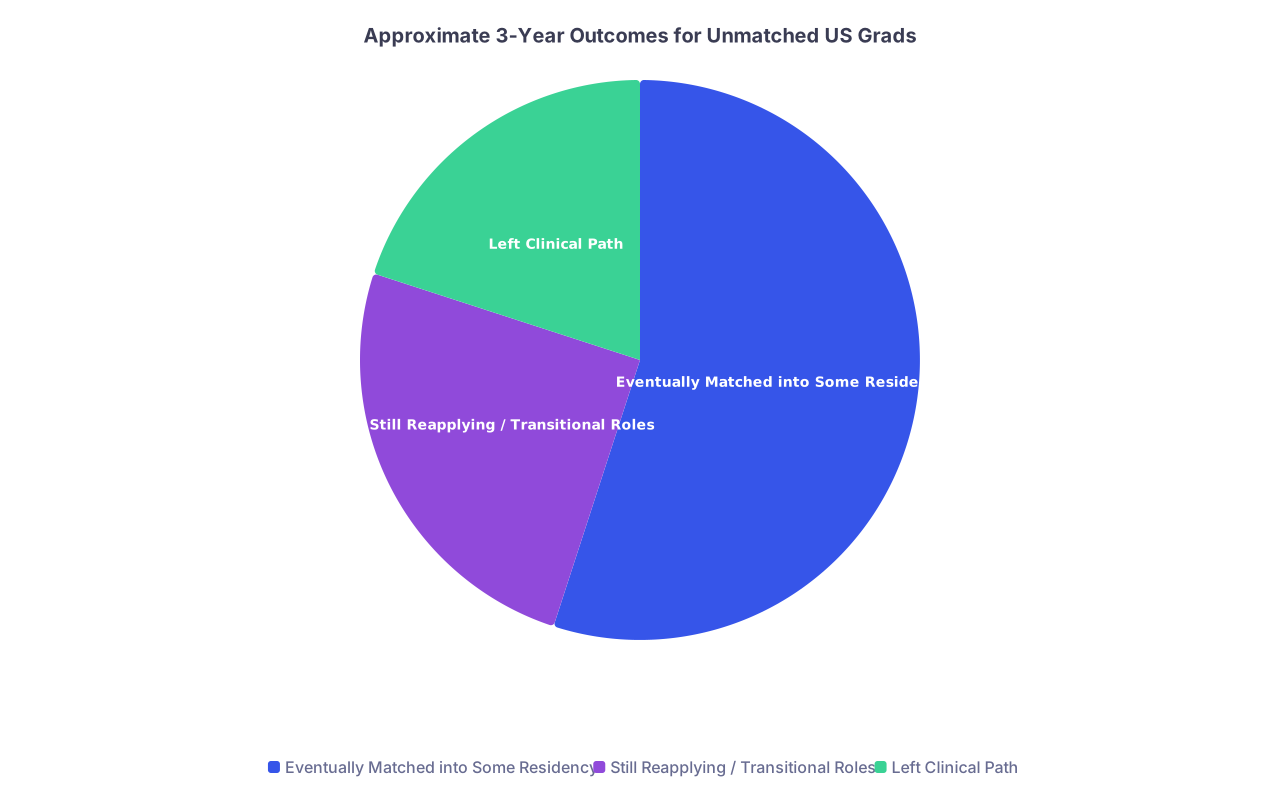
| Category | Value |
|---|---|
| Eventually Matched into Some Residency | 55 |
| Still Reapplying / Transitional Roles | 25 |
| Left Clinical Path | 20 |
Again, this is ballpark, not gospel. But it kills the myth that “no one recovers” and also the fantasy that “almost everyone gets in eventually.”
Roughly half to maybe two-thirds make it back into residency if they stay engaged and strategically adjust. The rest either stall out in a cycle of weak reapplications or pivot out of clinical practice.
So, unmatched once = wounded, not dead. The big variable: what you do between cycles.
The Most Damaging Myth: “Just Apply Again Next Year”
This is the trap I see constantly: applicants treating an unmatched year as an automatic do-over instead of a signal that their whole strategy needs surgery.
If your previous application had:
- Step 1: pass, Step 2: barely 210–220,
- No meaningful U.S. clinical experience (for IMGs),
- Aiming for derm, ortho, or plastic as an average student,
- 20 applications total to “only top places I’d actually go,”
…then simply “trying again” without changes is not persistence. It’s self-sabotage.
Programs remember. ERAS remembers. PDs look at how many times you’ve applied. Every additional failed cycle is a red flag: “Why has no one picked this person yet?”
By your second or third attempt, your story matters as much as your numbers. You need a coherent answer to: “Why should I believe this year is different?”
That answer cannot be: “I really want it this time.”
It has to sound more like:
- I changed specialty to one where my metrics are competitive.
- I did a structured research or clinical year with X, Y, Z outputs.
- I fixed a weak Step 2 score with strong clinical evaluations or a solid Step 3.
- I got letters from people program directors actually know and trust.
If you can’t point to 2–3 concrete upgrades, the reapplicant penalty will crush you.
Specialty Reality: Some Doors Close, Others Open
Another myth: “If you were once a derm applicant, you can always fight your way back to it with enough hustle.”
No. For ultra-competitive specialties (derm, ortho, plastics, neurosurgery, ENT, some radiology and anesthesia in recent cycles), an unmatched year is usually the hard fork in the road.
Data shows reapplicants to hyper-competitive specialties have very poor outcomes unless they were already top-tier and had something unusual torpedo their first try (e.g., weird geography preference, visa delays, personal emergency). PDs in those fields have their pick of perfect CVs who matched already.
This is the uncomfortable truth: if you go unmatched in an ultra-competitive specialty as a borderline applicant, your best “long-term medicine” move is often to pivot.
I’ve watched candidates salvage their careers by switching from:
- Ortho → Physical Medicine & Rehab or General Surgery
- Derm → Internal Medicine, Family Medicine, or Pathology
- Neurosurgery → Neurology or General Surgery
- Integrated Plastics → General Surgery with plastics exposure later
Do they bitterly remember their original dream sometimes? Yes.
Are they practicing physicians instead of perpetual applicants? Also yes.
On the other hand, if you went unmatched in internal medicine, family medicine, psych, peds—especially as a US grad—your long-term odds of eventually matching somewhere are much better if you:
- Grow your application in a meaningful way
- Apply broadly and realistically (geographically and program tier)
- Are willing to consider community and less “prestigious” sites
The arrogance of refusing to rank community programs is a very efficient way to become a permanent cautionary tale.
What Actually Moves the Needle Between Cycles
Let’s talk about the interventions that actually change future match odds, as opposed to cosmetic CV fluff.
1. A Structured Gap Year That Looks Like Medicine
Programs hate unexplained blank space. A “year off to figure things out” looks like drift. A dedicated research or clinical year looks like commitment.
Strong options:
- Full-time research in your target or adjacent specialty with a known academic group, ideally leading to posters, abstracts, or publications
- A non-ACGME clinical fellowship or preliminary year that includes strong evaluations and letters
- For IMGs: solid U.S. clinical experience with hands-on responsibilities and documented performance
Weak options:
- Random non-medical jobs with no clinical or academic tie
- Unpaid “volunteer” positions with minimal responsibility and no letters
- Vague “independent study” with no outputs
If a PD reads your year and shrugs “What did this actually achieve?” you have not helped yourself.
2. Fixing the Numbers That Scare PDs
Step scores aren’t everything, but a clearly low Step 2 (and now Step 1 pass/fail) will tank your application silently.
Realistic fixes:
- Strong Step 3 if you’re already eligible (US grads or those with ECFMG)
- High-shelf scores and glowing MSPE/clinical evaluations, if still a senior
- Extra sub-internships or audition rotations in your new target specialty with concrete narratives: “Top 5% student I’ve worked with in 10 years”
Do not obsess over research if your main problem is a 205 on Step 2 and mediocre clinical comments. PDs in core specialties care more about: “Can this person function on my wards without falling apart?”
3. Expanding (Not Narrowing) Your Geographic and Program Scope
This is where ego quietly kills careers.
If you previously applied to 40 programs only in California and NYC, and you still refuse to rank places in the Midwest or South, you are not a “tragic victim of the system.” You are making a choice.
I’ve seen US grads with average stats go unmatched twice because they’d “rather not do residency than live in rural areas,” while their classmates with worse scores matched into solid community programs in places they’d never heard of and are now board-certified and employed.
The market does not care about your zip code preferences. Not if you’re already reapplying.
Red Flags That Truly Wreck Long-Term Odds (And What to Do)
There are some issues that absolutely can tank your reapplicant trajectory unless you address them head-on:
- Failed Step examinations (especially multiple)
- Serious professionalism issues documented in MSPE or dismissed from a program
- Gaps of multiple years with no meaningful clinical connection
These do not mean guaranteed failure, but they shift you to a much narrower lane.
If this is you, your playbook is different:
- Obtain clear, recent documentation of excellent clinical performance (observerships alone usually aren’t enough; you need real responsibilities if possible).
- Consider less competitive specialties and community programs aggressively.
- Work with someone brutally honest—an advisor, PD, or dean—who will tell you if a pivot out of clinical medicine is a smarter long-term decision.
I’ve seen people with multiple failed Steps eventually match psych, FM, or prelim IM after years of disciplined rebuilding. I’ve also seen others burn 3–4 years chasing a residency that was never coming when they could have built a high-impact non-clinical career in public health, pharma, informatics, or research.
“Never give up” sounds heroic. Sometimes it’s reckless.
What the Data Really Says About Being “Doomed”
Let’s strip away the emotion and look at the core reality.
Overwhelmingly, residency programs prefer:
- First-time applicants
- Recent graduates (0–3 years since medical school)
- Clean exam records and no professionalism issues
So yes, being unmatched once puts you behind. Being >3 years from graduation puts you further behind. Every failed cycle increases the suspicion that programs before you knew something they don’t.
But none of that equals “no chance.”
Your real question isn’t “am I doomed?” It’s:
- How much am I willing to adjust my expectations (specialty, location, prestige)?
- Am I willing to make my application objectively stronger, not just cosmetically different?
- At what point, if cycle after cycle fails, do I pivot instead of clinging?
That last question is the one almost no one talks about. Because it involves grief, ego, and sunk-cost pain. But if you want to behave like an adult professional rather than a character in an inspirational montage, you have to confront it.
What You Should Do If You Just Went Unmatched
Very condensed, no fluff:
- Get your actual numbers and application in front of someone who knows match data and will be brutally honest. Not just your friend who matched derm.
- Decide if your original specialty still makes statistical sense given your record. If not, mourn it and pivot. Quickly.
- Build a 12-month plan that produces outputs: exams, letters, publications, strong evaluations. “Work hard” is not a plan.
- Next cycle, apply broadly, rank widely, and kill the ego about location and prestige. Your new #1 goal is “become a resident,” not “live in San Diego.”
Key Takeaways
- Being unmatched once does not doom you—but repeating the same failed strategy absolutely will.
- Many unmatched applicants eventually match, often in a different specialty or less glamorous program; many others do not, especially if they refuse to adapt.
- The difference between “wounded” and “doomed” is whether you’re willing to change your specialty, your geography, and your entire application strategy based on what the data—not your ego—actually supports.
(See also: Unmatched in March? Your 90-Day Recovery Plan for next-cycle tactics.)