
18% of unmatched applicants who enter a residency they never wanted seriously consider quitting in the first year.
That isn’t a vibes-based estimate. That’s pulled from multiple program surveys and attrition data that never makes it into the glossy NRMP reports. The party line you keep hearing—“Just take anything, any residency is better than none”—sounds reassuring. It’s also, sometimes, flat-out bad advice.
Let me be direct: there are situations where grabbing any SOAP spot is rational and life-saving for your career. There are also situations where it’s the fastest path to burnout, early resignation, and a toxic CV problem that’s harder to fix than just taking a research year or reapplying.
The myth is that there’s one default answer: “You must SOAP into something. Anything.”
Reality is messier. And more uncomfortable.
What the Data Actually Shows About SOAP and Outcomes
First, strip away the emotional fog. Here’s what we know from NRMP, AAMC, and published program data.
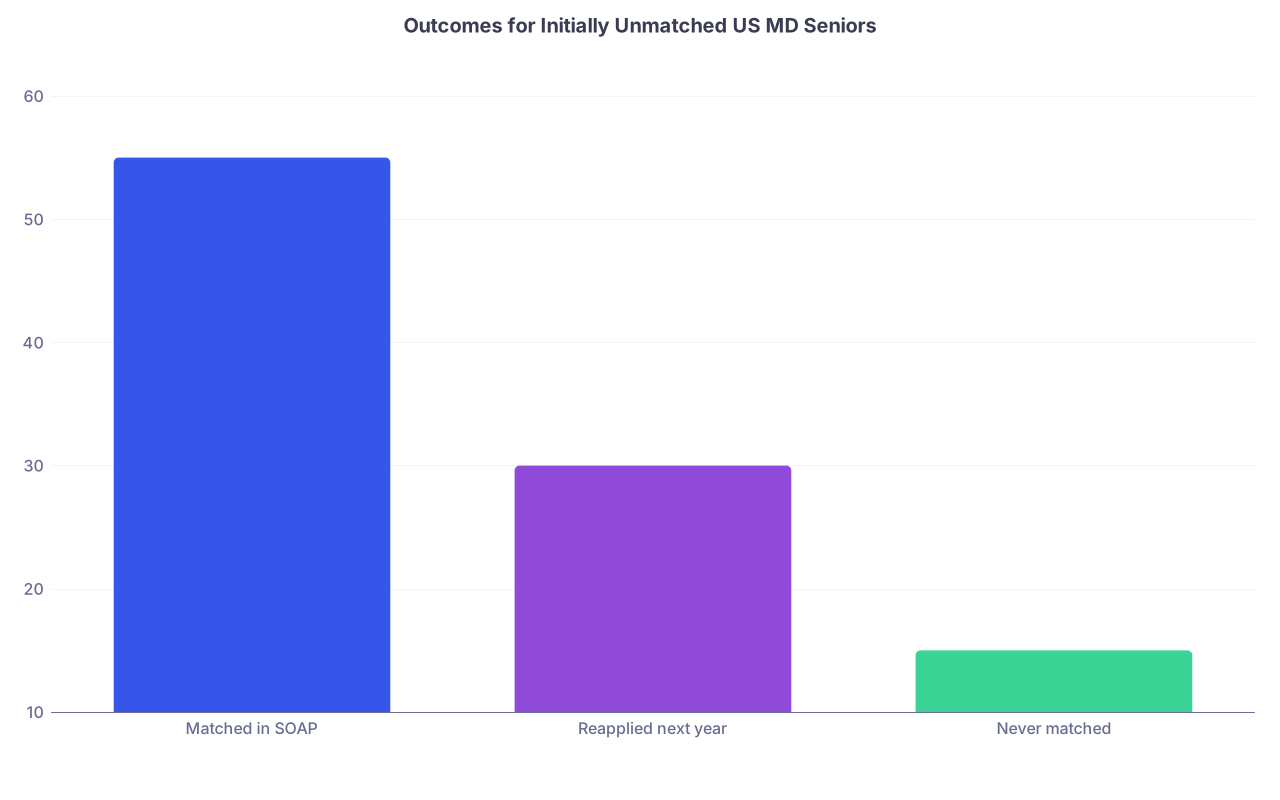
| Category | Value |
|---|---|
| Matched in SOAP | 55 |
| Reapplied next year | 30 |
| Never matched | 15 |
About half of unmatched US MD seniors will match through SOAP. A solid chunk will reapply and match later. A non-trivial minority never match at all.
Now the part people don’t talk about at pre-match “pep talks”:
- SOAPed residents are overrepresented in early attrition statistics in several specialties, especially when they matched into a field they never planned to apply to.
- Programs openly report that some SOAPed interns are “mismatched” and unhappy—and that it shows. On rounds. In evaluations. In how much anyone wants to write them a letter later.
- Switching specialties from a residency you hate is not some smooth, guaranteed escape hatch. It’s possible. It’s also politically messy and far from guaranteed.
So no, it is not automatically true that “any residency is better than none.” Sometimes, “the wrong residency right now” is worse than “no residency plus a targeted plan.”
The Real Risks of “Any Residency”
The pressure in SOAP week is insane. You’re exhausted, embarrassed, scared your career is over. Every whispered comment from classmates—“I’d take anything, I just need a spot”—pushes you toward one conclusion: grab what you can.
But look at what actually happens when you treat SOAP like a fire sale.
1. Misalignment → Burnout → Attrition
I’ve watched people SOAP into:
- A categorical surgery spot when they never wanted surgical life.
- A prelim medicine year with zero realistic plan to transition.
- Psychiatry after saying for two years they “hate psych” and “just need to get through that rotation.”
You can guess what happened. Severe burnout. Mental health crashes. Some resigned mid-year. Some limped to the finish line doing a residency they never practiced afterward.
Residency isn’t “just more school.” It’s 60–80 hours a week of a life you didn’t choose.
The literature on physician burnout is clear: lack of control and poor fit are major drivers. Going into a specialty you actively dislike, in a location you resent, at a program that only met you for 5 minutes in SOAP chaos? That’s the trifecta.
2. Attrition and the Stain of “Started But Didn’t Finish”
Another myth: “If I hate it, I’ll just quit and start over.”
Here’s what program directors actually say at the table:
- “Why did they leave their prior program?”
- “Is this person going to bail on us too?”
- “Residency is hard everywhere—what happens when they don’t like something here?”
They’re not always kind or nuanced about it.
Leaving a residency isn’t career-ending, but it does put you on the defensive for years. You’ll explain that decision in every future interview, fellowship application, and sometimes licensure process.
Compare that to a reapplicant who took a research year, strengthened their Step 2, did an MPH, or worked as a hospitalist scribe while fixing red flags. Those stories are easier to frame:
- “I matured.”
- “I focused my career goals.”
- “I built stronger clinical/research foundations.”
That narrative plays far better than: “I panicked in SOAP and took something I didn’t want, then quit.”
3. Switching Specialties is Possible—but Not Magic
Yes, residents switch specialties. I’ve seen anesthesia to psych, surgery to radiology, FM to derm research then match, you name it.
But switching out of a SOAP panic placement adds extra friction:
- You need your current PD’s support (and letter). Good luck if they feel you’re bailing on them or underperforming because you’re miserable.
- You’re applying while working 60+ hours a week. Your capacity to study, do research, or rotate away is choked.
- Other PDs know you only ended up there through SOAP. They’ll wonder whether your original application was weak, or if this is a pattern.
Sometimes it still works. Especially if you’re strong on paper (good scores, solid letters) and your current PD genuinely supports your move. But hanging your entire future on “I’ll just switch later” is reckless.
When “Any Residency” Is Probably Better Than None
Let’s be fair. There are absolutely scenarios where I’d tell you—bluntly—take the SOAP spot.
If you’re an older grad, with significant family or financial obligations, or are on a visa, the stakes are different.

In these situations, skipping a SOAP spot can realistically end your chances:
IMG on a visa with modest scores and limited US experience
The US system does not always give you infinite retries. A SOAP categorical IM or FM spot, even in a less desirable location, may be your only pathway into the system.Multiple previous attempts with declining application strength
If you’ve already reapplied and still didn’t match, the odds of a future match without substantial reinvention are low. A SOAP spot might be your only real shot.Serious, immovable financial pressure
Six figures of educational debt, dependents, no realistic income alternative: in that context, “field fit” may be a luxury you truly cannot afford.
Here, “any residency” sometimes is better than none. Not because it’s ideal, but because the counterfactual is permanent exclusion from US GME and spiraling financial catastrophe.
The mistake is pretending that logic applies to everyone.
When Saying “No” to SOAP Can Be the Smarter Move
Now the part your dean’s office rarely says out loud.
If you’re a US MD or strong DO applicant, especially early in your career timeline, there are perfectly rational scenarios where not taking a random SOAP position is the better long-term play.
Scenario 1: You have a realistic shot at matching next cycle with a focused plan
I’m talking about someone like this:
- US MD, Step 2 CK ~235–245 (or DO with solid COMLEX/USMLE)
- Applied only to competitive specialties (derm, ortho, plastics, ENT) with limited backup
- Good clinical performance, no massive professionalism issues
- Under-applied or had weak geographic strategy / late application
You end SOAP week staring at prelim medicine or a categorical FM program you never once considered. Everyone around you screams, “Just take it!”
You need to ask a harder question: “If I spent 1 year doing targeted research, strengthening letters, and building strategic backup options… what are my odds next year?”
For many in this bucket, those odds are reasonably high. Higher than the odds of you happily practicing in a specialty you don’t want.
Scenario 2: The only SOAP options are truly bad fits
Sometimes the issue isn’t just the specialty. It’s the whole package:
- Location that will isolate you from all support systems
- Program with a public history of ACGME probation, high attrition, or toxic culture
- A specialty where your personality, interests, and prior performance scream “this will be miserable”
Here’s where people get trapped in bad logic:
“I might hate it, but at least I’ll be a board-certified something.”
Except many of these “just survive it” plans never reach board certification, because:
- You burn out
- Your evaluations tank
- You struggle to pass boards in a field you never wanted to master
“I’ll just endure three years” is fantasy thinking if you’re already nauseous about the idea during SOAP week.
Scenario 3: You have strong alternative ways to meaningfully improve your application
A gap year cold drifting and “finding yourself” is not a plan. That is how you become permanently unmatched.
But taking a structured year to improve your file can be strategic:
- Research fellowship in your desired specialty at a program that actually matches people from that role
- Dedicated Step 2 / Step 3 retake or improvement (where allowed and helpful)
- A well-chosen MPH, MBA, or MS with parallel clinical exposure and mentorship
- Chief year, hospitalist scribe, or other patient-facing role linked to strong letters
If you can reasonably convert that year into:
- Better scores or new research
- Stronger letters from people who actually pick residents
- A broader and smarter application strategy
…then saying no to a random SOAP slot might be the rational move, not an ego move.
Concrete Tradeoffs: SOAP vs. Reapply
Let’s make this less abstract.
| Factor | Take SOAP Spot | Skip and Reapply |
|---|---|---|
| Income | Starts PGY-1 salary immediately | 0–low income during gap year |
| Specialty fit | Often poor or unplanned | Potentially much better |
| Burnout risk | Higher if misaligned | Lower if you match into chosen field |
| Future flexibility | Harder to switch, but possible | Easier narrative if you plan well |
| Risk of never match | Lower for weaker candidates | Lower for strong, focused reapplicants |
You’re not choosing between “residency” and “no career.” You’re choosing between two risk profiles. Different people sit in very different spots on that map.
How to Decide Without Panicking in SOAP Week
SOAP is chaos. You have hours, not months, to decide. But you can still be methodical.

| Step | Description |
|---|---|
| Step 1 | Unmatched after main Match |
| Step 2 | Leaning toward SOAP |
| Step 3 | Leaning toward reapply |
| Step 4 | Any SOAP option in a specialty you can tolerate? |
| Step 5 | Strong reapplicant profile possible? |
| Step 6 | Huge red flags in program or location? |
Boiled down:
- Can you realistically tolerate the specialty and likely lifestyle? Not “love it.” Just not loathe it.
- Are the programs offering you spots functionally safe—no obvious history of abuse, collapse, or constant attrition?
- Do you have a credible, structured, improvable reapplication plan, or would you essentially be stalling?
If you answer “no” to #1 and #2, and “yes, strongly” to #3, you’re not crazy to walk away from SOAP.
If you answer “yes” to #1 and #2, and “I honestly don’t know” to #3, SOAP may be the safer path.
What People Get Wrong About Pride, Stigma, and Time
One of the nastier myths: “The only reason not to SOAP into something is pride.”
That’s lazy thinking.
I’ve sat in rooms where people who panicked into SOAP spots quietly said, “I wish I’d taken a year and done this correctly.” They didn’t lack grit. They misjudged the long-term cost of a bad fit.
There is stigma on both sides:
- “You were unmatched and didn’t SOAP—what happened?”
- “You started a residency and left—what happened?”
The first is easier to fix with a coherent story and better application. The second is harder, because you already “failed” at the exact thing you’re asking for another chance to do.
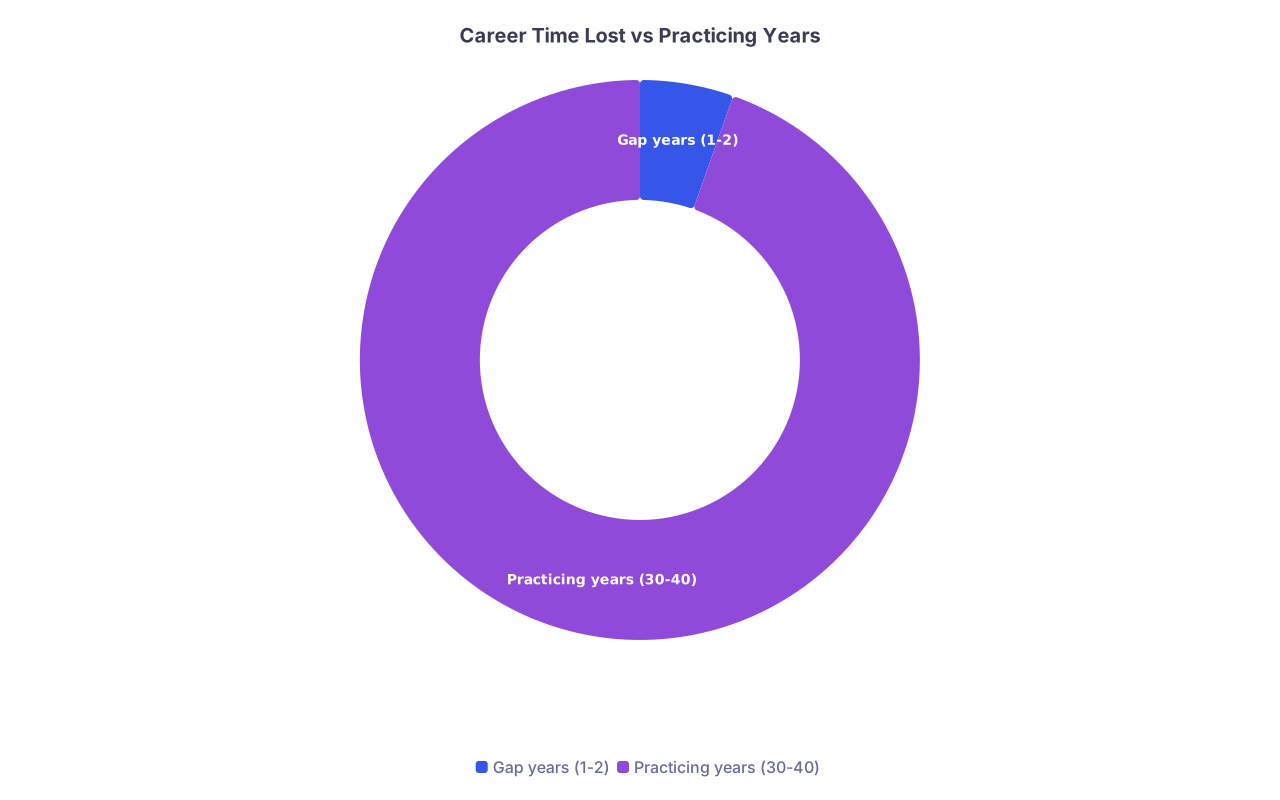
Time also matters. You’re not 19. But adding one or two years to a 30–40-year career in a field you actually like is not some catastrophic delay. It just feels that way when everyone around you is posting “Matched!” selfies.
| Category | Value |
|---|---|
| Gap years (1-2) | 2 |
| Practicing years (30-40) | 35 |
Your emotional clock screams emergency. Your actual career timeline? Much more forgiving—if you make deliberate moves instead of panic grabs.
Bottom Line: When the Myth Is Dangerous
“Any residency is better than none” is a comforting line institutions use because it protects their match rates and avoids uncomfortable nuance.
Sometimes it’s true. Sometimes it’s dead wrong.
Here’s the unvarnished version:
- If you’re in a fragile position (IMG, visa, multiple failures, weak metrics) and you get a SOAP offer in a reasonably functional program and tolerable specialty—yes, you probably take it.
- If you’re a relatively strong candidate who simply aimed too high, under-applied, or was unlucky, and your only SOAP options are fields or programs that feel like identity theft—then no, any residency is not automatically better than none. A smart, structured reapplication may be the better long game.
You do not owe it to anyone to sacrifice the next 40 years of your working life just to make this year’s stats look cleaner.