
Does Doing a Prelim Year Guarantee a Categorical Transfer?
Doing a prelim year does not guarantee you a categorical spot. Not in medicine. Not in surgery. Not in anything. The belief that “I’ll just match a prelim now and slide into categorical later” is one of the most persistent, and most dangerous, myths in the post‑Match world.
I have watched this play out in real time: interns banking on a magical “transfer,” chiefs quietly telling them, “We almost never convert prelims,” and PDs bluntly stating on Zoom calls, “If you come here as a prelim, assume it’s one year and done.” The disconnect between what applicants think will happen and what programs actually do is massive.
Let’s tear the myth apart and replace it with reality.
What a Prelim Year Really Is (And Isn’t)
First, definitions, because a lot of people are fuzzy on this.
A preliminary year is usually a 1‑year, non‑continuity residency position. Common flavors:
- Preliminary internal medicine
- Preliminary surgery
- Transitional year (slightly different, but often lumped together in applicants’ minds)
They exist mainly:
- To satisfy the PGY‑1 requirement for advanced specialties (anesthesiology, radiology, derm, rad onc, etc.)
- To provide extra service coverage for hospitals (yes, that’s a polite way of saying cheap labor)
A categorical position is a full training slot from PGY‑1 through completion in that specialty (IM 3 years, GS 5+ years, etc.).
Here’s the core misconception:
Many applicants assume a prelim spot is a back door into a categorical position at the same program. In most cases, it’s not a back door. It’s a side door that leads to a hallway with no clear exits.
Programs often design prelim slots specifically as non‑continuation positions. They are not “categorical but we’ll see.” They’re a different animal, with different expectations and different outcomes.
What the Data and the System Actually Show
There isn’t one neat national spreadsheet labeled “prelim to categorical conversion rate.” The NRMP and ACGME don’t publish that. But you can triangulate from several pieces of information and what PDs openly say.
Start with what we actually know:
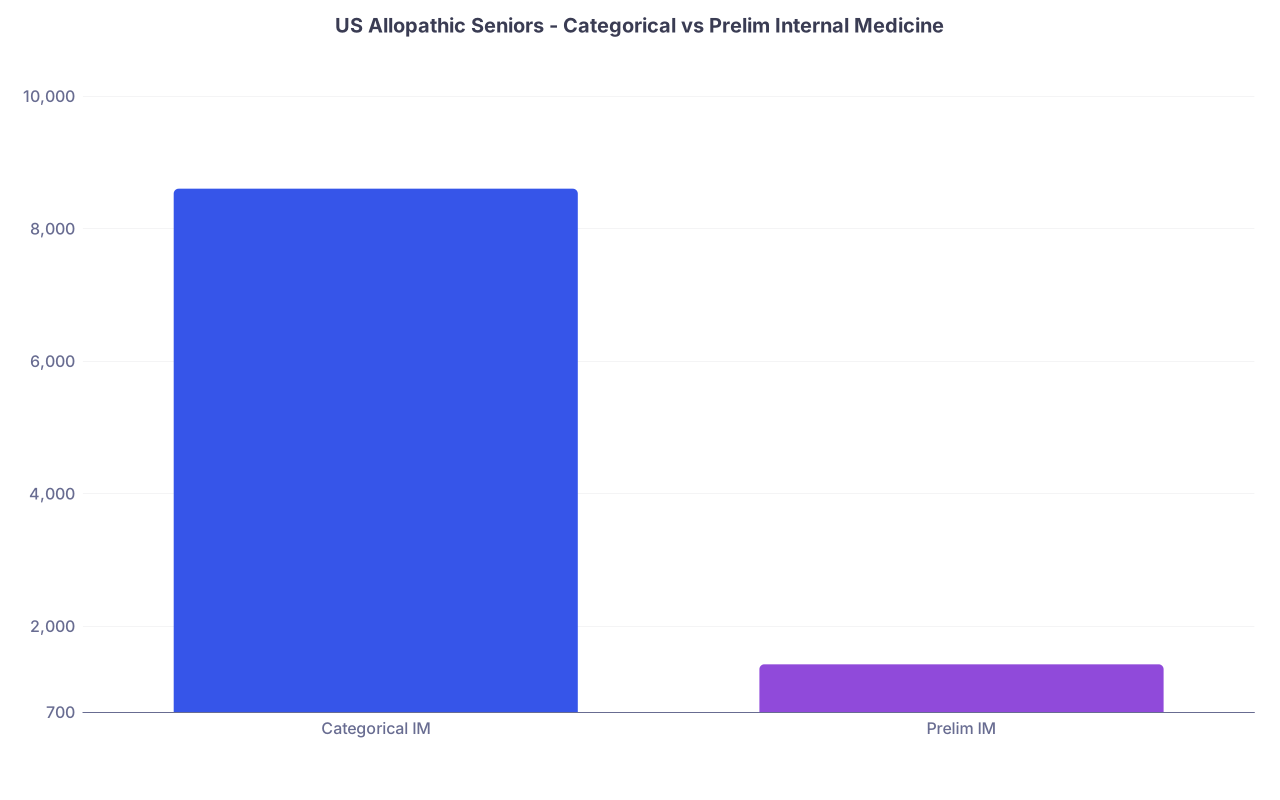
| Category | Value |
|---|---|
| Categorical IM | 8600 |
| Prelim IM | 1420 |
In a recent Match cycle, thousands of categorical internal medicine positions were offered vs a smaller but still large pool of prelim IM spots. Most of those prelim IM spots are tied to advanced programs, not to “maybe we’ll convert you.”
Look at general surgery:
- Many academic surgery programs have zero historical prelim-to-categorical conversions in a given 5–10 year window.
- Others convert one prelim every few years. Often because a categorical resident left or was fired.
You know who fills those rare openings? The rock‑star prelim that the entire department is lobbying for. Not the average “I’ll just work hard and they’ll keep me” intern.
And there’s structural reality: programs are funded and approved for a specific number of categorical positions by year. They can’t just decide mid‑stream to turn three prelims into categoricals because “they’re nice.” They need:
- Available funding lines
- ACGME approval for complement changes
- A vacancy (resignation, dismissal, extra line created and approved)
That combination is uncommon. And even when it happens, there is no rule that the prelim in house gets priority over an external PGY‑1 or PGY‑2 transfer. Many PDs actually prefer external transfers with specific backgrounds they want.
In other words: the system is not built as a guaranteed pipeline from prelim to categorical. It’s built around categorical spots, and prelims are mostly support staff plus PGY‑1 years for advanced tracks.
The Five Common Myths About Prelim → Categorical
Let me walk through the biggest myths, because they’re everywhere on Reddit threads and hallway gossip.
Myth 1: “If I work hard and don’t screw up, they’ll keep me.”
No. Baseline competence is not a ticket to a categorical spot. It is the minimum required not to be a problem.
Programs do not promote prelims just because they’re good and hard‑working. They promote prelims when:
- A categorical vacancy exists, and
- Leadership decides to fill it internally, and
- That prelim is clearly among the very best options available
That third point is brutal. Because when a PGY‑2 IM spot opens, a PD can often pick from:
- Their own strong prelim(s)
- A PGY‑2 transferring from another program
- A previous categorical resident who stepped out for research
- Occasionally, a stellar off‑cycle candidate with niche skills
Your “I show up and do my work” is not a selling point. It’s assumed.
Myth 2: “Programs love converting prelims — it’s ‘cheap’ and easy.”
I’ve sat in those leadership meetings. Prelim conversion is not always cheaper or easier.
Reasons programs hesitate:
- Paperwork and ACGME complement changes can be annoying.
- Funding lines may be tied to categorized positions only.
- Some departments use prelim lines deliberately as 1‑year buffers, not training pathways.
- Politics: faculty already promised “the next open spot” to someone else (research resident, insider, etc.).
In surgery especially, some programs are explicit: “Our prelims almost never become categorical here.” And they mean it.
Myth 3: “If a spot opens, it’ll automatically go to a prelim.”
Not guaranteed. Sometimes they want a different profile entirely.
Example I watched:
A big-name IM program had a PGY‑2 categorical resident leave. They had three strong prelims that year. Instead of promoting one, they recruited a PGY‑2 from a smaller community program who already had ICU exposure and specific research in cardiology, aligning with departmental priorities. The prelims were furious. The PD’s perspective was simple: “We picked the best fit for our needs.”
You’re not in a queue. You’re in a competitive pool that may extend beyond your own hospital.
Myth 4: “If I match any prelim, I’m safe — I’ll just move later.”
This is how people end up in limbo after GME. A prelim year alone, with no follow‑on advanced spot and no clear transfer, leaves you:
- Clinical skills improved, sure
- But not board‑eligible in anything
- Not automatically desirable as a “partial trainee”
Does a prelim year help? Sometimes. For some people, yes. But as a strategy of “I’ll definitely transfer later,” it’s weak.
Myth 5: “Prelim surgery is my best route into categorical surgery.”
For most, it’s actually the riskiest route.
Many big surgical programs:
- Have more prelims than categoricals
- Intentionally do not plan to retain most prelims
- Use prelim spots as service coverage for trauma, SICU, night float
Unless you have a specific, high‑probability plan, prelim surgery is often a one‑and‑done experience. That’s fine if you know that going in. It’s a disaster if you think it’s an automatic stepping stone.
When a Prelim Can Help — And When It Backfires
Now, I’m not saying a prelim year is always bad. I’m saying it’s often misused.
Here’s where a prelim can be useful:
You already matched an advanced position (e.g., anesthesia, radiology, PM&R) and just need a PGY‑1. That’s exactly what these spots exist for. The risk is far lower, because your pipeline is predefined.
You’re retooling after a failed match, and a specific program is genuinely interested in you as a potential future categorical, and they’ve said so clearly. And you have this in writing or from multiple faculty, not just a vague “We like to take care of our own.”
You need US clinical experience as an IMG and have a realistic plan for how that year will improve your next application (letters from known people, visa support, clear research plan, etc.).
Where it backfires:
- You accept a random prelim thinking “I’ll figure it out later.”
- You assume your likeability or effort guarantees retention.
- You choose a prelim in a specialty with historically terrible conversion rates (looking at you, prelim gen surg at certain big academic powerhouses) without any data on their track record.
If you’re seriously considering a prelim, you should be asking hard questions before you sign anything.
| Question | Why It Matters |
|---|---|
| How many prelims have you converted in the last 5 years? | Reveals actual track record vs promises |
| How many prelim spots vs categorical spots? | Shows how crowded the “pipeline” is |
| Why do prelims exist here? | Service coverage vs genuine training pathway |
| Who decides on conversion and when? | Clarifies process & transparency |
| Do past prelims recommend the program? | Filters out toxic or exploitative environments |
If they dodge these questions or give you hand‑wavy answers, that’s a data point in itself.
The Harsh Truth: You’re Mostly Competing Again
Think of prelim → categorical like this: you’re effectively re‑entering the market.
Programs reviewing you for a categorical transfer are going to look at:
- Your original application (scores, grades, failures, gaps)
- Your performance as an intern (evaluations, professionalism, how you function under pressure)
- Your letters from faculty and PD
- The timing of available positions
You do get one advantage: recent, concrete proof that you can function in residency. That matters. A strong prelim evaluation can absolutely rescue a borderline Step score or a lackluster MS3 transcript.
But do not mistake “better chances than before” for “guaranteed categorical spot.” These are not the same thing.
There’s also an ugly nuance: if you perform poorly as a prelim — chronic lateness, marginal clinical work, poor teamwork — you can actually hurt your long‑term prospects. A bad PD letter can close more doors than a single failed Step exam.
How Programs Actually Think About Their Prelims
This is the part applicants rarely hear out loud.
Off the record, I’ve heard versions of each of these from attendings and PDs:
- “Our prelims are mainly here to cover nights and the ED. We are honest with them that conversion is unlikely.”
- “We convert maybe one prelim every 3–4 years. They need to be outstanding and we need a position.”
- “Sometimes we’d rather take an external PGY‑2 transfer. Less drama, fewer intra‑class issues.”
- “We had a prelim class of twelve one year. We kept zero. We told them upfront.”
On the other end, I’ve also seen:
- Small community IM programs that routinely convert 1–2 prelims per year into categorical because they always have some attrition and need stable, known quantities.
- Transitional years loosely tied to advanced programs that basically guarantee continuity if you hit minimum expectations.
The point: programs aren’t uniform. Some use prelims as genuine pipelines. Others use prelims as disposable labor. You absolutely cannot assume which is which based on reputation alone.
Ask. Specifically. And compare what the PD says with what prior prelims quietly tell you on the side.
Strategic Use of a Prelim Year (If You Decide to Take One)
If you do end up in a prelim year, here’s the mindset shift you need:
You are not there “waiting to be chosen.” You are in active campaign mode from day one.
You:
- Clarify with your PD early what your goals are and whether internal conversion is even plausible.
- Build strong, specific relationships with faculty who can write heavyweight letters, not just “hard‑working intern” fluff.
- Aggressively monitor for off‑cycle openings in your specialty through word of mouth, specialty societies, and program websites.
- Decide by mid‑year whether a second application cycle is realistic or whether you’re better off pivoting (different specialty, non‑clinical path, research years, etc.).
The worst mistake is drifting through the year assuming the system will take care of you. It won’t.
Here’s how the timing usually feels on the ground:
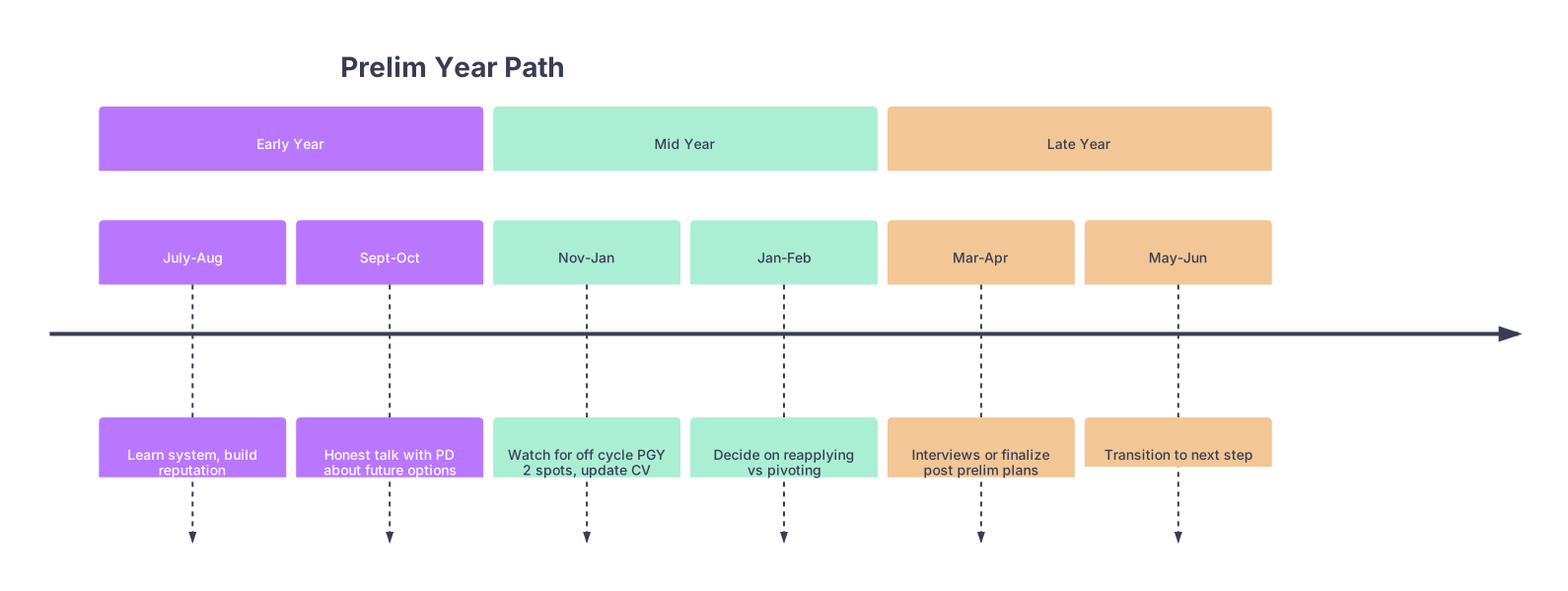
| Period | Event |
|---|---|
| Early Year - July-Aug | Learn system, build reputation |
| Early Year - Sept-Oct | Honest talk with PD about future options |
| Mid Year - Nov-Jan | Watch for off cycle PGY 2 spots, update CV |
| Mid Year - Jan-Feb | Decide on reapplying vs pivoting |
| Late Year - Mar-Apr | Interviews or finalize post prelim plans |
| Late Year - May-Jun | Transition to next step |
If you’re not having those PD conversations by the fall, you’re already behind.
So, Does a Prelim Year Guarantee a Categorical Transfer?
No. It doesn’t guarantee anything other than one more year of experience and one more line on your CV.
Sometimes, a prelim year is the right move:
- As a planned PGY‑1 for an advanced spot
- As a calculated risk at a program with a proven history of internal conversion
- As a structured way to strengthen a weak application with US clinical experience and strong letters
But using a prelim year as a generic backup plan with the expectation of a near‑automatic categorical transfer is delusional. The system is not built that way, and the numbers don’t support it.
To wrap it up in plain language:
- A prelim year does not guarantee — or even reliably predict — a categorical transfer. At best, it improves your odds if you play it very well.
- Programs vary wildly. Some almost never convert prelims; a few do it regularly. You need hard data from that specific program, not vague assurances.
- If you choose a prelim, treat it as a one‑year contract with no promised sequel. Everything beyond that is something you’ll have to actively earn — and even then, the system might say no.