
It’s the Monday of Match Week, 11:03 a.m. Eastern. You’ve just checked OASIS or ERAS and seen the line that guts you:
“You did not match to any position.”
While you’re trying not to throw up, there’s something else happening on the other side of the screen.
In a conference room down the hall from a program director’s office, a PD, coordinator, and maybe one chief are staring at a different kind of message:
“Your program did not fill all positions.”
And here’s the part almost nobody tells you: some of them are not upset.
They’re… relieved.
Because they’ve been quietly playing a game for a few cycles now. And for them, SOAP is not the “last resort emergency scramble” narrative you’re fed as a student. For them, SOAP is a strategy. A tool. Sometimes even a preference.
Let me walk you through how that really works.
The Official Story vs The Real Behavior
Publicly, every program will tell you the same thing: “We aim to fill all our positions in the Main Match with the best candidates possible.” And yes, many absolutely do.
But behind closed doors, especially in certain specialties and tiers, a different calculation happens.
Here’s the mental model I’ve heard in real PD meetings and post-Match debriefs:
- “We can rank this marginal applicant high enough to fill in the Match… or let the spot go unfilled and see what SOAP gives us.”
- “If we SOAP, we can target a visa-ready candidate / geographic tie / non-problematic resident much more precisely.”
- “We don’t want to be stuck with this person for four years when we might pull someone just as good or better from the SOAP pile.”
SOAP gives them optionality. And optionality is addictive.
To understand why some programs quietly like SOAP, you have to see what the process gives them that the Main Match doesn’t.
Why Some Programs Quietly Like SOAP: The Real Incentives
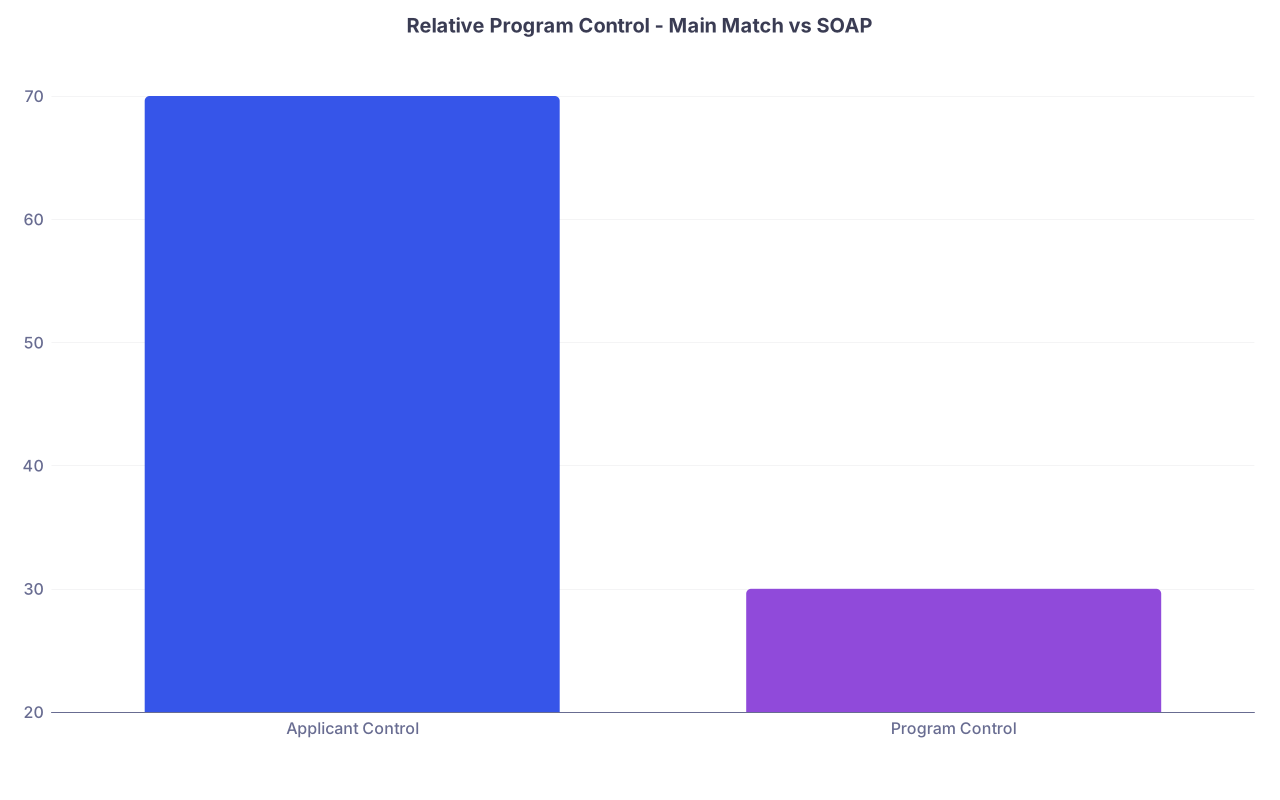
| Category | Value |
|---|---|
| Applicant Control | 70 |
| Program Control | 30 |
1. More Control Over Who They Actually Get
Program directors hate one thing more than not filling: getting stuck with a bad fit for multiple years.
In the Main Match, once they certify their rank list, they lose control. If that “iffy” candidate ends up being the one who lands in their spot, they’re locked in for 3–5 years, or more. In real conversations, PDs say things like:
- “I’ll take a temporary vacancy over a guaranteed problem.”
- “There are two people on our list I really, really don’t want, but we might end up with them if we fill in the Match.”
SOAP flips some of that control back.
During SOAP, they can see who’s in the unmatched pool, in real time, filtered by:
- Exam status (Step 2 score present, passed vs failed, etc.)
- Citizenship/visa eligibility
- Previous training
- Geographic ties (from personal statement or application)
- Red flags they can smell in the documents
And they get to respond to this concrete pool, not a hypothetical ranked list from months ago.
I’ve seen programs deliberately rank short. They’ll rank 10–12 for 8 spots, when they could rank 25–30. Why? Because they’d rather risk a couple unfilled positions and then try their luck in SOAP than rank deeper into candidates they actively distrust.
They’ll never admit that publicly. But I’ve sat in those pre-Match meetings. I’ve heard the PD say, “We’re not ranking anyone we’d be upset about getting. If we don’t fill, we’ll manage it in SOAP.”
2. Cheaper Labor, Same Service Load
Let’s be blunt: residents are cheap labor. Especially interns.
And programs know SOAP candidates are often desperate. Desperate people accept less.
I’ve watched this play out at lower-tier community programs and some prelim-heavy institutions:
- They’ll SOAP into categorical or prelim spots and then “strongly encourage” those new residents to pick up extra moonlighting, extra weekend coverage, or “voluntary” Q3 call that magically isn’t so voluntary.
- SOAP residents complain less at first. They feel lucky just to have a spot, so they tolerate more schedule abuse and administrative nonsense.
You don’t see that in glossy brochures. You do hear it in resident work rooms and PD group chats.
Does every program do this? No. But the ones that do recognize the pattern: SOAP allows them to fill spots with people who are less likely to push back. That reduces friction, especially for programs with poor reputations or heavy service demands.
3. Quiet Fix for Bad PR or Weak Recruitment Years
Imagine a program that had a brutal year: ACGME citation, resident publicly posting about toxic culture, two residents left mid-year. Word travels. Students talk. Advisors quietly say, “Avoid that program if you can.”
Those programs often see their rank lists thin out, and their fill rate starts wobbling.
Now here’s the problem: If they don’t fill in the Main Match, it’s public. The NRMP’s Program Results data a year later shows a lower fill rate. People notice.
SOAP gives them cover.
They can:
- Purposefully keep their rank list shorter
- Not stretch into “please don’t match here” candidates
- Then, during SOAP, quietly fill vacancies with weaker or desperate applicants who didn’t have other options
By July, the board shows, “We’re fully staffed. All good.” Nobody outside sees the maneuvering. The NRMP fill number looks bad on paper, but they still have full bodies in July. Administrators are happy.
I’ve heard an APD at a mid-tier IM program say verbatim: “If we don’t fill a couple spots, I’m not worried. We’ll pick up some FMG SOAPers. Admin just wants warm bodies starting July 1.”
That’s the mentality.
How SOAP Gives Programs Tactical Advantages

| Step | Description |
|---|---|
| Step 1 | Main Match Unfilled |
| Step 2 | Try SOAP for targeted needs |
| Step 3 | Call GME and Chair |
| Step 4 | Offer SOAP positions |
| Step 5 | Leave unfilled or plan off cycle |
| Step 6 | How many spots? |
| Step 7 | Good applicant pool? |
1. Rapid Targeting of Specific Candidate Types
Programs can’t easily say this out loud, but in SOAP they can chase specific profiles they secretly want:
- Couples who split – one matched locally, the other didn’t
- Strong scores but weird red flag (failed a class, strange gap, visa issues)
- Non-US grads with extensive prior clinical or research experience
- Applicants with explicit geographic ties they believe will stay
In the Main Match, they’re guessing months ahead of time who will actually end up in their spot. In SOAP, they see the board. Right now. With filters.
A PD can literally sit down, sort by “US citizen, MD, Step 2 > 235, applied to our specialty, regionally local,” and then scan.
I watched one community IM program in the Midwest SOAP a stellar US-IMG who had strong US clinical experience but no interviews because his Step 1 timing was weird. They said openly: “We would have ranked this guy near the top if we’d seen his full file earlier. Now we can get him through SOAP without burning a rank spot months ago.”
2. Backdoor Flexibility with Prelim vs Categorical
Surgical programs and transitional years especially use SOAP strategically.
Some games I’ve seen:
- A prelim-heavy general surgery program leaves some prelim spots unfilled in the Match, knowing that unmatched advanced positions in other fields (like radiology, anesthesia) will create desperate SOAP candidates willing to do a prelim year anywhere.
- Programs quietly convert some categorical proposals into prelim in discussions with GME, planning to SOAP into cheaper, disposable prelim interns rather than commit to 5-year categorical slots.
Nobody publishes this in a brochure, but in internal emails you’ll see lines like, “If we underfill prelims, we’ll have our pick of SOAP candidates from unmatched rads/ortho/etc. They’ll work hard, and many won’t stay anyway.”
SOAP is their flex lever. Main Match locks them in. SOAP lets them adjust to reality.
3. Thinner Vetting, More Room for “Gut Calls”
In the Main Match, committees pretend to be rational: score cutoffs, objective criteria, voting structures. SOAP breaks that structure down.
SOAP is compressed chaos. Tight timeline. High anxiety.
On the program side this means:
- PDs and APDs make faster, more personal decisions.
- That one faculty championing a candidate can push them harder.
- “Gut feel” over Zoom or phone suddenly matters more than some spreadsheet from October.
Is that good for applicants? Sometimes, if someone really advocates for you. But it’s definitely appealing to certain PDs who hate committee bureaucracy. I’ve heard: “I can get the person I want in SOAP without fighting the committee for three months.”
And yes, some programs like that freedom.
Specialty and Program Types That Tend to Use SOAP Strategically
Not every program likes, or can afford to like, SOAP. Let’s separate who we’re talking about.
| Program Type | Likelihood to Use SOAP Strategically |
|---|---|
| Community IM/FM | High |
| Prelim Surgery/TY | High |
| Mid-tier Academic IM | Moderate |
| Competitive Fields (Derm, Ortho) | Low |
| Core University Programs (Flagship) | Low |
Community Internal Medicine & Family Medicine
These are probably the classic SOAP players:
- Tons of applicants.
- Many applicants are IMGs or US grads with uneven applications.
- Admins care deeply about “filled” status but less about ultra-high metrics.
They’ve figured out they can:
- Rank fewer risky or borderline candidates in the Main Match.
- Fill holes with a deep pool of SOAP applicants (often very strong on paper but with one or two application weaknesses).
I’ve seen a community IM program literally say: “We get our stars from ERAS early and our service workhorses from SOAP.”
Crude, but honest.
Prelim Surgery and Transitional Year Spots
Prelim surgery positions are practically built for SOAP. So many unmatched applicants from other specialties are willing to take a prelim year just to stay clinically active.
Programs know this. They under-rank prelim spots intentionally, then swoop:
- Unmatched ortho, ENT, urology, radiology, anesthesia applicants with excellent scores but no categorical home.
- They’ll work insanely hard, generally don’t complain, and leave after a year. Very appealing for some surgical departments.
Transitional year programs do a softer version of this too, especially ones attached to mid-tier hospitals. They’ll use SOAP to fill with high-board-score unmatched applicants who still raise the “quality profile” of the program on paper.
Mid-Tier Academic Programs with Image Problems
Not Harvard, not bottom-of-the-barrel either. Think mid-tier university-affiliated community programs, or smaller academic centers that recently got new leadership, more service demands, or some negative press.
They may:
- See their Match pool soften over 2–3 years.
- Become wary of ranking certain borderline candidates just to “fill.”
- Use SOAP to quietly reload with people who, yes, are more desperate, but also more likely to tolerate the program’s issues.
They don’t “prefer” SOAP in the sense of loving the chaos. They prefer it as a damage-control tool.
What This Means for You as an Applicant
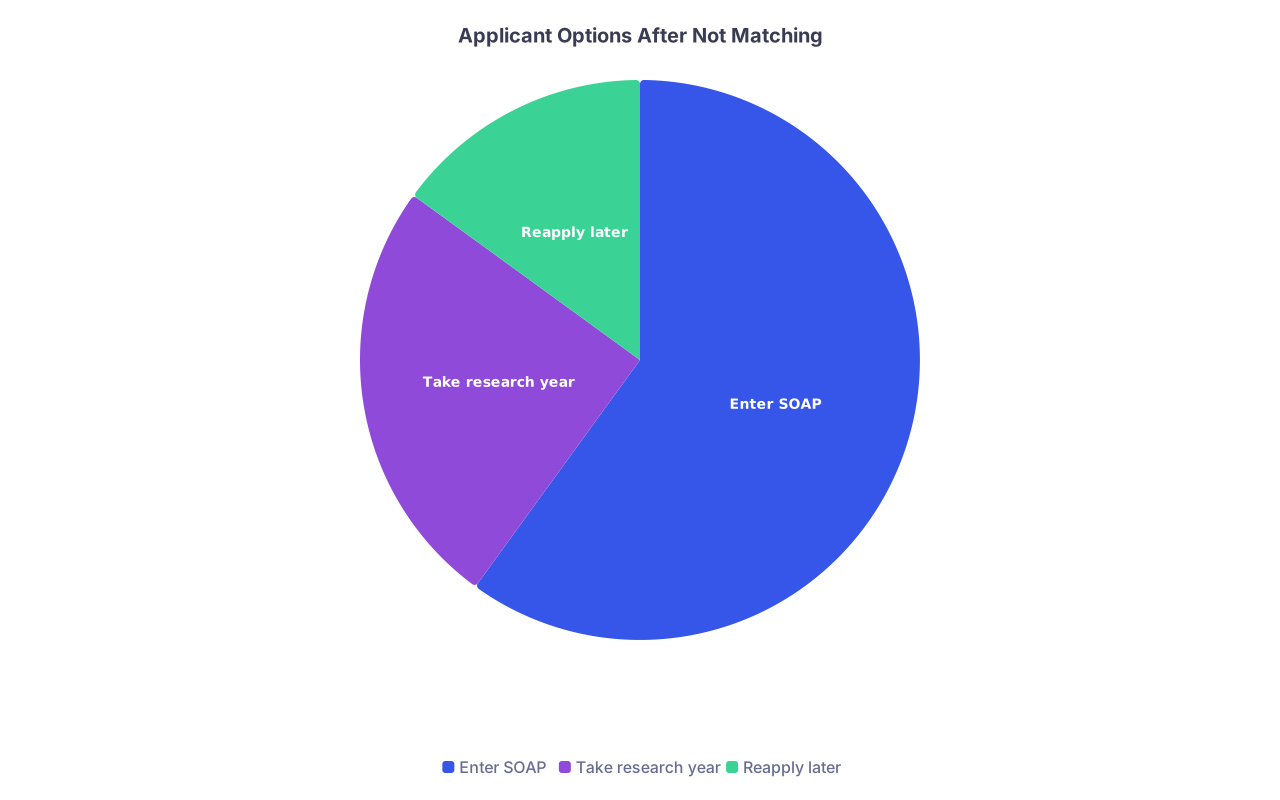
| Category | Value |
|---|---|
| Enter SOAP | 60 |
| Take research year | 25 |
| Reapply later | 15 |
You’re probably thinking: fine, programs like SOAP because it gives them power. What do I do with that?
Here’s the part you won’t hear from your dean or some generic webinar.
1. Some Programs Will Like You More in SOAP Than in October
If you’re in one of these categories, SOAP can actually raise your stock:
- Strong scores, weird red flag (failed a class early, one poor clerkship eval, late Step 2 score).
- Strong US-IMG with real US clinical experience but weak home-school match rates.
- Applicants who applied over-competitively (e.g., borderline ortho applicant now pivoting to prelim surgery or IM in SOAP).
In October, you looked like a risk: might match somewhere else, might not be serious about them. In SOAP, you look like a gift: immediately available, proven scores, grateful, and likely to work hard.
I’ve seen PDs say, “We didn’t take a chance on him in the main Match, but now? He’s exactly the kind of SOAP get we want.”
That’s cold comfort when you’re unmatched, but it’s real.
2. You Need to Understand Which Programs Are Actually SOAP-Friendly
Quiet fact: some programs do well by SOAP every year and know how to work it. Those are good SOAP targets.
You can spot them by:
- Looking at historic NRMP data for unfilled programs in your specialty and region.
- Cross-referencing which of those still have decent reputations on forums or through residents.
- Noticing patterns: “Program X in the Midwest seems to have unfilled positions most years but alumni still get fellowships.”
Those programs are often:
- Comfortable with SOAP.
- Less panicked when they see unfilled slots on Monday.
- More likely to make rational, not purely desperate, SOAP choices.
This matters because you don’t want to throw all your SOAP applications at places that only grab true last-resort candidates.
3. You Must Present as “Low Risk, High Gratitude, High Utility”
SOAP moves fast. PDs are making decisions with very little time.
Programs using SOAP strategically are hunting for three signals:
- You can safely start and pass boards.
- You will not be a headache.
- You will show up in July grateful and ready to work.
So your SOAP strategy should be built on that frame:
- Personal statements laser-focused on reliability, work ethic, and concrete reasons you’d stay at that program/region.
- Letters or updates emphasizing “no professionalism concerns, works well with team, clinically strong.”
- Calm, prepared, concise phone/Zoom behavior during SOAP calls. No bitterness. No entitlement.
You don’t need to sound like a robot. You do need to sound like someone they won’t regret for years.
The Ugly Part: When SOAP Becomes Exploitative
I’m not going to sugarcoat this. Some programs abuse the leverage SOAP gives them.
You’ll see it in:
- Ridiculous call schedules disproportionately loaded onto SOAPers.
- “We expect extra commitment from those who found us through SOAP” type speeches.
- Less support, less advocacy, more “you should be grateful you’re even here” culture.
If you’re heading into SOAP, you need a filter, even when you’re scared.
Red flags during SOAP interactions:
- PDs or faculty emphasizing “we work very hard here” in a vague, ominous way.
- Residents never left alone with you on calls; only administrators talk.
- Vague or evasive answers when you ask about prior unfilled positions or attrition.
You don’t always get to be choosy in SOAP, I know that. But keep your eyes open. A bad program can poison your career and your mental health.
Quick Reality Check: Do Programs Really Prefer SOAP Overall?
No, most do not. The majority of PDs still want to fill in the Main Match with known quantities, robust interview impressions, and less chaos.
But a non-trivial number of programs have quietly learned:
- SOAP is not just a safety net.
- It’s a backup recruitment channel with different rules.
- In some cycles, for some spots, they’d rather take their chances there.
Those are the programs I’m talking about.
You don’t get to see this in public-facing data. You see it when a PD casually says at 11:05 a.m. Monday, “Only two spots unfilled? Good. We’ll get some solid people in SOAP.”
And nobody blinks.