
It’s Wednesday of Match Week. Your phone finally pings with a SOAP offer… and your stomach drops.
It’s not your specialty. It’s not your ideal location. It’s not even close to what you pictured for your career.
Now you’re stuck on the worst question of the week:
Do you grab any SOAP offer just to be in a residency, or say no and roll the dice on reapplying next year?
Here’s the answer you’re looking for.
First: The Core Question You Actually Need to Answer
Forget the noise for a second.
The real question isn’t “Should I accept any SOAP offer?”
The real question is:
Would I rather:
- Start this specific residency in July, in this specialty and location,
or - Spend the next 12 months as a reapplicant with no guarantee I’ll match next year?
If your gut answer is clearly #1, you accept.
If your gut answer is clearly #2, you decline.
Everything else is just clarity-building around that choice.
Let’s structure that clarity.
Key Factor #1: Are You Okay Doing This Specialty Long-Term?
This is non-negotiable. I’ve watched people try to “just get through” a specialty they hate. It ends badly.
You do not need to love the specialty. But you must be able to say:
“If all doors closed and I stayed in this specialty forever, I could live with it.”
If the answer to that is a hard no, you should be extremely cautious about accepting.
When it’s usually reasonable to accept
You’re likely okay to accept a SOAP offer if:
It’s your specialty or a closely related one you can imagine enjoying
Example: You wanted IM, got a SOAP IM prelim or categorical → usually reasonable.It’s a reasonable backup you thought about before
Example: You always liked FM as a backup to IM → SOAP FM categorical offer is solid.You can see a path to a future you’re okay with
Example: You wanted Cards, but got IM categorical in a community program. You can still build a solid career and maybe even get cards with hustle.
When you should seriously consider walking away
Red flags for not accepting:
You dislike both the patient population and the day-to-day work
Example: You hate OB and L&D, and the offer is OB/GYN preliminary or categorical. That’s a recipe for misery.You strongly prefer cognitive specialties and got a procedurally heavy one (or vice versa)
You’re already resentful just imagining doing this work for 3–7 years. That resentment does not get better at 3 a.m. on call.
Specialty misalignment is one of the biggest predictors of burnout and early resignation. Don’t hand yourself that problem just because it’s Match Week and you’re scared.
Key Factor #2: Categorical vs Prelim vs Transitional – Not All Offers Are Equal
You can’t evaluate a SOAP offer without understanding what kind of position it is.
| Type | Years | Guarantees PGY-2+? | Typical Use Case |
|---|---|---|---|
| Categorical | 3–7 | Yes | Full training in specialty |
| Preliminary | 1 | No | IM/GenSurg base year, then reapply |
| Transitional | 1 | No | Broad base year, flexible |
Categorical offer (gold standard)
If you get a categorical offer in:
- Your target specialty → Very strong reason to accept.
- A reasonable backup specialty you can live with → Strong lean toward accept.
Declining a categorical SOAP spot in a tolerable specialty is usually a high-risk decision. You’re turning down a guaranteed residency for a theoretical better match later.
Prelim or Transitional year
With prelim or TY offers, the calculation changes.
Prelim/TY can make sense if:
You’re a decent candidate who narrowly missed →
Example: Mid–high Step 2, some interviews, just didn’t match. A prelim year may strengthen you and keep you in the system.You’re set on a specialty that typically accepts people after prelim years (radiology, anesthesia, derm via prelim IM/TS, etc.)
Prelim/TY is more dangerous if:
- You’re already a weak applicant on paper (low scores, no interviews)
- You have no realistic path to significantly improving your application
- You’re using prelim as a vague “maybe something will work out” move without a concrete PGY-2 strategy
Prelim without a real plan for PGY-2 can leave you as a PGY-1 with no PGY-2 spot. That’s a rough place to be.
Key Factor #3: Your Applicant Strength and Why You Didn’t Match
You can’t decide about SOAP vs. reapply without brutally honest self-assessment.
Ask yourself (and your advisors) these questions
How strong was my application this cycle?
- US MD with decent scores and a normal number of interviews who just got unlucky?
- US DO or IMG with limited interviews mainly at lower-tier or community programs?
- Very few or no interviews?
Do I clearly know why I didn’t match?
- Too few programs applied to?
- Very late application?
- Poor Step 2, failed exam, academic issues?
- Terrible or mediocre interview skills?
- A red flag like professionalism issues, leave of absence, etc.?
Can those weaknesses realistically be fixed in 12 months?
- Yes: You can raise Step scores (if not all pass/fail), add USCE/research, get stronger letters, or broaden your specialty list.
- No: If your fundamental profile is unlikely to change, a reapplication may not magically fix the problem.
If you’re a borderline but salvageable candidate and you have a clear remediation plan, waiting a year is more rational.
If your application is fundamentally weak with no obvious fix, turning down a SOAP categorical spot in any viable specialty starts to look like gambling rather than strategy.
Key Factor #4: Your Life Situation – Money, Visa, and Personal Reality
Let’s be blunt: life logistics can make the decision for you.
Financial reality
Things that push you toward accepting:
- Six-figure debt and no safety net
- Need stable income and benefits ASAP
- Supporting dependents or family members
Waiting a year with no income, trying to piece together research or a prelim/TY, and reapplying is financially brutal for many people.
Visa and immigration concerns
If you’re an IMG on a visa or needing a visa:
- SOAP offer with visa support → very strong reason to accept
- No clear pathway to stay in the country for another year → reapplication becomes much riskier
Mental health and burnout
Some people absolutely should not take on another high-stress year of uncertainty. If this cycle already broke you and you barely held it together, planning for another intense year of applications, rotations, and anxiety might not be wise.
Residency is hard. But endless limbo is its own kind of hard.
Key Factor #5: Program Reputation and Red Flags – When “Any Offer” Is Actually Dangerous
Not all SOAP spots are just “less competitive.” Some are empty because nobody wants to be there.
Here’s what I’ve seen consistently as bad signs:
- Chronic unfilled spots year after year at the same program
- Known malignant culture, high attrition, or residents quietly warning students to avoid it
- Recent or ongoing ACGME probation or serious citations
- Wildly excessive work hours without support or education
- Zero graduates getting decent fellowships or jobs
If you’re hearing: “We lose 1–2 residents every year” or “They’re always short-staffed” or “Everyone’s trying to transfer out” – that’s not just background noise. That’s a warning.
Sometimes no residency this year is better than a truly toxic residency that could wreck your career and mental health.
A Simple Decision Framework You Can Use Today
Here’s a practical way to think through it.

| Step | Description |
|---|---|
| Step 1 | Received SOAP Offer |
| Step 2 | Lean toward decline and reapply |
| Step 3 | Strong lean toward accept |
| Step 4 | Consider decline and structured reapply |
| Step 5 | Accept prelim/TY as best available path |
| Step 6 | Categorical or Prelim/TY |
| Step 7 | Could I tolerate this specialty long term |
| Step 8 | Realistic PGY2 plan |
| Step 9 | Major program red flags |
| Step 10 | Can I improve my app without this year |
Overlay that with:
- Financial reality
- Visa/legal situation
- Your emotional bandwidth for another round
Then you’re not making an emotional decision. You’re making a strategic one.
How a “Wait and Reapply” Year Actually Looks (Not the Fantasy Version)
People romanticize the reapplicant year. “I’ll do research, network, improve my scores, and match at my dream program.”
Sometimes that happens. Often, it doesn’t.
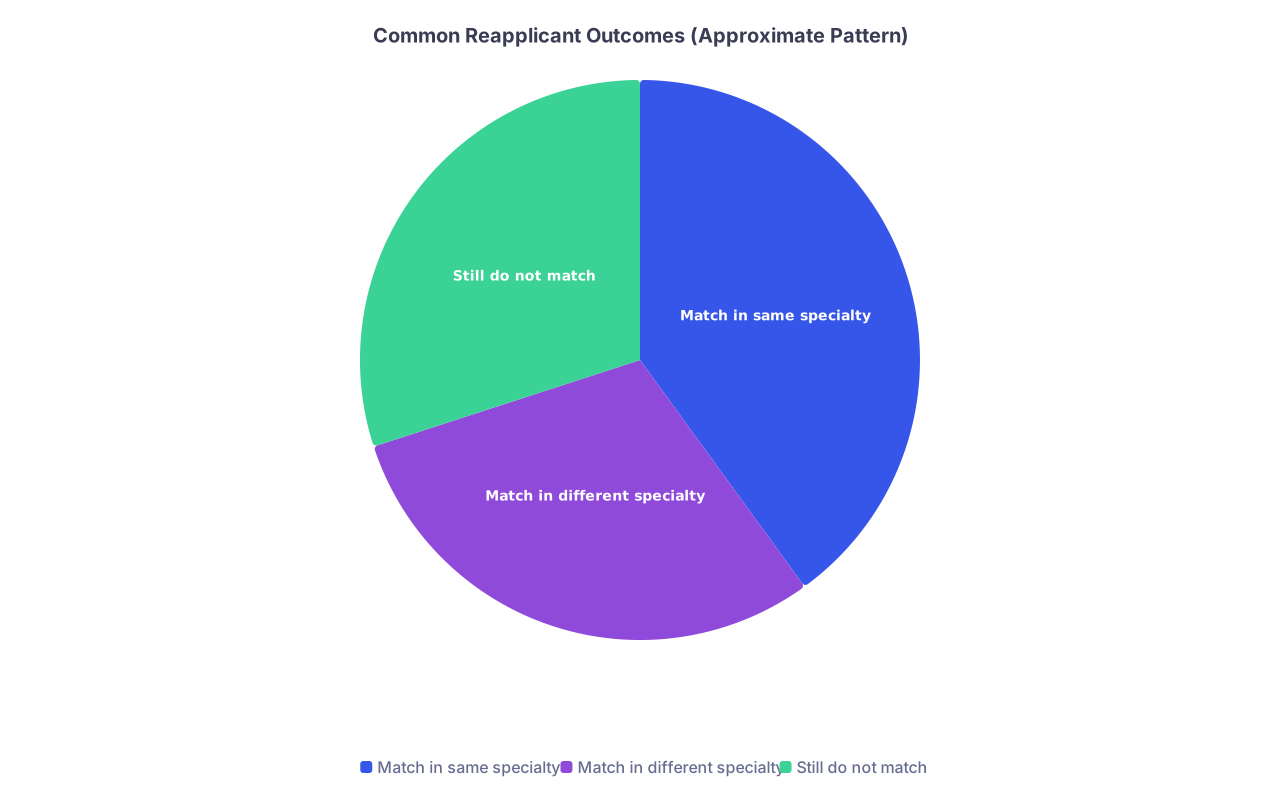
| Category | Value |
|---|---|
| Match in same specialty | 40 |
| Match in different specialty | 30 |
| Still do not match | 30 |
Not exact data, but directionally true based on what advisors and coordinators see:
- Some do match next time, often at similar or slightly less competitive places.
- A chunk pivot to another specialty.
- A nontrivial number still don’t match, now with an even more complicated story to explain.
If you’re going to reapply:
- You need a specific 12-month plan, not vague “I’ll be stronger.”
- You need mentorship from someone who has actually helped reapplicants match.
- You should be okay with the idea that you might end up in the same level of program (or lower) a year later.
Concrete Scenarios: What I Would Do
Let me just call some of these.
Scenario 1: US MD, wanted IM, SOAP IM categorical in mid-tier community
- Solid Step 2, decent interviews, just unlucky.
- Offer: IM categorical at a smaller community program you didn’t rank high.
I’d accept. This is a win in SOAP world. You’re in your specialty, categorical, and employable.
Scenario 2: US DO, wanted ortho, no interview invites, SOAP FM categorical
- Weak Step scores for ortho, minimal ortho research, no interviews.
- Offer: FM categorical in a stable program.
If you can honestly live with FM forever, I’d accept. Reapplying to ortho with that profile is low yield. Saying no to a stable FM categorical is a big gamble.
Scenario 3: IMG, low Step 2, no US clinical, SOAP prelim IM in a malignant program
- Weak application, no clear path to raise scores or add USCE in time.
- Prelim year at a program known for abusing residents and high attrition.
Here I’d seriously consider not accepting, unless you’re cornered by visa issues. One bad prelim year can leave you burned out with no PGY-2.
Scenario 4: US MD, strong scores, anesthesia applicant, got SOAP TY at good hospital
- Solid app, just rough year for anesth; some interviews but no match.
- Offer: Transitional year at a solid academic center.
I’d lean to accepting the TY, then aggressively reapplying anesthesia with stronger connections and fresh letters from that institution.
Quick Reality Check: “Any Residency Is Better Than None” Is Not Always True
You’ll hear this phrase a lot this week. Sometimes from well-meaning people. Sometimes from people who simply don’t want to see you struggle another year.
It’s not automatically true.
If the offer is categorical in a tolerable specialty at a passable program →
Yeah, in many cases it is better than none.If the offer is a prelim in a toxic place, no PGY-2 plan, in a specialty you don’t want →
No. That can be worse than strategically regrouping.
Use “any residency is better than none” as a conversation starter, not a conclusion.

FAQs: SOAP vs Waiting for Next Match
1. If I decline a SOAP offer, will programs hold it against me next year?
Programs won’t have a flashing red label on ERAS saying “declined SOAP,” but they will notice gaps. You’ll have to explain why you didn’t train this year. If your story is coherent (research, family, strategic reapply) and your plan made sense, most reasonable PDs won’t punish you for it. But yes, unexplained gaps always raise questions.
2. Is it easier to switch specialties from inside any residency than from the outside?
Sometimes, but not automatically. Being in a residency helps because you’re “in the system” and have fresh clinical letters. But PDs also don’t like taking people who might jump again. Switching from a prelim/TY into something related (IM → neuro, TY → rads/anesthesia) is relatively common. Switching from a categorical you clearly hate to something ultra-competitive? Much harder than students think.
3. Should I ever accept a SOAP offer in a specialty I know I don’t want long-term?
Generally, no. The exception is when your immigration, financial, or personal circumstances truly leave you no safe alternative. Even then, you should walk in with eyes wide open and a plan: either try to switch later or be mentally ready to finish in that specialty. “I’ll tolerate several miserable years then quit” is a terrible plan.
4. How much do program red flags matter if this is my only SOAP offer?
A lot. One chronically toxic program can damage your health, your confidence, and your career prospects. If multiple reliable sources (recent grads, current residents, trusted faculty) are warning you away, don’t dismiss that lightly. One bad year is survivable; 3+ years in a malignant environment is a much bigger problem.
5. Is a prelim or TY year ever a bad idea if I’m unmatched?
Yes. If you already have a weak application with no realistic way to improve it (very low scores, no interviews, serious red flags), a prelim year can just delay the inevitable. You may finish PGY-1 and still have no PGY-2 spot. That’s worse financially and emotionally than stepping back now and reassessing your career path or country of training.
6. What if my advisors give me opposite advice about accepting vs waiting?
Then you push them. Ask each: “If this were your kid, what would you tell them?” and “What’s the worst case if I follow your advice and it goes badly?” Advisors who’ve actually helped reapplicants before will have concrete stories, not vague platitudes. Weigh their track records and how well they know you. When in doubt, prioritize the person who lays out specifics, not just vibes.
7. Bottom line: when do you almost always say “accept the SOAP offer”?
When it’s:
- Categorical
- In a specialty you can genuinely tolerate long-term
- At a program without major, well-documented toxicity
- And your chances of a clearly better outcome next year are uncertain or low
In that setup, rolling the dice on another year often looks more like denial than strategy.
Key takeaways:
- Don’t ask “Should I accept any SOAP offer?” Ask, “Can I live with this specific specialty and program vs. a risky reapply year?”
- Categorical in a tolerable specialty at a non-toxic program is usually worth accepting; prelim/TY and toxic programs need much more scrutiny.
- If you’re going to decline and reapply, you need a realistic, concrete 12‑month plan to actually change your application — not just hope.