
It’s Wednesday of SOAP week. Your phone finally dings: “Preliminary Internal Medicine – SOAP Offer.” Not categorical. Not your dream specialty. But it’s something. You’re staring at the clock, the accept/decline button, and your brain is ping‑ponging between “take anything” and “don’t trap myself.”
Here’s the answer you’re looking for: a prelim SOAP spot can be excellent, or it can be a one‑year detour that doesn’t move you closer to what you want.
The trick is knowing which is which.
Let’s break this down like an honest senior resident talking to you in the call room.
First: What a Prelim SOAP Spot Actually Is (And Isn’t)
A prelim year is a one‑year position, usually in:
- Internal Medicine
- Surgery
- Transitional Year (TY)
- Occasionally other specialties
It’s meant to be PGY‑1 training before an advanced position (like radiology, anesthesia, derm, neuro, PM&R). Or as a stand‑alone intern year.
During SOAP, most prelim offers you’ll see are:
- Leftover positions at community or lower‑tier academic programs
- Often in IM or General Surgery
- Not guaranteed to roll into a categorical spot
Here’s what a prelim year does NOT automatically do:
- It doesn’t guarantee you a categorical spot at that program later
- It doesn’t magically convert you into a competitive applicant for any specialty
- It doesn’t excuse a weak application without other improvements
So the real question isn’t “Is prelim good or bad?” It’s:
Is this specific prelim SOAP spot a smart move for my goals, right now, versus reapplying?
Step 1: Be Honest About Your Actual Goal
Before you click anything, answer this bluntly:
- What specialty do you really want?
- Are you willing to change specialties to avoid going unmatched again?
- How risk‑tolerant are you? (Emotionally, financially, logistically)
Different goals = different answer.
If you want a non‑competitive or moderately competitive specialty
Think: IM, FM, peds, psych, neuro, OB/GYN (at many places), anesthesia in some regions.
A prelim year can help if:
- You can use the year to get strong US clinical experience, and
- You get strong letters, and
- You fix your obvious weaknesses (Step 2 failure, red flags, no US experience, weak personal statement, poor interviewing)
But if you already had a decent chance this year and just over‑applied to a reach specialty or targeted too few programs, then:
- Reapplying more strategically as a fresh grad might be better than burning a year in a random prelim spot.
If you want a highly competitive specialty
Think: derm, ortho, plastics, ENT, urology (through their own match systems), neurosurgery, optho.
A prelim year alone will not magically fix your competitiveness.
You need at least two of the following to make a prelim year useful here:
- Real research with publications in your target specialty
- Strong connections/mentors in the field
- USMLE scores that are already in range
- A plan to apply more broadly (backups) next time
Otherwise, you’re just delaying a necessary pivot.
Step 2: Understand the Actual Pros and Cons of Taking a Prelim SOAP Spot
Pros that actually matter
You don’t lose clinical momentum
You stay in the system. No awkward gap explaining what you did for 1–2 years.Salary and benefits
You’re paid a PGY‑1 salary, have insurance, and can start paying loans (or at least enter income‑driven repayment).Fresh US letters
A good prelim year with strong performance can give you:- PD letter saying “would take again as categorical”
- Attendings backing you up in applications
- Real “team player, hardworking intern” descriptions that programs believe
Stronger narrative for reapplying
“I grew, I handled patient loads, I’ve proven I can do the job.”
That plays well, especially if your earlier issue was limited clinical exposure or interview concerns.
Cons that people underestimate
You’ll be doing a full‑time residency job while trying to reapply
You’ll be tired. You’ll be on nights. You’ll be on call.
Writing personal statements and scheduling interviews between call shifts is brutal.No guarantee of transition to categorical
I’ve seen prelims told, “We like you, but we only have 3 categorical spots and they’re already promised.” End of conversation.Geographic lock‑in
If your prelim is in the middle of nowhere, you’re interviewing by Zoom from a call room at 6 am your time. Not ideal.If the program is malignant, your life will be miserable
Bad culture + high workload + no support for reapplication = wasted year plus burnout.
Step 3: How to Evaluate This Specific Prelim SOAP Offer
Don’t just ask, “Is prelim worth it?” Ask, “Is this prelim worth it?”
You need data. Fast.
Questions to ask the program (or current residents)
- How many prelims have successfully matched into categorical spots (here or elsewhere) in the last 3–5 years?
- Do any prelims typically convert to categorical at your program? How often?
- How many hours/week are interns usually working?
- Do you allow time off for residency interviews?
- Are faculty supportive of reapplicants?
- How many prelims are in the program, and what do they typically do after?
If they dodge these questions or sound vague, that’s a red flag.
Green flags
- Track record of prelims matching into IM/FM/Anes/Neuro/etc
- PD or APD explicitly says they support reapplying and interviews
- Reasonable schedule (not all 80‑hour weeks with brutal call)
- Residents aren’t warning you away when you ask privately
Red flags
- “We don’t really keep track of where prelims go.” Translation: they don’t care.
- Reputation as malignant (you’ll hear this from residents at other programs too).
- They discourage time off for interviews or say “You can’t miss this many days.”
- No prelim has ever converted to categorical there.
Step 4: Compare Scenarios Side by Side
Here’s the decision you’re actually making: Take prelim now vs. say no and reapply.
| Factor | Take Prelim SOAP | Reapply Without Prelim |
|---|---|---|
| Clinical experience | Continuous, recent | Possible gap, harder to explain |
| Letters | Fresh PD/attending letters | Same letters unless you find new work |
| Money | PGY‑1 salary/benefits | Maybe research/clinical job, maybe nothing |
| Time to study | Harder during internship | More flexible if you structure it well |
| Burnout risk | High, residency is intense | Lower, but mental stress of no spot |
| Narrative | “I proved myself as an intern” | “I reflected, improved, and reapplied” |
Which one helps your story more?
If your main weaknesses are clinical exposure, letters, and program trust, prelim helps.
If your main weaknesses are board scores, lack of research for competitive fields, or poor specialty choice, you might be better with a structured gap year focused on fixing the core problem.
Step 5: Break It Down by Common Scenarios
Let me be blunt with some typical situations I’ve seen.
Scenario 1: You wanted categorical IM, got nothing, now have prelim IM SOAP offer
If:
- You’re okay with IM as a long‑term career
- The program is decent and has a path (or strong support) for prelims to match IM later
Then yes, a prelim IM SOAP spot is often worth it.
You can:
- Bust your ass, get a stellar PD letter
- Reapply IM broadly next cycle
- Possibly slide into an open categorical spot at that or another program
This is one of the best‑case uses of a prelim.
Scenario 2: You wanted ortho, struck out everywhere, now have prelim surgery SOAP offer
Hard truth: most prelim surgery spots do not become categorical ortho or gen surg.
If:
- You’re dead‑set on ortho and have zero publications, midrange scores, and no strong ortho mentors
- And you take a random prelim surgery spot with no real support or track record
You’re probably signing up for a miserable intern year with low odds of it changing your outcome.
What can make sense:
- You pivot: accept that you’re likely headed toward general surgery (if lucky), or another field
- Or you skip the prelim, do 1–2 years research at a strong ortho department (with real mentorship), and then reapply
For ortho/ENT/plastics/derm, a generic prelim year at a random place usually isn’t the magic key. A true targeted plan is.
Scenario 3: You’re an IMG with no US clinical, now have prelim IM offer at a small community program
For many IMGs, this is actually a big opportunity if:
- The program is functional (not abusive)
- They have experience sending IMGs onward to categorical IM/FM/Neuro/Anes/etc
You get:
- US inpatient experience
- Real letters
- A PD vouching for you to other programs
Yes, it’ll be hard work. But for IMGs trying to break into the US system, a prelim year is often more valuable than sitting out a year trying to do observerships that don’t pay and may not generate strong letters.
Scenario 4: You’re completely burned out and not even sure you still want medicine
If that’s you, locking yourself into a brutal prelim year might be the worst thing you can do.
You’re allowed to hit pause.
It can be smarter to:
- Take a structured year
- Work in research, clinical jobs, or even outside health care
- Get therapy, reset, and then decide if you actually want to reenter the match
“Take anything you can get” is terrible advice if you’re already at the edge.
Step 6: Timeline and Strategy If You Accept a Prelim SOAP Spot
If you decide to take it, you need a plan on day one, not in November.
Here’s your basic playbook.

| Step | Description |
|---|---|
| Step 1 | Start Prelim Year |
| Step 2 | Meet PD early |
| Step 3 | Clarify future goals |
| Step 4 | Request prime rotations |
| Step 5 | Work hard and stand out |
| Step 6 | Secure strong letters |
| Step 7 | Prepare ERAS early |
| Step 8 | Schedule interviews smartly |
| Step 9 | Reapply with new narrative |
Month 1–2
- Meet your PD or APD. Say clearly: “I plan to reapply to X next cycle. I’d value your advice and support.”
- Ask for:
- Rotations with good letter writers early in the year
- Flexibility around interview season
Month 3–6
- Crush your rotations. Show up early, stay late when needed, be organized and likable.
- Ask 2–3 attendings for letters as soon as you’ve worked with them long enough.
Month 6–9
- Get your ERAS ready early. Your schedule will not magically open up in fall.
- Be aggressive about using days off and vacation for interviews.
Throughout
- Keep track of your cases, patient load, leadership examples. You’ll use all of this in personal statements and interviews.
Step 7: When You Probably Shouldn’t Take a Prelim SOAP Spot
Let me spell out the no‑go situations.
You probably shouldn’t take the spot if:
- The program has a known malignant reputation and zero track record of helping prelims
- Your true issue is Step failures or massive score deficits that a clinical year won’t fix
- You’re aiming at a hyper‑competitive specialty and refuse to apply broadly or have a backup
- You’re on the edge of serious burnout and your mental health is hanging by a thread
- You have a concrete, realistic reapplication plan that would be blocked by taking a prelim (e.g., 1–2 years dedicated research at a top department, already lined up)
In those cases, “something is better than nothing” is just wrong. A bad prelim year can set you back more than a carefully used gap year.
Quick Decision Framework
If you’re still torn, run yourself through this:
- Do I want to be in any residency next year, even if it’s not categorical?
- Does this specific program have evidence of helping prelims move forward?
- Does a year of strong clinical work directly help my biggest weaknesses?
- Can I handle the stress of reapplying while working as an intern?
- If I say no, do I have a realistic, structured alternative plan?
If you answer yes to 1–4 and your alternative plan is vague, the prelim is probably worth it.
If you answer no to 2–3 and your alternative plan is solid, walking away might be the smarter move.
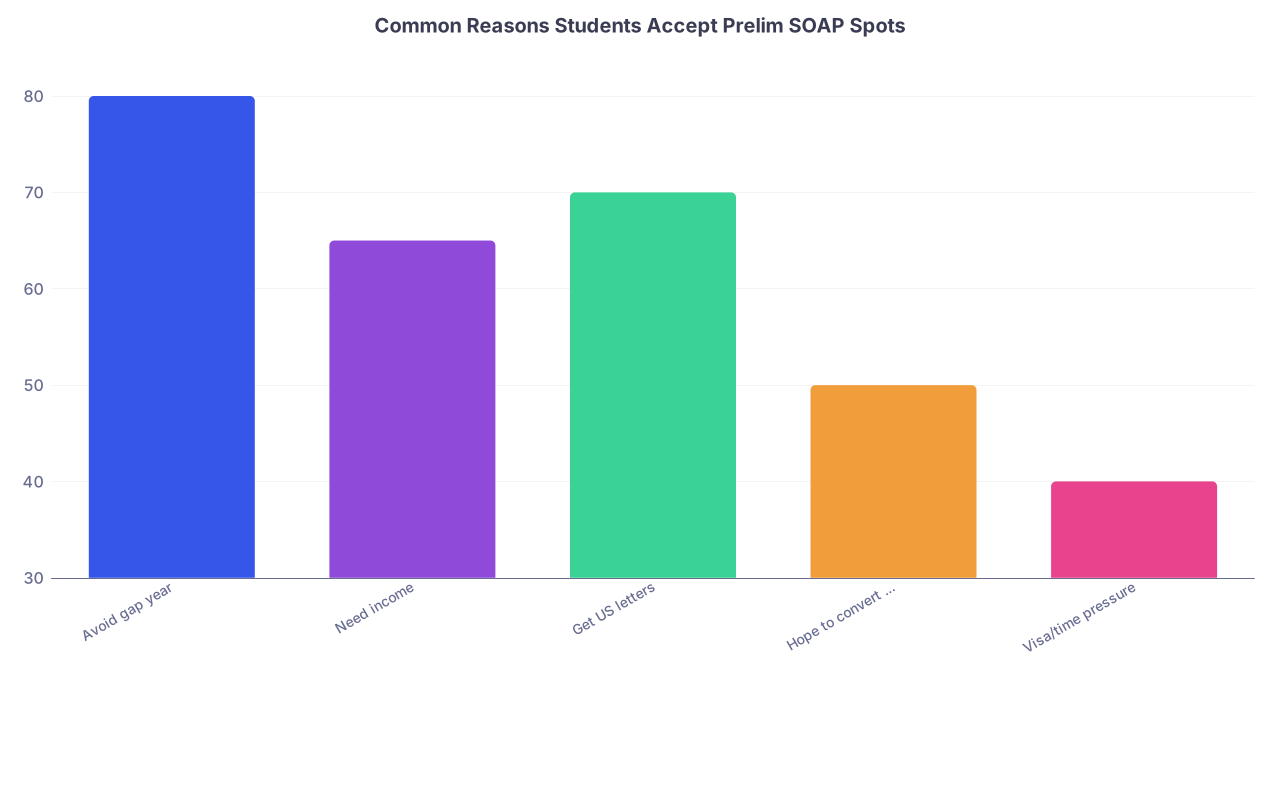
| Category | Value |
|---|---|
| Avoid gap year | 80 |
| Need income | 65 |
| Get US letters | 70 |
| Hope to convert to categorical | 50 |
| Visa/time pressure | 40 |

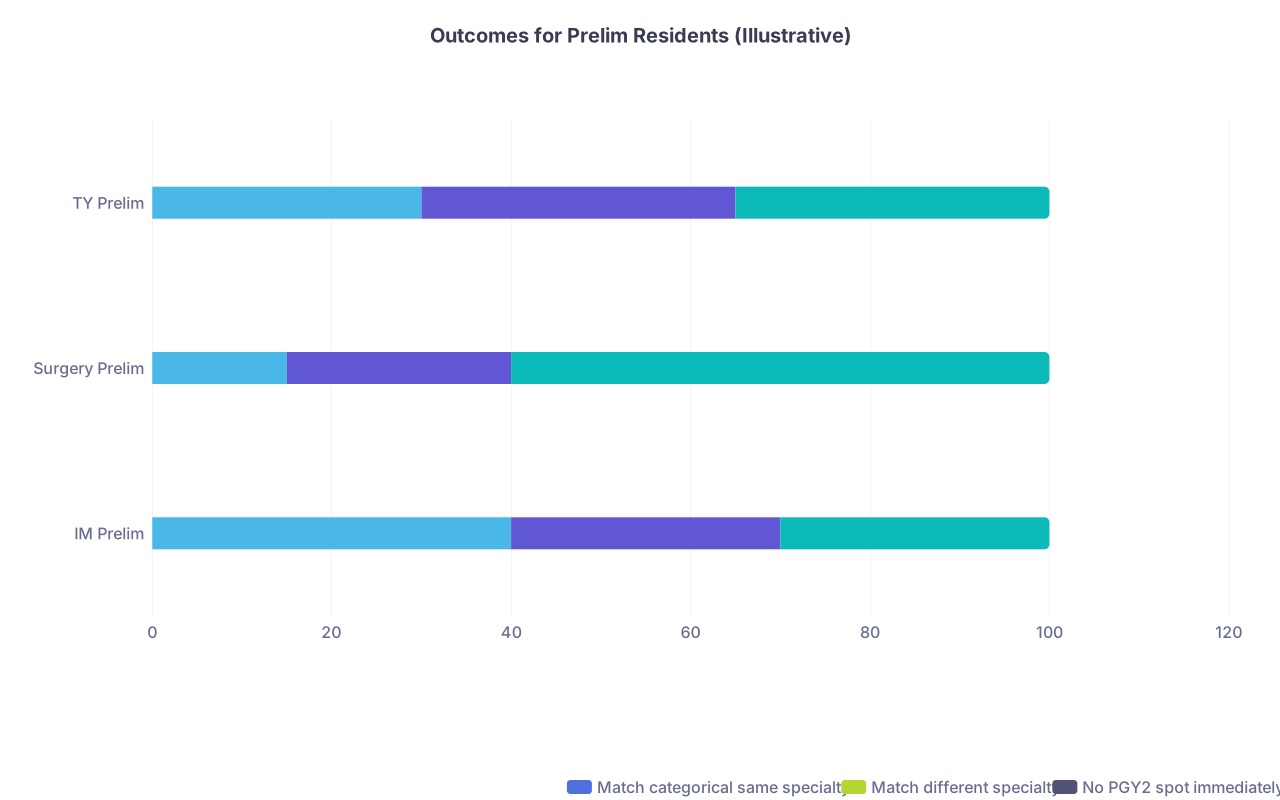
| Category | Match categorical same specialty | Match different specialty | No PGY2 spot immediately |
|---|---|---|---|
| IM Prelim | 40 | 30 | 30 |
| Surgery Prelim | 15 | 25 | 60 |
| TY Prelim | 30 | 35 | 35 |

FAQ: Prelim SOAP Spots
1. Does a prelim year make me more competitive for the Match?
It can, but only if your weaknesses are in areas a prelim year actually fixes: lack of US clinical experience, weak letters, or question marks about your ability to function as a resident. If your issue is a Step failure, very low scores for your target specialty, or zero research for a hyper‑competitive field, a prelim year by itself doesn’t solve those. You’d need a broader reapplication plan either way.
2. Can a prelim position turn into a categorical spot at the same program?
Sometimes, yes. Some programs routinely slide strong prelims into categorical positions if people leave or if they keep “informal” spots open. But it’s absolutely not guaranteed. You should ask directly: “How often do prelims become categorical here?” If they can’t give concrete examples from the last few years, assume the chance is low and plan on reapplying broadly.
3. Is a prelim surgery spot a good idea if I want ortho or another surgical subspecialty?
Usually not, unless you already have a strong ortho (or other subspecialty) profile and real mentors backing you. Most prelim surgery years are high workload with low conversion rates to categorical surgery, let alone ortho/plastics/ENT. If you’re set on a competitive surgical field and your application is weak, focused research at a strong department is generally more valuable than a random prelim surgery year.
4. I’m an IMG. Is a prelim IM SOAP offer better than a year of observerships?
For many IMGs, yes. A prelim IM year gives you real inpatient experience, a salary, and strong PD/attending letters from a U.S. residency program. That’s more compelling than a stack of short observerships with lukewarm letters. The key is making sure the program isn’t malignant and has some track record of prelims moving on to PGY‑2 positions in IM, FM, neuro, anesthesia, or related fields.
5. How bad does it look to have a gap year instead of taking a SOAP prelim?
A gap year doesn’t look bad if you use it well and can explain it clearly. Working in research, doing structured clinical work, improving your application, and having a cohesive story about growth is totally acceptable. What looks bad is a vague “I did nothing much for a year” with no clear improvement in your application. A well‑planned gap year can beat a malignant or useless prelim year any day.
6. If I accept a prelim spot in SOAP, can I still reapply to a completely different specialty?
Yes. Residents pivot all the time. You might do a prelim IM year and then apply psych, neuro, FM, or even anesthesia. The main questions programs will ask are: Why the switch? What did you learn from your prelim year? And do your letters support the new direction? If you’re honest, have a coherent story, and your PD backs you up, switching fields after a prelim is very possible.
Bottom line:
- A prelim SOAP spot isn’t automatically good or bad. It’s a tool.
- It’s worth it when that tool fixes your specific weaknesses and the program has a decent track record.
- If it doesn’t move you toward your actual goal—and traps you in a miserable year with no support—saying no and executing a real reapplication plan is the smarter play.