
The biggest mistake applicants make in SOAP is contacting too many programs and saying nothing meaningful to any of them.
You don’t win SOAP by spamming 200 programs. You win SOAP by targeting a realistic number and sending high‑quality, tailored messages.
Here’s the answer you’re actually looking for.
The Short Answer: How Many Programs Should You Contact?
If you’re in SOAP, you’re under time pressure and probably overwhelmed. So let’s cut to the chase.
For most applicants, this is the realistic target range:
| Applicant Type | Recommended Range |
|---|---|
| US MD, strong application | 20–40 programs |
| US DO / US IMG, solid app | 30–60 programs |
| Non-US IMG or weak app | 50–80 programs |
| Very niche specialty SOAP (e.g., Rads, Derm) | 10–25 programs |
| Aggressive but still sane upper limit | ~80–100 programs |
Key point: Beyond ~80–100 programs, the quality of your outreach almost always collapses. Programs can smell a mass email instantly. They ignore it.
So instead of asking “How many can I possibly email?” the better question is:
“How many can I realistically send targeted, thoughtful, non‑spammy messages to within SOAP timelines?”
That’s your real ceiling.
First: Should You Even Be Contacting Programs?
There’s a dumb myth that “you’re not supposed to contact programs during SOAP.”
That’s wrong.
Here’s the actual situation:
- NRMP rules say you can’t solicit positions or offers before you’re eligible for SOAP (i.e., before Monday 10 AM ET when your eligibility is confirmed).
- You can’t ask programs to offer you a position outside of the SOAP system.
- You can:
- Email programs to express interest
- Send an updated CV, Step 2 score, or recent LOR
- Clarify your commitment to the specialty or region
- Politely let them know you’ve applied
The line you don’t cross: Don’t ask for a promise, pre‑offer, or hint of “I’ll rank you if you rank me.”
In practice, many programs ignore outreach. Some do read it. A few actually adjust who they call based on it.
You’re not trying to “game” the system. You’re trying to make it easier for a PD or APD to say: “Oh yeah, I remember that person. Let’s interview them.”
How Many Can You Actually Reach Well in SOAP Time?
SOAP is brutally compressed. You don’t have time for 200 customized novels.
Let’s look at the time reality.
Say you want to:
- Look up each program briefly
- Check their website / requirements
- Personalize 2–3 sentences
- Spell‑check and send
That’s 5–10 minutes per program if you’re being even modestly careful.
During SOAP, you might realistically have:
- 2–4 focused hours Monday afternoon
- Maybe 1–2 hours Tuesday morning
- After that, if you’re getting interviews, you’re tied up
Call it 6 hours of focused outreach time.
At 6 hours = 360 minutes:
- At 6 minutes per program → 60 programs
- At 10 minutes per program → 36 programs
That’s why those ranges above matter. They’re not theoretical. They’re based on what an actual human can do with quality.
Strategy First: Who Deserves Your Outreach?
You don’t message every program you applied to. That’s lazy and ineffective.
You prioritize.
Here’s how I’d group and rank them:
Top Priority (must contact) – 10–20 programs These are:
- Programs in your geographic area or where you have ties
- Programs where you rotated or know faculty
- Programs aligned with your stats/specialty realistically
Secondary Priority – 20–40 programs
- Programs in regions you’d genuinely go to
- Programs that routinely take applicants like you (based on DO/IMG friendliness, Step ranges, etc.)
- Programs where your story actually matches their profile (community vs academic, research vs service)
Tertiary Priority – only if time allows
- Programs you applied to mostly just to fill your list
- Locations you’re less excited about but still willing to attend
If you’re an IMG or have a weaker application, sure, you’ll reach further. But don’t drop your standards entirely. If you know you’d really struggle at a very malignant surgery program in a city you hate, don’t waste time pitching them.
How to Decide Your Number (Without Guessing)
Use this quick framework. Takes 10–15 minutes.

| Step | Description |
|---|---|
| Step 1 | Start |
| Step 2 | Count SOAP eligible apps |
| Step 3 | Plan to contact 60–80 percent |
| Step 4 | Cap outreach at 60–80 programs |
| Step 5 | Plan to contact 40–60 programs |
| Step 6 | Prioritize by ties and fit |
| Step 7 | Draft template and customize |
| Step 8 | Send in ranked priority waves |
| Step 9 | Less than 30 programs? |
| Step 10 | More than 80 programs? |
Now translate that into numbers:
- If you only have 20–30 SOAP options:
- Contact 60–80% of them (12–24 programs)
- If you have 40–80 SOAP options:
- Contact 40–60 programs
- If you somehow have >100 SOAP‑eligible programs:
- Cap yourself at 80–100 max and stop
What Your Outreach Should Actually Look Like
You can’t send 40 totally unique essays. You’ll burn out. You need a base template + 2–3 custom lines.
Here’s a simple structure:
Subject line:
- “SOAP Applicant – [Your Name], [Specialty] Interest”
- Or: “[Specialty] SOAP Applicant with [State/School] Ties”
Who to email:
- Program Director
- Program Coordinator
- CC associate PD if email is public
- Use program website / FREIDA for contacts
Body outline (short and tight):
- 1 line: Who you are (US MD/DO/IMG, grad year, specialty)
- 1–2 lines: Why that program specifically
- 1–2 lines: One key strength or update
- 1 line: Clear, polite interest
- Signature with ERAS AAMC ID
Example (compressed and realistic):
Dr. Smith and Ms. Johnson,
My name is Alex Lee, a 2024 US DO graduate, and I’ve applied to your Internal Medicine program through SOAP. I completed core rotations in [Region] and am very interested in training in a community‑focused program like yours that serves a diverse patient population.
I scored 235 on Step 2 and have strong inpatient evaluations, especially in IM and ICU. I’d be grateful for the opportunity to interview and would be very excited to train at [Program Name].
Thank you for your time and consideration.
AAMC ID: 12345678
That’s it. No autobiography. No paragraph about your childhood.
When Should You Send These Messages?
Timing matters more than people think.
Typical pattern during SOAP:
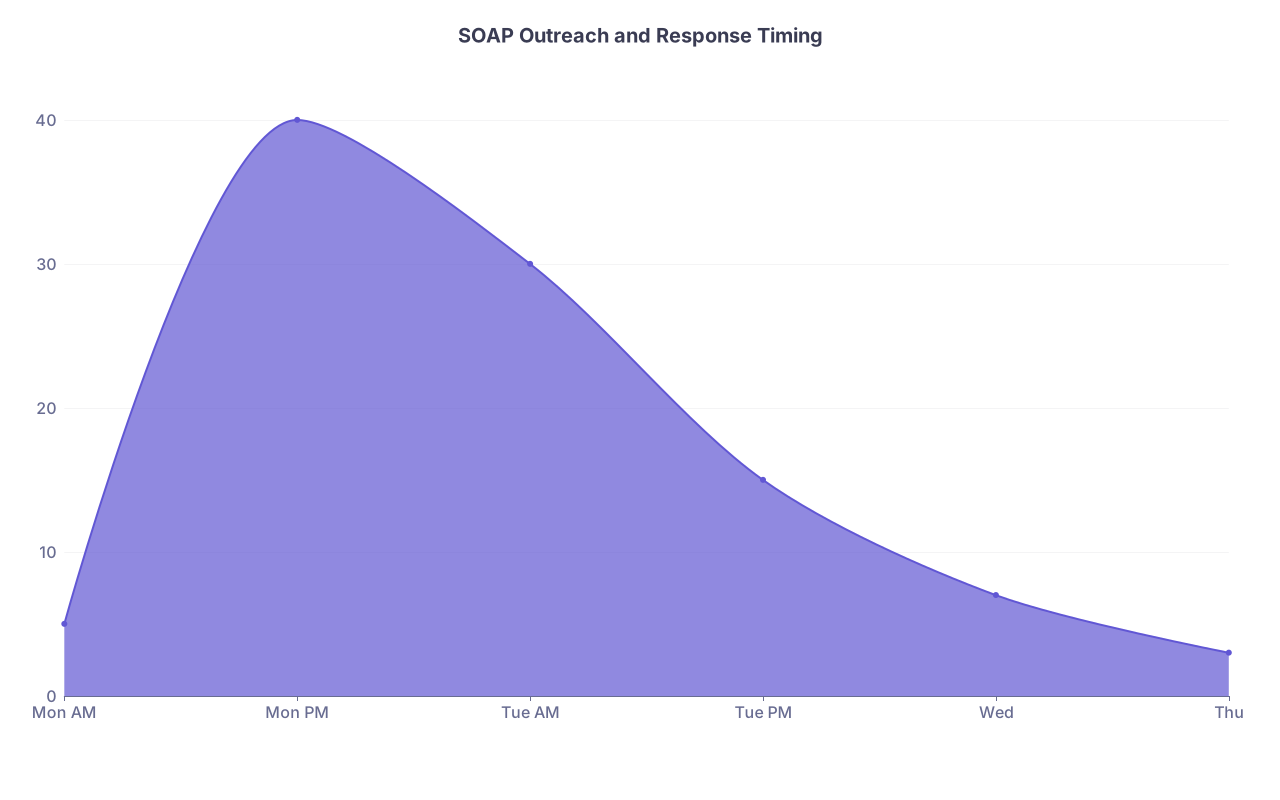
| Category | Value |
|---|---|
| Mon AM | 5 |
| Mon PM | 40 |
| Tue AM | 30 |
| Tue PM | 15 |
| Wed | 7 |
| Thu | 3 |
Most useful windows:
Monday afternoon
- After you see which programs you could apply to and submit applications
- Start with your top 10–20 programs
Tuesday morning
- Round 2 of outreach once all your applications are in
- Add another 20–40 programs if you have capacity
After that, you switch into interview mode. If you’re not getting any calls at all by late Tuesday, then you can consider expanding to more programs with lighter customization.
Common Bad Strategies (That Tank Your Chances)
I’ve watched people torch their own chances with these.
-
- “Dear Program Director,”
- No program name, no details, obviously copied and pasted
- Many PDs don’t even finish reading that sentence
Essay-length emails
If your email is longer than 2 short paragraphs, they’re not reading it fully. They’re triaging 100+ SOAP emails plus their normal workload.Desperate tone
- “I will go anywhere, please help me, I’m begging you”
It’s understandable emotionally. But professionally, it reads poorly.
- “I will go anywhere, please help me, I’m begging you”
Ignoring instructions
If the program explicitly says “do not contact us during SOAP” on their website, don’t be the person who ignores that. They remember.Emailing 3–4 times
One email. Maybe a brief follow‑up the next day if you have a meaningful update (new score, LOR). That’s it.
Tailoring Your Number Based on Your Profile
You’re not everyone. So here’s how to interpret the ranges.
Strong US MD / DO, solid scores, common specialty (IM, FM, Peds, Psych)
- You’re competitive for SOAP spots in your specialty and possibly others.
- Target:
- 10–20 top priority programs
- Another 10–20 secondary programs
- Total: 20–40 programs
Focus heavily on quality. You don’t need to blast 80 programs.
US DO or US IMG, mid‑range scores
- You’re in the mix, but less automatic.
- You need more reach.
- Target:
- 20 top and secondary programs
- Another 20–40 reasonable stretches
- Total: 30–60 programs
Quality still matters, but you might need to accept a bit less personalization in the later batches.
Non‑US IMG, low scores, attempts, or gaps
You’re playing in a harder mode. You need more at‑bats.
- Target:
- 20–30 programs where your profile is clearly in their usual range
- 30–50 broader programs where you’d still fit
- Total: 50–80 programs
Don’t write novels. Aim for short, clear, non‑desperate messages. And be realistic: SOAP is competitive. This is about maximizing odds, not guaranteeing a match.
How to Stay Organized (So You Don’t Embarrass Yourself)
Nothing screams chaos like emailing the same PD twice with different stories.
Keep a simple tracker. Even a quick table like this helps:
| Program | Priority | Emailed? | Response | Notes |
|---|---|---|---|---|
| Program A | High | Yes | Interview | Has IM chief resident |
| Program B | Medium | Yes | No response | Community program |
| Program C | High | No | - | Needs tailored email |
| Program D | Low | No | - | Only if time allows |
Update as you go. This is five minutes that saves you from dumb mistakes.
Don’t Forget: SOAP Outreach Is a Bonus, Not the Core
One thing you need to internalize:
- Core of SOAP success =
- Applying smartly through ERAS
- Having a clean, clear application
- Taking interviews seriously
Emailing programs is supplemental. It can bump you into “let’s take a look” territory. It will not magically fix a fundamentally weak or mismatched application.
But it can be the difference for a few applicants at the margin.
Your goal is to be one of those.
FAQs
1. What if I don’t hear back from any programs I emailed?
Silence is common. Programs are slammed. Don’t interpret silence as a sign you did something wrong. Many will never respond but may still review your file. Keep your phone on, check email frequently, and focus on interviews if they come. If by late Tuesday you have zero contact, you can expand your outreach list slightly, but don’t panic‑spam.
2. Should I call programs or only email?
Email first. Calling can work in some small community programs, but it can also irritate already overwhelmed coordinators. If you do call, be brief, polite, and don’t push: confirm they received your application, express interest in 1–2 sentences, and thank them. Never call repeatedly or pressure them about interviews or offers.
3. Who exactly should I address in the email?
Ideally: Program Director and Program Coordinator. If they list an Associate PD or SOAP contact, you can CC them. Use names correctly spelled. Don’t send a generic “To whom it may concern” if names are easily available online. It’s a minor detail but signals effort and professionalism.
4. Can I reuse the same email for multiple programs?
You can reuse the structure, not the content. Have a base template, but always customize the program name and at least 2–3 lines related to that specific program (location, focus, patient population, your connection). If all you change is the first line and program name, it’ll read like a form letter, and they can tell.
5. Should I mention I didn’t match or why I’m in SOAP?
No long explanations. Everyone knows why you’re in SOAP: you didn’t match. That’s enough. Don’t open the door to a long narrative about failures, illness, or drama. If there’s a simple, brief update that strengthens you (new Step 2 score, recent strong rotation, new LOR), mention it. Otherwise, stay forward‑looking and concise.
6. What’s one thing I can do today to be ready for SOAP outreach?
Make a simple spreadsheet of potential SOAP programs in your specialty and rank them into high, medium, and low priority. That way, when SOAP opens, you aren’t wasting precious hours researching from scratch—you can immediately start sending high‑quality, targeted emails to your top 10–20 programs.
Now, open a blank document and draft your base SOAP outreach template. Keep it to 6–8 sentences. Then when SOAP hits, you’re editing, not writing from zero.