
You probably do NOT need a completely new personal statement for SOAP. But you absolutely cannot just reattach your old one and hope for the best.
Let me be direct: your SOAP personal statement can be an edited, targeted version of what you already used—but it must be sharper, specialty-focused, and aligned with the realities of SOAP. If you treat SOAP like “resend everything and pray,” you’re wasting a big opportunity.
Here’s how to think about it, step by step.
1. Do I really need a new personal statement for SOAP?
Short answer: usually no, but you do need a revised one. Sometimes two.
You’re in one of three situations:
You’re reapplying to the same specialty during SOAP.
You do not need a brand new statement, but you should:- Tighten it (less fluff, more clarity)
- Acknowledge growth from the interview season
- Cut anything that sounds “dream program only” or too selective
- Emphasize readiness to start residency immediately
You’re applying to a different but related specialty in SOAP (e.g., IM → FM, Gen Surg → Prelim Surg, Anesthesia → IM).
You need a new, specialty-specific personal statement. Recycling your original with a different specialty name slapped in is lazy and obvious. Programs can tell.You’re applying broadly in SOAP to multiple unrelated specialties (e.g., Psych + IM + FM + Prelim Surg).
You likely need 2–3 short, targeted statements, not one generic one.
For example:- One for IM/FM style primary care fields
- One for psychiatry/neurology if you’re going there
- One for surgery/prelim surgery if you’re chasing those spots
If your question is: “Can I just reuse my old PS as-is?”
My answer is: That’s a bad plan. It signals you haven’t learned anything from this cycle and that you’re treating SOAP as a backup trash bin, not a serious second chance.
2. What’s different about a SOAP personal statement?
SOAP is not the same game as main Match. The priorities shift.
Here’s what SOAP programs care about more:
- Can you start safely and reliably on July 1?
- Will you show up, work hard, and not quit?
- Are you okay with this program, not just “my dream academic place”?
- Do you understand this specialty and actually want it?
Your SOAP personal statement should:
- Be shorter (usually 3–4 solid paragraphs, ~500–700 words)
- Be direct about your path and your readiness
- Reduce “aspirational fluff” and increase concrete examples of responsibility, reliability, and clinical work
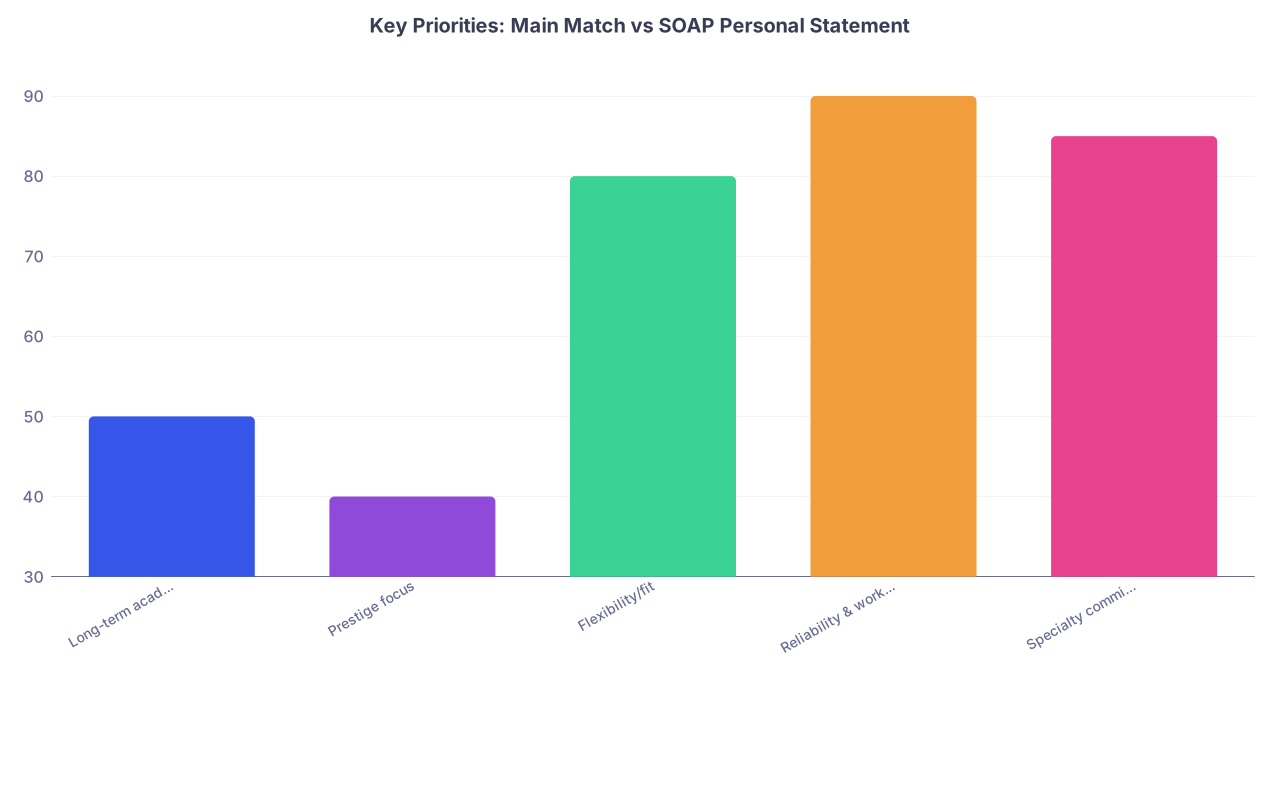
| Category | Value |
|---|---|
| Long-term academic goals | 50 |
| Prestige focus | 40 |
| Flexibility/fit | 80 |
| Reliability & work ethic | 90 |
| Specialty commitment | 85 |
Think of your SOAP PS as: “This is why I’m a safe, motivated, realistic choice for you right now.”
Not: “Let me tell my life story from childhood again.”
3. How to reuse and revise your existing personal statement
If you’re staying in the same specialty, you can absolutely build off your old essay. Here’s the framework I’d use.
Keep these parts (with edits)
- A strong opening story or hook—but shorten it. Cut to the point quickly.
- Any concrete clinical examples that show:
- Ownership of patient care
- Communication skills
- Working well on teams
- Handling call, nights, or high-stress situations
- Any clearly stated, realistic career interest within the specialty (e.g., “I’m drawn to general internal medicine with an interest in hospital medicine.”)
Fix or cut these parts
- Long backstory about why you chose medicine in high school / your grandmother’s illness, etc. You do not have that kind of space now.
- Overly dreamy language about “top programs,” “cutting edge research” if you’re applying broadly to community or prelim spots.
- Anything that sounds rigid, like:
- “I am only interested in categorical positions in highly academic centers.”
- “My ultimate goal is a competitive fellowship at an elite institution.”
During SOAP, that kind of line can make you look like a flight risk.
Add this
Two SOAP-specific components:
A concise, honest bridge from Match to SOAP, without sounding bitter or desperate. Something like:
“This application season has pushed me to reflect on the kind of physician and teammate I want to be. While I did not initially match, my clinical evaluations, ongoing work ethic, and feedback from mentors have strengthened my conviction that I’m ready to contribute meaningfully as a first-year resident in internal medicine.”
A clear statement of what you bring on Day 1:
- Reliability, professionalism
- Willingness to work hard and learn
- Comfort with bread-and-butter cases in that specialty
- Any specific skills: procedures, languages, EMR familiarity, leadership
4. If you’re switching specialties for SOAP
This is where people make the biggest mistakes.
No, you can’t just “find and replace” psychiatry → family medicine and call it done. Program directors can smell that from a mile away. I’ve watched folks get burned by this exact thing.
You need a statement that:
- Clearly explains why this specialty makes sense for you, based on your actual experiences
- Doesn’t sound like “I’m just grabbing whatever’s left”
- Avoids trashing or downplaying your original specialty choice
(Don’t say “I realized I never really liked surgery.” That’s not reassuring.)
What to include
One or two specific experiences in the new specialty
Example for IM after a surgery-heavy season:“On my internal medicine rotation, I found myself drawn to the longitudinal problem‑solving and the chance to understand each patient’s medical story over several days. Managing complex diabetic patients and working through diagnostic uncertainty on the wards felt energizing in a way that stayed with me after the rotation ended.”
A believable narrative shift:
- “I initially applied to X because…”
- “During the year I realized Y from rotations / sub‑I / mentors…”
- “Those experiences clarified that I’m best suited for Z.”
Evidence you understand the actual work of that specialty:
Not “I love talking to people so psych seems great.”
Instead: describe managing suicidal patients, working with collateral, appreciating longitudinal med management, etc.
What to avoid
- Sounding like this specialty was always your #1 but you inexplicably didn’t apply there. Program directors are not naive.
- Over-promising: “I guarantee I’ll stay here forever.” Just say you’re committed and interested in building a career in that field.
- Whining about the Match or blaming others.
5. Handling multiple specialties in SOAP
If you’re applying to more than one specialty during SOAP, keep it clean and practical.
You do not need 6 personal statements. You probably need 2–3.
| Situation | Recommended PS Setup |
|---|---|
| Only IM categorical | 1 IM-focused PS |
| IM + FM | 1 IM, 1 FM PS |
| Psych + Neurology | 1 Psych, 1 Neuro PS |
| FM + IM + Prelim IM | 1 shared IM/FM, 1 prelim PS |
| Surgery categorical + Prelim Surg | 1 surg PS, use for both |
Guidelines:
- Don’t mix specialties in one PS. No “I love both psychiatry and internal medicine because…” in a single document.
- For prelim-only applications, you can have a specific prelim-focused version that:
- Emphasizes being a team player, reliable, procedure-friendly, OK with heavy service work.
- Briefly mentions long-term goals (e.g., anesthesia, radiology) without making you sound like you’ll mentally check out.
6. How honest should I be about not matching?
You don’t need a full autopsy of your application in the personal statement. That’s a common trap.
Do NOT write:
- “I did not match likely because of my low Step 1 score and limited interviews.”
- “I struggled significantly with time management during M3 and failed two rotations.”
The PS is not your confessional.
What you can do, briefly:
Acknowledge resilience and growth this year:
“This year has pushed me to seek more feedback, refine my clinical skills, and reflect on how I can be a stronger intern from day one.”Highlight ongoing work:
- Current clinical work if you’re a grad
- Acting internships, sub‑Is, extra rotations
- QI/research relevant to the specialty
If there’s a major issue (red flag, gap, failure), that’s often better explained in the SOAP supplemental questions or via your dean’s letter / advisor communications, not the PS itself.
7. Practical timeline and strategy during SOAP week
You do not have days to perfect this. You have hours.
Here’s what a realistic workflow looks like if you’re preparing right after an unmatched result:

| Step | Description |
|---|---|
| Step 1 | Learn SOAP status |
| Step 2 | Decide target specialties |
| Step 3 | Sort old statements by specialty |
| Step 4 | Create copy for each SOAP specialty |
| Step 5 | Shorten and refocus each copy |
| Step 6 | Add SOAP specific language |
| Step 7 | Quick proofread by advisor or peer |
| Step 8 | Upload to ERAS SOAP applications |
If you’re reading this before Match Week and you’re worried about not matching, smart move. Do this now:
- Create a shorter version of your main specialty PS.
- Draft one alternate specialty PS if you have a realistic backup field.
- Draft a prelim surgery or prelim internal medicine PS if that’s part of your backup plan.
You don’t need them perfect. You just need them 80% ready so you’re not writing from scratch at 1:00 p.m. on SOAP Monday.
8. Concrete template you can adapt
Here’s a rough SOAP-oriented structure you can plug your content into:
Opening (2–4 sentences)
One concise clinical story or moment that hooked you into this specialty (not childhood, not vague inspiration).Why this specialty (1 paragraph)
- Connect 1–2 rotations or experiences
- Name specific aspects of the specialty you like (types of patients, pace, problem-solving style, continuity vs acute care)
What you bring as an intern (1–2 paragraphs)
- Clinical strengths: examples from rotations, sub‑Is, evaluations
- Work ethic: nights, call, busy services you handled
- Team skills: communication with nurses, consultants, patients, families
- Any procedural / language / EMR skills relevant to that specialty
Brief nod to the current situation & forward-looking close (1 paragraph)
- One line acknowledging growth this year (no self-pity)
- Reaffirm your commitment to that specialty
- State you’re ready to contribute from day one and eager to grow at any program that offers solid training
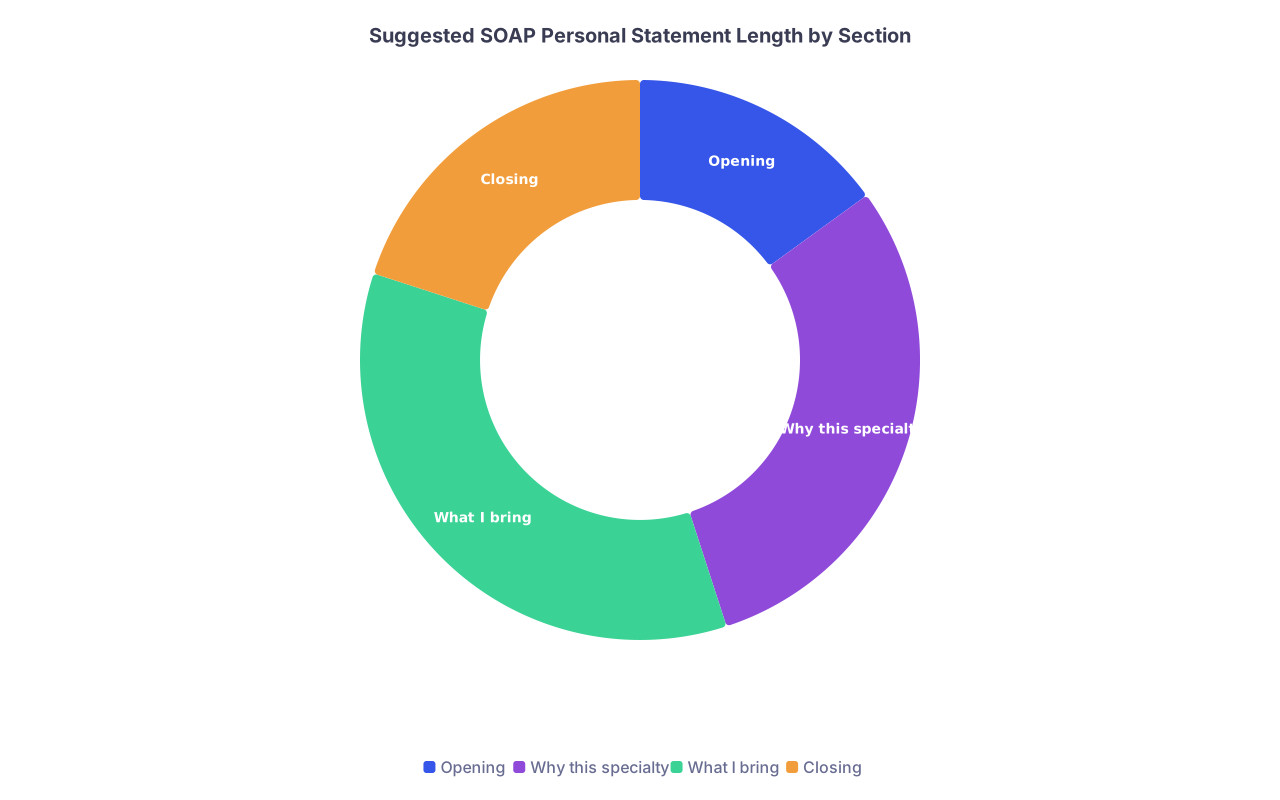
| Category | Value |
|---|---|
| Opening | 15 |
| Why this specialty | 30 |
| What I bring | 35 |
| Closing | 20 |
FAQ: SOAP Personal Statements (5 Key Questions)
1. Can I upload different personal statements for different SOAP applications?
Yes. ERAS lets you assign different personal statements to different programs, including during SOAP. Use this. Do not send a psych-focused PS to a family medicine program because you were in a rush.
2. Is it bad if my SOAP PS is shorter than my original one?
No. In SOAP, shorter and sharper is usually better. Program directors are skimming hundreds of files at high speed. A clear, 500–700 word statement that shows you understand the specialty and are ready to work is more effective than a 1,200 word autobiography.
3. Should I mention that I am open to any geographic location or type of program?
You don’t need to say, “I’ll go anywhere.” It can sound desperate. Instead, signal flexibility with lines like: “I’m eager for strong clinical training in a program where I can care for diverse patients and contribute fully as a team member,” and then let your application list (community, rural, academic, etc.) show your flexibility.
4. Do I need a completely different PS for prelim vs categorical programs?
Not always. For surgery, an appropriately written surgery PS can usually serve both categorical and prelim applications. If your long-term goal is something like anesthesia or radiology, you may want a slightly different version for prelim medicine or prelim surgery that briefly and professionally states that goal while emphasizing you’ll take the intern year seriously.
5. Who should review my SOAP personal statement if I have very little time?
One person who understands residency application reality is better than a crowd:
- Your dean’s office / student affairs
- A mentor in the target specialty
- A recent grad who successfully matched in that specialty
Give them a Google Doc, ask for “brutal but fast edits,” and implement only the changes that make your message cleaner and more specific.
Key takeaways:
- You usually do not need a brand new personal statement for SOAP, but you absolutely need a revised, tighter, specialty-focused one.
- If you’re changing or adding specialties, write separate targeted statements—no lazy copy‑paste jobs.
- Your SOAP PS must answer one core question: “Why are you a safe, motivated, realistic choice to start as an intern in this specialty on July 1?” If it does that, you’re using SOAP the right way.