
You’re sitting in a small conference room (or on Zoom), your SOAP interview is humming along, and then it lands:
“So… can you tell us why you went unmatched?”
Your stomach drops. You know this question is coming, but you still do not have a clean, confident answer in your head. You’re worried that whatever you say will either sound defensive, vague, or like a confession.
Here’s the good news: there is a right way to answer this. And a lot of wrong ways. Let’s walk through the right way.
The Real Goal Behind “Why Did You Go Unmatched?”
Programs are not asking this to shame you. They’re running a risk calculation.
What they’re really asking:
- Are you self-aware or in denial?
- Was this a one-time miss or a pattern?
- Are you going to be a headache, or can you learn and adapt?
They want three things from your answer:
- A clear, specific cause (or small set of causes).
- Evidence you’ve already taken action to fix it.
- Reassurance it’s unlikely to happen again and that you’ll be a solid resident.
If your answer doesn’t hit those three, it’s a weak answer.
Step 1: Figure Out Your Actual Reason(s) – Not the Fluffy Ones
Before you craft a script, you need a diagnosis. Be honest with yourself.
Typical real reasons people go unmatched:
- Applied too narrowly or too few programs
- Applied to a hyper-competitive specialty with a borderline application
- Step scores on the lower side for the chosen specialty
- Red flags: failed exam, LOA, professionalism/faculty concerns
- Big geographic restrictions with no strong home ties
- Poor personal statement or letters that didn’t help (or possibly hurt)
- Weak or awkward interviews
- Late application or incomplete pieces (Step 2 CK late, LORs late, etc.)
- Career switch or unclear “story” that confused programs
The worst answer is, “I don’t really know.” You need a theory that’s grounded, specific, and believable.
If you truly aren’t sure, assume it was a combination of at least:
- Competitiveness of specialty, plus
- Something suboptimal in your strategy (number of programs, geography, timing, etc.)
Step 2: Build a Clean, 3-Part Answer
You need a simple structure that you can flex depending on your situation.
Here’s a template that works in SOAP:
- Brief, specific reason
- Concrete steps you took after recognizing the problem
- Why you’re now better prepared for residency
Let me give you some word-for-word examples.
Example 1: Competitive specialty + narrow list
“I went unmatched mainly because I aimed too narrowly in a competitive specialty. I applied to about 40 programs in only two regions and did not include a parallel backup specialty. My application was solid but not exceptional for that field, and I underestimated how much volume and flexibility I needed in my list.
Since then, I’ve gotten very direct feedback from my dean and a faculty mentor. I broadened my search, included [this specialty] which fits my clinical strengths, and I’ve been working full-time in a clinical role to keep my skills sharp and build stronger letters. I understand the process much better now and I’m very motivated to contribute from day one.”
Example 2: Low Step score / academic concern
“My main concern in the last cycle was my Step [1/2CK] score. I applied to a specialty where my score was below the typical range, and I did not provide programs enough evidence that my test performance would not reflect my clinical work.
I addressed this by focusing on performance in my sub-internships, securing strong clinical letters, and taking additional shelf-style practice and remediation to strengthen how I study. My evaluations from those rotations are much stronger, and I’ve been very intentional about building habits that transfer to in-training exams and daily patient care.”
Example 3: Interview problems
“I had multiple interview invitations but did not match. After feedback from a mentor who did a mock interview with me, it became clear that I was not effectively communicating my interest or my story. I sounded rehearsed and a bit stiff, and that likely hurt me.
This year, I did several mock interviews with faculty and career services, recorded and watched myself, and refined how I present my experiences. I’ve gotten much more comfortable and genuine in conversation, and I think that’s coming through in my interviews now.”
Example 4: Gap/LOA or professionalism concern
“In my prior application, I had a leave of absence that understandably raised questions. At that point, I did not explain it as clearly or as directly as I should have, which likely made programs hesitant.
Since then, I’ve been transparent and consistent about what happened and how I addressed it. I returned, completed my clerkships without issue, and received strong feedback from my clinical supervisors. I’ve also put structures in place—regular check-ins with my advisor, clear routines—that have kept me stable and high-functioning. I’m confident I can maintain that as a resident.”
Notice the pattern: brief reason, actions, reassurance. No spiraling. No 10-minute life story.

| Category | Value |
|---|---|
| Too few programs | 25 |
| Overly competitive specialty | 30 |
| Low scores | 20 |
| Interview issues | 15 |
| Geographic limits | 10 |
Step 3: What You Should Avoid Saying (Because Programs Hate It)
There are several ways to tank this answer fast.
Avoid these:
Blaming the system or programs
“The match is random.”
“Programs just don’t look at holistic factors.”
This screams: “I’m not taking responsibility.”Blaming your school or advisors
“My school told me I’d be fine applying to 30 derm programs.”
You can mention misjudgment, but end with what you changed, not how others failed you.Long emotional narratives
SOAP interviews are fast. You do not have time for a 7-minute saga about your journey since high school. They want a concise explanation and a sense that you’re stable.Over-disclosing sensitive personal or mental health details
You can briefly and neutrally say you handled a health or family issue and it’s under control. You do not need your psychiatric history in a SOAP interview.Acting like you were perfect and unlucky
“Honestly, I think I just had bad luck.”
Everyone says this. It doesn’t help you. Find something you actually changed.
Good answer: short, specific, accountable, future-focused. Bad answer: vague, defensive, or pity-seeking.
Step 4: Tailor Your Answer to SOAP Specifically
SOAP is not the main Match. Programs are in triage mode. They are:
- Moving fast
- Comparing you mostly to other SOAP applicants, not to their original rank list
- Looking for someone who can function clinically and not cause trouble
So your answer in SOAP should over-emphasize:
- Reliability
- Coachability
- Stability
- Willingness to work hard and learn
This means:
- Lean into how you stayed clinically active (research assistant, scribe, prelim year, externship, etc.)
- Highlight positive recent evaluations
- Emphasize that you’re grateful for the opportunity and ready to commit to their specialty

| Step | Description |
|---|---|
| Step 1 | Why unmatched question |
| Step 2 | State main reason briefly |
| Step 3 | Describe actions taken |
| Step 4 | Connect to readiness now |
| Step 5 | Express interest in program |
Step 5: Combine It With “Why This Specialty / Why This Program”
They will not only ask why you went unmatched. They will pair it with:
- “Why [this specialty] in SOAP?”
- “If you were aiming for X before, why are you applying to Y now?”
You need a tight bridge between your unmatched explanation and your current interest.
Example if you switched from a more competitive specialty to IM:
“Last cycle I applied only to [competitive specialty], with some interviews but ultimately did not match. My primary mistake was not applying more broadly and not including a specialty that actually aligns very well with what I enjoy day to day: longitudinal patient care, complex medical management, and team-based work. Over the past year, I’ve done additional rotations in internal medicine, and that really confirmed this is where I fit best. That’s why I’m genuinely excited about an internal medicine position now and committed to building my career here.”
Notice: you’re not saying IM is your “backup.” You’re saying it’s a better fit that you underappreciated before.
| Main Issue | What To Emphasize Now |
|---|---|
| Applied too narrow | Broader, smarter strategy |
| Overly competitive specialty | Better fit with SOAP specialty |
| Low score | Strong clinical performance |
| Interview weakness | Practice and improved skills |
| LOA / gap year | Stability and full recovery |
Step 6: Script It, Then Make It Sound Human
You should write out your answer word-for-word. Then practice until it sounds natural, not memorized.
Checklist for a good script:
- Can you say it in 45–60 seconds?
- Does it clearly answer: “What happened?” “What did you do?” “Why is this not a repeat risk?”
- Does it avoid trashing anyone or sounding bitter?
- Do you sound like you’re moving forward, not stuck on disappointment?
Say it out loud. If it sounds like a personal statement paragraph, cut it down. If it sounds like you’re reading off a legal deposition, relax your language a bit.

Step 7: Handling Follow-Up Questions Without Panicking
Sometimes they’ll push:
- “Do you think there were any red flags in your file?”
- “If we look at your MSPE, what might concern us?”
- “How have you been spending your time since graduation?”
Here’s how to deal with that.
If there is a known red flag (failure, LOA, professionalism write-up):
State it clearly, own it, show the fix.“Yes, the main concern in my file is the failed Step 1 on my first attempt. I addressed that by changing my study methods, remediating heavily, and passing with a much higher score on the retake. Since then, all my clinical evaluations have been strong, and I have not had any further academic issues.”
If you have a graduation gap or prior unmatched year:
Programs hate hearing “I was just at home studying.” Give structure and proof of productivity.“Since last cycle, I’ve been working as a [job/role], staying involved in clinical care, and I completed [X] additional observerships/rotations. I also stayed current by [CME, reading, question banks]. I did not want to lose my clinical edge while reapplying.”
If they just keep digging:
Stay calm, don’t get defensive, and keep looping back to what’s different now.
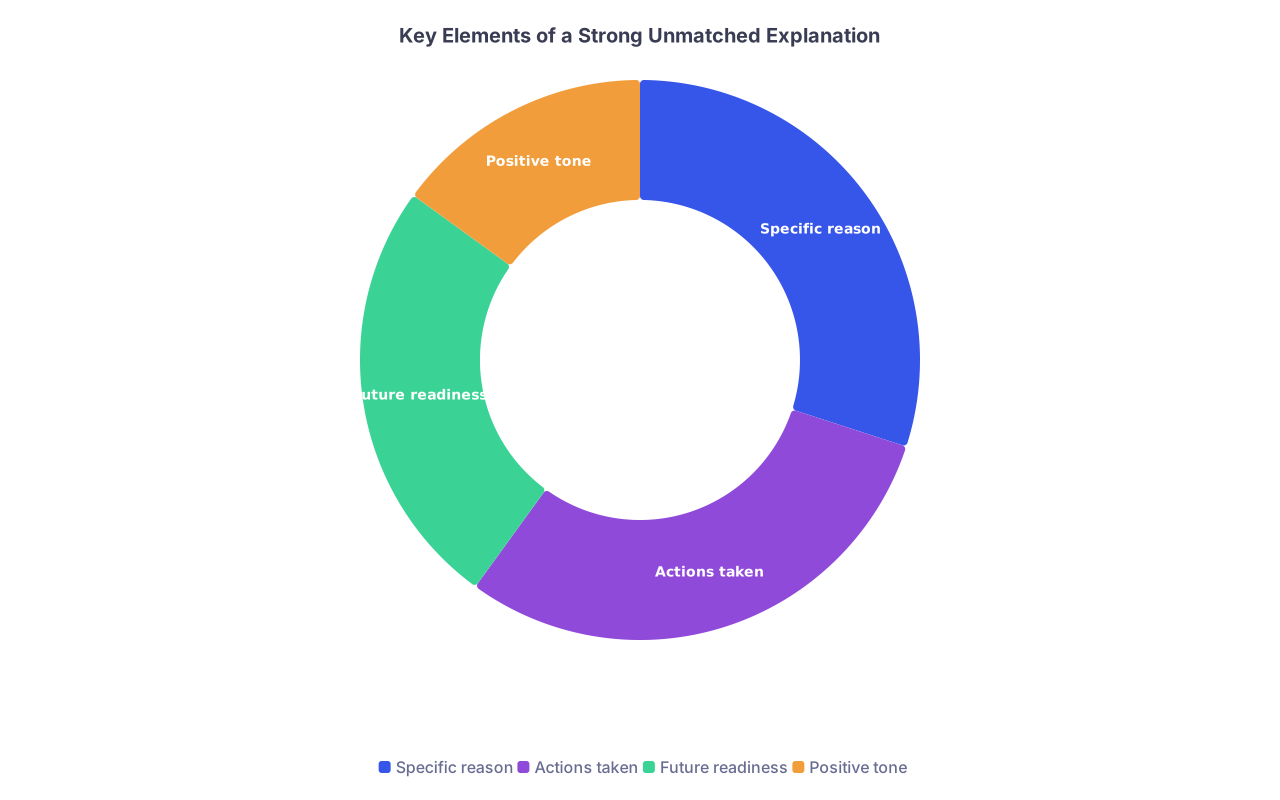
| Category | Value |
|---|---|
| Specific reason | 30 |
| Actions taken | 30 |
| Future readiness | 25 |
| Positive tone | 15 |
Concrete Plug-and-Play Templates
Here are some quick frameworks you can adapt:
- General Template
“I went unmatched because [brief clear reason]. Looking back, I should have [what you’d change]. Since then, I’ve [specific actions: rotations, work, mentorship, improved interviews/scores], and the feedback I’ve gotten from supervisors has been [positive detail]. I’m confident I’m better prepared now and very motivated to contribute as a resident here.”
- Competitive Specialty to SOAP Specialty
“Last cycle I focused only on [prior specialty], which is extremely competitive, with a profile that was borderline for that field. I did not include [current specialty], even though my strongest clinical evaluations were in this area. Over the past year, through [rotations/work/mentors], I’ve realized that [current specialty] is actually where I fit best. I’ve worked hard to strengthen my application for this path, and I’m committed to building my career in it.”
- Exam / Academic Concern
“I had a setback with [exam/rotation] during medical school, which understandably weakened my application. I took that seriously, worked with [advisor/tutor], changed my approach to studying and organization, and since then I’ve had [passing score/strong rotations/no further issues]. Those changes are durable; they’re how I plan to approach in-training exams and ongoing learning in residency.”

FAQ: “Why Did You Go Unmatched?” in SOAP
1. Should I ever say “I think it was just bad luck”?
No. You can mention that the process is competitive, but you must identify at least one concrete factor you’ve already addressed. “Bad luck” sounds like you learned nothing.
2. Do I have to bring up my red flag if they don’t directly ask?
If the red flag is obvious in your file (failed Step, LOA, professionalism note), be ready to discuss it when they ask why you went unmatched, but don’t open with it if it isn’t clearly the main reason. If they ask directly about red flags, answer head-on.
3. How honest should I be about switching specialties just for SOAP?
Do not say, “I’m only here because of SOAP.” Connect your real interests and strengths to the SOAP specialty. You can acknowledge you previously applied elsewhere, but you must make a convincing case that this field is a genuine, sustainable fit.
4. Is it okay to say my school/advisors misjudged my competitiveness?
You can say, “I realize now that I overestimated my competitiveness for that field,” or “I should have applied more broadly.” Put the responsibility on yourself and then pivot to what you’ve done differently. Blaming advisors directly looks bad.
5. How long should my answer be in a SOAP interview?
Aim for 45–60 seconds. Long enough to be specific and show growth. Short enough that you don’t ramble or sound like you’re making excuses. If they want more, they’ll ask.
6. What if I honestly don’t know why I went unmatched?
Then your job is to construct the best hypothesis based on data: number of interviews, specialty competitiveness, any weaker parts of your application. Talk to your dean’s office and mentors. Pick a reasonable explanation, own it, and focus on what you’ve done since. “I don’t know” alone is not acceptable.
Key points:
- Programs want a short, specific, accountable answer that shows growth, not blame.
- Use a 3-part structure: what happened, what you did about it, why you’re ready now.
- Script your answer, practice it, and deliver it with calm confidence—SOAP moves fast, and you need this answer locked in before the call starts.