
It’s Monday of Match Week. You just opened that email. “We are sorry to inform you…” Your stomach drops. You did not match.
You scramble through the NRMP email, see the words “you are eligible for SOAP,” and then the next hard question hits:
“I applied to [Specialty A]. But the SOAP list is full of [Specialty B and C]. Can I switch specialties in SOAP without torching my reputation or relationships?”
Here’s the direct answer: yes, you can switch specialties in SOAP without burning bridges — if you do it deliberately, with a clear strategy, and you manage your messaging. People do it every year and still end up with happy careers. People also do it badly and make programs and advisors roll their eyes.
Let’s walk through how to do it right.
1. The Core Question: Is It Actually “Safe” To Switch?
Short version: Usually yes, but not in a consequence-free, “no one will notice” way. Programs and mentors will see what you did. The key is whether your switch looks:
- Thoughtful and coherent
vs. - Desperate and chaotic
If you do it thoughtfully:
- Your home department of the original specialty will usually understand. Many have seen this before.
- The SOAP programs you apply to won’t care that you were originally in a different specialty, as long as your story and goals make sense.
- Your long-term career options are still wide open. People change specialties formally after PGY-1 all the time.
If you do it chaotically:
- Mixed, inconsistent letters and personal statements confuse programs.
- Faculty feel blindsided because they vouched for your commitment to another field.
- You look unreliable instead of adaptable.
So the safety is not in the act of switching. It’s in how you execute the switch in a compressed time frame.
2. When Switching Specialties in SOAP Makes Sense (and When It Does Not)
Let me be blunt. There are good reasons and terrible reasons to flip specialties in SOAP.
Good reasons to switch now
- Your original specialty has almost no SOAP positions.
- Your Step scores / class rank were below the typical range, and you already knew you might need a parallel plan.
- You have genuine, documentable exposure to the new specialty (rotations, sub-I, elective, research, or strong narrative link).
- You would rather have any ACGME-accredited PGY-1 (in something you can live with) than reapply next cycle.
- You’re okay with the possibility that you might stay in this new specialty and not transfer out.
Dangerous reasons to switch
- Pure panic: “Everyone says I have to SOAP into something, anything!”
- You pick a new specialty you barely understand because “it’s less competitive.”
- You assume “I’ll just switch later” without understanding that switching after PGY-1 can be brutally competitive and depends on timing, visas, funding, and open slots.
If you can’t imagine yourself being at least okay finishing residency in this SOAP specialty, pause. At least ask: “Would I rather do a prelim/transitional year and reapply to my dream specialty, or commit to this categorical spot?”
3. How Programs View a SOAP Specialty Switch
You’re worried that programs will see you as flaky. That’s not usually the main issue. Here’s how they actually think:
- They know SOAP is chaotic. They’ve seen original ortho applicants SOAP into internal medicine, EM applicants SOAP into prelim surgery, etc.
- They’re not offended that you loved another specialty first. They mostly care if you can do the job they need filled, show up, learn, and not create drama.
- What turns them off is inconsistency: a PS that screams “lifelong pediatric neurologist” attached to an application for family medicine. Or letters that clearly only speak to your passion for a completely different field.
Programs want three basic things from a SOAP applicant:
- A plausible story for why you’re applying to them now.
- Evidence that you will actually show up and stay.
- Reassurance that you’re not just using them as a throwaway backup with one foot already out the door.
You can give them all three if you’re intentional.
4. Concrete Strategy: How To Switch Specialties in SOAP Without Burning Bridges
Here’s the actual playbook.
Step 1: Decide your primary goal
You have to be clear on your own hierarchy:
- Option A: “I will do ANY ACGME-accredited categorical residency to avoid going unmatched.”
- Option B: “I strongly prefer to reapply to my original specialty next year rather than lock myself into something I don’t want.”
- Option C: “I’m genuinely okay moving into a different long-term specialty that fits my skills and life better.”
Your answer here controls everything: what you apply to, how you frame your story, and whom you involve.
Step 2: Talk to the right people — fast
You don’t have a week. You have hours.
You should contact:
- Your Dean’s office / academic advising (they’ve seen dozens of SOAP cycles and weird paths).
- Your original specialty advisor or program leadership (to avoid blindsiding them).
- A trusted attending in the new specialty if you have one.
Your script can be simple:
“Dr. X, I did not match into [Specialty A]. I’m eligible for SOAP. I see more openings in [Specialty B]. I’ve enjoyed [relevant rotation/elective] and could see myself in this field. My priority is [A/B/C from above]. Can you advise how to approach SOAP without burning bridges with [Specialty A] and still making a credible application to [Specialty B]?”
Most decent faculty will appreciate that you’re being transparent instead of vanishing into a black hole.
Step 3: Fix your documents — but don’t over-engineer
You do not have time for a multi-week personal statement surgery. You need a quick, coherent pivot.
Minimum you should do:
Create a new personal statement tailored to the SOAP specialty.
- 1–1.5 pages, focused on skills and experiences transferable to this field.
- Briefly acknowledge your prior specialty interest only if it helps your story: “I initially pursued EM because I value acute care and rapid decision-making. During my inpatient medicine and ICU experiences, I realized I was more drawn to continuity and long-term management, which is why I’m now seeking internal medicine positions.”
Fix ERAS entries that scream “I’m only about X specialty.”
- You don’t have to erase your old narrative. Just reframe a bit: emphasize broad internal medicine skills, procedural comfort, communication, teamwork, etc., instead of niche subspecialty worship.
Make sure your photo, CV, and USMLE/COMLEX are up to date and error-free. No time for perfection, but you can avoid sloppy.
You usually won’t be able to change letters or MSPE at this stage. That’s okay. Programs understand SOAP constraints.
Step 4: Manage your letters strategically
Can you use letters from a different specialty when switching in SOAP? Yes. Happens all the time.
But be smart:
Prioritize letters that show:
- Work ethic
- Clinical reasoning
- Teamwork and reliability
- Ability to function in the environment of the new specialty (floor work, inpatient, outpatient, OR, etc.)
If you have any letter from the new specialty, use it, even if it’s not your “strongest” letter on paper. Direct specialty exposure matters.
If all your letters are from your original specialty, don’t panic. Programs know SOAP is a scramble. Your personal statement and interview will carry the explanation burden.
You’re not burning bridges by using those original letters. You’re honoring the time they put into supporting you. What does burn bridges is throwing away their support and ghosting them.
Step 5: Apply wide but not random
Yes, you should cast a wide net in SOAP. But there’s a difference between wide and reckless.
Target programs where:
- You’re geographically realistic (state ties, med school location, family nearby).
- Your scores and academics are within striking distance.
- You can actually imagine going and not being miserable.
Do not apply only to a single very competitive SOAP specialty on a fantasy: “Maybe I’ll magically get derm or EM in SOAP.” That’s not strategy. That’s denial.
Step 6: Interview messaging: what to say when they ask
They will ask: “You originally applied to X. Why are you now applying to Y during SOAP?”
A clean structure:
- Acknowledge the original plan without apologizing for it.
- Identify skills or values that overlap between the fields.
- Give 1–2 concrete experiences that drew you to their specialty.
- Make a clear commitment statement.
Example:
“I applied to anesthesiology initially because I liked physiology, procedures, and working in high-acuity settings. During my medicine sub-I and ICU rotation, I realized what I enjoyed most was following patients over days, seeing their trajectory, and being involved in broader diagnostic workups. I didn’t match this cycle, and when I reviewed SOAP options, it made sense to pursue internal medicine — it aligns with how I actually like to think and work. If I were fortunate enough to match here, I’d commit fully to IM and building a career in this field.”
Notice what that does:
- It doesn’t sound like, “You’re my backup, but I’m still dreaming of anesthesia.”
- It connects the dots between past and present.
- It reassures them about staying power.
5. How To Protect Relationships While You Pivot
You’re worried about “burning bridges.” Here’s how to keep those bridges intact.
Tell your original specialty mentors the truth (briefly)
Don’t disappear. That’s how you burn bridges.
Send a short email or have a quick call:
“Dr. Y, I wanted to update you directly. I unfortunately did not match in [Specialty A]. I’m eligible for SOAP and, after discussing with advising, I’ll be applying to [Specialty B] positions as well as [prelim/transitional, etc.]. I’m very grateful for your support this cycle and the opportunities you’ve given me. I wanted to be transparent about my plans so it doesn’t come as a surprise.”
Most reasonable people respond with empathy and support. The ones who get offended by your survival strategy? That tells you more about them than about you.
Don’t badmouth your original specialty
Even if you had toxic experiences. Even if your home program was a disaster. Keep that out of your SOAP conversations.
Programs think: “If you’ll trash them to us, you’ll trash us to someone else later.”
You can be honest about misalignment (“I realized I prefer continuity to shift work”) without torching anyone.
Keep doors open for potential future switching
If you seriously might want to re-enter your original specialty later:
- Maintain polite contact: occasional updates, a thank-you email after Match, etc.
- Do good work in your SOAP specialty. Being a strong intern anywhere is the single best asset if you try to change fields later.
- Don’t tell your new program during SOAP interviews that you “definitely plan to switch out.” That’s how you lose offers. Instead, focus on committing to doing excellent work where you land.
6. What If You Regret the Switch Later?
This is the part no one wants to talk about but you’re absolutely thinking.
If you switch specialties in SOAP and later want to move:
- It is possible. People go from prelim IM to neurology, from categorical FM to anesthesia, from general surgery to radiology. I’ve watched it happen.
- It is not guaranteed. Timing (open PGY-2 slots), visas, geography, and reputation all matter.
- Your behavior as an intern matters more than your SOAP story. If your PD can honestly say, “This resident is excellent; we hate to lose them,” other programs listen.
Ironically, your best shot at eventually re-aligning with your dream specialty is to take your SOAP position seriously and crush it. Not to treat it like a holding pen you resent.
7. Quick Comparison: Strategies For Preserving Relationships While Switching
| Situation | Best Move |
|---|---|
| Did not match original specialty | Inform mentors with brief update |
| Switching to completely new field | Rewrite PS with coherent story |
| Only have letters from old specialty | Use them, explain in interview |
| Might want to reapply to old specialty | Stay polite, send updates |
| SOAPing into categorical alternate field | Commit fully in interviews |
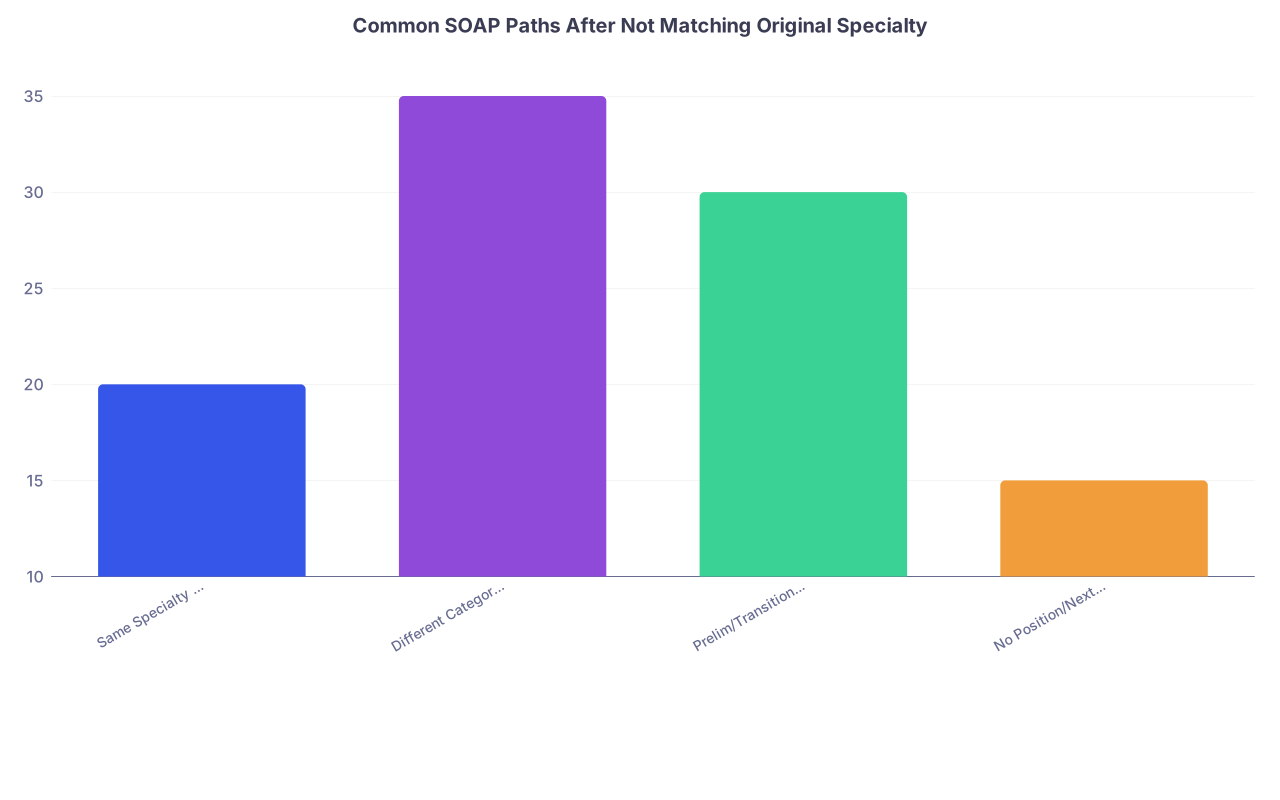
| Category | Value |
|---|---|
| Same Specialty via SOAP | 20 |
| Different Categorical Specialty | 35 |
| Prelim/Transitional Year | 30 |
| No Position/Next Cycle | 15 |

| Step | Description |
|---|---|
| Step 1 | Did not match |
| Step 2 | Apply same specialty in SOAP |
| Step 3 | Identify realistic alternate fields |
| Step 4 | Consider prelim year and reapply |
| Step 5 | Update PS and mentors |
| Step 6 | Submit SOAP applications |
| Step 7 | SOAP spots in original specialty? |
| Step 8 | Willing to change specialty? |
FAQ: Switching Specialties in SOAP Without Burning Bridges
1. Will programs see that I originally applied to a different specialty?
They won’t see your entire application history, but they will see your letters, MSPE, and how your experiences are framed. It’s usually obvious what you were initially targeting. That’s not a problem by itself. The problem is when your material is wildly misaligned with the specialty you’re SOAPing into and you never explain it.
2. Do I need a completely new personal statement for the SOAP specialty?
Yes, you should write a new one. It does not have to be perfect, but it must be coherent. One page about why you fit the SOAP specialty, how your prior experiences translate, and why you’ll commit to this path. Reusing a statement that gushes about a different field is the fastest way to sound like you’re not serious about them.
3. Am I betraying my letter writers or home department by switching fields in SOAP?
No. You’re reacting to a high-stakes situation in real time. The respectful thing is to inform them briefly, thank them, and not vanish. Most faculty have seen this exact scenario before. What damages relationships isn’t the switch — it’s ghosting, dishonesty, or badmouthing the specialty afterward.
4. How do I explain my switch in a SOAP interview without sounding desperate?
Keep it simple and forward-looking: acknowledge your original interest, connect specific skills and values that overlap with the new field, cite concrete experiences that drew you to their specialty, and end with a clear statement that you would be fully committed if you matched there. Do not overshare your emotional meltdown from Monday morning.
5. Is it better to SOAP into an alternate categorical specialty or take a prelim year and reapply?
It depends on your tolerance for risk and your career flexibility. If you can genuinely see yourself being okay in the alternate specialty long-term, a categorical spot gives security. If you’re dead set on one field and willing to risk another year of applications (and cost), a prelim or transitional year can be the better move. But there’s no universal right answer; this is where an honest talk with an advisor is critical.
6. If I SOAP into a different specialty, will I be “stuck” there forever?
Not necessarily, but you should act as if you might be, because switching later isn’t guaranteed. People do successfully change after PGY-1 or PGY-2, but it requires open positions, strong performance, and support from your current PD. Your best play is to fully engage, do excellent work, and keep optionality open — not to treat your SOAP spot like a temporary mistake.
Today, do one concrete thing: draft a 3–5 sentence explanation of your potential specialty switch that you’d be comfortable saying out loud in an interview or to a mentor. If those sentences sound honest, coherent, and forward-looking, you’re on the right track. If they sound like panic or apology, revise them now—before SOAP opens.