
Changing your mind after accepting a SOAP offer is possible. But it’s not painless, and you need to understand exactly what you’re risking before you move a muscle.
Let me be very clear: once you accept a SOAP offer, NRMP treats you as committed to that program for the entire contract year. Walking away is technically allowed only through a formal waiver. Doing it informally (ghosting, “oops I decided not to come”) is how you get labeled as a Match violator. And that label follows you.
Here’s how this actually works and what your smartest options are.
The hard rule: Accepting a SOAP offer is a binding commitment
When you click “Accept” during SOAP, you’re not just saying, “Sounds good, maybe I’ll come.” You’re entering into a binding commitment under NRMP rules.
Very simple framework:
- Before you accept a SOAP offer → you’re free to decide.
- After you accept a SOAP offer → you are committed to that program for that training year, just like if you had matched there on Monday.
- The only official way out → NRMP waiver (which is not easy, quick, or guaranteed).
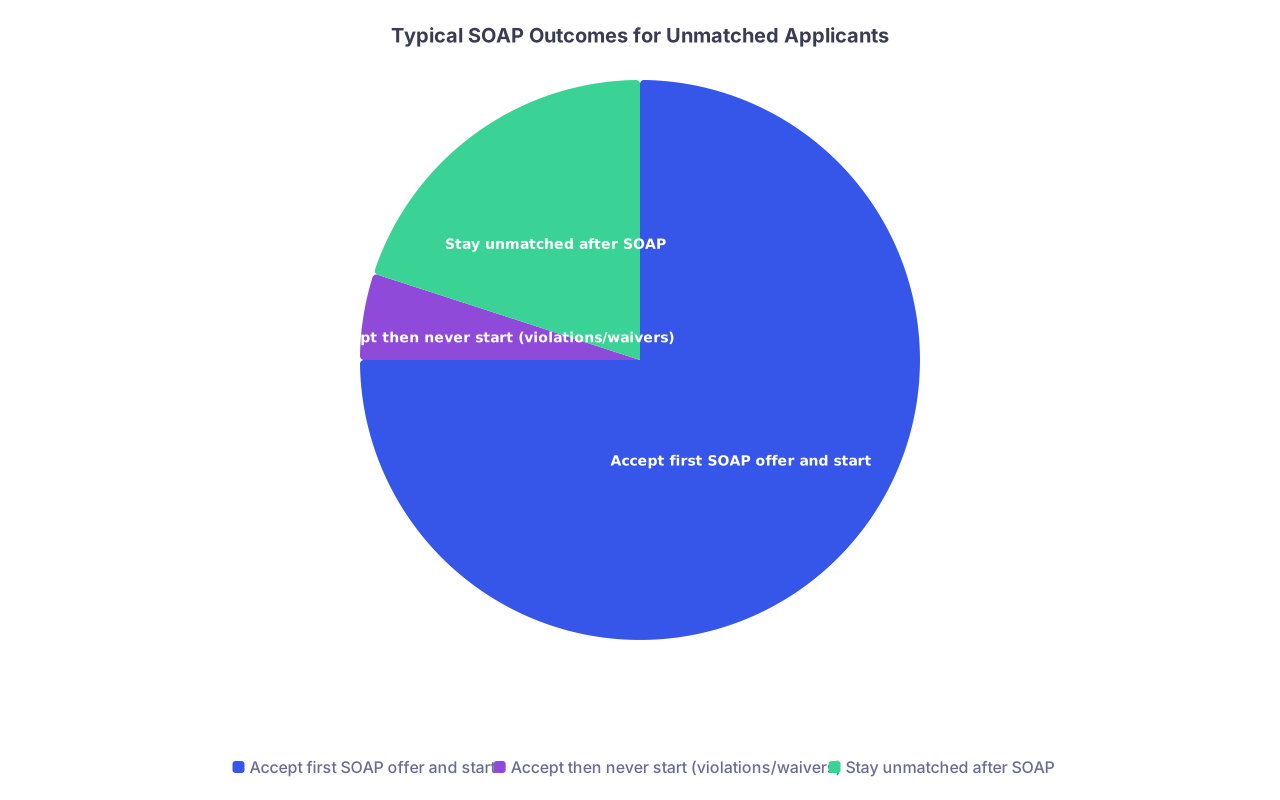
| Category | Value |
|---|---|
| Accept first SOAP offer and start | 75 |
| Accept then never start (violations/waivers) | 5 |
| Stay unmatched after SOAP | 20 |
If you’re thinking about backing out, you’re really asking one of three questions:
- Can I switch to another SOAP offer or program?
- Can I cancel this offer and sit out or try something else?
- What actually happens if I just don’t show up?
I’ll walk through each.
Scenario 1: “I accepted, but a better SOAP offer just came in”
This is the most common panic moment. You accept an offer from Program A, and then Program B (your real top choice) calls or emails asking if you’re still available.
Here’s the blunt truth: once you accept a SOAP offer, you’re removed from SOAP. You are done. You cannot accept another SOAP position that cycle.
That means:
- You can’t “upgrade” to another SOAP position.
- You can’t decline your first acceptance to take a later one.
- You can’t hold multiple offers “just in case.”
If another program reaches out after you’ve accepted:
- You must tell them you already accepted a position and are no longer available.
- If you lie or try to play both sides, you and the program both risk NRMP violations.
So the real strategy is before you accept:
- Only accept if you could actually live with going there.
- Don’t accept instantly out of fear if you know there’s a realistic chance of a better offer in that same SOAP round.
- But also don’t play “wait for the unicorn” and end up with nothing.
I’ve watched people stall too long and lose their only offer. And I’ve watched others panic-accept at 1:03 PM and then spend the next hour crying after a more desired program emails. You’re trying to balance those two extremes.
Scenario 2: “I accepted, but now I don’t want to go there at all”
This is more serious. Typical reasons:
- You got new information (toxic culture, program instability).
- A major life change (family illness, visa issue, pregnancy, finances).
- You just panicked and now deeply regret your choice.
Your options here:
Option A: Honor the commitment and go
Not glamorous, but honestly the safest path for your long-term career.
Why this is often the smartest move:
- NRMP violation stays on your record and can haunt you for years.
- Programs talk. PDs call each other. They remember the person who walked away post-SOAP.
- It’s much easier to later re-apply, transfer, or switch specialties from inside the system than from outside with a violation.
What you can do if you go anyway:
- Ask the program honestly about your concerns (hours, support, transitions).
- Reassess after PGY-1. Many people successfully:
- Switch programs
- Switch specialties
- Do a preliminary year then reapply
I’ve seen residents turn unwanted SOAP spots into solid careers by gritting through year one, building strong relationships, and reapplying smartly.
Option B: Seek a formal NRMP waiver
This is the only legitimate way to back out without an automatic violation.
How it works in real life:
- You submit a waiver request to NRMP explaining why you’re asking to be released.
- NRMP will notify the program and get their input.
- They review whether your reason is compelling enough (usually significant unforeseen hardship or change).
- They can:
- Grant the waiver (you’re released, no violation).
- Deny the waiver (you’re still bound, and walking away is a violation).
- Investigate further if things look messy.
Commonly accepted reasons:
- Major personal/family health events
- Immigration or visa issues that genuinely prevent you from starting
- Serious, documented hardship that makes relocation impossible
Commonly not accepted reasons:
- “I changed my mind.”
- “I got a better offer outside the Match.”
- “I want a different specialty.”
- “I dislike the city/program after Googling it.”
And don’t kid yourself: “I’ll just say I have family issues” without documentation or consistency often backfires. Programs and NRMP are not naïve; they’ve seen every bad excuse.
If a waiver is granted:
- You’re released from that position.
- You’re allowed to participate in future Matches normally.
- You still have to figure out what you’re doing instead (gap year, research, another specialty, etc.).
If it’s denied and you still don’t show:
- Now you’re almost certainly looking at a violation.

| Step | Description |
|---|---|
| Step 1 | Accept SOAP offer |
| Step 2 | Want to back out |
| Step 3 | Submit waiver request |
| Step 4 | NRMP reviews |
| Step 5 | Released from contract |
| Step 6 | Still bound to program |
| Step 7 | NRMP violation investigation |
| Step 8 | Start residency as planned |
| Step 9 | You refuse to go |
Scenario 3: “What if I just don’t show up?”
This is the “nuclear” path. People ask it more often than they admit.
Here’s what happens if you ghost:
- Program reports you to NRMP as not honoring your Match commitment.
- NRMP opens an investigation.
- If they find you in violation (they usually do in this scenario), consequences can include:
- You’re barred from participating in the Match for 1–3 years (sometimes longer).
- A “Match violation” goes on your NRMP record.
- Future programs see that history when they verify your status.
That violation box is a scarlet letter when you apply again. Some PDs won’t even consider applicants with prior violations, no matter how good the rest of the file looks.
So yes, technically you can just not show. Practically, it’s about the worst career move you can make unless you’ve entirely decided to walk away from GME in the NRMP system.
What if I get a non-NRMP opportunity after accepting a SOAP offer?
Example: after SOAP you accept a prelim internal medicine spot, then a one-year research fellowship or a non-NRMP categorical program offers you a position you like more.
Tempting, right? But still dangerous.
If you:
- Accepted an NRMP position (SOAP or main Match), and
- Then sign a contract elsewhere for that same training year without a waiver,
you’re still at risk of a violation. NRMP rules don’t suddenly stop applying just because the other opportunity is “outside the Match.”
Right way to handle this:
- Request an NRMP waiver first.
- Be transparent with the other opportunity about your timeline and obligations.
- Only accept the new role once you’ve been formally released.
If you try to be clever and double-sign, you put both institutions and yourself in a mess. PDs really hate feeling like they got played.
How to decide: should I stay or should I try to get out?
Here’s a practical framework I use with students:
| Question | If Mostly YES | If Mostly NO |
|---|---|---|
| Is this program at least tolerable for 1 year? | Strongly consider going | Explore waiver or alternate plans |
| Is your reason truly major/unforeseen (health, visa, family crisis)? | Waiver request reasonable | Waiver less likely; risk rises |
| Would a Match violation seriously hurt future goals? | Avoid violation at all costs | Only accept violation if leaving medicine |
| Do you have a realistic, concrete alternative plan? | Leaving might be viable | Staying is probably safer |
Then ask yourself three blunt questions:
- If I just swallow my pride and go, can I build a decent career from here?
- If I walk away and eat a violation, do I have a backup path that doesn’t rely on NRMP soon?
- If I apply again in 1–2 years, which version of my story will be easier to explain to a PD?
Very often, the answer is: go, be the best resident there, and reposition yourself later.
If you haven’t accepted yet: how to avoid this mess entirely
Most of the agony I see could have been prevented 24 hours earlier.
Before you click “Accept” on a SOAP offer, hammer through this checklist:
- Would I rather do this than:
- Take a full gap year?
- Do research or an MPH?
- Reapply next cycle?
- Can I realistically see myself staying there at least PGY-1?
- Is this specialty still acceptable to me long-term or as a stepping stone?
- Am I saying yes from blind panic, or from a thought-out plan?
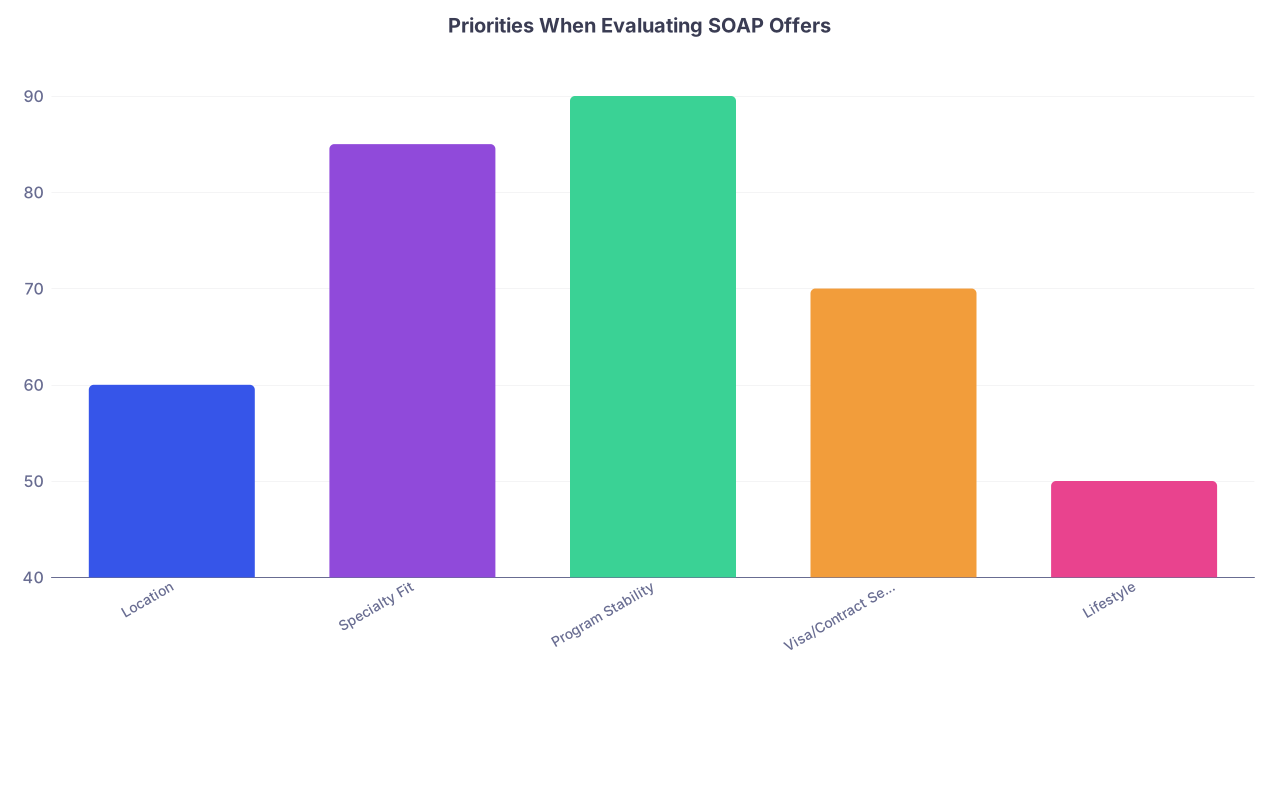
| Category | Value |
|---|---|
| Location | 60 |
| Specialty Fit | 85 |
| Program Stability | 90 |
| Visa/Contract Security | 70 |
| Lifestyle | 50 |
Notice: “panic and fear of being unmatched” isn’t on that list. It’s real, but it’s not a strategy.
If you’re truly unsure and it’s early in the round, you can ask for a bit of time to think (some programs will give you an hour or two; others won’t). But don’t drag this out unreasonably or play games with programs. That backfires fast.
How to talk to the program if you’re thinking of backing out
If you’re even considering not going, do not just ghost or send a one-line email.
Better approach:
Pause. Don’t promise anything to anyone else yet.
Script something like this:
- “I want to be transparent. I’m struggling with some serious personal/financial/family issues that came up after I accepted. I’m committed to doing the right thing, and I don’t want to leave you in a bad position. Can we talk about what’s possible here, including timing, support, or, if necessary, involving NRMP to request a waiver?”
Be honest but controlled. Don’t trash the program or sound flaky.
Listen to their response. Some programs:
- Offer creative solutions (delayed start, extra support).
- Are surprisingly understanding about waivers in genuine hardship cases.
- Or are very firm. Then you know what you’re dealing with.
Even if you ultimately stay, this conversation can clear the air and prevent your name from being associated with rumors before you even arrive.
Mental health side: it’s normal to freak out
SOAP decisions are made under disgusting pressure:
- You’re exhausted.
- You’ve just been told you didn’t match.
- You’re making career-defining decisions on a countdown clock.
So yes, it’s normal to feel regret, panic, or dread after you click accept.
Before you blow everything up, talk to:
- A trusted faculty advisor who understands NRMP rules.
- Your dean of students or student affairs office (they’ve seen this exact scenario).
- A resident you trust in that specialty.
- A therapist or counselor, if your anxiety is spiraling.

You want to separate:
- “This is actually an unworkable or unsafe situation” from
- “I’m grieving my original dream and scared this won’t be perfect.”
Those are very different problems with very different solutions.
Real talk: reputational damage and future applications
Programs will absolutely ask about any disruptions:
- “Why did you leave your prior program?”
- “Why didn’t you start the position you matched to?”
- “What happened with the NRMP violation?”
It’s much, much easier to say:
- “I honored my SOAP commitment, completed a strong prelim year, and realized I’m better suited for X. My PD is supportive and wrote me a letter.”
Than:
- “I accepted a SOAP offer, then didn’t show up, then got an NRMP violation, but trust me, I won’t do that again.”
Think like a PD. They’re betting 3–7 years of training investment on you. Trustworthiness matters almost as much as board scores.
Simple bottom line
- Accepting a SOAP offer = binding NRMP commitment for that year.
- Changing your mind is not just an email and “sorry!” You either:
- Honor the commitment, or
- Go through the formal NRMP waiver process and hope they agree your reason is legitimate.
- Ghosting or casually backing out is a fast track to an NRMP violation and long-term damage.
If you’re on the fence right now, your safest default is: assume you’ll have to live with whatever you accept. Because in almost all cases, you do.

FAQs

1. Can I withdraw from a SOAP offer before I sign the contract with the hospital?
No, not safely. NRMP considers your acceptance in the SOAP system itself as the binding commitment, not the hospital’s HR paperwork. Even if you haven’t signed the hospital contract yet, you’re still bound by NRMP rules once you click accept. Walking away without a waiver can still be a violation.
2. Does a SOAP acceptance limit my ability to reapply in future cycles?
Not at all. Many people complete a prelim year from SOAP, then reapply for a different specialty or a categorical spot. In fact, being inside a residency, earning strong clinical evaluations, and getting letters from attendings can make you a stronger applicant next time—far stronger than sitting out a year with nothing on your CV.
3. How long does an NRMP waiver request usually take and will it delay other plans?
It can take weeks to months, depending on complexity and how quickly everyone responds. During that time, programs and other opportunities may hesitate to commit until your status is clear. That’s why you should submit a waiver request quickly once you realize there’s a genuine, serious issue—not after dragging it out for months.
4. If I get an NRMP violation, can I ever match again?
Sometimes yes, sometimes no. It depends on:
- The severity of the violation
- Whether you’re barred from participating for a set period
- How you explain it later Even if you’re allowed back into the Match, a violation is a serious red flag for PDs. You’ll need a very strong application, clear explanation, and ideally letters from people who can vouch for your professionalism.
5. Should I ever intentionally not rank programs I’d only take in SOAP?
If you are 100% certain you’d rather go unmatched than train there, then don’t rank them. Because if you rank them and match, or if you accept them in SOAP, you’re committing. But be brutally honest with yourself: is “I don’t love this city” really worse than being fully unmatched, doing a gap year, and trying again in a tougher cycle? For most people, a less-than-perfect program is far better than no program at all.
Key points to walk away with:
- Accepting a SOAP offer is binding under NRMP—treat it like a Match.
- Backing out safely requires a formal NRMP waiver; casual withdrawal risks a violation.
- In most cases, honoring the commitment, doing the year well, and repositioning later is the safest long-term career move.