What actually moves the needle in SOAP: you calling programs yourself, a faculty advocate making calls, or trying to line up both and hoping something sticks?
Let me answer that directly: if you can get both you and a strong faculty advocate calling, that’s the best-case scenario. But that is not always realistic, and done wrong it can actually hurt you. So you need a strategy, not chaos.
Here’s how to think about it.
Core Rule: You’re The Primary, Faculty Are The Force Multiplier
During SOAP, programs are sorting through frantic emails, ERAS updates, and way too many applicants. They do not have time for confusion.
Your guiding principle:
- You = primary communicator and “face” of your application
- Faculty = credibility amplifier and door-opener, used selectively and strategically
If you only remember one hierarchy, it’s this:
- You must be reachable and responsive yourself.
- Faculty calls are optional but powerful.
- Random people calling “on your behalf” is noise.
When I’ve seen SOAP go well, students did 3 things:
- Took ownership of direct communication (calls/emails).
- Used one or two well-positioned advocates.
- Gave those advocates a focused, realistic target list.
The people who relied on “my school said they’re calling around for me” without doing their own outreach? Usually ended up disappointed.
When YOU Should Be Making Calls Yourself
Short answer: almost always.
Programs expect to interact with you, the applicant. Even if faculty are advocating, you still need to:
- Call to clarify interest
- Respond to interview offers lightning fast
- Follow instructions from the program coordinator
- Handle any quick “mini interview” questions over the phone
Here’s when you definitely should be the one picking up the phone:
Cold calling programs you’re applying to in SOAP
If the program hasn’t heard of you, a faculty cold call without you having applied or reached out can feel random. Your steps should be:
- Make sure your ERAS materials are updated and accurate
- Apply to the position in SOAP
- Then send a short email + possibly a call:
- “I’ve just applied to your prelim medicine spot through SOAP…”
- One or two lines on fit
- Offer to be available immediately for an interview
Answering any program-initiated calls
In SOAP, many “interviews” are fast phone calls or Zooms set up on short notice. That means:
- Your phone must be on loud
- Voicemail must be set up and professional
- You call back immediately if you miss something
You cannot offload that to anyone else. Programs are assessing professionalism and communication in real time.
Following up after your faculty advocate calls
Let’s say your PD or advisor calls a program on your behalf. Great. Your job:
- Email the program to express interest
- Reference the shared connection only briefly (“Dr. X from [your school] mentioned your program”)
- Be ready if they reach out quickly; faculty can open the door, but you must walk through it.
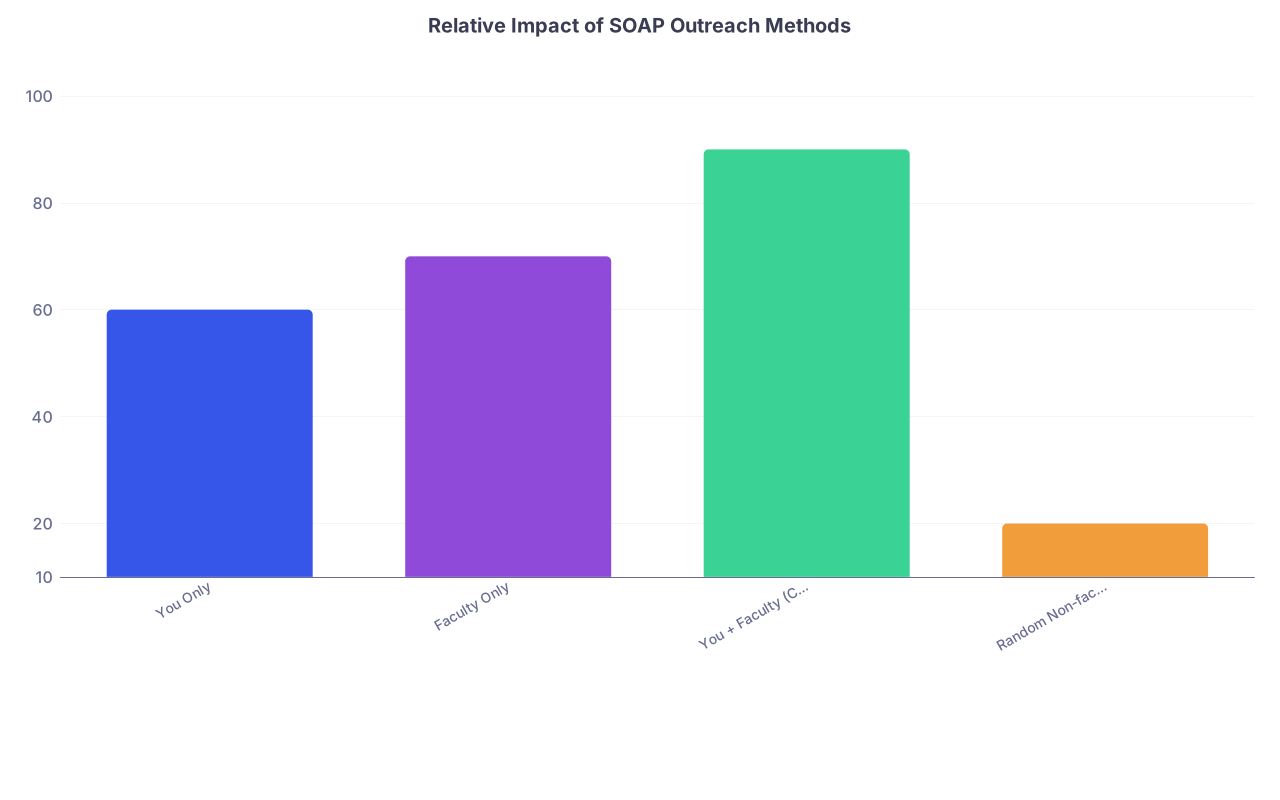
| Category | Value |
|---|---|
| You Only | 60 |
| Faculty Only | 70 |
| You + Faculty (Coordinated) | 90 |
| Random Non-faculty Advocates | 20 |
When FACULTY Should Be Making Calls For You
Faculty calls are not magic. A random non-IM doctor calling an IM program director they have never met before? That’s just awkward.
Faculty advocacy is most powerful when:
- There’s a real relationship or known connection
- Your advisor/PD knows your file and can vouch specifically
- They’re calling within the same specialty or region
Situations where faculty calls are high-yield:
Home department to affiliated or known programs
Examples:
- Your internal medicine PD calls a community IM program where former residents now work
- Your surgery chair reaches out to a regional PD they trained with
- Your school has a known pipeline to several smaller programs
Those calls often sound like:
- “We have a student in SOAP who I’d rank in our top third in terms of clinical performance, just had a rough interview season.”
- “We’ve had three residents from our school match with you in the last five years; this one is similar or better.”
That kind of advocacy does move applications to the top of the review stack.
Explaining red flags
If you have:
- A Step 1 or Step 2CK failure
- A leave of absence
- A professionalism concern that’s now resolved
A faculty member who knows the full context can say:
- “They failed Step 1 early, remediated, crushed Step 2 with a 243, and their clinical performance has been excellent. I trust them with patients.”
Programs are much more comfortable hearing that from a PD or dean than from you alone.
You’re a strong candidate who under-applied or targeted too high
I’ve seen excellent students who overreached and ended up in SOAP. Their PD calling and essentially saying:
- “They’re better than their SOAP status suggests. If you pick them up, you’re getting a very solid resident.”
That matters. Especially at solid mid-tier or smaller community programs who love getting unexpectedly strong applicants.
When You Want BOTH: But Coordinated, Not Chaotic
The best SOAP strategy for most people: you + 1–2 focused faculty advocates, working from the same playbook.
That means:
- You are not having five random attendings call five different programs with five different stories.
- You are not sending emotional, rambling emails while your PD is giving some totally different version of events.
- You are not asking faculty to cold call programs where you haven’t even applied.
Think in terms of roles.
Your job:
- Create a ranked, realistic target list of programs
- Update your ERAS documents and make them as clean as possible
- Draft a tight outreach email template you can customize
- Be immediately reachable
Faculty job:
- Identify where they have real connections
- Call or email a small subset of programs that:
- Fit your profile
- Are in your geographic preferences
- Have open positions matching your credentials
Here’s how a clean version of “both” looks in practice:
- You identify 15–20 realistic programs in your specialty (or in a backup prelim/TY if needed).
- You and your advisor go over the list:
- 5 where they have a connection → high-priority faculty calls + your personal outreach
- 10–15 where you’ll reach out yourself (email; call if program culture allows)
- Faculty sends focused, short advocacy notes or calls:
- Highlights 2–3 of your strengths
- Gives context for one or two weaknesses
- Emphasizes your reliability and work ethic
- You send your own email to the same programs, without sounding like a robot or a beggar:
- Confirm application submitted in ERAS
- One sentence on your background
- One line on why you like that program/location
- “I’d be honored to interview if there’s an opportunity during SOAP.”
| Scenario | Best Caller |
|---|---|
| Introducing yourself to a new program | You |
| Leveraging a known connection | Faculty (plus you) |
| Clarifying red flags / academic issues | Faculty |
| Scheduling / logistics / quick questions | You |
| Explaining strong but unusual application | Faculty (plus you) |
| Expressing interest after their outreach | You |
Who Should Not Be Calling For You
This is where people quietly torpedo themselves.
These “advocates” mostly just irritate program staff:
- Parents calling programs
- Family friends who are physicians but not in the specialty and have zero relationship with the PD
- Random community attendings who “want to help” but don’t know your record in detail
- Classmates or residents emailing on your behalf with no authority
Why this backfires:
- It looks unprofessional and desperate
- It suggests you lack insight or boundaries
- It creates more noise for overwhelmed coordinators and PDs
If you’re tempted to ask “my mom knows a cardiologist in town, can she call?” — no. She cannot. If that cardiologist actually trained with the PD and wants to send one short, factual email? Maybe. But that’s faculty-level advocacy, not “my mom called her doctor friend.”
Realistic Strategy By Applicant Type
Let me be blunt: not all SOAP applicants benefit equally from faculty calls. You need to be honest about your profile.
Strong candidate, unlucky or overreached
Example:
US MD, solid scores (Step 2 CK 240+), good clinical evaluations, but you only applied to hyper-competitive regions or top-heavy lists.
Strategy:
- You + strong faculty advocacy
- Focus on:
- Mid-tier academic
- Solid community programs
- Geographies more open to out-of-region applicants
- Faculty framing: “This is someone we would be proud to have; they just aimed too high geographically or program-wise.”
Average candidate, no major red flags
Example:
US MD/DO, Step 2 CK in 220–235 range, decent but not spectacular CV, maybe late to applying broadly.
Strategy:
- You as primary communicator
- Faculty calls to:
- Programs where your school often sends residents
- Places where they actually know someone
- Don’t waste faculty capital on top-tier programs that are going to fill from unmatched powerhouses before even looking at your file.
Candidate with red flags
Example:
- Step failure
- LOA for non-trivial reasons
- Professionalism note that is officially “resolved”
Strategy:
- Faculty must be involved
- You do not lead with your red flag in writing
- Faculty explains context and current performance:
- “They had a rough patch year 2, but in clinical years they’ve consistently been in the top half to top third.”
- You emphasize:
- Maturity
- Reliability
- Strong performance in recent rotations

| Step | Description |
|---|---|
| Step 1 | Identify program |
| Step 2 | Faculty + you contact |
| Step 3 | Faculty contact if possible |
| Step 4 | You contact directly |
| Step 5 | Be reachable for interview |
| Step 6 | Have real faculty connection |
| Step 7 | Any major red flags |

Practical Scripts: What Each Person Should Actually Say
No one gives you scripts, then wonders why students sound awkward. So here are straightforward versions you can adapt, not memorize word-for-word.
Your script (email)
Subject: Applicant for [Specialty] SOAP position – [Your Full Name, AAMC ID]
Body (short):
“Dr. [Last Name],
I’ve applied to your [specialty, PGY-1 or prelim] position through SOAP. I’m a [US MD/DO, IMG] senior from [School] with strong interest in [brief focus – community medicine, hospitalist path, surgical training, etc.].
I completed recent rotations in [relevant fields], and I’m very interested in training in [region/program feature]. I would be grateful for consideration and am available immediately for an interview if there’s an opportunity.
Thank you for your time,
[Full name]
[School]
[Cell number]”
Faculty script (phone or email)
“Hi [First name if they know them, otherwise Dr. Last Name],
This is [Dr. X], [role – IM program director / clerkship director / associate dean] at [School]. I’m calling about one of our seniors in SOAP, [Your Name]. They’ve applied to your [specialty] position.
They’re [1–2 strengths: clinically strong, very reliable, team-oriented]. We were surprised they ended up in SOAP and think they’d be an asset in a program like yours. If you have any flexibility to review their application, I’d appreciate it. I’m happy to answer any questions about their performance or background.
Thanks for taking the time.”
That’s it. Short. Concrete. Respectful of the PD’s time.
Common Mistakes That Quietly Kill Your Chances
I’ve watched these play out year after year:
- You assume your school is “making calls for you” but never clarify who, where, or how many. Translation: probably not much is happening.
- You let five different faculty members email five different PDs with five different descriptions of you. Inconsistent = red flag.
- You don’t answer your phone because the number is unknown. Programs do not leave ten voicemails.
- Your voicemail box is full or has a joke greeting. They move on.
- You have a family member harassing coordinators. Program notes your name and quietly avoids you.
If you’re going to use faculty, do it intentionally. One PD or one dean who really knows your story is better than seven random “advocates.”
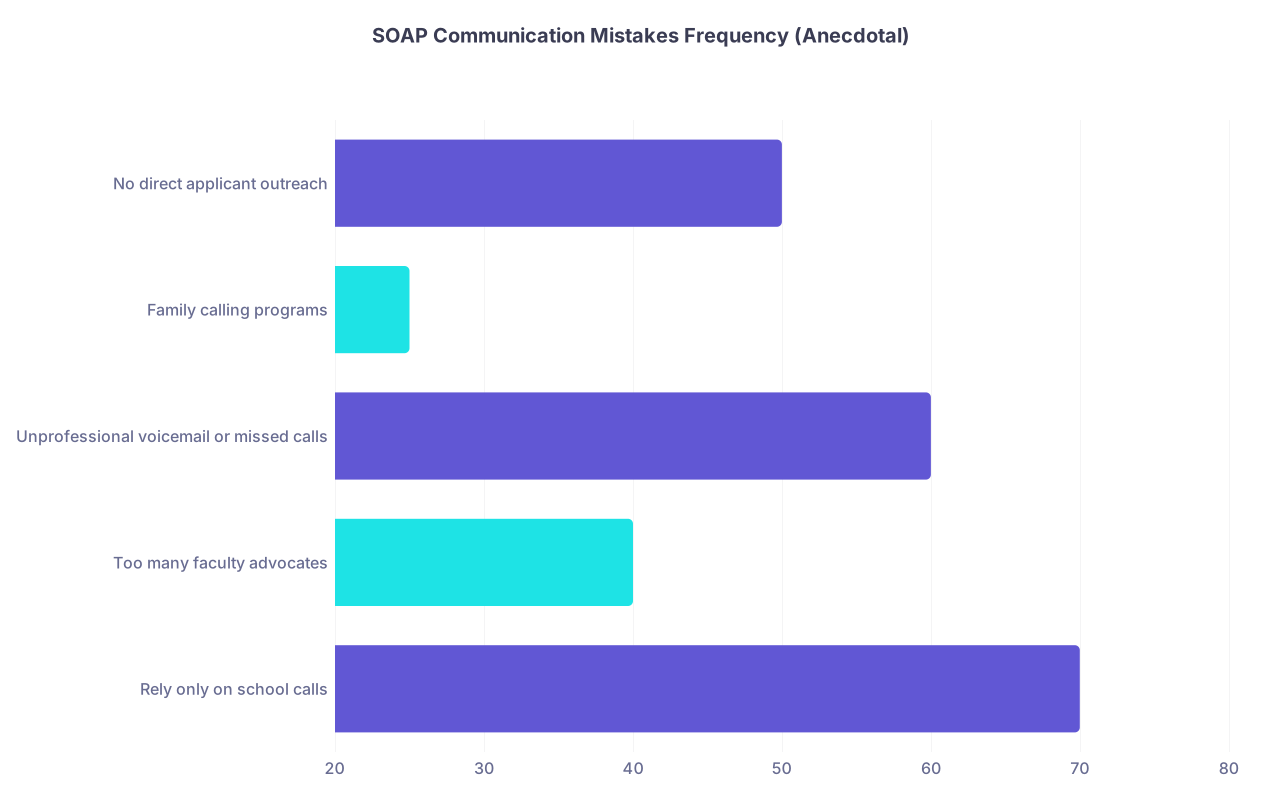
| Category | Value |
|---|---|
| Rely only on school calls | 70 |
| Too many faculty advocates | 40 |
| Unprofessional voicemail or missed calls | 60 |
| Family calling programs | 25 |
| No direct applicant outreach | 50 |
FAQ: Calls During SOAP – Exactly 7 Questions
If my school says they’re “supporting me in SOAP,” does that mean they’re calling programs?
Not necessarily. “Supporting” can mean anything from updating your MSPE to sending one generic email to all PDs. Ask specifically: “Who will be making calls or sending individual emails on my behalf, and to how many programs?” If the answer is vague, plan your own outreach and request targeted advocacy, not blind assurance.Should I call programs myself, or is email enough?
Start with email for most programs. Many explicitly prefer not to be called during SOAP chaos. If a program seems open to calls (small community programs, places where your faculty have personal connections), a short, respectful phone call can help. But never badger coordinators, and don’t call the same place multiple times in a day.How many programs should my faculty realistically call?
Quality beats quantity. For most students, 3–8 personalized faculty contacts to aligned programs is ideal. Once faculty start sending mass emails to 20+ programs, it loses impact and feels like spam. Focus on programs within your reach where there’s at least some personal or institutional connection.Does it matter which faculty member calls for me?
Yes. Hierarchy and relevance matter. Best: PD, APD, clerkship director, or a senior faculty member who has actually worked with you clinically. Second-best: dean-level person who knows your story well. Weak: random attending you barely worked with. Useless: anyone outside your field with no relationship to the PD.What if I’m an IMG or from a newer school with weak connections?
You still benefit from faculty calls, but the bar is higher. Focus on: alumni from your school at specific programs, prior matched residents who can flag your file internally, and any faculty who trained or worked at your target programs. Even if they don’t know the PD personally, a clear, concise email from a faculty member beats silence.Should faculty call before or after I apply to a program in SOAP?
After. Always after or at least simultaneously. If your name is not already in ERAS for that position, the PD has nowhere to look you up, and it feels premature. Ideal flow: you apply → you email the program → your faculty advocate reaches out within a similar time window and mentions you’ve already applied.Can I ask residents at a program to advocate for me during SOAP?
Carefully. Residents can sometimes nudge a PD to look at an application, but they don’t carry the same weight as faculty or leadership. One short, targeted message from a resident who genuinely knows you can help. A mass group text to ten residents asking them to “put in a word” is annoying and unprofessional. Use it sparingly.
Key points to walk away with:
- You must be the primary communicator during SOAP; faculty are a targeted amplifier, not a replacement.
- One or two well-positioned faculty making focused calls to realistic programs beats a swarm of random advocates.
- Never delegate professionalism: answer your phone, clean up your voicemail, and coordinate your outreach so everyone tells the same story.