
Taking a SOAP position does not automatically kill your fellowship dreams—but how you handle the next 2–3 years will decide everything.
Let me be blunt: program directors care far more about your performance in residency than about the fact that you came through SOAP. I’ve seen SOAP residents land GI, cardiology, heme/onc, pain, critical care, even competitive fellowships—when they played their cards right. I’ve also seen people blame SOAP for fellowship failures that were actually caused by weak evaluations, no research, and coasting through training.
Here’s the real answer you’re looking for: SOAP can narrow some doors if you’re not strategic, but it does not hard-cap your future. You’re not doomed. You just lost the luxury of being sloppy.
Let’s walk through what actually matters.
1. How Fellowship Programs Really View SOAP

Fellowship directors are not sitting around memorizing who matched in the main NRMP round versus SOAP. They look at:
- Your residency program’s reputation and rigor
- Your clinical performance and evaluations
- Letters of recommendation from trusted faculty
- Research and scholarly work
- Any red flags (remediation, professionalism issues, unexplained gaps)
SOAP status? That’s at most a footnote.
Where SOAP can indirectly matter:
- You end up at a lower-resourced or non-academic program with limited research or subspecialty exposure.
- You land in a specialty or program that doesn’t align with your long-term fellowship goals (e.g., you wanted cardiology but SOAPed into prelim surgery with no medicine continuity).
But those are structural obstacles, not a permanent brand on your forehead.
Most fellowship application systems (ERAS for fellowships, SF Match, etc.) don’t even highlight “SOAP” anywhere. Programs may notice from the timeline or your CV that you scrambled, but they also know this: every year, great applicants land in SOAP because of strategy, geography, couples match, test timing, or just bad luck.
The summary: fellowship programs care about who you are now as a resident, not who you were on Match Day.
2. Which Fellowships Are Still Very Realistic After SOAP?
Here’s the truth nobody tells you clearly: your specialty and residency environment matter more than how you got the position.
If you SOAP into an ACGME-accredited categorical residency and do well, you’re viable for a wide range of fellowships.
| Fellowship Type | Typical Difficulty After SOAP | Key Factors That Matter Most |
|---|---|---|
| Hospitalist / No fellowship | Easy–Moderate | Strong clinical performance |
| Pulm/Crit Care, Nephro, Endo | Moderate | Letters, some research |
| Cardiology, GI, Heme/Onc | Hard but doable | Top evaluations, strong mentors, real scholarly work |
| Pain, Critical Care (Anes/IM) | Moderate–Hard | Case volume, rotations, letters |
| Less competitive subspecialties | Usually realistic | Show interest + reliability |
pattern I’ve seen:
Soap into internal medicine at a solid community or smaller academic program
→ Do very well, grab some research, work with subspecialists
→ Cards, GI, heme/onc stay on the table, just more competitiveSOAP into FM, peds, psych, neurology, anesthesia
→ You can still get their respective subspecialty fellowships if you top-perform and secure mentorsSOAP into prelim year only
→ You must treat that year as an audition year and reapply smartly, or you risk drifting with no categorical spot and no clear path to fellowship
The leverage point is not SOAP. It’s: Are you in the right specialty and environment, and are you performing at the top of that environment?
3. Biggest Real Risks of Taking a SOAP Position
There are real downsides, but they’re not what people obsess over.
1. Ending up at a weak or isolated program
Some SOAP programs:
- Have minimal research infrastructure
- Have few or no subspecialists on faculty
- Rarely send residents to competitive fellowships
- Have high service load and low teaching/mentorship
This doesn’t make fellowship impossible. It just means you’ll have to:
- Aggressively seek external research (multi-center collaborations, virtual projects)
- Attend conferences early and network
- Get letters from recognizable names, even if outside your home program
If you loaf in that setting, yes—your fellowship options will narrow quickly.
2. Wrong specialty for your long-term goal
Common scenario: you want cardiology, but SOAP only has prelim surgery or transitional year.
If you take a prelim with no clear path to a categorical IM spot, then yes—cardiology (and other IM subspecialties) may become extremely difficult or functionally impossible.
If your ultimate identity is tied to a specific fellowship (e.g., “I want to be a GI doc, not just anything in medicine”), then you cannot treat SOAP as “anything is fine.” You need to prioritize:
- Getting into the correct core specialty (IM for GI/cards/heme-onc, peds for peds subspecialties, etc.)
- Or at least a prelim year that realistically lets you re-enter the right specialty next cycle
3. Stigma inside your own program
Some programs are mature about SOAP. Others are…less so.
You might hear throwaway comments like “This program SOAPed hard last year” or “We took a lot of SOAP residents.” Rarely, a faculty member will quietly assume SOAP residents are weaker.
You counter that with performance:
- Show up early
- Know your patients cold
- Be the resident the attendings trust on busy nights
Within 3–6 months, nobody cares how you matched if you’re clearly strong.
4. Strategy: If You SOAP and Still Want a Competitive Fellowship
Now the real “how-to” that you actually need.
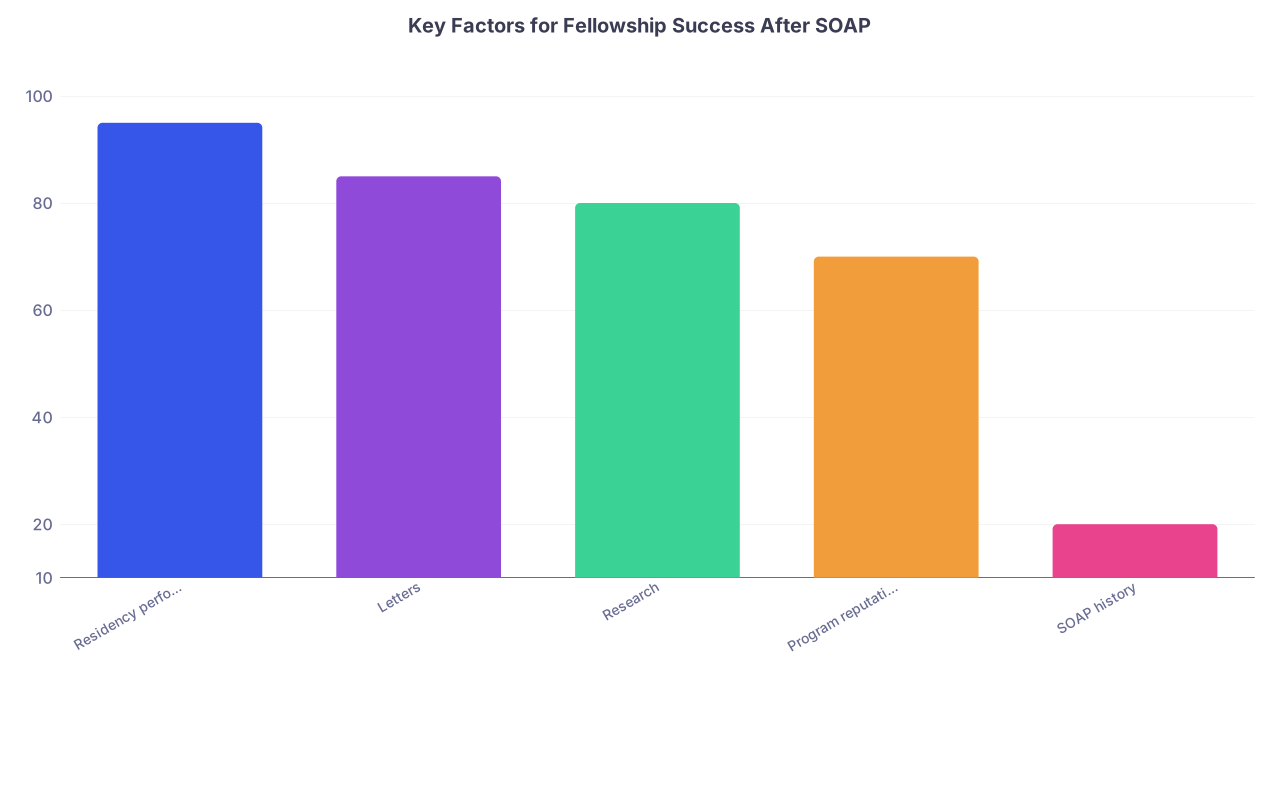
| Category | Value |
|---|---|
| Residency performance | 95 |
| Letters | 85 |
| Research | 80 |
| Program reputation | 70 |
| SOAP history | 20 |
Step 1: Be intentional about which SOAP spot you accept
During SOAP, do not just think “I need any job.” Think:
- Does this get me into the correct core specialty?
- Is this program ACGME-accredited, with at least some academic connections?
- Do they have subspecialists in my area of interest on staff?
- Do graduates successfully place into any fellowships?
If your long-term dream is fellowship-heavy (GI, cards, heme/onc, critical care, etc.), a categorical IM spot at a mid-tier program is almost always better than a prelim in a more “prestige” field with no clear path.
Step 2: First year = reputation-building year
Your PGY-1 year sets your trajectory. I’ve watched this play out over and over.
You want:
- Strong clinical evals from day one
- At least one attending on your side who says “this resident is going to do great things”
- No professionalism flags, no chronic lateness, no complaining reputation
Your name should come up when faculty are informally asked, “Who are our top residents this year?”
Step 3: Secure mentors and letters early
By mid-PGY-1 or early PGY-2:
- Identify 1–2 subspecialists in your target field (even if they’re visiting or adjunct)
- Make your fellowship interest explicit: “I’m interested in GI; I know I SOAPed in, but I want to be competitive. What would you do in my position?”
- Ask to help with a project, QI, case report, or small study
You’re not asking for a random letter from whoever will write it. You’re building a relationship with someone who will later say:
“This resident came through SOAP but has outperformed expectations and is in the top X% of our trainees.”
That line carries serious weight.
Step 4: Do real scholarly work, not checkbox fluff
Fellowship programs don’t care about “Presented a poster at local hospital day” as your flagship accomplishment.
You want:
- At least one substantial project: retrospective study, clinical research, or multi-center project
- A couple of case reports or small series are fine as supplements
- Your name on at least one publication or significant abstract by application time (PGY-2 or early PGY-3 for IM)
If your home program is weak on research, use multi-institution collaboratives (e.g., for IM: you can find virtual collaborative projects, subspecialty societies, mentors through conferences).
Ask your mentors directly: “What project could I realistically complete in 9–12 months that would help my fellowship application?”
Step 5: Be strategic with where you apply for fellowship
You don’t have to chase only top-10 name brands. You need programs that:
- Know your home program, or at least are regionally aware of it
- Have a track record of taking residents from community programs
- Value work ethic and performance over pedigree
Overweight:
- Places where your mentors have contacts
- Regions where your residency program occasionally sends fellows
- Programs that interview broadly, not only top-tier academic hospitals
5. Special Cases: SOAP into Prelim vs Categorical

| Step | Description |
|---|---|
| Step 1 | SOAP Match |
| Step 2 | Build strong residency record |
| Step 3 | Apply for fellowship |
| Step 4 | Plan reapplication |
| Step 5 | Now same path as categorical |
| Step 6 | Reassess fellowship goals |
| Step 7 | Categorical spot? |
| Step 8 | Get categorical in target specialty? |
If you SOAP into a categorical spot
You’re in good shape. Your path is standard:
- Excel in residency
- Build mentorship and research
- Apply for fellowship on a normal timeline
SOAP becomes background noise.
If you SOAP into a prelim year only
This is riskier for future fellowships. Your priorities:
Use the prelim year to:
- Prove you’re a strong resident
- Get standout letters (“one of the best interns I’ve worked with”)
- Clarify your specialty commitment
Reapply early and aggressively to categorical positions in your target specialty. Treat this like a second Match, not an afterthought.
Be realistic: If you cannot secure a categorical IM spot after prelim, many IM-based fellowships (cards, GI, heme/onc) become logistically very difficult. You may need to pivot priorities.
The prelim year can be a launchpad or a holding pattern. You decide which one.
6. How Much Does “Program Name” Matter After SOAP?
Program reputation matters. But not in the cartoonish way people think.
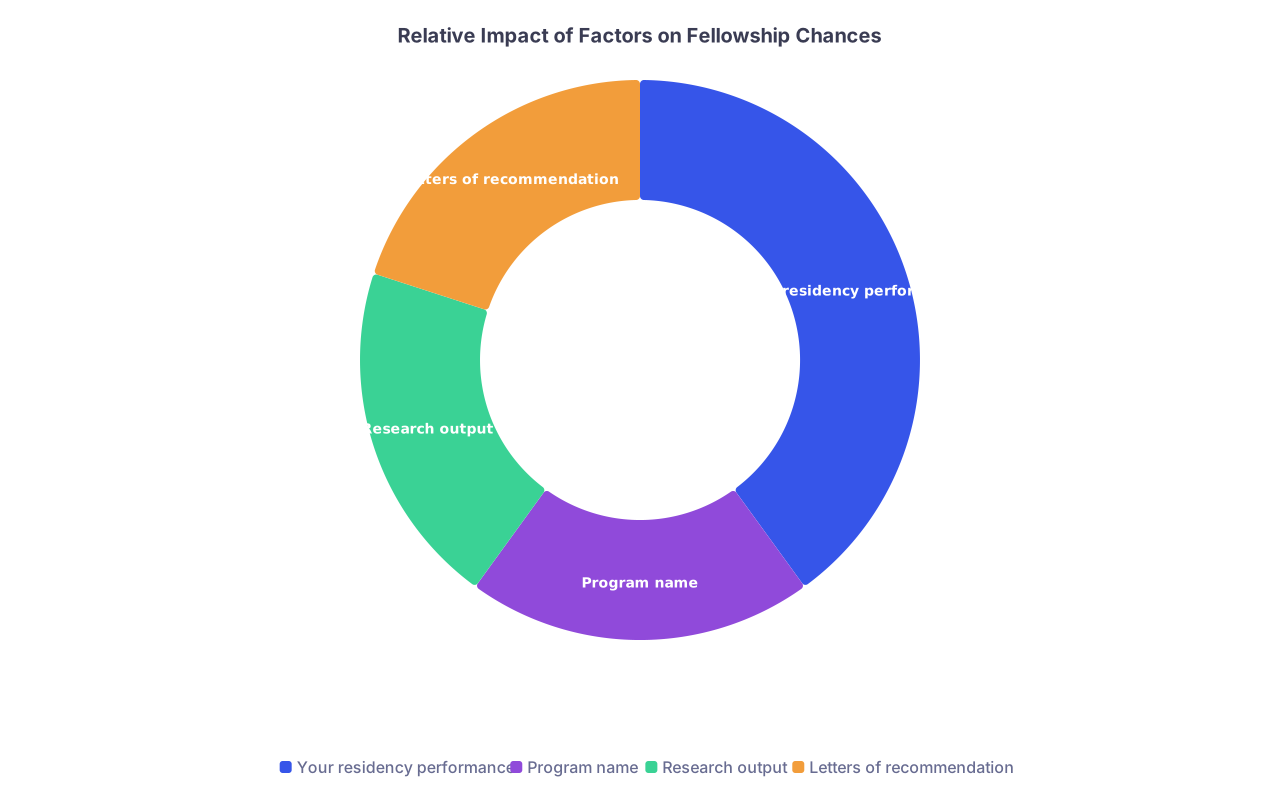
| Category | Value |
|---|---|
| Your residency performance | 40 |
| Program name | 20 |
| Research output | 20 |
| Letters of recommendation | 20 |
Rough reality:
- Coming from a top academic program opens doors more easily, especially for top-tier competitive fellowships.
- But I’ve seen residents from small community programs match GI, cards, and heme/onc when they were clearly the standout trainee with solid research and glowing letters.
If your SOAP program is less well-known:
- Double down on objective achievements: publications, presentations, strong letters
- Network at conferences (ACC, ACG, ASH, SCCM, etc.) so someone outside your program can vouch for you
- Consider away electives in PGY-3 at fellowship-heavy institutions if your program allows it
Don’t waste mental energy mourning the academic brand name you didn’t get. Use that time to build a track record nobody can argue with.
7. When Does SOAP Truly Limit Fellowship Options?
There are a few situations where SOAP genuinely boxes you in:
- You accept a position in the wrong core specialty and never transition out.
- You land at a program with serious dysfunction (chronic ACGME citations, poor education) and your evaluations suffer.
- You underperform—average or below-average resident, minimal initiative, mediocre letters.
Notice something? In all three, the root problem is not “SOAP.” It’s either strategic misalignment or performance.
If you’re asking the question now—before or right after SOAP—you’re already ahead of the many who just “take a job” and think about fellowship in PGY-3. That’s too late for them. Not for you.
FAQ: SOAP and Fellowship – 5 Common Questions
1. Will programs know I got my residency through SOAP?
They usually won’t see a bright red “SOAP” flag, but they can sometimes infer from timelines or your story. Most do not care if your current record is strong. Fellowship directors are used to non-linear paths—reapplicants, international grads, career changers. SOAP is just one more variation.
2. Is it better to SOAP into a prelim at a big-name program or a categorical at a smaller program?
If you want a fellowship tied to a specific core specialty (like GI or cardiology from IM), a categorical spot in the right specialty usually beats a prelim year at a “fancy” name with no guarantee of a categorical position. Long-term alignment beats one year of brand name.
3. I SOAPed into a community IM program. Do I still have a shot at cardiology or GI?
Yes, if you are near the top of your class, get excellent letters, and do real scholarly work. Is it harder than coming from a top academic IM program? Sure. Is it impossible? No. I’ve seen it done more than once.
4. How soon should I tell my residency program I’m interested in fellowship?
Within the first 6–9 months. Not on day one, but early enough that mentors can steer you: which rotations to prioritize, which projects to join, which conferences to attend. Waiting until late PGY-2 is how people end up with thin applications and lukewarm support.
5. What if my SOAP program has almost no research?
Then you have to be proactive and slightly scrappy. Ask faculty if they collaborate with other institutions. Look for society-led multi-center projects. Attend national meetings and literally ask, “Do you take outside residents on projects?” It’s not glamorous, but it works if you’re persistent and reliable.
Key points to walk away with:
- Taking a SOAP position does not by itself limit your fellowship options; your residency performance, mentorship, and research output matter much more.
- The biggest real risk is ending up in the wrong specialty or at a program where you don’t actively build a strong track record.
- If you’re strategic about your SOAP choice and intentional in residency, you can still compete for serious fellowships—just without much margin for coasting.