
What if your phone stays silent while your classmates start casually saying things like, “Oh yeah, I got a pre‑match from X last week”… and you have nothing?
Because that’s the nightmare, right? Group chat blowing up with “I just got an offer!!”, people joking about where they’ll live next year… and you’re staring at your screen, refreshing email, trying not to throw up.
Let’s actually go there. And then figure out what you can do about it.
First: What Pre‑Match Actually Means (And What It Doesn’t)
The fear in your head probably goes something like:
“No pre‑match = programs hate me = I won’t match = I’ll never be a doctor.”
That chain is wrong. Dramatic, but wrong.
A pre‑match offer is just this: a program decides early, outside the match, to offer you a contract directly. You sign, you’re committed, and you’re basically done.
Key thing you already know but your anxiety keeps ignoring: most people do not get pre‑match offers. And most residents you’ll work with in July matched the regular way.
Here’s why you might not see pre‑match offers even if you’re a totally solid applicant:
- Many specialties and regions barely use pre‑match at all.
- Some programs never pre‑match on principle.
- Some only pre‑match home students or people with strong inside connections.
- Pre‑match is often used for edge cases (visa, special circumstances, off-cycle stuff).
So when you see classmates flexing their offers, remember: you’re seeing a tiny, skewed slice of the process. Not the full picture.
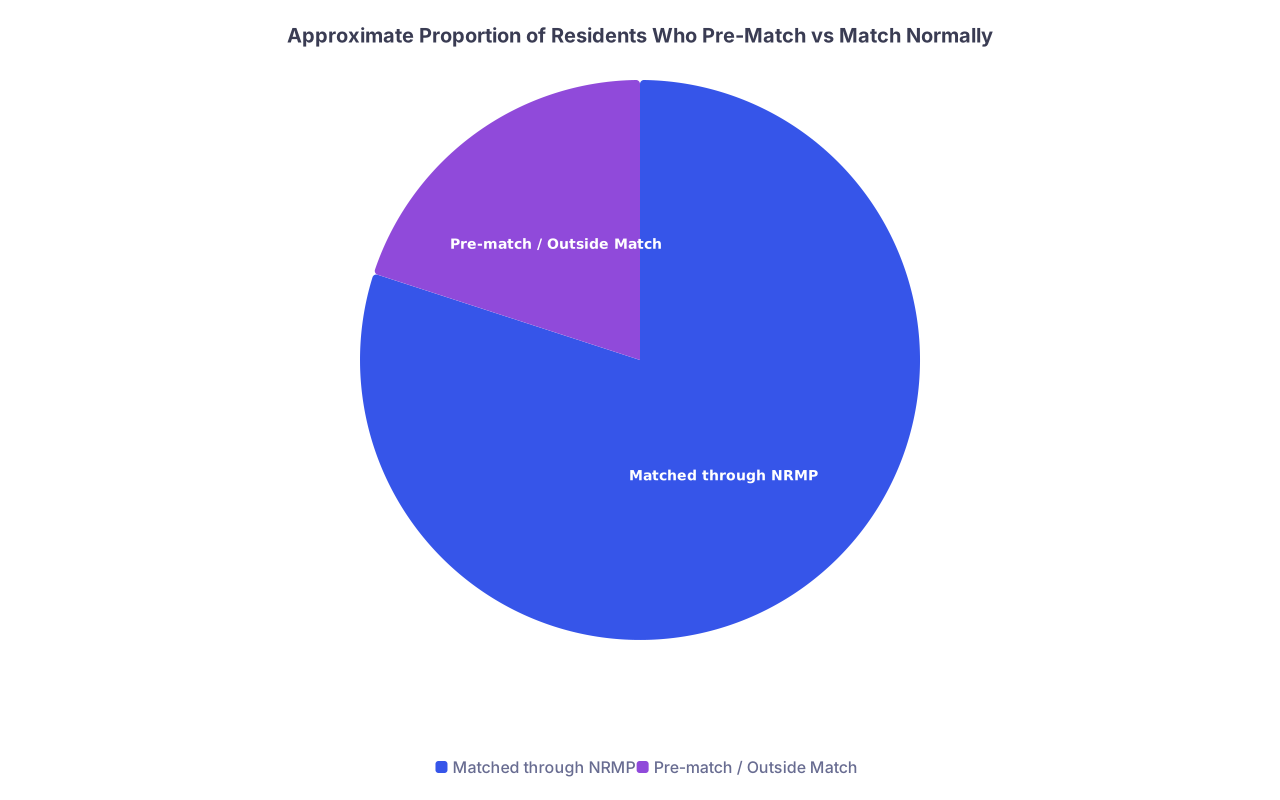
| Category | Value |
|---|---|
| Matched through NRMP | 80 |
| Pre-match / Outside Match | 20 |
Does that exact percentage vary by specialty, country, and program? Of course. But the pattern holds: the default pathway is still the regular match, not pre‑match.
Your brain is acting like pre‑match is the main highway and you’ve already missed the exit. Reality: it’s a side road. Busy in some neighborhoods, but still a side road.
Why It Hurts So Much When Everyone Else Seems To Be Pre‑Matching
Let’s be honest. This isn’t just about “not having an offer.” It’s about:
- Feeling like you’re behind
- Feeling exposed in front of classmates
- Wondering if your interviewers secretly hated you
- And the big one: “Did I massively overestimate myself?”
I’ve watched this play out every year:
M4s sitting in a lecture hall, someone whispers, “Hey, did you hear, Maria pre‑matched at Baylor IM,” and then suddenly everyone starts sharing their news. Meanwhile, the person who’s already anxious about their Step score is just sitting there, smiling weakly, doing mental math about how many interviews they did, how they answered that one terrible question, and whether they should have ranked more community programs.
Here’s what your brain will do if you let it:
- Turn every classmate’s success into proof of your failure
- Rewrite your interview memories as “obviously terrible”
- Convince you that silence = rejection, instead of what it usually is: silence
Don’t confuse lack of immediate good news with evidence against you. There’s a lag in this process. A stupid, painful lag.
Worst-Case Fears: Let’s Say You Never Get a Pre‑Match
You’re probably already imagining the worst, so let’s walk through it and stop letting it lurk in the shadows.
Worst-case in your head:
“I get no pre‑match offers, and then I don’t match at all.”
That’s really two separate fears:
- No pre‑match
- Not matching
Those are not automatically linked. Plenty of applicants get zero pre‑matches and match perfectly fine.
The people who absolutely spiral are usually those who:
- Count other people’s offers like it’s a leaderboard
- Ignore their actual interview numbers and program list
- Forget that match outcomes are based on ranked lists, not speed of communication
Here’s the less dramatic reality:
- Many programs don’t offer pre‑match at all. You literally could not have gotten one.
- Some programs pre‑match a handful of people, then rank everyone else like normal.
- If you don’t get pre‑matched, you’re still on the rank list. You’re not “out.”
I’ve seen strong applicants ignore all this and decide, “No pre‑match = I must be bottom of every list”. That’s just not how it works.
Concrete Steps If Your Peers Are Getting Offers And You’re Not
You don’t need motivational posters. You need a plan. Here’s what I’d actually do if my classmates were all bragging about pre‑matches and my inbox was dead quiet.
1. Audit Your Reality, Not Your Feelings
Grab a piece of paper (or spreadsheet) and write honestly:
- Number of interviews you’ve had
- Number still upcoming
- Which programs explicitly said they don’t pre‑match
- Which specialties/regions you applied to
Then ask:
- Am I in a specialty where pre‑match is even common?
- Did any of my interview programs actually mention pre‑match as an option?
- Do I have enough interviews for my specialty to be in a reasonable match range?
If you don’t know what “reasonable” is, talk to your dean’s office or someone who actually tracks data. Not just the loud PGY-1 who matched derm and thinks everyone should apply to 80 programs.
| Specialty Type | Safer Interview Range* |
|---|---|
| Primary Care (FM, IM) | 8–12+ |
| Peds / Psych | 8–12+ |
| Anesthesia / EM | 10–14+ |
| Gen Surg / OB-GYN | 10–15+ |
| Competitive (Derm, Ortho, ENT, etc.) | 15–20+ (often with backup) |
*Not exact, and depends on your specific situation, but you get the idea. If you’re in these ranges, zero pre‑matches doesn’t automatically spell disaster.
2. Talk to Someone Who Sees the Whole Picture
Not your equally-panicked friend. Not Reddit.
Schedule a quick meeting with:
- Your Dean of Students
- Specialty advisor
- Program director at your home institution (in your field if possible)
Say something like:
“I’m anxious because classmates are starting to get pre‑match offers and I haven’t heard anything. Can we go over my interview list and how worried I should realistically be?”
Is that vulnerable? Yes. Does it suck? Also yes. But I’ve seen so many students simmer in silent panic when a 20‑minute honest conversation could have grounded them.
You want:
- An external reality check
- Feedback on whether you should consider a parallel backup (if it’s not too late)
- Reassurance if your numbers are actually fine and your brain is just… being your brain
How to Handle the Social Minefield
This part is underrated. The pre‑match flex culture can be brutal.
Here’s how to survive it without losing your mind:
Control your exposure.
Mute the group chat if it’s turning into a running scoreboard. You’re not weak for protecting your mental space. You’re smart.Have canned responses ready.
When people ask, “So, did you get any offers yet?” you don’t owe them your internal collapse. Try:
“I’m still in regular match mode; I’ve had some good interviews and I’m waiting to see how things shake out.”
Then change the subject.Don’t overshare your fear with people who won’t get it.
Vent to 1–2 trusted people who won’t one-up you with their own anxiety or start “fixing” you with random Reddit advice.Notice jealousy without judging yourself for it.
You’re allowed to feel bitter when someone with a 20‑point lower Step score casually says, “Oh yeah, I just pre‑matched at that place you wanted.”
Feel it. Don’t act from it.
If You’re Tempted To Panic-Email Programs
I know what you’re thinking:
“Should I email programs and ask if they’re doing pre‑match? Or tell them they’re my top choice? Or ask for an update?”
Take a breath.
Bad idea: blasting every program with “You’re my #1” type messages or fishing for offers.
Possible reasonable actions:
- One short, sincere update letter to your genuine top 1–2 programs (if that’s culturally normal in your specialty).
- Share any major new achievement (paper accepted, significant award, updated Step 2 score) with a brief, professional note.
What not to do:
- Email asking, “Am I going to get a pre‑match?”
- Mention that your classmates are getting offers and you’re worried.
- Send emotional, rambling messages.
Programs are not going to pre‑match you because you sound desperate. If anything, that can hurt you.
If the Silence Is Destroying Your Focus and Sleep
The constant waiting does something nasty to your brain. It becomes background noise you can’t shut off.
Some things that actually help (not magic, but better than spiraling):
Time‑boxed worry:
Give yourself 15 minutes a day to freak out. Write every terrible what‑if. Then stop. Outside that window, when thoughts intrude, tell yourself, “Not now. 9:45–10:00 pm is panic time.” It sounds dumb. It works.Anchor tasks:
Schedule things you have to show up for: clinic, exercise with a friend, even boring errands. Empty days = brain free-fall.Sleep protection:
No email/ERAS checking in bed. Bed is for sleep (and your phone is a liar that tells you your future is in your inbox). Give it a hard cutoff — e.g., last check at 9 pm, then phone on Do Not Disturb.Replace doom-scroll with something structured:
If you’re going to be online, fine. But pick one long article, one podcast, one show — not an infinite scroll of application forums.
You can’t brute-force your way into calm. But you can build a little scaffolding around your brain so it doesn’t collapse every time someone posts “OMG I just signed!!”

Planning for Actual Worst Case: If You Truly Don’t Match
You might be thinking, “Okay, but what if I’m that person?” The one who doesn’t match. The one everyone whispers about.
Let’s talk about it like adults.
A non-match is painful, public, and expensive. It’s not the end of your medical career.
True worst-case roadmap (that still leads somewhere):
SOAP (if your system has it):
If you don’t match, you get a shot at unfilled spots. It can be chaotic and humbling, yes, but people land good enough positions and go on to have normal careers.Reapplication year:
You sit down with your dean and brutally audit your app:- Scores?
- Letters?
- Red flags?
- Specialty choice vs competitiveness?
Then you build a plan: research year, prelim year, more interviews, different specialty, etc.
That path sucks. No point sugarcoating that. But I’ve met plenty of attendings who didn’t match the first time and their patients literally have no clue and don’t care. One did a prelim surgery year, switched to anesthesia, and is now thriving. Guess how often his non-match comes up? Never.
You are not applying for a one-shot golden ticket to a single ideal future. You’re trying to get a path that gets you trained and employed. There are more of those than your panicked brain will admit.

| Step | Description |
|---|---|
| Step 1 | Interview Season Ends |
| Step 2 | Signed Outside Match |
| Step 3 | Enter Main Match |
| Step 4 | Start Residency |
| Step 5 | Enter SOAP or Similar |
| Step 6 | Reapply Next Cycle |
| Step 7 | Pre-match Offer? |
| Step 8 | Matched in March? |
| Step 9 | Secured Position? |
How To Prepare Now While Everyone Else Flexes Their Offers
If you’re in that ugly in‑between space — no pre‑match, waiting for the regular match — here’s how to use this time so you don’t feel totally helpless.
Stay professionally active.
Keep showing up in rotations. People talk. The resident who says, “Yeah, they still work hard and seem engaged” matters more than you think for last-minute impressions and letters.Keep an updated CV and personal statement handy.
If something opens up unexpectedly, or you need to send a quick update, you won’t be scrambling.Quietly line up contingency advice.
Not because you expect disaster, but because if it happens, you won’t be starting at zero. Talk to your dean about:- How SOAP works
- Who helps you during that week
- Whether a prelim year could make sense for you
Limit comparison. Aggressively.
You already know who the class pre‑match celebrities are. You don’t need to track them like a sport. Let them live their story. You stay in yours.

Final Reality Check
If your peers all seem to be getting pre‑match offers and you’re not, your brain is going to scream that you’re failing in real time. It’s not.
Three things to hold onto:
- Pre‑match is a side pathway, not the main road. No pre‑match does not equal no match.
- Your outcomes depend on interviews and rank lists, not how fast you hear good news. Silence is not a verdict. It’s just silence.
- Even worst-case scenarios have real, workable next steps. SOAP, prelims, reapplication — none of them erase your shot at being a physician.
You’re not behind. You’re just not done yet.