
The fear that you’ll turn down a pre‑match and then not match anywhere else is not irrational. It’s exactly the kind of nightmare scenario that has actually happened to real applicants.
Let’s not sugarcoat it.
What you’re really afraid of
You’re staring at an email or a contract from a program that’s… fine. Not your dream. Maybe not even your top 5. But it’s an offer. A pre-match. A guarantee. And your brain immediately goes:
- If I sign this, I’m stuck.
- If I don’t sign this, I could end up unmatched.
- If I rank other programs higher, will they even want me?
- What if this is the only program that will ever like me?
And underneath all of that is the big one:
“What if I turn down this pre-match and then don’t match anywhere and I’ve just blown my one shot at residency?”
Let me be blunt:
Yes, that can happen.
No, it does not automatically mean your career is over.
And no, you should not blindly accept every pre-match just because you’re terrified.
The whole point is not to pretend the risk doesn’t exist, but to understand it clearly enough that you can make a rational decision instead of a panic decision.
Step one: Get brutally honest about your risk level
Before you decide what to do with a pre-match offer, you have to stop guessing and actually assess your odds. Not vibes. Not “my friend said I’m a strong applicant.” Real risk.
Here’s what actually matters more than your feelings about yourself:
| Factor | Higher Risk If... |
|---|---|
| Specialty | It's highly competitive (Derm, Ortho, Plastics, ENT, Rad Onc, etc.) |
| Interview Count | You have < 8–10 interviews in most fields, or < 12–15 in super competitive ones |
| Step Scores | Below or just at typical program cutoffs for the specialty |
| Application Type | You’re an IMG, older grad, or with attempt/fail history |
| Program Mix | Most of your interviews are at community or lower-tier programs only |
If you recognize yourself in multiple high-risk boxes, the fear you’re feeling about turning down a pre-match is not overblown. It’s appropriate, actually.
On the flip side, if you’re sitting on:
- 12+ interviews in Internal Medicine with mid-to-high Step scores
- Multiple interviews at solid university programs
- No major red flags (no fails, recent grad, solid letters)
…then turning down a pre-match is still scary, but you’re not walking blindfolded into traffic.
Most people lie to themselves at this stage. They either think:
- “I’m sure I’ll match somewhere; I have like 6 interviews” (false confidence).
or - “I’m basically doomed even with 15 interviews” (catastrophizing).
Both are wrong. You need data, not panic.
How pre-match offers really work (and what they mean)
Pre-match offers are not a compliment to your soul. They’re a program’s strategy.
They usually mean:
- They’re worried you won’t rank them highly.
- They have trouble filling with the candidates they most want.
- They want to lock in a certain number of residents early.
Sometimes they’re great programs. Sometimes they’re programs everyone quietly warns you about on Reddit and WhatsApp groups.
Here’s the part no one tells you out loud:
Programs that pre-match a lot often expect some people to say no. They’re not fragile. You’re not personally offending them by wanting to see what happens in the Match.
But from your side, a pre-match means:
- This is guaranteed, if you sign.
- You must withdraw from the Match for that specialty (or entirely, depending on rules and country).
- You are choosing certainty over possibility.
Neither choice is automatically “smart” or “stupid.” It depends entirely on your profile and your tolerance for risk.
The nightmare scenario: You say no… and then don’t match
Let’s walk straight through the thing you’re scared of.
You have a pre-match offer from a community Internal Medicine program. It’s not malignant, but it’s not academic, not in your preferred city, not subspecialty-heavy. You want GI or Cards. You feel like you could “do better.”
You say no.
You rank your interview list.
Match Day: “We are sorry, you did not match to any position.”
What happens now?
Phase 1: Emotional gut punch
This part is ugly. It’s crying in the bathroom, avoiding your phone, feeling physically sick. You replay the moment you declined the pre-match and decide that was The Mistake That Ruined Everything. Your brain will rewrite history:
- “If I had just said yes, I’d be fine.”
- “I was arrogant.”
- “I overestimated myself.”
Sometimes that’s a fair critique. Sometimes you actually made a reasonable call based on your data and the randomness of the Match screwed you anyway. Both can be true.
Phase 2: SOAP / Scramble reality
Now the practical part.
If you’re in NRMP (US), you’re likely eligible for SOAP:
- You get a list of unfilled programs (often not in the best locations or specialties).
- You have a few cycles of sending applications, doing brief phone / video interviews.
- It’s chaotic. Programs can be blunt. Rejections are fast and often silent.
In other systems (some IMG-heavy countries, certain Gulf or European systems), there might be an informal “scramble” where you email programs, call coordinators, beg your mentors to push for you.
Sometimes it works. Sometimes it doesn’t.
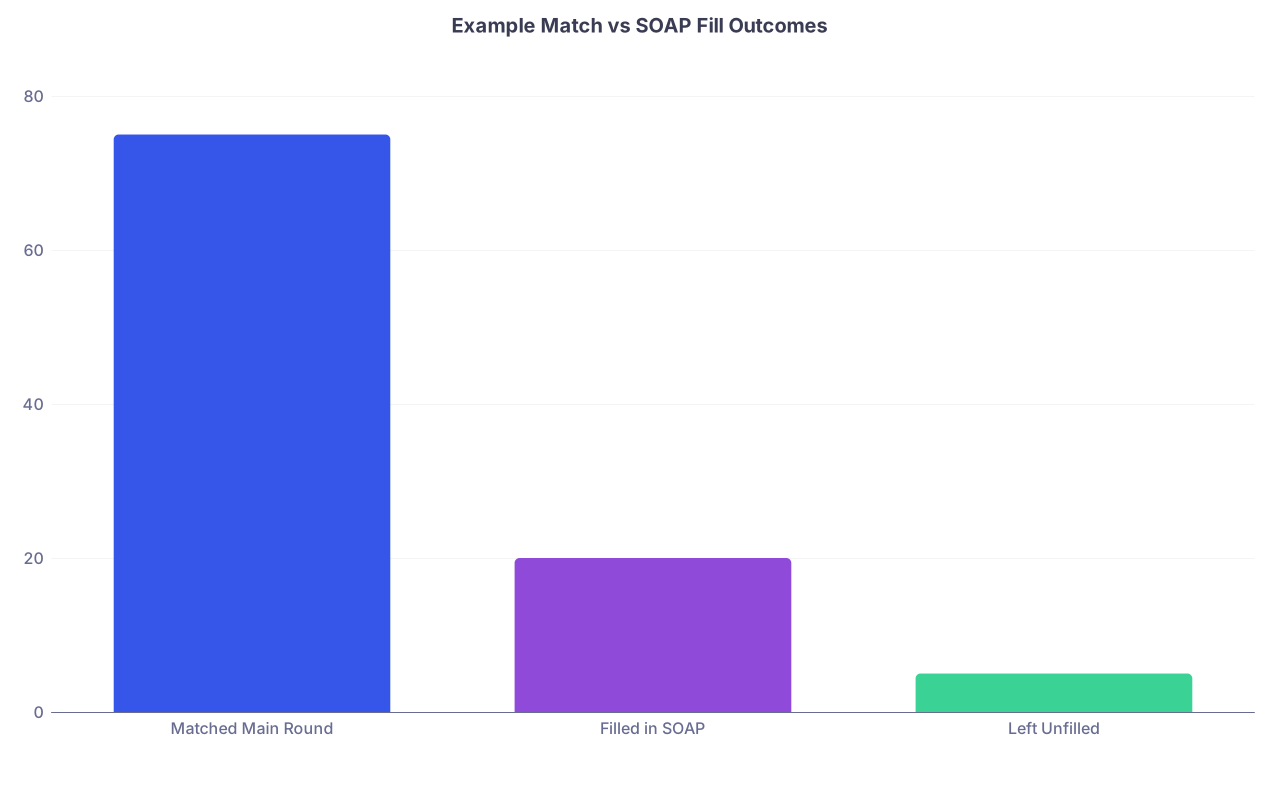
| Category | Value |
|---|---|
| Matched Main Round | 75 |
| Filled in SOAP | 20 |
| Left Unfilled | 5 |
Are these exact numbers universal? No. But the pattern is consistent: late spots are fewer, more chaotic, and often less desirable. You’re playing musical chairs with fewer chairs and more people.
Phase 3: If you still end up without a position
This is the actual worst case: no pre-match, no Match, no SOAP. Off-cycle, no position.
The part your brain whispers: “That’s it. You’re done. Career over.”
That’s almost never actually true.
What really happens is one of these:
- You spend a year doing research (unpaid or low-paid), collecting stronger letters.
- You work as a prelim/TY or non-categorical somewhere if you can find it.
- You do observerships, hands-on clinical work if you’re an IMG.
- You reapply, usually to a broader or less competitive set of programs/specialties.
Does it suck? Yes.
Does it permanently destroy your chances? No.
I’ve seen people match on their second and third tries. I’ve also seen people never match and pivot their careers entirely. Both exist.
How to decide: Take the pre-match or roll the dice?
This is where you want a neat formula. You won’t get one. But I’ll give you a framework that’s a lot better than flipping a coin in the shower.
1. Compare your risk vs your tolerance
You’re high risk if:
- You’re an IMG with < 8 interviews for IM/FM/psych, or < 10 for others.
- You have Step failures or attempts, older YOG, or major gaps.
- You’re going for very competitive specialties with average stats.
If that’s you and your pre-match is not malignant, you should strongly consider accepting. Even if it’s not “perfect.” Because your realistic alternative might be no spot at all.
You’re lower risk if:
- You have 10–15+ interviews in a moderately competitive field.
- No red flags, good letters, decent research, recent grad.
- Your pre-match is clearly below the caliber of many programs that interviewed you.
In that scenario, declining is not insane. It might be the only way you ever end up at a stronger program.
2. Stop pretending location and happiness don’t matter
I’ve heard applicants say, “I’ll go anywhere, I just want to match,” and then six months into intern year they’re miserable in a town they hate, at a program that doesn’t support them, with no family support.
You are allowed to value:
- Being near your support system
- Training in a program with good fellowship exposure
- Not being in a toxic or 80+ hour-per-week sweatshop culture
If your pre-match is in a place you know you might hate for three years, you need to weigh that too. A guaranteed miserable three years is not automatically better than a small risk of having to regroup and reapply.
3. Actually research that pre-match program
Not the glossy website. Real intel:
- Ask current residents privately: “If you had another choice, would you still pick this program?”
- Check board pass rates, fellowship match lists, attrition.
- Ask about culture: how they treat struggling residents, how they handle mistakes.
Some pre-match programs are hidden gems. Others are revolving doors where residents leave, fail boards, or get burned out and gaslit.
If multiple residents are basically saying, “Run,” that should factor into your choice.
Planning for the worst while hoping for the best
Let’s say you decide to decline the pre-match. You’re still anxious. Good. You should be. But now you build a safety net instead of just obsessing.
Before Match Day
- Talk to mentors early. Let them know: “If I don’t match, can I call you immediately to help with SOAP/scramble?”
- Identify possible backup options: research positions, prelim spots, community programs open to off-cycle hiring.
- Update your CV so it’s ready for rapid use.
You’re not jinxing yourself by planning. You’re being a grown adult who understands that bad outcomes are possible.
If the worst actually happens
If Match Day email says you didn’t match:
- Let yourself feel awful for a few hours. You’re not a robot.
- Then flip into action mode: SOAP, email programs, call coordinators, get mentors to advocate.
- If still no position after all that, shift focus to rebuilding:
- Enhance your application (research, extra degrees, stronger US clinical experience).
- Widen your specialty or geographic range next cycle.
You’re allowed to grieve the path you thought you’d be on. But after that, you either get bitter or you get strategic. The people who eventually match again choose the second one.
The quiet truth: You can’t eliminate risk either way
The thing that keeps you up at 2 a.m. is this illusion that there’s a “right” decision that guarantees safety:
- If you accept the pre-match, you risk three miserable years in a place you hate or a program that limits your options.
- If you decline, you risk going unmatched and losing a year.
There is no zero-risk option. You’re being forced to choose which kind of risk you’ll tolerate:
- Short-term emotional risk (declining and living with uncertainty).
- Long-term career and life risk (accepting a bad fit that will shape your training and maybe your fellowship chances).
Nobody can make that call for you. Not me, not Reddit, not your anxious group chat.
But here’s what I will say plainly:
- If you’re a clearly high‑risk applicant and the pre-match is not toxic: taking it is often the rational move, even if your pride hates it.
- If you’re a reasonably strong applicant and the pre-match is clearly a poor fit or bad program: declining can be a smart bet, even though it might blow up in your face.
Both choices require courage. One is courage to gamble. The other is courage to accept “good enough” and let go of the fantasy.

| Step | Description |
|---|---|
| Step 1 | Pre match offer received |
| Step 2 | Consider declining, prepare for risk |
| Step 3 | Strongly consider accepting |
| Step 4 | Reasonable to decline |
| Step 5 | Think about fit and goals |
| Step 6 | High risk profile |
| Step 7 | Program malignant? |
| Step 8 | Program far below other interviews |
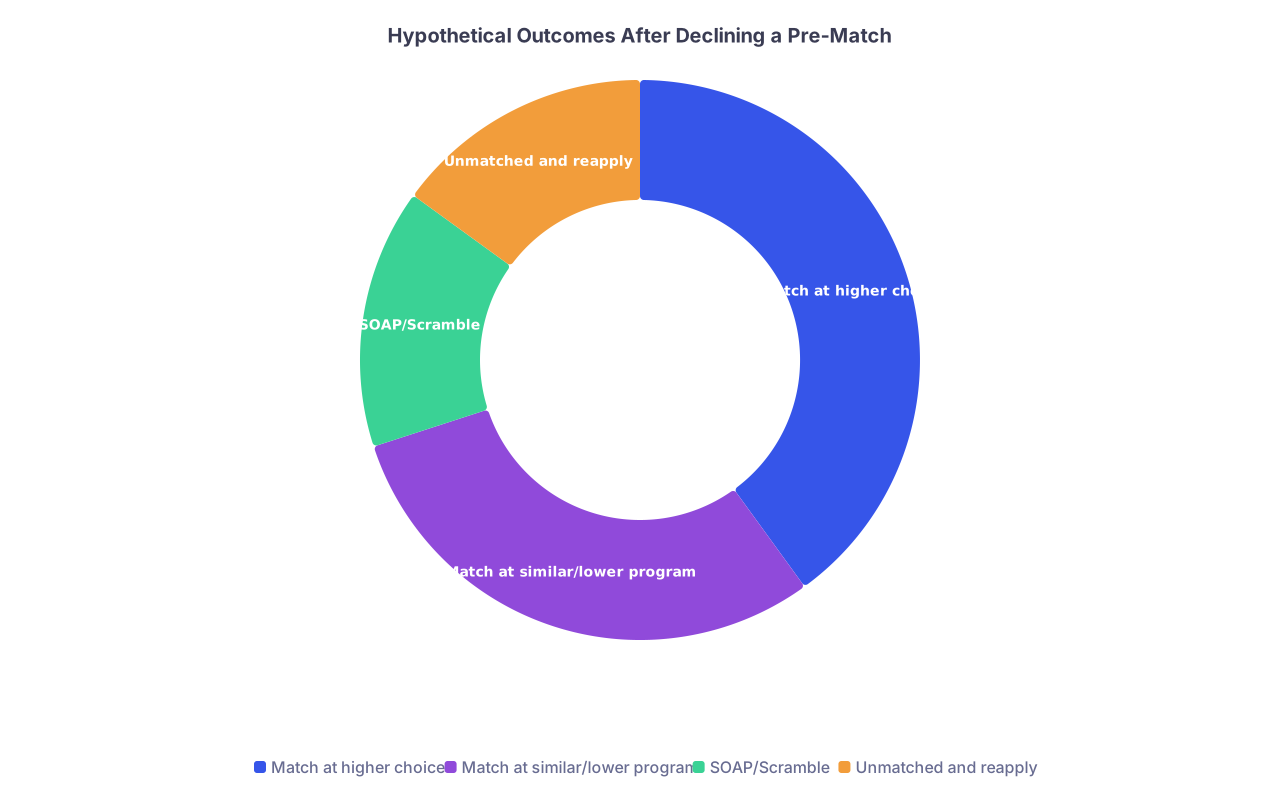
| Category | Value |
|---|---|
| Match at higher choice | 40 |
| Match at similar/lower program | 30 |
| SOAP/Scramble | 15 |
| Unmatched and reapply | 15 |
Does every applicant land like this? No. But this is closer to reality than the 100% doom story your brain is running.


If you’re stuck and terrified right now
Here’s what I’d actually do if I were in your shoes, scared of turning down a pre-match and then not matching anywhere:
- Write down, on paper, your exact profile: scores, YOG, IMG/AMG, number of interviews, any red flags. No sugarcoating.
- Show that to two honest mentors who know your specialty. Ask them one question: “If I were your kid, would you tell me to take this pre-match?”
- Get real intel about the pre-match program from current residents, not just forums.
- Decide your worst acceptable outcome:
- Is “one year delayed but better fit” acceptable?
- Or is “absolutely must match this year no matter what” your reality (money, visa, family, etc.)?
- Make a decision and then commit. Don’t torture yourself replaying it daily.
You’re going to feel afraid either way. That’s normal. The goal is not to find a path that removes fear; it’s to choose a path you can live with even if the worst-case happens.
Bottom line
- Turning down a pre-match and then not matching anywhere is a real, painful possibility—but it’s not automatic career death.
- Accepting a pre-match that’s a terrible fit can quietly wreck your happiness and limit your options for years. That risk is real too.
- The “right” choice depends on your actual risk profile, the quality of the pre-match program, and how much uncertainty you’re willing to live with—not on panic or ego.