
The worst SOAP week disasters do not happen in SOAP. They happen in the four weeks beforehand, when people assume, “I am probably matching,” and prepare nothing.
You do not get that luxury.
Here is a four‑week, day‑by‑day checklist so that if you open that email on Monday and see “You did not match,” you are shaken—but not scrambling. You will have files, lists, and scripts ready to deploy in minutes, not hours.
Overall 4‑Week Game Plan
At this point, you should think of SOAP prep as an insurance policy. You hope you never need it. You will be very glad you have it.
Your four weeks break down like this:
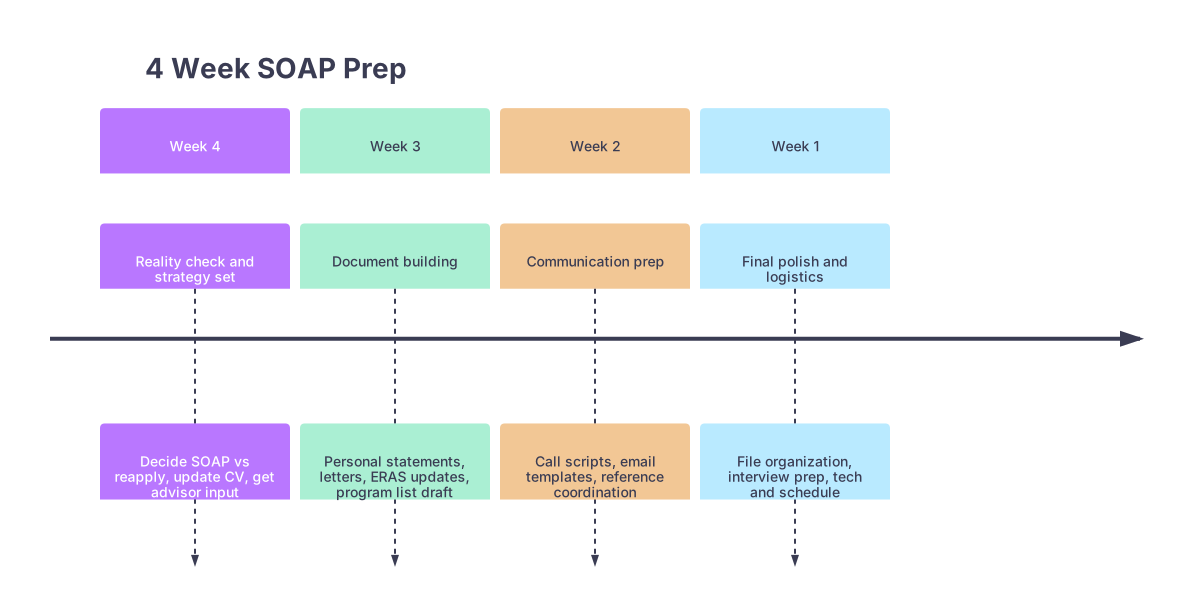
| Period | Event |
|---|---|
| Week 4 - Reality check and strategy set | Decide SOAP vs reapply, update CV, get advisor input |
| Week 3 - Document building | Personal statements, letters, ERAS updates, program list draft |
| Week 2 - Communication prep | Call scripts, email templates, reference coordination |
| Week 1 - Final polish and logistics | File organization, interview prep, tech and schedule |
At each stage, I will spell out: what must be done this week, what can slide, and what is a trap.
Week 4 Before Match: Reality Check and Strategic Positioning
This is the “stop lying to yourself” week.
At this point you should:
Get an honest competitiveness assessment (1–2 days).
Book a meeting with:- Your Dean of Students or equivalent
- Specialty advisor or PD in your desired field
- If IMG, your advising service / mentor
Go in with:
- Step 1 / Step 2 scores
- Number and type of interviews
- Rank list length and quality of programs
Ask bluntly:
- “If I do not match, should I SOAP in the same specialty or pivot?”
- “Given my scores, what are realistic SOAP categories?”
- “If I unmatched, would you support me for SOAP? For next cycle?”
Write down what they actually say. Not what you wish they said.
Decide your SOAP strategy framework (1 day).
You are not picking exact programs yet. You are choosing your “if I SOAP, I will…” rules.Common realistic strategies:
- “If I do not match in Internal Medicine, I willSOAP mainly IM categorical with some prelim medicine and transitional year.”
- “If I do not match in a surgical field, I willSOAP prelim surgery/medicine and consider reapplying.”
- “If I do not match anywhere, I willSOAP FM/IM/Peds open spots and commit to that field.”
Write down:
- Primary SOAP specialty (or 2 at most)
- Whether you would take:
- Prelim only
- TY only
- Any categorical in specific fields
This avoids emotional panic choices on Monday of SOAP.
Update your core professional documents (2–3 days).
At this point you should have:- A current CV, including:
- All rotations with months and locations
- Leadership, research, publications
- Employment and volunteer work
- An updated ERAS experience list (save a PDF screenshot or printout)
- A current photo ready (no vacation selfies, no lab coat glamour shoots)
If you had any of these happen since you submitted ERAS:
- New Step 2 score
- New publication / poster
- New leadership role Create a short, 3–4 line “update blurb” you can paste into emails or upload if allowed.
- A current CV, including:
Clarify your geographic and visa constraints (0.5 day).
You will not have time to ponder “Do I want to move to rural Alabama?” during SOAP. Decide now:- Places you absolutely will not go (write them down explicitly)
- States you strongly prefer
- Visa status limits (if IMG or needing sponsorship)
- Family / childcare / partner constraints
That list goes into your SOAP decision filter.
Map your backup specialties (1 day).
Look at NRMP data and your own profile. Build a short internal list of “acceptable SOAP targets” with realism, not pride.
| Original Target | Realistic SOAP Focus | Notes |
|---|---|---|
| Ortho, ENT, Derm | Prelim Surg, Prelim Med, TY | Plan to reapply |
| Gen Surg | Prelim Surg, Prelim Med, TY | Some pivot to categorical IM later |
| EM | IM, FM, TY | EM SOAP is brutal most years |
| Rad, Anesthesia | Prelim Med/Surg, TY, sometimes categorical IM | Often reapply after base year |
| Competitive IM programs | Community IM, FM | Prioritize categorical spots |
You do not broadcast this list, but you keep it in your notes. When SOAP opens, you match unmatched spots against this prewritten map.
Week 3 Before Match: Build the SOAP Document Arsenal
This week is for writing. Uncomfortable but non‑negotiable.
1. Draft Multiple Personal Statement Variants (3–4 days)
At this point you should have at least:
- 1 main specialty PS (the one you already used)
- 1 shorter, SOAP‑specific version for the same specialty
- 1 PS for each backup specialty you might actually rank
Target length for SOAP variants: shorter and punchier, about 400–600 words. PDs are skimming, not savoring.
Structure them like this:
Paragraph 1: Clear statement of commitment.
“I am committed to a career in Internal Medicine because…” (not “I have always wanted to be a doctor.” They have seen that line 500 times.)Paragraph 2–3: Clinical examples that show:
- Work ethic
- Reliability
- Ability to function in a team
- Any resilience or “comeback from difficulty”
Last paragraph: Why you are ready to start on July 1 and be low‑maintenance.
SOAP programs want someone who will show up, work hard, and not implode.
For backup fields, do not fake a lifelong dream. Be honest:
- “I applied to X initially. Through rotations and subinternships I realized that Y also aligns with my strengths in A, B, C.”
2. Build a “Rapid‑Edit” Template PS (1 day)
You need one template that can be tailored in 10 minutes for any specific program:
- Keep:
- First 3–4 paragraphs general for the field
- Last 1–2 paragraphs:
- Leave [BRACKETS] where you will insert program‑specific lines:
- “[program name]”
- “[geographic region reason]”
- “[specific patient population or training feature]”
- Leave [BRACKETS] where you will insert program‑specific lines:
During SOAP, you will not have time to write custom essays from scratch. This template saves you.
3. Identify and Secure Key References (1–2 days)
At this point you should:
- Pick 2–3 attendings who:
- Actually know your work
- Can speak to reliability and clinical performance
- Are reachable quickly during SOAP week
Then:
- Email them now and say directly:
- That you are preparing in case you enter SOAP
- That you may need them to be responsive to emails or quick calls that week
- Ask: “If I do not match, may I list you as someone PDs can contact for an informal reference?”
This way, when a PD emails them at 10 p.m. Wednesday, they are not surprised.
Week 2 Before Match: Communication Scripts and Targeting
This week is about planning exactly what you will say and to whom when the clock starts.
1. Pre‑write Email Templates (1–2 days)
At this point you should have:
Initial contact email to programs (SOAP week).
Skeleton:- Subject: “SOAP Applicant – [Your Name], [Specialty], [AAMC ID]”
- 3–5 sentences:
- Who you are (school, anticipated graduation, scores in one line)
- Your genuine interest in their program / region
- One strength (“strong evaluations in inpatient medicine,” “significant prior career experience,” etc.)
- Attach: CV and relevant PS if allowed, or reference ERAS application
Email to your school’s leadership if unmatched.
One template to:- Dean
- Office of Student Affairs
- Specialty advisor
Content:
- One line acknowledging the result
- Your early plan:
- “I plan to actively participate in SOAP this week prioritizing X and Y programs/specialties.”
- Request for:
- Any immediate advice
- Willingness to speak to PDs on your behalf
Save these in a folder: /SOAP/EmailTemplates/ so you are not writing from scratch while upset.
2. Draft Call Scripts (0.5–1 day)
Yes, you will be calling programs. No, you should not be improvising.
Create a 6–8 line script you can adapt:
- Opening:
- “Good afternoon, my name is [Name], I am a [US MD / DO / IMG] senior applying to [specialty] through SOAP.”
- Purpose:
- “I wanted to express my strong interest in your program and see if there is any additional information I can provide.”
- Highlights:
- One line on scores
- One line on clinical strengths or specific experience
- Close:
- “If it is possible, I would be grateful to be considered for an interview. I am happy to send an updated CV or connect you with my Dean if helpful.”
Keep the script in front of you during calls. Nerves will be high.
3. Build a Program Tracking Spreadsheet (1–2 days)
At this point you should create the sheet you will live in during SOAP.
Columns to include:
- Program name
- ACGME ID
- Specialty / Categorical vs Prelim / TY
- Location (city, state)
- Contact email / phone
- SOAP Round (1–4)
- Status: “Applied / Emailed / Called / Interviewed / Offer”
- Priority (High / Medium / Low)
- Notes: “Has IMG spots”, “Prefers Step 2 > 230”, “Spoke with coordinator at 2:30 pm, seemed positive”
You will fill in some info later when the unfilled list is released. But set up the structure now.
Week 1 Before Match: Final Polishing and Logistics
This is the tightening week. You are not adding new projects. You are making your system airtight.
1. Organize a SOAP Folder System (0.5 day)
On your laptop (and in cloud backup) at this point you should have:
/SOAP/PersonalStatements/IM_main.docxIM_SOAP_short.docxFM_SOAP.docxTY_prelim.docx
/SOAP/CV/CV_SOAP_final.pdf
/SOAP/EmailTemplates/Program_outreach.txtDean_unmatched_notification.txt
/SOAP/References/- Contact info document with:
- Name
- Title
- Phone
- How they know you
- Contact info document with:
Everything labeled clearly so if you are shaking on Monday at 11:05 a.m., you still click the right file.
2. Do a Mock SOAP‑Style Interview Session (1 day)
SOAP interviews are fast and sometimes awkward. PDs are under pressure. They will not baby you.
At this point you should:
- Schedule a 30–45 minute mock with:
- Advisor
- Resident you trust
- Career office
Have them ask rapid‑fire:
“Why did you not match?”
You need a 20–30 second honest but composed answer. No blaming. No tears. Something like:- “I had a limited number of interviews in X due to [late Step 2 / geographic restrictions], and unfortunately that did not result in a match. I reflected with my mentors and am fully committed to starting training this July, especially in programs like yours that emphasize [specific feature].”
“Why our program specifically?” Plug in one pre‑researched fact and one personal alignment point.
“Tell me about a time you failed.”
Do not pretend your entire life has been perfect. PDs can smell that.
Record the mock if possible. Fix the stumbles now.
3. Tech and Availability Check (0.5 day)
SOAP moves very fast. Missed calls cost positions.
At this point you should confirm:
- Phone:
- Voicemail greeting is professional, not a joke or “Hi it is me, you know what to do.”
- Voicemail box is not full.
- Email:
- Professional email address is the main contact.
- Notifications are on.
- Video:
- Zoom/Teams/whatever installed and updated.
- Simple neutral background.
- Headphones that work.
Also:
- Clear your calendar for SOAP week:
- Tell family / friends that you might be unavailable.
- Arrange for coverage of any shift or minor obligations if possible.
4. Emotional Contingency Plan (0.5 day)
You are not a robot. The “Did I match?” email hits hard.
So at this point you should decide:
- Who is your “first call” if you do not match?
- Where will you physically be when you open the email?
- Pick a private, safe place. Not surrounded by 200 classmates.
- What is your rule for the first 30 minutes?
- No social media posts.
- No mass texting.
- One or two key people only.
Then, you pivot into execution mode using the work you did these four weeks.
SOAP Week: How Your Prep Plays Out (Brief Overview)
Just so you see how this all connects, here is your rough schedule when SOAP actually happens:
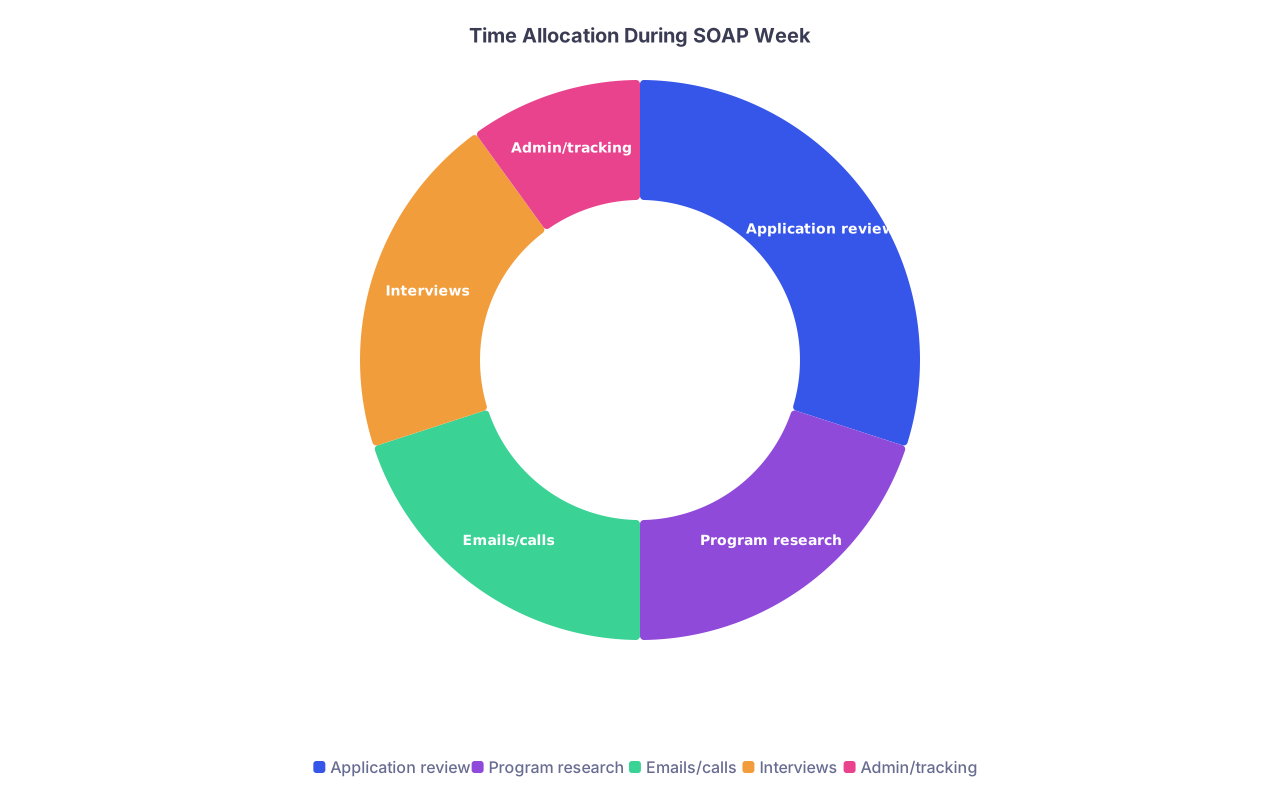
| Category | Value |
|---|---|
| Application review | 30 |
| Program research | 20 |
| Emails/calls | 20 |
| Interviews | 20 |
| Admin/tracking | 10 |
Monday Morning – “Did I Match?” Email
- If matched:
- You smile, cry, celebrate. Then you quietly archive the SOAP folder.
- If unmatched or partially matched:
- 30–60 minutes to process.
- Notify:
- Dean / advising office with your pre‑written template.
- Your “first call” support person.
- Then you open your spreadsheet and start working.
Monday Afternoon – List of Unfilled Programs Released
You immediately:
- Cross‑match unfilled spots with:
- Your pre‑decided specialty and geographic rules.
- Populate your spreadsheet:
- Program name, state, type, priority.
- Tailor:
- Attach appropriate PS variant for each specialty you apply to.
Your four weeks of prep become the difference between rational, fast decisions and panicked chaos.
Tuesday–Thursday – Calls, Emails, Rapid Interviews
Everything you built comes into play:
- Email templates → fast, coherent outreach
- Call scripts → less rambling, more focused conversations
- PS templates → minor tweaks, not full rewrites
- Mock interview practice → less freezing on “Why did you not match?”
Quick “At This Point You Should…” Recap
By the time SOAP week starts, you should:
Have a clear, written decision tree
- Primary and backup specialties
- Categorical vs prelim vs TY boundaries
- Geographic / visa constraints
Have a fully stocked SOAP toolkit
- Multiple PS variants
- Updated CV and ERAS info
- Reference list and pre‑alerted attendings
- Email templates, call scripts, and a tracking spreadsheet
Have your logistics and mindset ready
- Organized folders and working tech
- Mock interview practice done
- Emotional plan for Monday morning
You cannot control the Match algorithm. You can absolutely control whether SOAP week is a calculated strike or a desperate scramble. Prepare now, so if the worst email hits, you already know exactly what to do next.