
Program directors review hundreds, sometimes thousands, of applications for a handful of positions. The data shows that most applicants blur together on paper faster than they want to admit. Test scores cluster. Honors are common. Research entries start to look interchangeable. An away rotation is different because it shrinks the denominator. Instead of being one file in a stack of 800, you become one of perhaps 10 to 30 visiting students a program actually watches in real clinical conditions.
That is why away rotations matter more than most applicants think. This is not a month-long oral boards exam. It is a live test of whether people would trust you on their service at 5:45 a.m., after a rough call night, when the list is long and nobody has time for theatrics. I have seen students arrive believing they need to impress everyone with obscure facts. Wrong strategy. Program directors are usually asking a simpler question: if we match this person, will they make the team better or harder to run?
Away rotations are high-signal auditions. Especially in competitive specialties where many candidates look strong on paper. If the application gives a program a hypothesis, the away rotation gives them observed data. And observed data carries weight.
The scoring categories are not mysterious. They are just rarely stated plainly. In most departments, visiting students are evaluated on a tight cluster of variables:
- Clinical competence
- Work ethic
- Communication
- Professionalism
- Team fit
The exact forms vary, but the pattern does not. The data shows that professionalism and reliability usually outperform raw brilliance as predictors of a strong rotation evaluation. A student who is prepared every day, follows through, updates the resident, and presents cleanly is often rated above the student who knows more facts but creates friction.
If I had to translate how many faculty think, it would sound like this:
- Professionalism: Can I trust you to act like a future colleague?
- Work ethic: Do you carry your share without being chased?
- Clinical knowledge: Are you safe, prepared, and improving?
- Communication: Do you make rounds smoother or messier?
- Fit: Would residents want to work with you for three years?
Consistency is the strongest positive signal. Not one great answer on rounds. Not one heroic note. Consistency. Showing up early every day. Knowing your patients every day. Owning tasks every day. Programs are using a short observation window to reduce uncertainty, so they remember repeated patterns, not isolated flashes.
The ugly truth: red flags are more memorable than positives. That is basic cognitive math. If a team sees you for 15 shifts and you are excellent on 12 but late on 3, those late days get discussed. If you are smart but defensive, people remember the defensiveness. If you are pleasant but disappear when work appears, that becomes your brand. Short rotations compress judgment, so negative variance hurts more.
This is why average knowledge plus strong reliability often beats above-average knowledge plus erratic behavior. One profile lowers uncertainty. The other raises it. Program directors do not like uncertainty.
The Behaviors That Move You Up: What Gets Noticed Day to Day
Trust on an away rotation is built through micro-behaviors. Small things. Repeated things. The data shows these behaviors compound quickly because residents compare students constantly, even if unofficially.
What gets noticed?
- Arriving early enough to orient yourself before the team starts moving
- Pre-rounding efficiently and coming prepared with overnight events, vitals, labs, imaging, and a plan
- Giving presentations that are concise, organized, and clinically useful
- Following through on tasks without needing reminders
- Asking for feedback, then visibly applying it
- Knowing when to help and when to stay out of the way
I have watched a student gain the confidence of an entire service in four days by doing almost nothing flashy. He was there early. He updated the list accurately. He knew which patient had the rising creatinine before anyone asked. He spoke briefly. He volunteered once, then completed the task fast. By the second week, residents were handing him more responsibility because he had earned operational trust. That is how this works.
The point directors remember is rarely a single impressive answer. It is repeated competence across multiple days and settings. Morning rounds. Clinic flow. Afternoon sign-out. Consult follow-up. A student who performs at a steady B+ to A- level every day is often ranked more favorably than the student with two A+ days and three chaotic ones. Reliability scales. Volatility does not.
A common misunderstanding is that being useful means being aggressive. It does not. The best visiting students are helpful without overstepping. They know when to ask, "Would it help if I called radiology?" They do not independently improvise in places where local workflow matters. They escalate appropriately. They read the room. That phrase gets overused, but here it matters. If the attending is rushing to the OR, save the five-part question. If the resident is buried, do not announce that you would "love more teaching right now." Bad timing is its own form of poor judgment.
Accepting feedback without defensiveness is another major signal. Programs are not selecting finished products. They are selecting trainable ones. If a resident tells you to shorten your assessment, and your next presentation is sharper, that gets noticed. Fast improvement is impressive. Arguing with feedback is not. Ever.
Common Mistakes That Hurt Rankings More Than Applicants Expect
Here is the short list of rotation killers. None of them are exotic.
- Being late
- Looking disinterested
- Talking too much
- Missing social cues
- Failing to adapt to the local system
These mistakes hurt because they tend to repeat. And repeated errors become identity. The student who is late twice is not "someone who had two late mornings." They become "the student who runs late." The applicant who keeps forcing long answers on rounds becomes "the overtalker." That label sticks fast.

The most damaging pattern is not lack of knowledge. It is carelessness. I can forgive a student who does not know the antibiotic spectrum on day three. Nobody expects perfection. But if you repeatedly forget patient details you already reviewed, fail to circle back on tasks, or ask questions that were answered ten minutes earlier, the team reads that as poor attention. Fairly.
Arrogance is worse. So is performative confidence. Away rotations punish students who are desperate to seem impressive. You do not get extra points for dominating rounds or inserting yourself into every discussion. Usually the opposite. Programs want residents who are teachable, not exhausting.
Another avoidable error: refusing to adapt to local workflow. Every service has its own rhythm. How notes are structured. Who calls consults. When students speak on rounds. Where updates get documented. The student who insists on doing things the way their home institution does them looks rigid. That is not a small problem. Residency is workflow adaptation for years.
How to Stand Out Without Looking Performative
Standing out is not about being the loudest person in the room. That approach is amateur. The data shows the highest-yield differentiator is being low-drama, high-reliability, and easy to work with. Programs remember the student who made the month run better.
Here is what actually works:
- Offer help specifically, not vaguely. "I can call the consult and update the family if that helps."
- Follow up on tasks and close the loop. Do not make residents wonder whether it happened.
- Read about the cases you saw and bring back one useful point the next day.
- Ask one strong question rather than six shallow ones.
- Show interest in the specialty through preparation, not performance.
The chart logic is blunt: reliability beats technical brilliance. Every time. A student who is solid, calm, responsive to feedback, and pleasant under pressure will outperform the show-off more often than applicants think.
You should also ask for feedback directly. Not once at the end when nothing can be fixed. Early and mid-rotation. Simple works best: "What is one thing I could do better this week?" That question signals maturity, and it gives you actionable data. Then apply it quickly. Visible adjustment is memorable.
Mistakes happen. They are not fatal unless you mishandle them. If you miss a lab value in your presentation, correct it, own it, and improve tomorrow. Do not spiral. Do not make excuses. Fast recovery is a positive signal because interns make mistakes too; the team is watching how you respond.
Your final impression matters. In the last week, students often become either complacent or oddly theatrical. Both are mistakes. Finish steady. Thank people genuinely. Reaffirm interest without sounding rehearsed. Leave them with the clearest possible message: you worked hard, you were coachable, and you understood how to be useful.
What Happens After the Rotation: How Observations Turn Into Interviews and Rankings
Most students imagine a formal score appearing from nowhere. The actual process is messier and more human. Usually it goes something like this: residents share impressions, faculty submit evaluations or informal comments, a clerkship or service leader summarizes the month, and then those observations filter toward the program director or selection committee.
That means your away rotation creates both documented and undocumented data. A comment from a chief resident that says, "I would be happy to work with this student again," carries real weight. So does the opposite. Internal advocacy matters because it lowers uncertainty. The program no longer has to guess what you might be like as a resident. They have seen you.
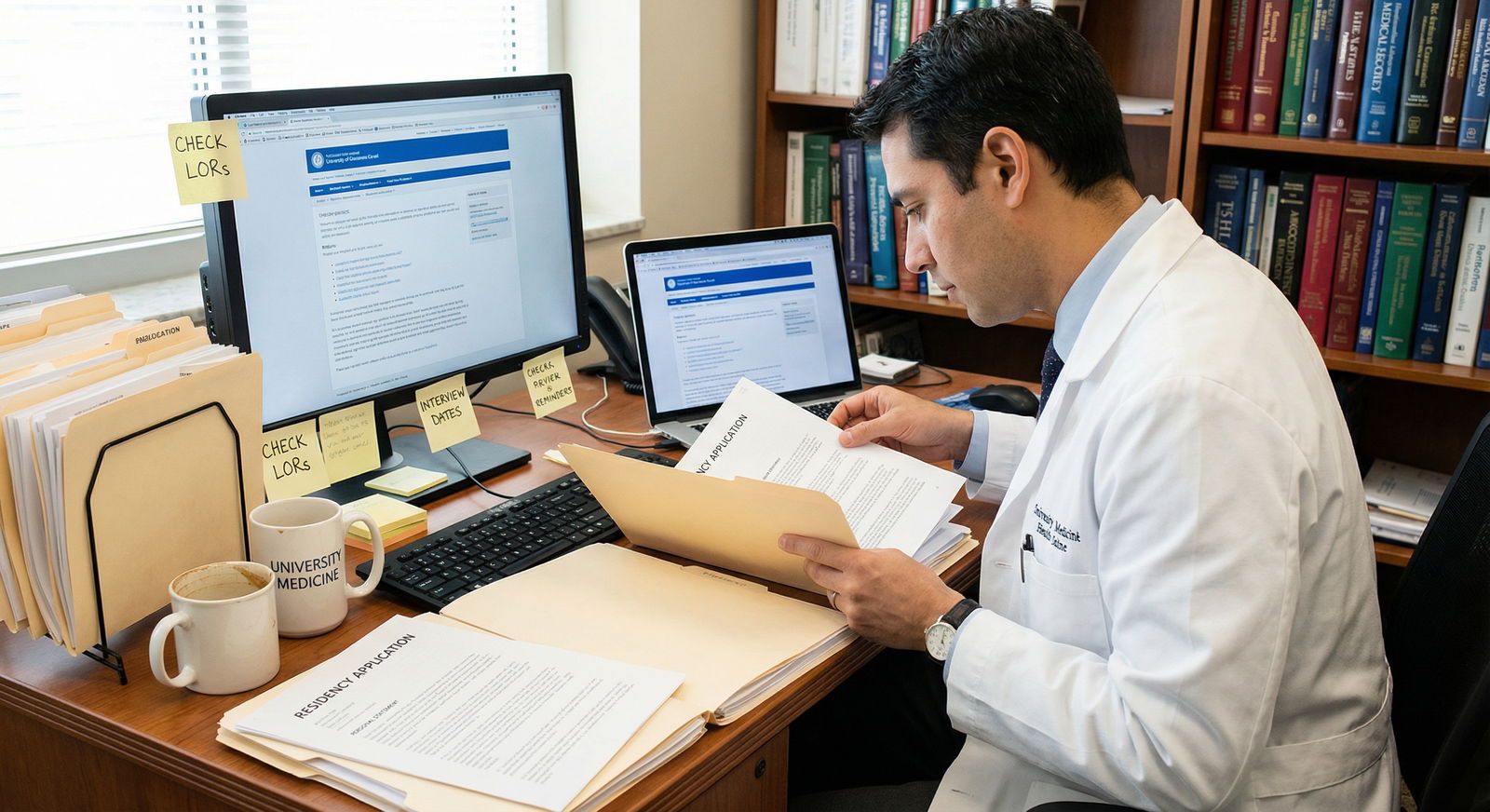
Away rotations do not guarantee an interview or a favorable rank. The data does not support that fantasy. But a strong rotation can create advocates inside the room, and advocacy changes outcomes. That is the real value. Someone can say, with evidence, "We know this student. They perform well here."
From a decision-analysis standpoint, that is powerful. Programs rank with more confidence when the signal is consistent. Your job is to reduce their uncertainty.
Action Steps: Your Away Rotation Game Plan
Treat your away rotation like a month-long reliability test. Because that is exactly what it is.
Before day one:
- Review the specialty's most common presentations, workups, and emergencies.
- Learn the basics of note style, presentations, and common service tasks.
- Reach out early if you need logistics, schedules, or onboarding details clarified.
During the first 48 hours:
- Learn the workflow fast.
- Ask what expectations are for students on rounds, notes, consults, and call.
- Figure out who the operational leaders are. Usually senior residents, not the loudest attending.
Use this daily process:
- Prepare: know your patients, read overnight events, anticipate questions.
- Perform: present clearly, complete tasks, be useful.
- Request feedback: ask one person for one concrete improvement.
- Adjust: apply that change the very next day.
- Document: keep short notes on what you learned, recurring diagnoses, and feedback themes.
In the final week:
- Stay disciplined. Do not coast.
- Thank residents, coordinators, and faculty by name.
- State your interest plainly and professionally if the program is a strong fit.
- Make sure your last few days look like your best habits, not your tiredest ones.
The data shows away rotations are less about dazzling people and more about sending repeated, low-noise signals: punctuality, preparation, judgment, communication, and teachability. That is what program directors actually look for. Not magic. Not swagger. Not one perfect answer on rounds.
Just the evidence that you will be a good resident. Day after day. That is the whole game.